Ask Jeeves shuts down after 30 years as AI search reshapes how we find information online


3 Sources
[1]
Popular 90s search engine 'Ask Jeeves' finally bites the dust -- parent company shutters website that pioneered natural language queries, only a placeholder results page remains
The online search valet is finally retiring after 30 years of serving up answers to our millions of questions. If you were one of the people who went online during the mid-90s, you didn't rely on Google if you wanted to find anything across the wild west of the internet. Instead, you may have
[2]
Ask Jeeves closes just as AI brings back chat-to-search
Like actual butlers, this relic of the first dotcom boom has been a quaint anachronism for decades In the mid-1990s, search engine designers settled on the user interface that dominates to this day: a text box into which users enter text, and a resulting list of websites. Then came Garrett
[3]
The end of Ask.com, and the shifting sands of internet use - The Economic Times
After a 25-year run, Ask Jeeves has officially shut down as part of a strategic shift by parent company IAC. Launched in 1996 as a conversational search engine, the platform's closure reflects a broader transition in internet usage away from traditional search towards AI-driven direct answers.After
Share
Copy Link
Ask Jeeves, the pioneering 90s search engine that allowed users to ask questions in natural language, has officially closed after 30 years. Parent company IAC shuttered Ask.com on May 1, 2026, marking the end of a platform that foreshadowed today's AI-driven search landscape. The closure reflects a broader shift in internet usage toward AI assistants and chatbots that deliver direct answers rather than traditional search results.
Ask Jeeves Closes After Three Decades of Service
After 30 years of answering millions of questions, Ask Jeeves has officially shut down. Parent company IAC announced the Ask.com closure on May 1, 2026, marking the end of one of the internet's earliest attempts to make search more conversational and intuitive
1
.
Source: ET
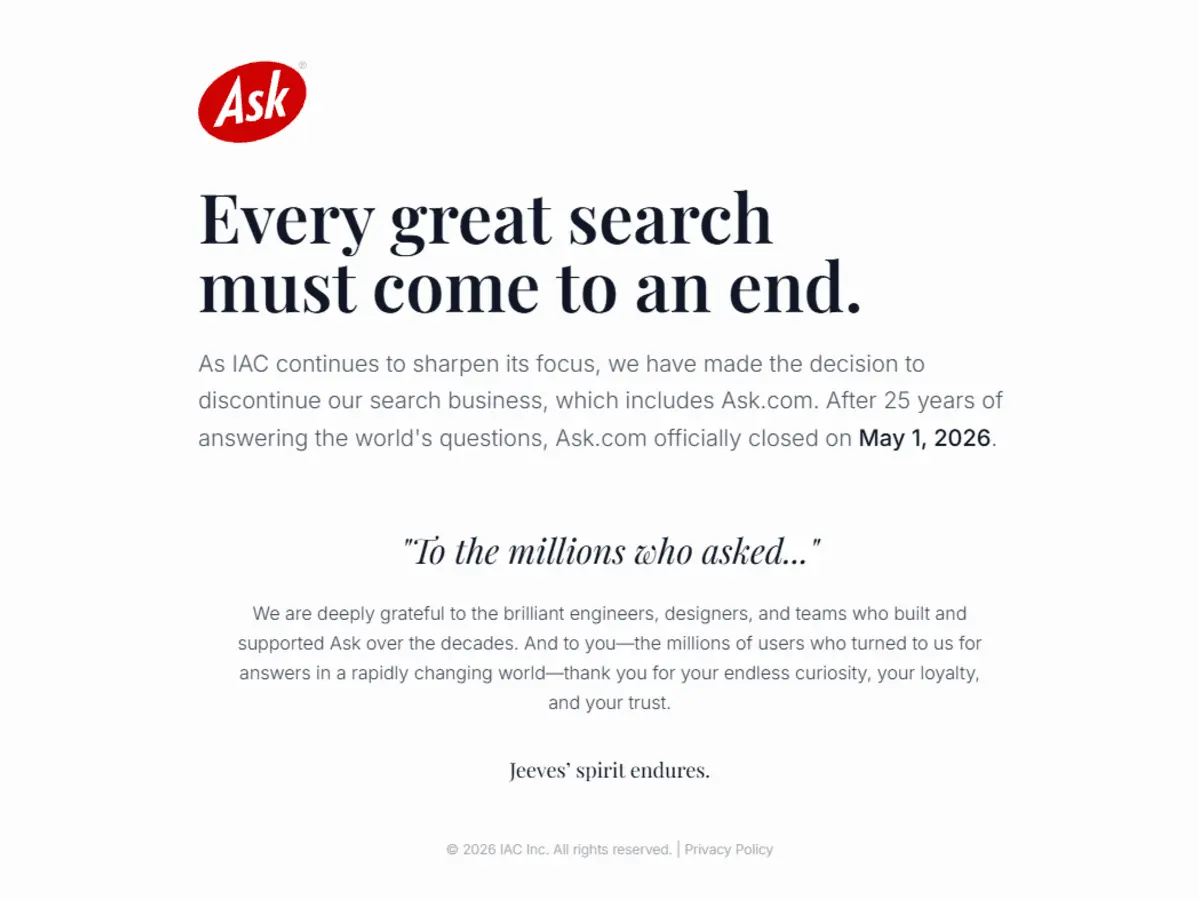
The pioneering 90s search engine that predated Google by several years has left behind only a placeholder page with a farewell message: "Every great search must come to an end. As IAC continues to sharpen its focus, we have made the decision to discontinue our search business, which includes Ask.com"
3
.Launched in 1996 by founders Garrett Gruener and David Warthen, Ask Jeeves distinguished itself with a quirky approach that allowed users to pose questions using natural language queries rather than keywords and Boolean operators
2
. The service derived its name from the fictional valet created by British author P. G. Wodehouse, symbolizing a digital assistant designed to fetch precise answers. Over its 25-year run under the Ask.com brand, the platform accumulated 245 million global visits and reached three percent of the global population2
.
Source: Tom's Hardware
The Rise and Fall of a Search Engine Pioneer
Ask Jeeves went public in 1999 amid the stock market frenzy of the first dotcom boom, but began laying off staff just a year later as competition intensified
2
. The search engine struggled to compete against Google's groundbreaking PageRank algorithm, which assessed the authoritativeness of sites based on the number and quality of backlinks and delivered more relevant search results1
. In 2004, Ask Jeeves acquired another early player, Excite, before being itself acquired by IAC in 2005 for $1.85 billion in stock to capitalize on growth in internet advertising and web search3
.
Source: The Register
The company underwent a major rebrand in 2006, dropping the Jeeves persona to become Ask.com and developing its own web crawler and search algorithm
3
. By 2010, intensifying competition from Google had eroded its market share to the point where Ask outsourced its core search technology and repositioned itself as a question-and-answer platform, stepping back from direct competition in traditional search.AI Search and the Shift in Internet Usage
The irony of the Ask.com closure is striking: the chat-to-search paradigm that Ask Jeeves pioneered in the 1990s has returned as the dominant model for AI search
2
. Modern AI assistants and chatbots like ChatGPT, Microsoft Copilot, and Google's AI-powered search now deliver AI-driven direct answers using natural language processing—exactly what Ask Jeeves attempted to achieve without large language models three decades ago1
.This shift in internet usage is reshaping how people access information online. According to a 2026 report by data analytics firm Chartbeat, pageviews from Google Search dropped 34% between December 2024 and December 2025, while search traffic from Google Discover declined 16% over the same period
3
. The decline reflects a broader transition away from the traditional "search and surf" culture toward platforms that provide direct answers rather than lists of links.Related Stories

What This Means for the Future of Search
Google continues to dominate with close to 90% market share, while engines like Bing, Yahoo, and DuckDuckGo together make up most of the remaining 10%
3
. However, even Google's parent Alphabet is seeing businesses other than its flagship search advertising grow faster. Google Cloud revenue increased 63% year-on-year to $20 billion in the first quarter of 2026, accounting for 18% of Alphabet's revenues3
.The nature of web traffic itself is evolving: bots accounted for over 53% of all web activity in 2025, up from 51% the previous year, with human activity contributing just 47%
3
. These trends suggest the internet is no longer primarily a space users explore through search queries, but one increasingly mediated by AI systems and automated traffic. Unlike other struggling companies that have pivoted toward AI, data centers, or semiconductors, IAC chose not to transform Ask.com for the AI era1
. The closure of Ask Jeeves marks less an isolated event and more a structural transition in how the web is accessed and used—one where the conversational approach it pioneered has finally become mainstream, just too late for the platform itself.References
Summarized by

Navi
[2]
Related Stories
Google AI Search officially replaces traditional web search with Gemini-powered conversations
22 May 2026•Technology

AI-Powered Search Engines: Reshaping Internet Curiosity and Information Discovery
09 Nov 2024•Technology

ChatGPT Launches Search Feature, Challenging Google's Dominance in AI-Powered Internet Search
30 Oct 2024•Technology

Recent Highlights
1
Microsoft and Nvidia Launch Surface Laptop Ultra: A $2,599 AI-Ready PC With RTX Spark Chip
Technology

2
Scientists Build AI Model That Reconstructs Images From Brain Scans in Record Time
Science and Research

3
Anthropic AI Cuts Live Internet Access After Model Sends False Homicide Tip to Philadelphia Police
Technology

Recent Highlights
Today's Top Stories








Don’t drown in AI news. We cut through the noise - filtering, ranking and summarizing the most important AI news, breakthroughs and research daily. Follow topics that matter to you and stay ahead.


