Hyundai's Atlas humanoid robot masters complex football moves, learns year of skills in one day


3 Sources
[1]
Hyundai showcases Atlas humanoid robot's football skills in new series
Ahead of the FIFA World Cup 2026, Hyundai Motor has unveiled "School of Football," a new global campaign starring Boston Dynamics' humanoid robot Atlas. Developed under the automaker's "Next Starts Now" World Cup platform, the initiative uses football as a lens to showcase the next generation of
[2]
Hyundai Motor's soccer robot learns year of skills in 1 day - The Korea Times
A Boston Dynamics researcher trains humanoid robot Atlas in football skills. Courtesy of Hyundai Motor A humanoid robot weaving through football drills and flawlessly executing one of the sport's most difficult trick kicks has demonstrated a profound leap in machine learning, according to
[3]
Hyundai's humanoid robot stuns football star Son Heung-min with advanced skills
South Korea's Hyundai Motor Group humanoid robot Atlas has demonstrated a series of football techniques in a new World Cup-themed campaign, drawing praise from South Korean captain Son Heung-min. "School of Football," a five-part social film series launched by Huyndai earlier this week, follows
Share
Copy Link
Hyundai and Boston Dynamics unveiled their Atlas humanoid robot performing advanced football skills in a new World Cup campaign. The robot mastered the complex 'Ghost Rabona' kick by training in digital simulations, acquiring roughly a year's worth of human practice in just 24 hours through reinforcement learning. The demonstration impressed South Korean football captain Son Heung-min and showcases significant advances in physical AI and human-centered robotics.
Hyundai Unveils Atlas Humanoid Robot Football Campaign
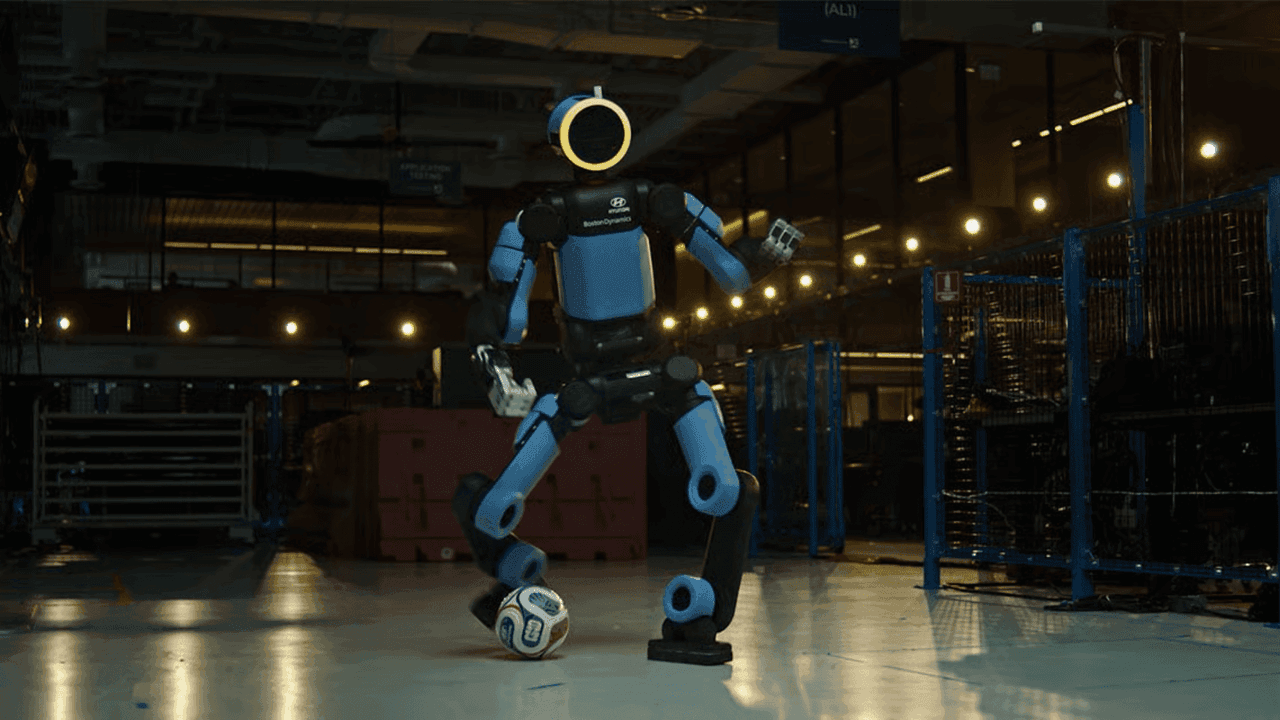
Hyundai Motor has launched "School of Football," a five-part campaign featuring Boston Dynamics' Atlas humanoid robot learning to play football ahead of the FIFA World Cup 2026
1
.
Source: Interesting Engineering
1
. Developed under Hyundai's "Next Starts Now" World Cup platform, the initiative uses football to present advances in human-centered robotics and artificial intelligence in an accessible format1
.According to Sungwon Jee, Executive Vice President and Global Chief Marketing Officer at Hyundai Motor Company, the campaign frames Atlas' journey as a way to explore how future robotic systems can be shaped by human qualities such as creativity, passion, and self-expression
1
. Hyundai, which acquired Boston Dynamics in 2021, identified humanoid robots as a key growth area in the emerging physical AI market3
.Atlas Learns Year of Advanced Football Skills in 24 Hours
The technical achievement behind the campaign represents a profound leap in machine learning capabilities. Atlas managed to accumulate the equivalent of roughly a year of human trial and adjustment in just 24 hours by training through reinforcement learning inside physics-based simulations
2
. Engineers first mapped the movements of professional football players using motion-capture systems, then translated that human motion data to fit the robot's distinct chassis through a process called retargeting2
.Running thousands of digital simulations simultaneously across a cloud GPU environment, the robot independently optimized its own balance, force distribution, and coordination through millions of virtual repetitions
2
. When the learned behaviors were finally uploaded into the physical hardware, Atlas executed the complex, highly dynamic maneuvers reliably on its first attempt2
. This synthesis of cloud simulation and advanced hardware means a machine can acquire a lifetime of physical mastery in a single afternoon, marking a shift from decades of rigid, preprogrammed robotic commands2
.Ghost Rabona Kick Demonstrates Complex Human-Machine Interaction
One of Atlas' most notable achievements is the "Ghost Rabona," a cross-leg kicking move that requires precise timing, balance, and deceptive motion
1
. The Ghost Rabona kick is a high-stakes strike where the kicking leg crosses behind the standing leg after a deceptive feint, making it far more complex than simple movement replication2
. Performing the move depends on dynamic balance control in unstable and asymmetrical positions, full-body coordination across multiple joints and limbs, real-time adaptation to shifting weight and momentum, and precise motor control under physically constrained conditions1
.According to engineering briefs published on Boston Dynamics' official blog, football was specifically selected as a training environment because it demands a simultaneous combination of balance, split-second timing, and real-time physical adaptation
2
. All sequences in the campaign were executed without computer-generated imagery, underscoring the authenticity of the performance and reinforcing the underlying engineering precision behind the platform1
.Related Stories


Son Heung-min Impressed by Robotic Agility Display
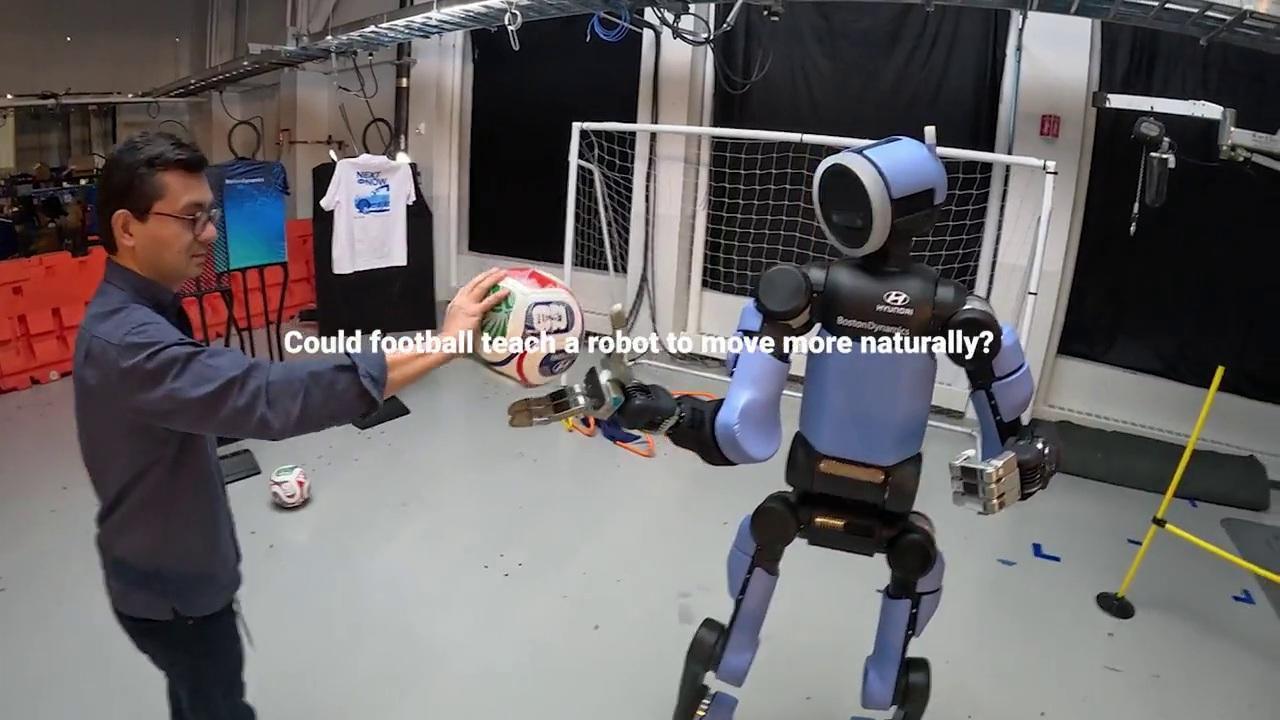
South Korean football captain Son Heung-min watched Atlas train and expressed surprise at its performance. "This is real? It's better than your average player," Korea JoongAng Daily quoted Son as saying
3
.
Source: Korea Times
3
. Each episode builds on the last, reflecting a step-by-step development process that mirrors human learning and adaptation1
.Hyundai said the robot must continuously adjust its balance, body position, and movement in real time to perform football techniques accurately
3
. Over the next period, Hyundai Motor will release additional behind-the-scenes content exploring the development and training behind Atlas' movements, offering technical insight into robotic learning and motion design1
. "It is significant that we showed the world the future of robotics through football in an engaging, human-centered way," Jee said. "We plan to keep building a range of brand experiences that draw on mobility and robotics"3
.References
Summarized by

Navi
[1]
Related Stories
Recent Highlights
1
Microsoft and Nvidia Launch Surface Laptop Ultra: A $2,599 AI-Ready PC With RTX Spark Chip
Technology

2
Trump Consulted Grok AI Before Ordering Venezuela Invasion and Capture of Nicolás Maduro
Policy and Regulation

3
Scientists Build AI Model That Reconstructs Images From Brain Scans in Record Time
Science and Research

Recent Highlights
Today's Top Stories






Don’t drown in AI news. We cut through the noise - filtering, ranking and summarizing the most important AI news, breakthroughs and research daily. Follow topics that matter to you and stay ahead.


