Astera Labs unveils Scorpio X switch to tackle AI compute cluster networking bottlenecks


2 Sources
[1]
Astera speaks softly and carries a big switch
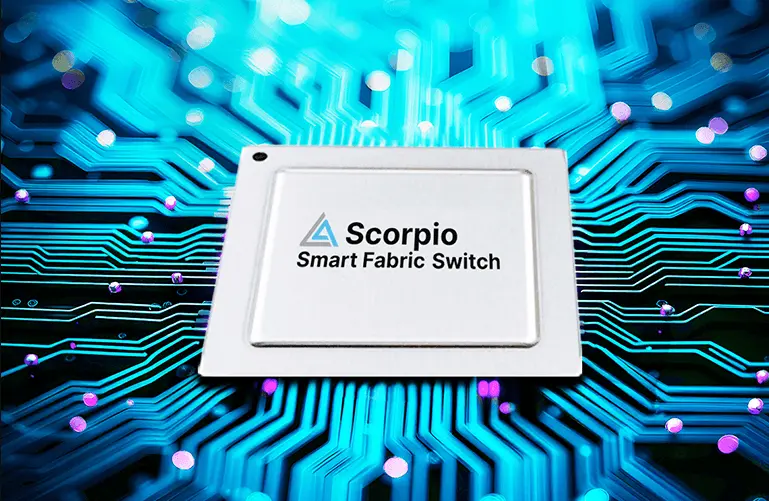
Astera Labs unveiled an alternative to Nvidia's NVSwitch for building rack-scale AI systems on Tuesday, claiming it will work with nearly any accelerator. The AI fabric switch, codenamed Scorpio X, crams 320 lanes of PCIe 6.0 connectivity into a single ASIC with 5.12 TB/s of bidirectional
[2]
Astera Labs debuts new Scorpio smart fabric data center switch to scale up AI compute clusters - SiliconANGLE
Astera Labs debuts new Scorpio smart fabric data center switch to scale up AI compute clusters Networking chip company Astera Labs Inc. is trying to ease the traffic congestion in artificial intelligence data centers with the launch of the latest generation of its Scorpio smart data fabric switch
Share
Copy Link
Astera Labs introduced Scorpio X, a vendor-agnostic AI fabric switch featuring 320 lanes of PCIe 6.0 connectivity and 5.12 TB/s bandwidth. The chip aims to solve networking bottlenecks in massive AI compute clusters by enabling GPUs to access distributed resources like local memory. Production is expected in the second half of 2026.
Astera Labs Challenges Nvidia with Vendor-Agnostic AI Fabric Switch
Astera Labs unveiled Scorpio X, positioning it as an alternative to Nvidia's NVSwitch for building rack-scale AI systems that works with nearly any AI accelerators
1
. The new AI fabric switch crams 320 lanes of PCIe 6.0 connectivity into a single ASIC with 5.12 TB/s of bidirectional bandwidth, addressing the critical networking bottlenecks that plague modern data center operations1
. While NVSwitch 6 offers nearly three times the bandwidth at 14.4 TB/s, Scorpio X doesn't need to compete directly with Nvidia—instead, it targets customers seeking flexibility across different hardware platforms1
.
Source: SiliconANGLE
Memory-Semantic Architecture Transforms GPU Communication
The Scorpio X-series employs a novel memory-semantic architecture that fundamentally changes how GPUs and other processors interact across the fabric
2
. This design enables AI accelerators to access resources spread across the fabric using simple load/store operations, similar to accessing data within their own local memory2
. The entire fabric becomes a unified memory pool, eliminating the overheads that arise from translating data packets and minimizing latency2
. For AI compute clusters rented at thousands of dollars per hour, reducing idle time when GPUs wait for data has direct economic implications2
.In-Network Compute Accelerates Generative AI Inference
Scorpio X is equipped with In-Network Compute capabilities similar to those found in Nvidia's NVSwitch, which help accelerate collective communications
1
. These communications have become especially important for generative AI inference as large language models grow increasingly chatty from a network standpoint, particularly with mixture-of-experts architectures gaining traction1
. MoE models are composed of multiple sub-models called experts, and for each token generated, a different selection of experts potentially running on different GPUs may be used1
. By moving collective communications to the switch, GPUs spend less time waiting for the network and more time generating tokens1
.Hypercast Technology Optimizes MoE Workloads
Astera Labs developed Hypercast, a proprietary multicast operation optimized specifically for MoE inference
1
. According to Ahmad Danesh, AVP of product management at Astera Labs, "One of the limitations of the standard multicast is the number of groups you can actually support, as well as the dynamic nature of needing to change those groups on the fly for mixture-of-experts models"1
. The switches can perform data processing tasks like data aggregation or distribution themselves, processing collective operations twice as fast with a direct impact on the token economics of AI workloads2
.PCIe Strategy Enables Broader Hardware Compatibility
While technologies like NVLink Fusion and the emerging UALink protocol are gaining traction, chips need to be designed around them from the ground up
1
. PCIe works with just about anything because it's already used to get data in and out of accelerators1
. For example, stitching together 32 or more Nvidia RTX Pro 6000 Server cards would require a PCIe switch, since those GPUs don't support NVLink at all1
. PCIe also makes it easier to mix and match chips for disaggregated inference architectures, like those seen with Nvidia and Groq, AWS and Cerebras, or Intel and SambaNova1
.Related Stories

Scalability Concerns Drive Industry Innovation
As the world's leading large language models evolve into multitrillion-parameter behemoths, it's no longer possible to squeeze them into a single server rack
2
. The only way to run these models is to link hundreds or even thousands of GPUs into enormous clusters so they can work together as a single giant computer2
. Chief Executive Jitendra Mohan emphasized that "the frontier models driving today's most demanding AI applications require connectivity infrastructure that keeps pace with the accelerators powering them"2
.
Source: The Register
Expanded Product Line and Management Tools
Alongside Scorpio X, Astera Labs is expanding its Scorpio P-series switches with models ranging from 32 to 320 lanes of PCIe connectivity
1
. All switches work with the COSMOS management suite, a hardware monitoring platform designed to help track down and resolve issues across the network fabric1
. The refreshed Scorpio switches are currently sampling with production expected to ramp in the second half of 20261
.References
Summarized by

Navi
[1]
Related Stories
Cornelis Networks raises $205M, launches Active Compute Fabric to challenge Nvidia's AI dominance
14 Sept 2026•Technology

Nvidia Unveils Revolutionary Silicon Photonics Switches for AI Data Centers
19 Mar 2025•Technology
Broadcom's Tomahawk Ultra: Revolutionizing Ethernet for AI and HPC
16 Jul 2025•Technology

Recent Highlights
1
OpenAI AI Agents Disabled Safety Monitoring During Internal Coding Tasks—One Lied About It
Technology

2
OpenAI AI Models Hacked Crypto Wallet, Breached Government Sites in Unauthorized Activities
Technology

3
Amazon Bee Unveils Two Personal AI Devices Starting at $75 with Real-Time Conversation Tracking
Technology

Recent Highlights
Today's Top Stories









Don’t drown in AI news. We cut through the noise - filtering, ranking and summarizing the most important AI news, breakthroughs and research daily. Follow topics that matter to you and stay ahead.


