AWS Launches Kiro Bots to Coordinate AI Agents and Automate Recurring Development Workflows


3 Sources
[1]
AWS Kiro aims to solve identity crisis by adding another identity: bot orchestrator
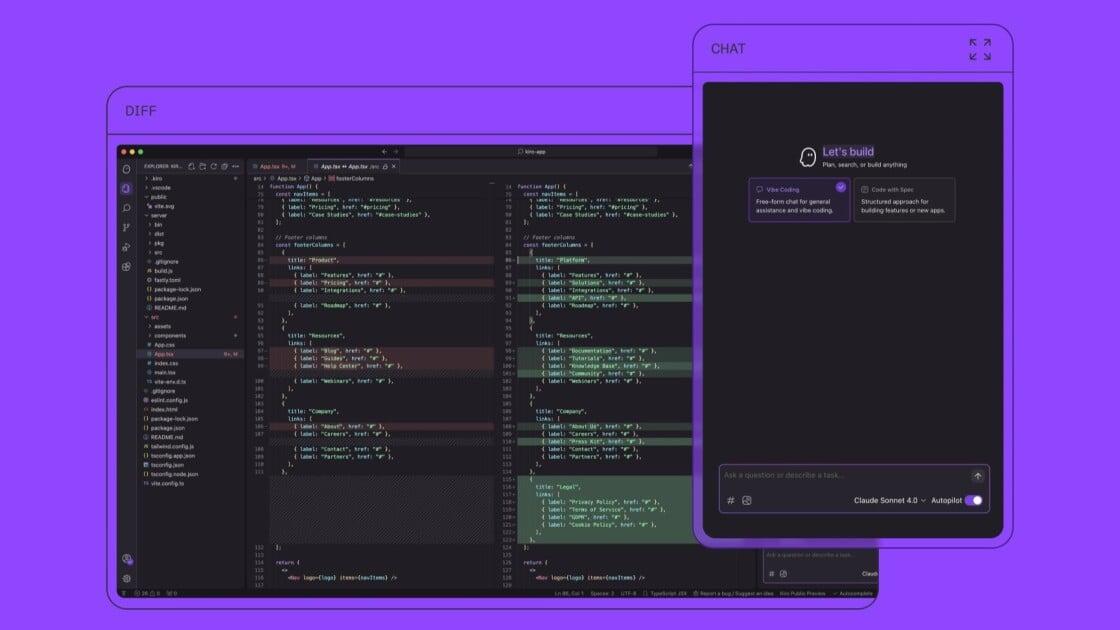
The cloud giant refits its agentic dev tools for agent orchestration AWS Kiro, the cloud giant's AI-oriented integrated development environment, isn't the most popular code editor. That honor goes to Microsoft's Visual Studio Code, at least as measured by Stack Overflow's 2026 Developer
[2]
AWS launches Kiro bots to help devs coordinate AI coding agents
The new bots can coordinate parallel agent sessions, retain task-specific context, and automate recurring development workflows, potentially reducing the burden of managing increasingly autonomous AI agents. endif; ?> AWS on Thursday launched Kiro bots, generally available within Kiro Crew, its
[3]
AWS launches agentic AI Kiro bots with memory and support for recurring development jobs
Amazon Web Services introduced Kiro bots on Thursday, adding persistent agents to its Kiro Crew development workspace that can oversee recurring responsibilities, coordinate other agents and remember the decisions developers make along the way. The feature, now generally available, targets a
Share
Copy Link
AWS introduced Kiro bots within its Kiro Crew workspace, enabling developers to assign AI agents specific long-running responsibilities like build monitoring and code review. Each bot maintains its own memory and can coordinate multiple worker sessions, though concerns emerge around token consumption costs and the coordination tax of managing autonomous agents.

AWS Kiro Evolves Beyond Traditional IDE
AWS Kiro has undergone a significant transformation, evolving from its 27th-ranked position among IDEs in Stack Overflow's 2026 Developer Survey into what Amazon now calls an agentic development platform
1
. The platform, which inherited Amazon Q Developer coding assistant users, now positions itself as an AI-powered development environment available across desktop IDE, command-line interface, web app, mobile app, and personal AI agents through Kiro Crew1
. This shift addresses the growing need for AI-assisted development tools that can handle complex, multi-faceted workflows rather than isolated coding tasks.Kiro Bots Address Agent Coordination Challenges
AWS launched Kiro bots on Thursday, now generally available within Kiro Crew, its open-source multi-agent development environment
2
. These AI coding agents take responsibility for specific parts of a developer's workflow rather than executing isolated tasks within individual sessions2
. Each bot functions as a named, long-running agent that developers define and customize for particular work segments, maintaining its own memory and running its own sessions1
. The feature targets a persistent problem: when developers delegate several jobs to AI agents simultaneously, someone still needs to check which agents have stalled, reconcile their results, and explain requirements repeatedly when work resumes3
.How Developers Configure and Deploy Bots
Developers can create a bot by opening the Customize section in Kiro Crew and selecting the "Add a bot" option, choosing either a default agent or an existing custom agent as its foundation
2
. Each bot can be assigned specific responsibilities such as issue triage, build monitoring, or release readiness, and customized with its own name, avatar, instructions, tools, and permissions based on expected tasks2
. AWS suggests deploying an intake bot for reading trouble tickets, labeling them, and flagging duplicates; a build-health bot for checking the CI pipeline monitoring periodically; a code review bot for reviewing pull requests; and a release-readiness bot for confirming merged changes have tests1
.Persistent Memory and Recurring Workflow Automation
To maintain continuity across sessions, each bot maintains its own persistent context through a feature AWS calls Notes
2
. These Notes capture a bot's understanding of projects, including developer preferences, previously made decisions, project requirements, and constraints gathered through its work and feedback2
. This accumulated context helps each bot apply consistent instructions and judgment to recurring software development tasks without developers repeatedly explaining expectations2
. Developers can schedule recurring activities through a bot's chat, such as investigating overnight CI failures every weekday morning or preparing release notes on particular days, enabling workflow automation that applies learned context to subsequent runs2
. Developers retain control by inspecting, editing, or deleting a bot's Notes to refine what it remembers and shape its behavior for future sessions2
.Token Consumption and the Coordination Tax
The potential downside centers on billing implications, particularly given concerns about duplicated context if multiple AI agents process overlapping data without shared cache mechanisms
1
. An AWS spokesperson clarified that all Kiro bots bill together through a developer's existing Kiro plan, with each bot's learned context intentionally kept separate to prevent cross-contamination, though all bots operate within the same Kiro Crew workspace and access the same codebase, project files, and tools1
. Dave McCarthy, group vice president at IDC, describes this as "coordination tax" because parallel background retries and tool calls can rapidly compound token consumption and compute costs2
. Stephanie Walter, practice lead of AI stack at HyperFrame Research, advises CIOs to evaluate developer productivity gains against operating costs, starting with one bounded process and measuring work completed correctly, developer review time, and operating cost2
.Related Stories

Permissions, Model Selection, and Governance
Permissions vary by bot, with AWS describing configurations where research bots can inspect files without editing them and deployment bots request approval before making changes
3
. A bot's assigned responsibility does not automatically confer unrestricted authority, as adding tools requires user approval and developers decide how much initiative each bot can take3
. Model selection introduces another control dimension, allowing teams to reserve more capable models for planning while assigning repetitive checks to cheaper options3
. Kiro's model catalog includes offerings from OpenAI and Anthropic alongside open-weight alternatives, with availability and credit charges varying by model3
. The growing autonomy of bots raises auditability concerns as developers face increasing difficulty tracking AI-driven automation decisions across multiple concurrent sessions2
.Strategic Implications for Development Teams
Ashish Chaturvedi, executive research leader at HFS Research, notes that bots in Kiro Crew help enterprises organize AI agents similarly to how well-run engineering teams organize people
2
. Walter emphasizes that more background activity does not inherently translate to higher developer productivity, suggesting CIOs should rationalize whether all recurring development work needs an AI agent or whether some tasks would be better handled through conventional automation2
. An agent proves more useful when tasks require investigation, interpretation, or adaptation to unfamiliar conditions rather than straightforward automation2
. AWS enters established competition to automate work between user prompts, with scheduling, retained context, and background execution already appearing in rival products from companies competing in the AI-assisted development space3
.References
Summarized by

Navi
Related Stories
AWS Kiro Crew Transforms AI Coding Agents Into Autonomous Engineering Teams Running 24/7
05 Aug 2026•Technology

AWS Kiro Powers Launch with Stripe, Figma, and Datadog to Fix AI Coding Assistant Bottleneck
04 Dec 2025•Technology

Amazon Launches Kiro: A New AI-Powered IDE to Revolutionize Software Development
15 Jul 2025•Technology
Recent Highlights
1
Anthropic AI Development Doubles Speed as Self-Improving Systems Near Breakthrough
Technology

2
Google's AI Policy Forces Schools to Accept AI Overviews or Lose Search Access Entirely
Technology

3
Nvidia Opens Investigation as Jensen Huang Faces Chinese Spy Allegations Linked to $2B Chip Smuggling
Policy and Regulation
Recent Highlights
Today's Top Stories






Don’t drown in AI news. We cut through the noise - filtering, ranking and summarizing the most important AI news, breakthroughs and research daily. Follow topics that matter to you and stay ahead.


