British Army secures £2bn AI training contract to prepare soldiers for modern warfare


2 Sources
[1]
British Army to prepare for 'modern warfare' with £2bn AI training
The British Army will use artificial intelligence (AI) to better prepare for "modern warfare" after a new £2bn contract was signed, the Ministry of Defence (MoD) has announced. Defence Secretary Dan Jarvis visited Salisbury Plain in Wiltshire earlier to confirm a new training system, featuring AI,
[2]
The UK's £2bn AI 'Combat Laboratory' for the British Army
The Ministry of Defence has handed a Raytheon-led consortium £2bn to build a "Combat Laboratory" that trains up to 60,000 soldiers a year using AI, analytics and virtual environments. The government calls it sovereign, but Germany's Rheinmetall takes nearly half. Britain is spending £2bn to train
Share
Copy Link
The Ministry of Defence has signed a £2bn contract to train British Army soldiers using artificial intelligence, advanced analytics and virtual environments. Up to 60,000 soldiers annually will train in what officials call a Combat Laboratory, designed to replicate the complexities of modern warfare. The 15-year deal creates 270 jobs in Wiltshire and supports 420 roles across the UK.
British Army launches AI-driven training system with £2bn contract
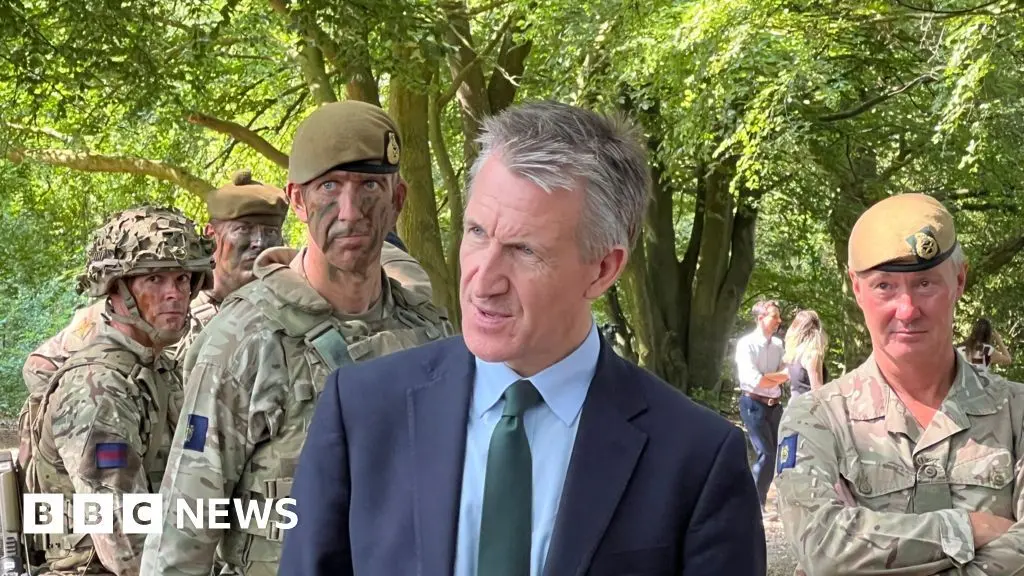
The British Army will deploy artificial intelligence to prepare soldiers for modern warfare under a £2bn contract announced by the Ministry of Defence. Defence Secretary Dan Jarvis confirmed the 15-year deal during a visit to Salisbury Plain in Wiltshire, where he outlined how the AI training system will use advanced analytics and virtual environments to ready troops for rapidly evolving threats
1
. The contract goes to Omnia Training, a consortium led by US contractor Raytheon UK, which includes Capita, Cervus, Rheinmetall UK and Skyral2
.
Source: BBC
The investment will create 270 skilled jobs in Wiltshire and support 420 roles across the UK over the next 15 years, with 100 apprenticeships developed in partnership with Wiltshire College and the University of Staffordshire
1
. Jarvis, a former Army officer, emphasized the urgency: "It is really important, given the rapid transformation and technology we are seeing in Ukraine and elsewhere, that our soldiers have the training to employ the kit they are going to need to be successful on the battlefield"1
.AI 'Combat Laboratory' will train 60,000 soldiers annually
At the heart of the initiative sits what the Ministry of Defence calls a Combat Laboratory—a digital platform designed to simulate modern warfare and replicate battlefield complexities. The system will train 60,000 soldiers annually in exercises that scale from teams of 100 to formations of 50,000
2
. Simulation, live systems and analytics will enable soldiers to train anywhere at any time, using AI to spot patterns, monitor performance and support decision-making1
.The MoD stated that the technology will help "build a more lethal, combat ready British Army" by recreating the chaos of modern warfare in controlled environments
1
. Officials say the system draws directly on lessons from Ukraine, where rapid technological transformation has reshaped battlefield dynamics2
. The government wants the British Army to be ten times more lethal by 2035, backed by a £298bn investment plan over four years2
.Related Stories


Questions over technological sovereignty despite UK control claims
While the Ministry of Defence emphasizes that intellectual property stays under UK control, the contract structure raises questions about technological sovereignty. Germany's Rheinmetall holds nearly half the contract value—just under €1bn ($1.14bn) according to Bloomberg—despite government framing of the deal as sovereign capability
2
. Rheinmetall UK will supply physical training infrastructure, system setup and logistics, expanding its footprint on the Isle of Wight and in Southampton .Two consortium members, Skyral and Cervus, built their software in Britain with more than £2m in government innovation funding
2
. The arrangement illustrates how European defence has become increasingly interconnected, even as nations pursue Armed Forces readiness through domestic capabilities. Implementation begins this summer, arriving as NATO builds an AI "kill web" on its eastern flank and Germany turns to combat software providers2
.The announcement comes less than two weeks after Prime Minister Sir Keir Starmer announced a £15bn increase in military spending
1
. Before any new weapon fires, this AI-driven training system represents where the army decides how it will think—a shift that may prove more consequential than hardware alone in preparing for evolving threats on future battlefields.References
Summarized by

Navi
[2]
Related Stories
Recent Highlights
1
Meta Unveils Muse Wonder Frontier AI Models, Claims Performance Matching OpenAI and Anthropic
Technology

2
IMF Report Warns AI Market Correction Could Spark Global Financial Crisis With $1.4T at Risk
Business and Economy

3
OpenAI Releases 722 AI-Generated Math Solutions, Triggering Existential Crisis in Mathematics
Technology

Recent Highlights
Today's Top Stories









Don’t drown in AI news. We cut through the noise - filtering, ranking and summarizing the most important AI news, breakthroughs and research daily. Follow topics that matter to you and stay ahead.


