Cadence Unveils Maestro AI Models for Chip Design, Claims 30% Quality Boost Over General Models


4 Sources
[1]
Cadence reveals Maestro, fine-tuned AI models built to run specialized chip design agents, with early access coming for 'select customers' in Q4 2026
Customers can run the models on-premises and post-train them on their own designs and data. Cadence, one of the largest electronic design automation (EDA) companies, has unveiled Maestro, its new portfolio of domain-specialized AI models tailored for its chip design agents, in a press release sent
[2]
Cadence unveils Nvidia-backed AI models that chipmakers can run in-house
SAN FRANCISCO, Oct 26 (Reuters) - Cadence Design Systems (CDNS.O), opens new tab on Monday launched a portfolio of AI models tuned to help design computer chips, deepening its partnership with Nvidia (NVDA.O), opens new tab and diverging from rival Synopsys's recent deal with OpenAI. Both
[3]
Cadence Launches AI Chip Design Models in Partnership with Nvidia
Cadence Design Systems on Monday launched a portfolio of AI models tuned to help design computer chips, deepening its partnership with Nvidia and diverging from rival Synopsys's recent deal with OpenAI. Both companies make software used to design computing chips - a process that involves arranging
[4]
Cadence partners with Nvidia to accelerate chip design through AI
Cadence Design Systems has unveiled a new range of artificial intelligence models specialized in semiconductor design, developed in collaboration with Nvidia. Dubbed Maestro, the suite is designed to automate certain complex tasks performed by engineers and accelerate integrated circuit
Share
Copy Link
Cadence Design Systems launched Maestro, a portfolio of domain-specialized AI models built for chip design automation in partnership with Nvidia. The models deliver up to 30% higher quality results and 5x better token efficiency compared to general-purpose AI models. Select early access customers will receive the first models in Q4 2026, with flexible on-premises and cloud deployment options.
Cadence Maestro Enters Chip Design Arena with Nvidia Partnership
Cadence Design Systems has introduced Cadence Maestro, a portfolio of domain-specialized AI models tailored specifically for chip design automation, marking a strategic divergence from competitor Synopsys's recent OpenAI partnership
1
2
. Built in part on Nvidia's open-weight Nemotron model and secured with Nvidia's OpenShell safety technology, the AI models for chip design promise to accelerate the intricate process of arranging billions of transistors to meet precise cost and performance targets3
. The announcement comes as electronic design automation companies race to deploy AI agents that work on behalf of human engineers, fundamentally reshaping semiconductor design workflows.
Source: Market Screener
Performance Metrics Show Substantial Efficiency Gains
Initial testing of these AI chip design models reveals compelling performance improvements over general-purpose alternatives. Cadence reports up to 30% higher quality results and up to 5x token efficiency compared to a general-purpose foundation model
1
4
. Paul Cunningham, senior vice president at Cadence, explained the cost efficiency gains by noting that agent costs have "really started to explode," making it essential to move more iterative work "into the weights of the models themselves"1
. The token savings stem from balancing electronic design automation tool calls with AI model invocations, using "the right model at the right time for the right task" rather than over-relying on compute-intensive operations1
.Flexible Deployment Addresses Data Sovereignty Concerns
Unlike GPT-Synopsys, which operates on OpenAI-hosted infrastructure, Cadence Maestro offers customers multiple deployment pathways that prioritize data control
2
. Customers can run these domain-specialized AI models on Cadence's cloud, public clouds, or maintain complete control through on-premises environments behind their own firewalls and data centers3
4
. This flexibility extends to post-training capabilities, allowing companies to fine-tune models on their proprietary data, designs, and workflows using Cadence's fine-tuning harness—potentially on their own GPUs and networks1
. This approach directly addresses semiconductor manufacturers' confidentiality requirements, allowing them to protect intellectual property while leveraging AI-driven chip design capabilities.AI Super Agents Orchestrate Complex Design Workflows
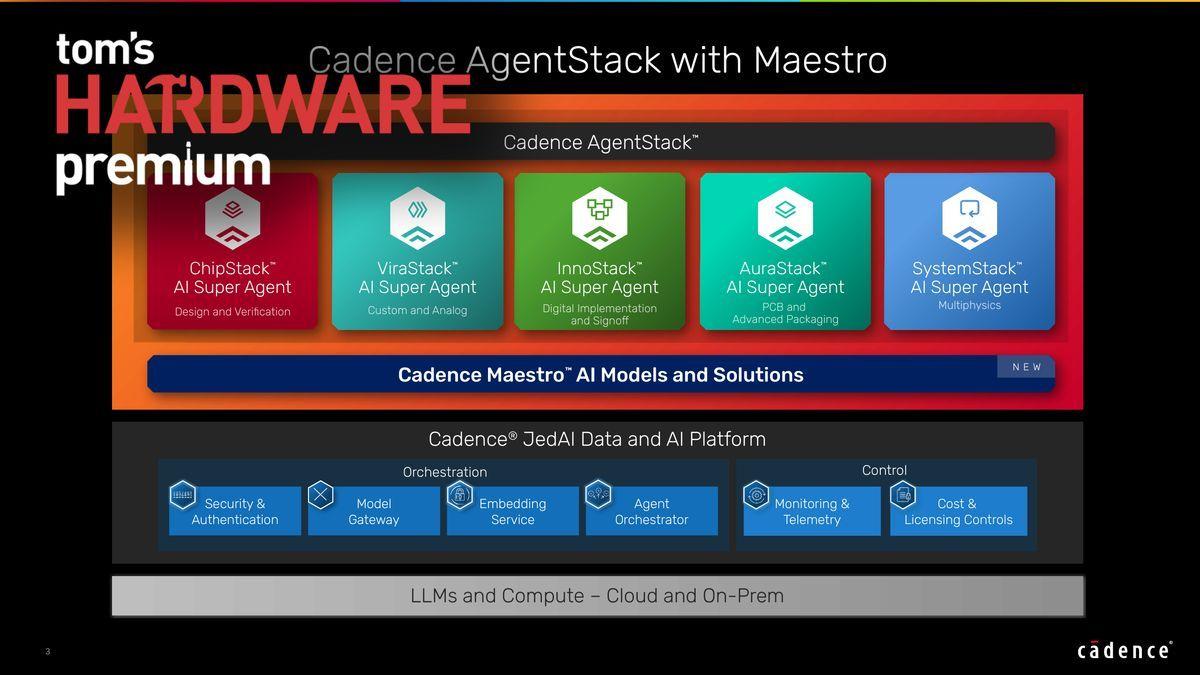
At the core of Maestro's architecture are Cadence's AI Super Agents, which interpret design intent, decompose complex tasks, and orchestrate the Maestro portfolio alongside other leading frontier and open-weight models
1
. The system employs reinforcement learning, where Cadence's deterministic solvers evaluate outputs against engineering objectives, constraints, and ground truth, with results feeding back into the models for continuous improvement1
. Rob Knoth, senior group director of strategy at Cadence, highlighted the runtime challenges in semiconductor design automation, noting that tool calls can take hours to days to return values while AI training loops typically operate in minutes1
. The models include Nvidia's Nemotron, which Cunningham noted was "giving really solid results and actually improving very, very fast"1
.
Source: Tom's Hardware
Related Stories

Strategic Positioning Against Synopsys's OpenAI Alliance
Cadence's model-agnostic approach deliberately contrasts with Synopsys's exclusive partnership with OpenAI announced on September 30
2
3
. Cunningham framed this strategy by observing that "there are more AI model providers out there than there are chip design software vendors"2
3
. When questioned about potential partnerships with proprietary AI labs, Cunningham indicated both open- and closed-weight approaches are being "pursued equally" and that collaboration with commercial labs remains "part of the Maestro vision," though he declined to provide specifics2
3
. This positioning suggests Cadence aims to maintain flexibility as the AI landscape evolves, avoiding vendor lock-in while preserving customer choice across deployment models.Market Traction and Q4 2026 Rollout Timeline
Cadence has demonstrated strong customer engagement with its AI agent portfolio over the past year. CEO Anirudh Devgan reported during the July earnings call that ChipStack, the company's design and verification agent, has secured more than 20 customer engagements, while ViraStack, its custom and analog agent, has attracted more than 25 customer engagements
1
. Socionext and Silicon Labs have publicly credited Cadence's AI solutions with accelerating their design processes1
. The first Maestro models will reach select early access customers in the fourth quarter of 2026, with pricing structured as a subscription model featuring a consumption allowance and charges for usage beyond allocated limits1
2
. Cadence is also collaborating with Nvidia on integrating OpenShell Reference Architecture for agent security, including sandboxing capabilities to further protect customer intellectual property1
.References
Summarized by

Navi
[1]
[4]
Related Stories
Cadence and NVIDIA Expand Partnership to Accelerate AI-Driven Engineering and Scientific Innovation
20 Mar 2025•Technology

Cadence embeds AI across chip design tools to tackle trillion-transistor complexity by 2030
10 Feb 2026•Technology
Cadence AuraStack AI agent cuts design time in half, delivers 15X productivity boost for engineers
16 Jul 2026•Technology

Recent Highlights



Recent Highlights
Today's Top Stories


Don’t drown in AI news. We cut through the noise - filtering, ranking and summarizing the most important AI news, breakthroughs and research daily. Follow topics that matter to you and stay ahead.


