Caltech Researchers Develop AI-Assisted Breast Imaging Technique: PACT


2 Sources
[1]
Caltech researchers develop safer and smarter breast imaging technique
California Institute of TechnologyJun 30 2025 A Caltech-led team has developed a safe, effective, and painless breast imaging technique that incorporates machine learning to help differentiate between suspicious and healthy tissue. The method has now been tested on patients and performs as well as
[2]
AI-assisted technique offers effective and painless breast imaging alternative
A Caltech-led team has developed a safe, effective, and painless breast imaging technique that incorporates machine learning to help differentiate between suspicious and healthy tissue. The method has now been tested on patients and performs as well as or better than other conventional breast
Share
Copy Link
Caltech-led team introduces PACT, a safe and painless breast imaging method using AI, offering an alternative to conventional techniques like mammography.
Revolutionary Breast Imaging Technique Developed by Caltech Researchers
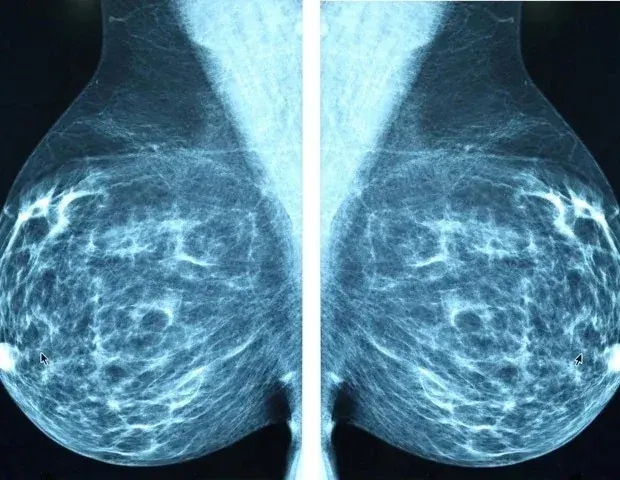
Researchers at the California Institute of Technology (Caltech) have developed a groundbreaking breast imaging technique called Photoacoustic Computed Tomography (PACT). This innovative method, which incorporates machine learning, offers a safer, more effective, and painless alternative to conventional breast imaging techniques
1
.Advantages of PACT over Traditional Methods
Pact addresses several limitations of current breast imaging techniques:
- Unlike X-ray mammography, PACT does not expose patients to ionizing radiation.
- It eliminates the need for painful breast compression.
- PACT is more accurate than ultrasound and less dependent on operator skill.
- Compared to MRI, PACT is faster, less expensive, and suitable for patients with claustrophobia or certain implants
2
.
How PACT Works

Source: Medical Xpress
Pact combines light and sound to create high-resolution images of breast tissue:
- A near-infrared laser pulse is shined into the breast tissue.
- The laser light is absorbed by molecules, causing them to vibrate ultrasonically.
- An array of 512 tiny ultrasonic sensors detects these vibrations.
- The data is used to assemble a detailed image of the breast's internal structures
1
.
AI Enhancement and Detection Capabilities
Pact's effectiveness is further improved by artificial intelligence and machine learning:
- The system is trained on images of malignant and benign growths, as well as suspicious and healthy tissue.
- This training enables PACT to detect subtle variations that indicate different types of tissue.
- PACT can often identify problematic features that might go unnoticed by the human eye
2
.
Clinical Testing and Results
The Caltech team, in collaboration with researchers from the City of Hope Comprehensive Cancer Center, has tested PACT on 39 patients:
- PACT achieved comparable results to mammography and MRI in differentiating between suspicious and normal tissue.
- It was equally effective in distinguishing between malignant and benign growths or lumps.
- The technique can identify tumors in as little as 15 seconds
1
.
Related Stories



Patient Experience and Practicality
Pact offers a comfortable and efficient patient experience:
- Patients lie face down on a table with a recess containing a warm water bath, ultrasonic sensors, and the laser.
- One breast at a time is placed in the recess, with the laser shining from below.
- Each scan can be completed during a single breath hold, making it very practical for clinical use
2
.
Future Implications
The development of PACT represents a significant advancement in breast imaging technology. As stated by Lihong Wang, the Bren Professor of Medical Engineering and Electrical Engineering at Caltech, "We'd like to make PACT a clinical tool that benefits patients - to help detect breast cancer without patients taking the risk of getting cancer or worrying about an allergic reaction."
1
With its ability to provide detailed, accurate images without the drawbacks of conventional methods, PACT has the potential to revolutionize breast cancer detection and improve patient outcomes.
References
Summarized by

Navi
Related Stories
Recent Highlights



Recent Highlights
Today's Top Stories



Don’t drown in AI news. We cut through the noise - filtering, ranking and summarizing the most important AI news, breakthroughs and research daily. Follow topics that matter to you and stay ahead.


