AI-designed vaccine passes first human trial, offering broad protection against coronaviruses


11 Sources
[1]
Researchers Successfully Trial AI-Designed Vaccine for the First Time
A new AI-designed vaccine has proved successful in its initial clinical trials. According to the researchers, this is the first time that a vaccine using an active component designed entirely through computer simulations has been tested in humans. Developed by the University of Cambridge and
[2]
World's first AI-designed vaccine explained
Researchers at the University of Cambridge have developed what they describe as a fundamentally new type of vaccine using artificial intelligence (AI). The vaccine's key component was designed entirely by AI and has now been tested in people for the first time. The goal is ambitious: a single
[3]
AI-designed universal coronavirus vaccine passes first human trial
A new type of universal coronavirus vaccine has passed its first human clinical trial, marking an important step toward broader protection against future virus outbreaks. Developed by researchers at the University of Cambridge and the university spinout company DIOSynVax (DVX) Ltd, the
[4]
The University of Cambridge says it successfully tested a vaccine with an AI-designed antigen - Engadget
The "super-antigen" could provide long-term protection against a wide range of diseases spread by humans. Wherever you stand on the role of AI in the future of humanity, it has undeniably proved useful in the field of medical research. And now a team of researchers from the University of Cambridge
[5]

'World-first' vaccine designed by Artificial Intelligence
Artificial intelligence has been used to develop a "fundamentally new" type of vaccine that could protect against large swathes of viruses and prevent pandemics, say researchers. The team at the University of Cambridge say it is the first time a vaccine's key component has been designed entirely
[6]

Researchers Are Using AI to Create Vaccines -- and It's Working
pEVAC-PS is the first experimental vaccine designed completely with AI to be tested in a human trial. As bad a reputation as artificial intelligence has gotten in the public eye as of late, it's helping to push medicine further. Case in point, an experimental pan-coronavirus vaccine developed with
[7]

Scientists use AI to create a 'universal vaccine' that prevents infection even as viruses like COVID-19 evolve
When COVID-19 spread around the world in 2020, scientists worked as fast as possible to create vaccines. Even so, the virus infected millions of people before the first vaccines became available. Researchers at the University of Cambridge hope to prevent that situation in the future. Instead of
[8]

The world's first AI-designed vaccine, explained
The Conversation is an independent news and commentary website produced by academics and journalists, free for the public. Artificial intelligence isn't just being used to optimise productivity or complete the annoying tasks that we'd rather not do. Scientists have developed what they describe as
[9]

'This is a fundamental shift in how we prepare for pandemics': Researchers used AI and known genetic codes to develop a 'fundamentally new' vaccine that 'could help speed up the roll out vaccines to benefit people all over the world'
* Researchers analyzed antigens from a family of viruses to create a "super-antigen" * The new development method could help quickly create safe new vaccines for pandemics * AI vaccines could be developed to combat Ebola, seasonal flu viruses, and bird flu In a world-first, researchers at the
[10]

First AI-designed 'universal vaccine' tested in humans: UK researchers
A groundbreaking vaccine, designed entirely by artificial intelligence, has been tested in humans for the first time. This experimental jab aims to protect against a wide range of viruses, including those that caused SARS, MERS, and Covid-19. Early trials involving a small group showed a modest
[11]

AI is being used to develop a "fundamentally new" vaccine to protect against pandemics
The hope is that the innovation will be able to treat multiple variants of viruses at once, potentially tackling the flu, Ebola, and Covid. For all of the frustrations artificial intelligence causes in the world of entertainment, the technology is proving to be rather useful in the realm of
Share
Copy Link
Researchers at the University of Cambridge successfully tested the world's first AI-designed vaccine in humans. The trial involved 39 volunteers and targeted multiple coronaviruses, including COVID-19 and SARS. The vaccine uses an AI-designed super-antigen that could provide lasting protection against entire virus families, even as they mutate, potentially transforming how we prepare for future pandemics.
University of Cambridge Tests First AI-Designed Vaccine in Humans
Researchers at the University of Cambridge have achieved a significant milestone by conducting the first human trial of an AI-designed vaccine, marking a fundamental shift in how scientists approach pandemic preparedness
1
. The experimental universal coronavirus vaccine was tested in 39 healthy volunteers between ages 18 and 50 at medical facilities in Southampton and Cambridge, with results showing the vaccine was safe and caused no significant side effects3
. This represents the first time a vaccine with an AI-developed active component designed entirely through computer simulations has been tested in people2
.Developed by the University of Cambridge and university spinout company DIOSynVax (DVX), the vaccine targets the sarbecovirus family, which includes SARS-CoV-2, SARS, and related bat coronaviruses that could potentially cause future pandemics
5
. The trial demonstrated that the vaccine stimulated immune responses not only against known human coronaviruses but also against related bat viruses that have not yet infected humans3
.
Source: GameReactor
How Machine Learning Created a Super-Antigen
The breakthrough centers on an AI-designed super-antigen that could provide broad and lasting protection against viruses across entire families. Researchers used machine learning on genetic sequence data from sarbecoviruses collected through global surveillance programs
1
. The AI system analyzed these genetic codes to identify features that remain stable across different strains and are unlikely to change through viral mutations2
.Professor Jonathan Heeney from the University of Cambridge's Department of Veterinary Medicine explained that this approach overcomes the limitations of traditional vaccines: "We've overcome the problem of traditional vaccines, which have limited protection. It means we can escape the constant cycle of chasing the virus variants circulating in humans and updating the vaccines to try to catch up, like a dog chasing its tail"
3
. This future-proof approach to vaccine development represents a shift from reactive to proactive pandemic preparedness4
.DNA Technology and Needle-Free Delivery
Source: ScienceDaily
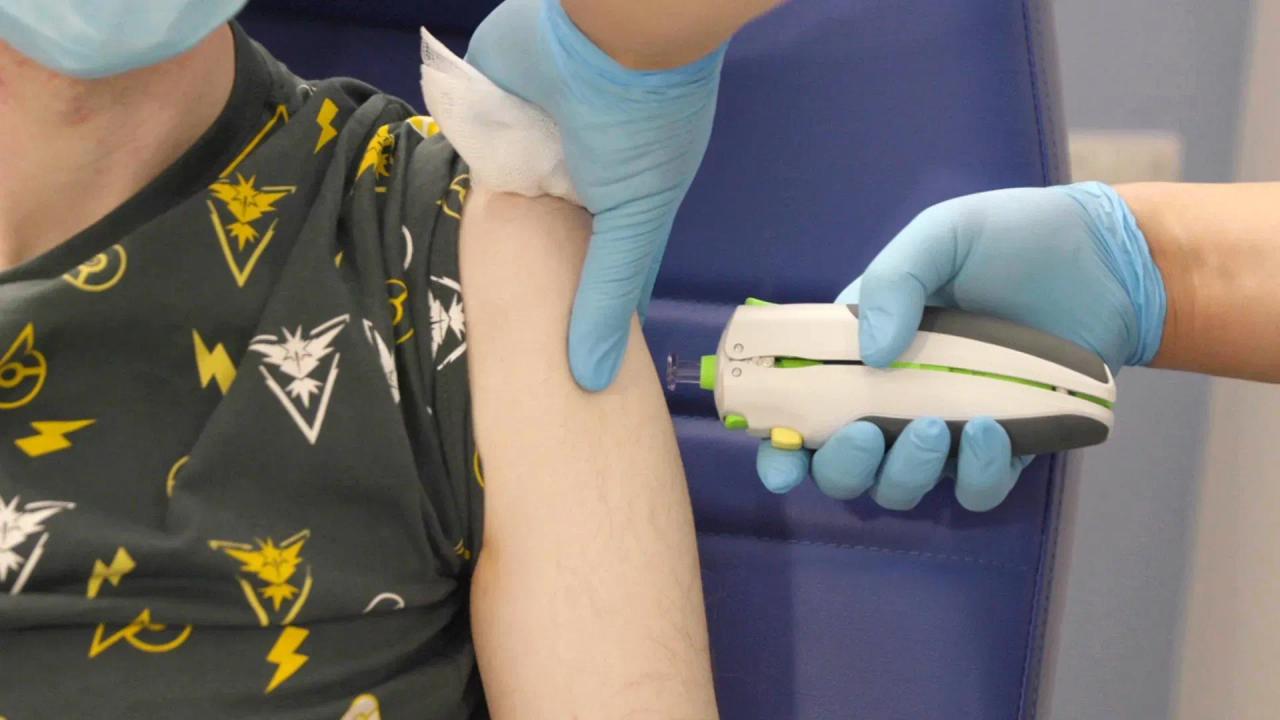
Unlike the mRNA vaccines used during the COVID-19 pandemic, this vaccine uses DNA technology delivered through a micro fluid jet system that doesn't require needles
3
. DNA vaccines offer significant advantages: they are more stable than mRNA vaccines, making them easier to store and transport, particularly in lower-income countries where cold-chain infrastructure is limited2
. The needle-free delivery system could also make large-scale vaccination campaigns faster and more accessible, especially for people uncomfortable with injections3
.Implications for Influenza and Ebola
The Cambridge team is already applying this technology to other virus families. They are conducting animal research on universal seasonal influenza vaccines that wouldn't need annual updates, as well as an H5N1 bird flu vaccine in case the virus currently affecting bird populations becomes a human pandemic
5
. The researchers are also developing a vaccine for viral hemorrhagic fevers, which would include Ebola species5
. This matters urgently because the recent outbreak in the Democratic Republic of Congo is caused by the Bundibugyo strain, which bypasses existing vaccines2
.Professor Saul Faust, who performed some of the trials at the University of Southampton, said the AI design "definitely has potential" and noted that "the technology is an awful lot better at designing vaccines for potential pandemics when viruses are changing"
5
.Related Stories

AI's Transformative Potential in Drug Discovery

Source: The Conversation
This trial arrives amid massive investment in AI's transformative potential in drug discovery. Pharmaceutical giants including Eli Lilly, AstraZeneca, and Novartis have signed multi-billion-dollar deals with companies working on AI-driven drug discovery in recent years
1
. US-based biotech startup Recursion, which uses machine learning to accelerate pharmaceutical discovery, reached a valuation exceeding $5 billion following its IPO in 20211
.Professor Andy Pollard, director of the Oxford Vaccine Group, called AI a "game changer" for vaccine research, noting that AI tools could predict how the immune response would respond to a vaccine, making development much faster and ultimately saving lives
5
.What Comes Next
While the initial results are encouraging, the immune responses following vaccination were modest, and questions remain about how long protection lasts and whether boosters will be required
2
. A larger Phase 2 trial involving around 200 participants is planned to assess the vaccine's ability to induce protective immune responses in a wider and more diverse population1
5
. The real test will be determining whether the vaccine can prevent or reduce virus infections in real-world settings2
. Professor Marian Knight, scientific director for the National Institute for Health and Care Research, called the trial "a pivotal leap forward in our ability to deliver broad, lasting viral protection"5
.References
Summarized by

Navi
[2]
[4]
Related Stories
AI Model EVE-Vax Predicts Viral Mutations to Enhance Future Vaccine Development
09 May 2025•Science and Research
AI Breakthrough: Scientists Design Functional Antibodies from Scratch Using Machine Learning
05 Nov 2025•Science and Research

AI-Driven Platform Optimizes Antibodies to Combat Evolving SARS-CoV-2 Variants
08 Apr 2025•Science and Research

Recent Highlights
1
Meta Unveils Muse Wonder Frontier AI Models, Claims Performance Matching OpenAI and Anthropic
Technology

2
IMF Report Warns AI Market Correction Could Spark Global Financial Crisis With $1.4T at Risk
Business and Economy

3
OpenAI Releases 722 AI-Generated Math Solutions, Triggering Existential Crisis in Mathematics
Technology

Recent Highlights
Today's Top Stories








Don’t drown in AI news. We cut through the noise - filtering, ranking and summarizing the most important AI news, breakthroughs and research daily. Follow topics that matter to you and stay ahead.


