2 Sources
[1]
Yang Zhilin, the rock star founder behind China's Moonshot AI
Following the breakout global success of Chinese AI lab DeepSeek's R1 model early last year, Yang Zhilin faced what many believed would be an existential test for his start-up Moonshot AI. The bespectacled 34-year-old founder had failed to capitalise on the early popularity of Kimi, his company's chatbot, which was plagued by outages and rapidly overtaken by larger rivals. At the same time, he was contending with a lawsuit from an investor in a previous venture and reports that he and a co-founder sold shares in Moonshot during an early fundraising round. The company denied the reports, which brought unwelcome scrutiny. Many in China's AI industry questioned whether Moonshot could survive the brutal and expensive race to build frontier large language models. In 2024, the start-up had made just $2.4mn in revenue, while its costs from model training and hiring researchers were exploding, according to one investor briefed on the numbers. Rivals including Baichuan and 01.ai had already abandoned the contest to focus on applications, and some wondered whether Yang would follow suit. But after DeepSeek's R1 release, Yang concluded that Moonshot had moved into commercialisation too early and decided to focus purely on model training, ditching efforts to market the Kimi chatbot. In another pivotal decision, he committed to open-sourcing Moonshot's leading AI models, allowing users to download the systems and run them on their own hardware. "If the top leader can't make decisive calls, that won't work," Yang said in a 2024 interview with the Chinese press. It was the start of a journey that culminated last week in the release of the company's K3 model. The new arrival closes the gap with leading US models and has prompted panic about the rising capabilities of China's AI, in an echo of last year's "DeepSeek moment". Investors are now clamouring to get access to Moonshot. The company, which is gearing up for an initial public offering, is currently doing two rounds of consecutive fundraising, the second of which would value it at around $50bn, according to investors with knowledge of the matter. A boom in AI coding assistants and autonomous agents has created surging demand from developers, turning Moonshot into one of China's fastest-growing model providers. Annual recurring revenue reached about $300mn in June, they added. Wang Tiezhen, an independent consultant and engineer, said Yang's status as a "leading AI researcher" has enabled him to "build a team of talented engineers all working towards the same goal". Before founding Moonshot, he was known for research extending models' context windows, allowing chatbots to retain more information over long conversations. China's AI race has been a battle for talent, with deep-pocketed tech groups aggressively poaching from smaller start-ups. Throughout this, Yang has kept one of China's strongest research teams together. Many of Moonshot's founding researchers studied alongside him either at Tsinghua University, where he graduated top of his computer science class, or at Carnegie Mellon University, where he completed his PhD. During his CMU years, Yang had stints at Google Brain and Meta. That cohesion has distinguished Moonshot from Chinese AI groups including Alibaba and Baidu, which have seen prominent researchers depart amid disagreements over balancing frontier research with commercial demands. Moonshot's decision to pivot to open source reinforced that advantage. Researchers are attracted by the opportunity to publish papers and receive individual recognition. "Researchers want to be remembered for breakthroughs," Wang said. "Open source gives them that." Employees describe an intense culture of long hours in Moonshot's utilitarian headquarters in Beijing's Haidian district. But Yang has also infused the company with his own particular obsession with rock music. The company's name comes from Pink Floyd, while meeting rooms are named after rock bands. A white piano stands prominently in the office. Former classmates recall Yang, born in the southern province of Guangdong, as unusually gifted. He began coding in high school and won first prize in the National Olympiad in Informatics -- an achievement that earned him direct admission to university. He also balanced elite academic performance with music. A drummer in a campus band called Splay, he organised university music competitions alongside future Moonshot co-founder Zhou Xinyu. "The fact that Yang could get top grades while doing all that made him famous at Tsinghua," one former classmate said. "People called him Yang Shen" -- which translates to "Yang the genius". "Friends would describe him as romantic and idealistic," they added. That mythology has helped distinguish Moonshot from China's otherwise austere AI industry. But Kevin Xu, an investor and China AI specialist, argues Yang's interest in music and the humanities is more than branding. "Culture that embraces not only hardcore technology but also music, art and the humanities gives Moonshot an edge," he said. "So much of frontier AI development has to do with research taste and combining the humanities with technology in a way that we have not seen before."
[2]
Meet Carnegie Mellon computer science PhD Yang Zhilin, who left US to build Chinese AI model shaking Silicon Valley
Carnegie Mellon University computer science Ph.D. Yang Zhilin left the U.S. to build Moonshot AI in China, whose new open-weight Kimi K3 model is sending shockwaves through Silicon Valley. Moonshot AI unveiled Kimi K3 late last week, a 2.8 trillion-parameter open-weight large language model designed for complex reasoning, software coding and analyzing long documents. It said it will release the model weights on July 27, allowing developers to download, fine-tune and build on it. Its coding and AI agent capabilities rival leading models from U.S. companies including OpenAI and Anthropic while operating at substantially lower cost, marking another milestone for China's AI industry, according to Business Insider. The launch quickly elevated both Moonshot AI and its founder onto the global stage. "This may be the single biggest release of the year," and marks a moment when open-source Chinese models are surpassing closed U.S. models, said Anastasios Angelopoulos, co-founder and CEO of Arena, a platform for evaluating AI systems, as quoted by Fortune magazine. On Chinese social media, Yang, 34, has become a celebrity. The hashtag "Post-90s Tsinghua University genius crashed U.S. stocks" ranked as the third most popular topic in Weibo's technology section on Wednesday, celebrating the Tsinghua graduate after Kimi K3's debut. "We once chased after Silicon Valley's AI, but now a post-90s Tsinghua entrepreneur has unveiled a cutting-edge open-source model, directly shaking Wall Street," a Weibo user wrote. Leaving U.S. for China Born in Shantou, Guangdong province, southern China, Yang showed an early talent for computing by winning a provincial informatics Olympiad prize while in high school. He later studied at Tsinghua University before earning a Ph.D. at Carnegie Mellon University in Pennsylvania, U.S., where he worked under prominent AI researchers William Cohen and Ruslan Salakhutdinov. Carnegie Mellon ranks third globally for computer science in the QS World University Rankings by Subject 2026. During his doctoral studies, Yang interned at Google Brain and Meta and co-authored research papers with leading AI scientists, including Meta chief AI scientist Yann LeCun, Google researcher Quoc V. Le and Canadian computer scientist Yoshua Bengio. Those achievements established him as one of the leading young researchers in large language models. "He is absolutely brilliant," Salakhutdinov wrote in an X post on July 17, adding that many major U.S. technology companies sought to recruit Yang after graduation but that he remained determined to return to China to build his own company. After returning to China, Yang contributed to several major AI projects, including Huawei's PanGu model and the Wu Dao multimodal model developed by the Beijing Academy of Artificial Intelligence. He also co-founded Recurrent AI, a startup that uses AI to analyze sales conversations and improve business performance. In a 2024 interview with Chinese technology journalist Xiaojun Zhang, Yang said his ambition extended beyond launching another AI product. He described his goal as an effort to "change the world over the next 10 to 20 years". Soon after ChatGPT was launched, Yang traveled to the U.S. in December 2022 to study the emerging generative AI industry and recruit talent for a future venture. He then told Chinese media that it was time to "ride the wave" of generative AI, the South China Morning Post reported. Building Moonshot AI In March 2023, Yang co-founded Moonshot AI with two former Tsinghua classmates, Zhou Xinyu and Wu Yuxin. The startup raised $60 million and assembled a team of around 40 AI specialists within its first three months. Moonshot first attracted attention by developing Kimi models with exceptionally long context windows, enabling them to process lengthy documents more effectively. The company later expanded into AI coding, research and autonomous agents while securing backing from Alibaba, Tencent and other major Chinese investors. Yang has repeatedly emphasized that he aims to build a company capable of leading the next era of artificial intelligence. "The ultimate AGI company will dwarf today's giants -- double, triple the scale. Not necessarily OpenAI, but such a company will exist," Yang said in his interview with Zhang. Vercel CEO Guillermo Rauch said Kimi K3 marked "the first time that an open model is ahead of all proprietary ones for this comprehensive web engineering benchmark," in a post on X. Ethan Mollick, associate professor at the Wharton School of the University of Pennsylvania, described it as "closest to the frontier yet." The release also triggered a sell-off, knocking hundreds of billions of dollars in major U.S. technology stocks including Google and Nvidia, drawing comparisons with the market disruption caused by Chinese AI startup DeepSeek last year. Days after Kimi K3 debuted, Moonshot AI announced Monday that it had suspended new subscriptions after demand overwhelmed its computing infrastructure. Despite the disruption, the company is still expected to pursue a Hong Kong stock market listing by the end of the year. Some estimates value Moonshot at around $30 billion, giving Yang a multibillion-dollar stake, according to The Telegraph. Yang's success has also fueled debate in the U.S. over retaining top AI talent. Prominent investor Vinod Khosla argued that restrictive immigration policies were driving talented researchers away. "Even bigger issue is the brilliant talent we are scaring away from other countries with our immigration policies for great talent," he said in response to the news of Kimi K3's success. Salakhutdinov, however, said Yang's decision had little to do with U.S. immigration challenges. While acknowledging that the immigration process can be intimidating and "uncertain," he said Yang had always intended to return to China and build his own startup. "I remember him telling me that if he didn't at least try starting his own company, he would regret it for the rest of his life. I respect that, and he was right," Salakhutdinov wrote on X.
Share
Copy Link
Yang Zhilin, a 34-year-old Carnegie Mellon PhD who turned down Silicon Valley offers, has built Moonshot AI into a $50 billion Chinese AI powerhouse. The company's Kimi K3 model rivals leading U.S. systems from OpenAI and Anthropic while operating at lower costs. After pivoting to open-source development and pure model training, Moonshot reached $300 million in annual recurring revenue and triggered a Wall Street sell-off comparable to DeepSeek's market impact.
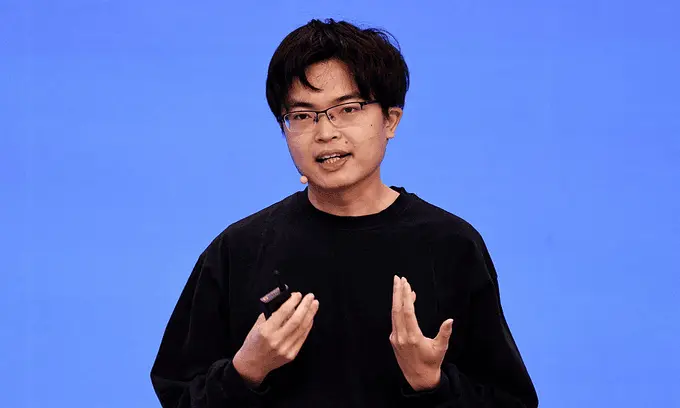
Yang Zhilin, a 34-year-old Carnegie Mellon PhD graduate, has transformed Moonshot AI into one of China's most formidable AI companies, with the startup now valued at approximately $50 billion as it prepares for an IPO
1
. The bespectacled founder, who rejected multiple offers from major U.S. technology companies after graduation, returned to China with an ambition to "change the world over the next 10 to 20 years"2
. His journey from academic prodigy to AI entrepreneur has positioned Moonshot AI at the forefront of China's AI industry, directly challenging established players like OpenAI and Anthropic.
Source: VnExpress
Born in Shantou, Guangdong province, Yang demonstrated exceptional talent early by winning first prize in the National Olympiad in Informatics during high school, earning him direct admission to Tsinghua University
1
. At Tsinghua, he graduated top of his computer science class while simultaneously drumming in a campus band called Splay and organizing music competitions1
. His former Carnegie Mellon PhD advisor Ruslan Salakhutdinov described him as "absolutely brilliant," noting that Yang remained determined to return to China despite recruitment efforts from major U.S. tech firms2
.Moonshot AI unveiled Kimi K3 last week, a 2.8 trillion-parameter open-weight large language model designed for complex reasoning, software coding, and long-document analysis
2
. The model's debut sent shockwaves through Silicon Valley, with Vercel CEO Guillermo Rauch declaring it "the first time that an open model is ahead of all proprietary ones for this comprehensive web engineering benchmark"2
. Ethan Mollick, associate professor at the Wharton School, described it as "closest to the frontier yet"2
.The release triggered a market sell-off that knocked hundreds of billions of dollars off major U.S. technology stocks including Google and Nvidia, drawing comparisons with the disruption caused by DeepSeek earlier this year
2
. Anastasios Angelopoulos, co-founder and CEO of Arena, called it "the single biggest release of the year," marking a moment when open-source Chinese models are surpassing closed U.S. models2
. Demand proved so overwhelming that Moonshot AI suspended new subscriptions days after the launch2
.Following DeepSeek's R1 model success early last year, Yang faced what many considered an existential crisis for Moonshot AI
1
. The company's Kimi chatbot, despite early popularity, suffered from outages and was rapidly overtaken by larger rivals. In 2024, the startup generated just $2.4 million in revenue while costs from model training and hiring researchers exploded1
. Rivals including Baichuan and 01.ai had already abandoned the race to build frontier large language models to focus on applications1
.Yang concluded that Moonshot had moved into commercialization too early and made two pivotal decisions: focus purely on model training while ditching efforts to market the Kimi chatbot, and commit to open-sourcing Moonshot's leading AI models
1
. "If the top leader can't make decisive calls, that won't work," Yang said in a 2024 interview1
. This strategic shift proved transformative, as researchers were attracted by the opportunity to publish papers and receive individual recognition that open-source development provides1
.Related Stories
Yang's status as a leading AI researcher enabled him to assemble and retain one of China's strongest research teams amid aggressive poaching by deep-pocketed tech groups
1
. During his doctoral studies, he interned at Google Brain and Meta, co-authoring research papers with prominent scientists including Yann LeCun, Quoc V. Le, and Yoshua Bengio2
. Many of Moonshot's founding researchers studied alongside him at either Tsinghua or Carnegie Mellon, creating a cohesion that distinguishes the company from rivals like Alibaba and Baidu, which have seen prominent researchers depart amid disagreements over balancing frontier research with commercial demands1
.Founded in March 2023 with former Tsinghua classmates Zhou Xinyu and Wu Yuxin, Moonshot raised $60 million and assembled a team of around 40 AI specialists within its first three months
2
. The company first gained attention by developing models with exceptionally long context windows, allowing chatbots to retain more information over extended conversations1
2
. Employees describe an intense culture of long hours in the company's utilitarian headquarters in Beijing's Haidian district, where meeting rooms are named after rock bands and a white piano stands prominently in the office—reflecting Yang's obsession with rock music that inspired the company's name from Pink Floyd1
.The boom in AI coding assistants and autonomous agents created surging demand from developers, turning Moonshot into one of China's fastest-growing model providers
1
. Annual recurring revenue reached approximately $300 million in June, according to investors with knowledge of the matter1
. The company is currently conducting two consecutive fundraising rounds, with the second valuing it at around $50 billion as investors clamor for access1
.On Chinese social media, Yang has become a celebrity, with the hashtag "Post-90s Tsinghua University genius crashed U.S. stocks" ranking as the third most popular topic in Weibo's technology section
2
. "We once chased after Silicon Valley's AI, but now a post-90s Tsinghua entrepreneur has unveiled a cutting-edge open-source model, directly shaking Wall Street," one Weibo user wrote2
. Yang's journey from winning provincial informatics competitions to leading a company he believes will "dwarf today's giants—double, triple the scale" represents a significant shift in the global AI landscape, where Chinese AI models are increasingly rivaling leading U.S. models in capability while operating at substantially lower costs1
2
.Summarized by
Navi
12 Jul 2025•Technology

20 Jul 2026•Technology

19 Jul 2026•Business and Economy

1
Technology

2
Policy and Regulation

3
Science and Research




