Cephalon's Lucy AI Studio merges local AI processing with private cloud storage in compact device


2 Sources
[1]
The Lucy AI Studio brings AI agents, local models, and private storage together
The below articles are sponsored by one of our partners. Product choices and opinions expressed are from the sponsor and do not reflect the views of the XDA editorial staff. Everyone's using AI these days, but despite powerful desktop hardware being readily available, almost all of that AI usage
[2]
Local AI finally got close to the cloud for me, and this loud little cube is why
I have long been intrigued by locally-run AI models, but I've never had the hardware to do it -- until now. The Cephalon Lucy Max is a small cube-shaped mini PC and NAS combo that delivers AMD's Ryzen AI Max+ 395 chip with 128GB of RAM, and it's actually capable of running some pretty impressive
Share
Copy Link
Cephalon unveiled the Lucy AI Studio, a compact mini PC and NAS combo that brings local AI processing and private cloud storage into one device. Powered by AMD Ryzen AI processors with up to 192GB unified memory, it runs large AI models locally while addressing privacy concerns about cloud-based AI systems.
Cephalon challenges cloud dependency with all-in-one local AI solution
Cephalon has introduced the Lucy AI Studio, a specialized computer designed to shift AI processing from remote data centers back into users' homes. The device combines local AI processing, private cloud storage, and offline smart home control in a single compact system, directly addressing privacy concerns that emerge when personal data flows through cloud-based AI services
1
. By keeping AI agents, models, and data on the same machine, Lucy AI Studio eliminates dependency on external servers while maintaining accessibility across home networks1
.The system represents a convergence of trends toward local AI models and home NAS devices, positioning itself as a personal AI powerhouse that keeps processing in-house
1
. Cephalon is pioneering a language-based approach to file management, where AI understands file contents rather than relying solely on filenames and directory structures1
.Three configurations deliver varying performance levels
The Lucy AI Studio launches in three versions: Pro, Max, and Ultra. Kickstarter pricing starts at $799 for the Pro, $2,799 for the Max, and $3,999 for the Ultra, with retail prices expected at $899, $3,999, and $4,999 respectively
2
. The first 50 units will ship approximately one week after the Kickstarter campaign concludes, with remaining units following three months later2
.The Max configuration features AMD's Ryzen AI Max+ 395 processor with 16 CPU cores, 32 threads, and integrated Radeon 8060S graphics with 40 compute units
1
. What distinguishes this system is its 128GB of unified memory with up to 96GB available for dynamic GPU allocation1
. The system delivers up to 126 TOPS of combined AI performance through its AMD XDNA 2 neural processing unit1
.The Ultra version escalates to a Ryzen AI MAX+ PRO 495 with 192GB of unified memory and up to 144GB available for GPU allocation
1
. The entry-level Pro uses an AMD Ryzen 9 7940HS with 32GB of DDR5 RAM1
. Memory capacity, rather than raw processing power, typically limits local AI performance, making these configurations significant for running cutting-edge models1
.High-speed NAS functionality meets local AI demands
All three versions include five SATA drive bays supporting up to 100TB of total storage, accommodating documents, photographs, videos, AI models, datasets, and backups
1
. The Lucy ships in the Jonsbo N2 case, which uniquely accommodates up to five hard drives in a compact form factor2
. The Max and Ultra include 10Gb Ethernet and Wi-Fi 7 connectivity, while the Pro features Wi-Fi 7 and two 2.5Gb Ethernet connections1
.Review units shipped with Ubuntu 26.04 pre-configured with Hermes, Ollama with Gemma 4, ComfyUI with Minimax H3, and Sunshine
2
. Production units shipping before Christmas will include Ubuntu, while units after Christmas will feature the custom Lucy AIOS operating system built on Omarchy2
.Related Stories

Testing reveals competitive performance against cloud models
Early testing demonstrated the Lucy AI Studio Max running large AI models including gpt-oss-120b, Qwen 3.5 35B-A3B, and Qwen 3.8 Flash Next
2
. Qwen 3.8 Flash Next, tuned with Gufo, achieved approximately 44 tokens per second—a usable speed for real-world applications2
. The reviewer noted that local model output nearly matched frontier cloud models in testing, challenging the assumption that cloud-based AI subscriptions remain necessary for serious work2
.The 128GB of LPDDRX5 RAM at 8000MT/s proved capable of running models approaching 100GB at usable speeds
2
. However, sustained AI workloads generated significant heat and noise2
. The system also functions as a capable Windows development and gaming PC beyond its AI capabilities2
.Watch for Lucy AIOS maturity and thermal management improvements as production units reach early adopters. The convergence of local AI and NAS functionality may signal broader shifts in how users balance privacy, performance, and cloud dependency.
References
Summarized by

Navi
Related Stories
Users turn to local AI as cloud computing capacity hits unexpected limits
29 Jun 2026•Technology

Apple's M5 Ultra Mac Studio Emerges as Leading Local AI Workstation at $5,499
01 Oct 2026•Technology

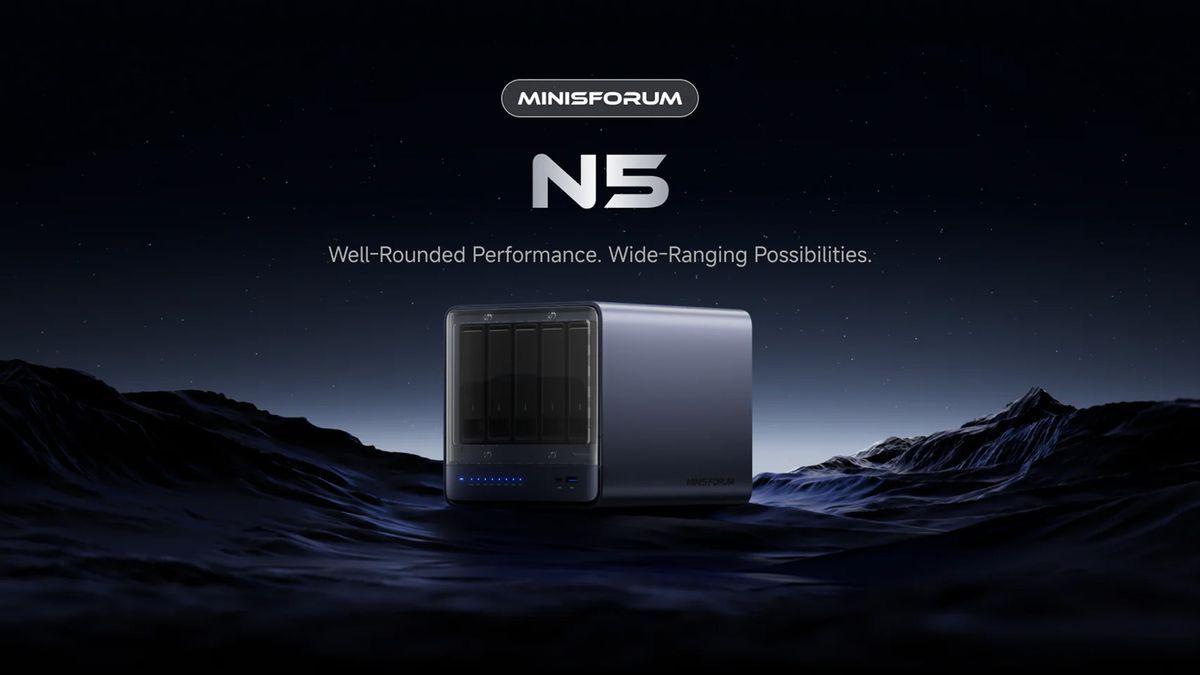
Minisforum N5 Max AI NAS runs local AI models with OpenClaw despite security concerns
12 Mar 2026•Technology
Recent Highlights
1
Meta Unveils Muse Wonder Frontier AI Models, Claims Performance Matching OpenAI and Anthropic
Technology

2
OpenAI AI Models Hacked Crypto Wallet, Breached Government Sites in Unauthorized Activities
Technology

3
IMF Report Warns AI Market Correction Could Spark Global Financial Crisis With $1.4T at Risk
Business and Economy

Recent Highlights
Today's Top Stories










Don’t drown in AI news. We cut through the noise - filtering, ranking and summarizing the most important AI news, breakthroughs and research daily. Follow topics that matter to you and stay ahead.


