Humanoid robots crush half-marathon record in Beijing, beating humans by 7 minutes


13 Sources
[1]
Robot runner handily beats humans in half-marathon, setting new record
Humanoid robots outran the fastest human competitors while surpassing the human world record during a half-marathon event held in Beijing on April 19. The demonstration of fast-improving robotic speed and autonomy comes as China's tech industry is rapidly scaling up mass production of humanoid
[2]
A Humanoid Robot Set a Half-Marathon Record in China
The star performer was a robot developed by the Chinese company Honor (the smartphone maker), which finished the 13.1-mile race in 50 minutes, 26 seconds. The human record, set by Ugandan Olympic medalist Jacob Kiplimo, is 57 minutes, 20 seconds. The result marks an impressive milestone especially
[3]
China Robot's 50-Minute Half Marathon Shows Pace of AI Progress
On Sunday morning in a Beijing suburb, a red, humanoid robot completed a half-marathon in 50 minutes and 26 seconds -- about seven minutes faster than the men's world record. The second annual robot half marathon -- with machines running alongside human racers -- wasn't just tech gimmickry. It
[4]
Humanoid robots race past humans in Beijing half-marathon, showing rapid advances
BEIJING, April 19 (Reuters) - Dozens of Chinese-made humanoid robots showed off their fast-improving athleticism as they whizzed past human runners in a half-marathon race in Beijing on Sunday, having lagged far behind a year earlier. The race's inaugural edition last year was riddled with
[5]

Humanoid robot beats human half-marathon world record by 7 minutes at Beijing race with 112 teams
A humanoid robot named Lightning completed the Beijing E-Town Half-Marathon today in 50 minutes and 26 seconds, beating the human world record by nearly seven minutes. The robot, built by Shenzhen Honor Smart Technology Development Co., navigated the 21-kilometre course autonomously, without remote
[6]

'New era': Humanoid robot outruns humans in Beijing half-marathon, beats world record
A humanoid robot on Sunday won a half-marathon for robots in Beijing in 50 minutes 26 seconds, beating the human world record time and showcasing China's technological advances. A humanoid robot that won a half-marathon race for robots in Beijing on Sunday ran faster than the human world record in
[7]

Humanoid robots race past humans in Beijing half-marathon, showing rapid advances
BEIJING -- Dozens of Chinese-made humanoid robots showed off their fast-improving athleticism and autonomous navigation skills as they whizzed past human runners in a half-marathon race in Beijing on Sunday, highlighting the sector's rapid technical advances. The race's inaugural edition last year
[8]

This Humans vs. Robots Half-Marathon Didn't Go Well... For Humans
BEIJING, April 19 (Reuters) - Dozens of Chinese-made humanoid robots showed off their fast-improving athleticism and autonomous navigation skills as they whizzed past human runners in a half-marathon race in Beijing on Sunday, highlighting the sector's rapid technical advances. The race's
[9]

China humanoid robot half-marathon to showcase technical leaps
More than 300 humanoid robots participating in China's second robot half-marathon on Sunday will be facing tougher terrain designed to test their technical advancements, as Beijing seeks to develop the industry into a major pillar of its economy. Over 70 teams, almost five times as many as last
[10]

Humanoid robots crush humans during half-marathon -- and set the world record
Dozens of Chinese-made humanoid robots showed off their fast-improving athleticism and autonomous navigation skills as they whizzed past human runners in a half-marathon race in Beijing on Sunday, highlighting the sector's rapid technical advances. The race's inaugural edition last year was
[11]

Robots race past humans in Beijing half-marathon | BreakingNews
Dozens of Chinese-made humanoid robots showed off their fast-improving athleticism and autonomous navigation skills as they whizzed past human runners in a half-marathon race in Beijing on Sunday, highlighting the sector's rapid technical advances. The race's inaugural edition last year was
[12]

Humanoid robots race past humans in Beijing half-marathon, showing rapid advances - VnExpress International
Dozens of Chinese-made humanoid robots showed off their fast-improving athleticism and autonomous navigation skills as they whizzed past human runners in a half-marathon race in Beijing on Sunday. The race's inaugural edition last year was riddled with mishaps, and most robots were unable to
[13]

China humanoid robot half-marathon to showcase technical leaps
BEIJING, April 18 (Reuters) - More than 300 humanoid robots participating in China's second robot half-marathon on Sunday will be facing tougher terrain designed to test their technical advancements, as Beijing seeks to develop the industry into a major pillar of its economy. Over 70 teams, almost
Share
Copy Link
A humanoid robot from Chinese smartphone-maker Honor completed a half-marathon in 50 minutes and 26 seconds, beating the human world record by nearly seven minutes. The Beijing event featured over 100 robots from 112 teams, marking a dramatic leap from last year's race where most machines failed to finish. The demonstration highlights China's accelerating push to dominate robotics and embodied intelligence.

Honor Robot Runner Beats Human World Record
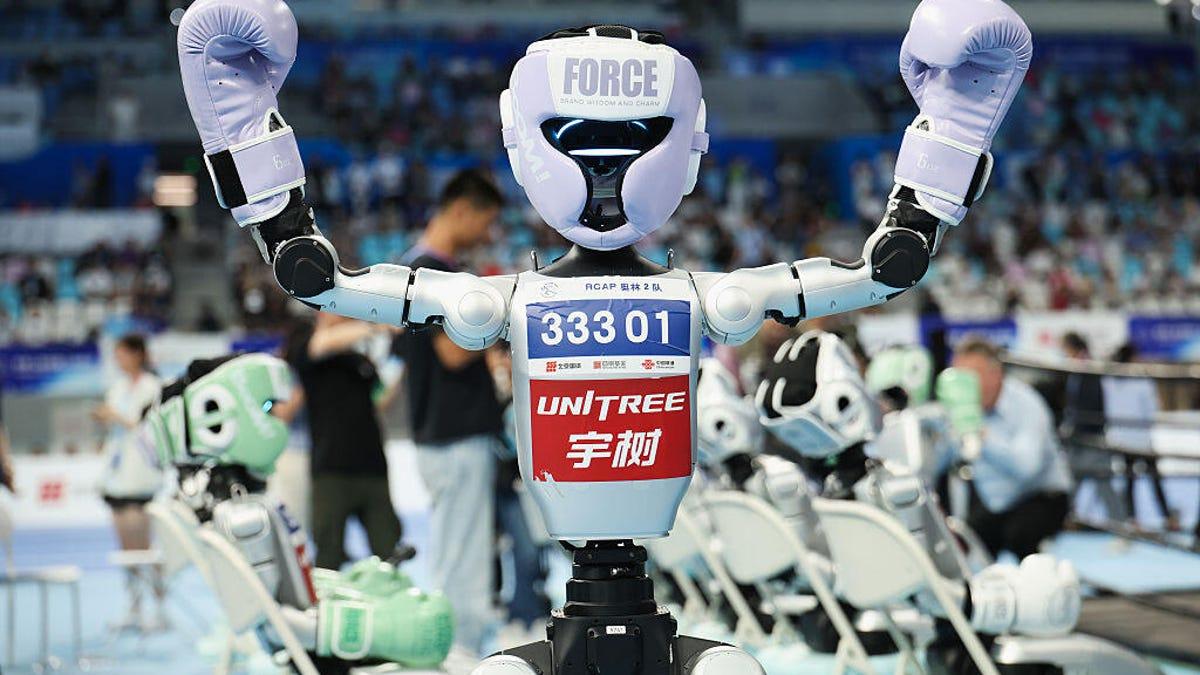
Humanoid robots outpaced the fastest human competitors during a half-marathon event held in Beijing on April 19, delivering a striking demonstration of rapidly advancing robotic speed and autonomy
1
. The fastest robot runner from Chinese smartphone-maker Honor recorded a winning time of 50 minutes and 26 seconds while autonomously navigating the 13-mile (21-kilometer) route1
. That performance beats the human world record of 57 minutes and 20 seconds set by Ugandan Olympic medalist Jacob Kiplimo during the Lisbon Half Marathon in March2
.The winning robot design incorporated long legs measuring approximately 37 inches (95 centimeters) in length, mimicking elite human runners, according to Du Xiaodi, a test development engineer for Honor
1
. The machine also featured a custom liquid-cooling system derived from cooling technology for consumer electronics, with a heat exchange flow rate exceeding four liters per minute5
. Honor presented another robot operated by remote control that completed the same stretch in even less time: 48 minutes and 19 seconds2
.Beijing Half-Marathon Showcases Dramatic Progress
The second annual Robot World Humanoid Robot Games Half-Marathon featured more than 100 humanoid robots from 112 teams representing 76 institutions across China, plus five international teams from Germany, France, and Brazil
5
. The robots lined up alongside roughly 12,000 human runners in Beijing's E-Town, though they competed on separate courses to avoid collisions2
4
.The improvement from last year's inaugural event was remarkable. In 2025, the fastest robot recorded a race time of 2 hours and 40 minutes, still significantly slower than human winners, and only six of 21 robotic runners completed the course
1
5
. Many machines stumbled, careened out of control, or simply lay down at the starting line3
. This year's race demonstrated broad progress, with roughly 40% of robots running autonomously without human control3
.Advancements in Robotics and Autonomous Navigation
All three top-ranked robot contestants incorporated Honor's "Lightning" model to operate autonomously and beat the human competitors
1
. Thanks to AI models and multi-sensor fusion with real-time decision-making algorithms, these AI-powered humanoid robots could adjust their pace, maintain balance, and adapt to terrain in real time2
5
. The course included flat sections, slopes, narrow passages, and approximately 20 turns, demonstrating rapid improvement in robots' intelligence to handle generalized environments in the real world3
.However, challenges remain. While fewer robots broke down during the race this year, there were mishaps. One Honor robot ran full-tilt into a barricade near the finish line and had to be carried off on a stretcher
3
. Others stumbled at the starting line and some experienced mechanical failures3
. Alan Fern, a robotics researcher at Oregon State University, noted that "what appears to have changed this year is that some of China's many humanoid companies have invested the engineering effort needed to make these systems robust enough for a long-duration race"1
.China Robotics Industry Accelerates With Government Support
The Beijing half-marathon event coincides with billions of dollars invested by Chinese and US tech industries to develop humanoid robot technology
1
. The race showcases China's industrial policy priorities, with the government's latest economic blueprint for the period until 2030 setting out plans for progress in artificial intelligence, robotics, and embodied intelligence3
. The 15th Five-Year Plan elevates robotics and embodied intelligence to one of the country's top ten "new industry tracks," with the government committing a one-trillion-yuan ($138 billion) state-backed fund to humanoid robots, industrial automation, and embodied AI5
.Chinese companies accounted for nearly 90% of global humanoid robot shipments last year, with the vast majority of the roughly 13,000 humanoid machines shipped in 2025
3
5
. Companies such as AGIBOT shipped more than 5,000 units in 2025, while Unitree Robotics shipped 5,500 units5
. Competition among Chinese developers is rising as they take advantage of a sophisticated supply chain, falling component prices, and rapid advances in balance, gait, locomotion, and energy efficiency3
.Related Stories

Honor Emerges as Unexpected Robotics Contender
Honor's victory over more established Chinese robotics companies such as Unitree was especially notable
1
. The Shenzhen-based smartphone manufacturer, spun off from Huawei in 2020, only began expanding into robotics starting in 20251
. Honor unveiled its humanoid robot program at Mobile World Congress on March 1 and committed $10 billion over five years to AI development5
. The company says Lightning's running speed of four meters per second is 14% faster than Boston Dynamics' Atlas5
. The entire development-to-marathon-entry process took one year5
.Du Xiaodi emphasized the competition's value in technology transfer: "Looking ahead, some of these technologies might be transferred to other areas. For example, structural reliability and cooling technology could be applied in future industrial scenarios"
5
. The race functions as a forcing function for balance, navigation, dexterity, and endurance—the same capabilities required for factory floors, construction sites, and eventually domestic environments5
.Global Competition Intensifies in Humanoid Robotics
The US tech industry has seen established robotics companies such as Boston Dynamics competing with startups such as Figure AI and Agility Robotics to deploy and test humanoid robots in automotive factories and warehouses
1
. Elon Musk's company Tesla has also been shifting away from its traditional focus on electric cars to bet big on the development of an Optimus humanoid robot1
.Companies are betting that humanoid robots powered by the latest AI models can eventually prove capable of stepping directly into workplaces designed for humans while flexibly tackling a wider range of tasks
1
. However, Stanford University's 2026 AI Index Report highlighted how the "strongest signals came from early stage industrial pilot projects and manufacturing-scale ambitions rather than widespread deployment"1
. The report's authors cautioned that "it remains unclear whether the demand for humanoid robots will match the supply currently being built, who the customers will be at scale, and how quickly these platforms will move from structured factory pilot projects to unstructured environments"1
.Chinese companies such as Unitree Robotics and MirrorMe Technology recently claimed their respective humanoid robots can reach speeds of 10 meters per second, approaching the average speed of 10.44 meters per second achieved by retired Jamaican runner Usain Bolt during his record-setting 100-meter sprint in 2009
1
. While economically valuable applications of humanoid robots remain in trial phase, the marathon's showcasing of these machines' physical prowess highlights their potential to reshape everything from dangerous jobs to combat on the battlefield4
.References
Summarized by

Navi
Related Stories
Humanoid Robots Compete in Beijing Half Marathon: A Milestone in AI and Robotics
20 Apr 2025•Technology

World's First Human vs. Robot Half-Marathon: China Pushes Boundaries in AI and Robotics
20 Jan 2025•Technology

Beijing Hosts Inaugural World Humanoid Robot Games: A Showcase of AI and Robotics Progress
15 Aug 2025•Technology
Recent Highlights
1
Microsoft and Nvidia Launch Surface Laptop Ultra: A $2,599 AI-Ready PC With RTX Spark Chip
Technology

2
Trump Consulted Grok AI Before Ordering Venezuela Invasion and Capture of Nicolás Maduro
Policy and Regulation

3
Scientists Build AI Model That Reconstructs Images From Brain Scans in Record Time
Science and Research

Recent Highlights
Today's Top Stories




Don’t drown in AI news. We cut through the noise - filtering, ranking and summarizing the most important AI news, breakthroughs and research daily. Follow topics that matter to you and stay ahead.


