Humanoid Robots Compete in Beijing Half Marathon: A Milestone in AI and Robotics


8 Sources
[1]
Stumbling and Overheating, Most Humanoid Robots Fail to Finish Half Marathon in Beijing
Only six of the 21 robots in the race crossed the finish line, highlighting just how far humanoids are from keeping up with their real human counterparts. On Saturday, about 12,000 human athletes ran in a half marathon race in Beijing, but most of the attention was on a group of other,
[2]
This video of humanoid robots running a half marathon is amazing, hilarious, and a little creepy
Despite lost limbs, overheating, and a crash or two, a few of the 20 robots competing in China over the weekend did quite well. See for yourself. If you thought bipedal robots were limited to the somewhat creepy and sweet breakdancing moves of Boston Dynamics' Atlas, think again, because the
[3]
New PR? Humanoid robots in China competed in their first half-marathon
Tiangong Ultra FTW. Credit: VCG / Visual China Group / Getty Image Over the weekend, humans running as fast as they could were chased by robots through the streets of Beijing, China. To be more specific, it was a half-marathon race, and the robots lagged far behind the humans. On Saturday, China
[4]
Watching These Humanoid Robots Try to Run a Half Marathon Is Hilarious and Bizarre
A half marathon foot race in Beijing, China, saw thousands of humanoid robots of various sizes running right alongside their flesh-and-blood counterparts for an attempt to take the crown. Footage shows the awkward bipedal robots trotting off, closely followed by their respective teams of two to
[5]

Robots lose embarrassingly to inferior meatbag humans in a first of its kind half-marathon race
"The robots are running very well, very stable ... I feel I'm witnessing the evolution of robots and AI." China managed to make one of the coolest sounding premises staggeringly nerdy as the country pits humanoid robots against humans in a half marathon run. According to The Guardian, this meat
[6]

Beijing holds first half-marathon with humanoid robots running with humans
The rise of artificial intelligence is putting at risk many jobs traditionally made by humans, specially in the arts and computer departments. But, do robots also pose a threat to sportspeople? It is not likely in the short term, but last Saturday's half-marathon in Beijing may have been a keystone
[7]

Humanoid robots join runners for half-marathon -- but some of the...
Twenty-one humanoid robots joined thousands of runners at the Yizhuang half-marathon in Beijing on Saturday, the first time these machines have raced alongside humans over a 21-km (13-mile) course. The robots from Chinese manufacturers such as DroidUP and Noetix Robotics came in all shapes and
[8]

70% of humanoids fail to finish world's first humanoid half-marathon - VnExpress International
Just six out of 21 humanoid robots finished the first-ever humanoid half-marathon in Beijing, with most dropping out due to breakdowns, overheating, or mechanical failures. The winning robot, named "Tiangong Ultra," completed the course on Saturday in 2 hours and 40 minutes, qualifying within the
Share
Copy Link
In a groundbreaking event, humanoid robots participated alongside human runners in a half marathon in Beijing, showcasing advancements and limitations in robotics technology.

Humanoid Robots Make History in Beijing Half Marathon
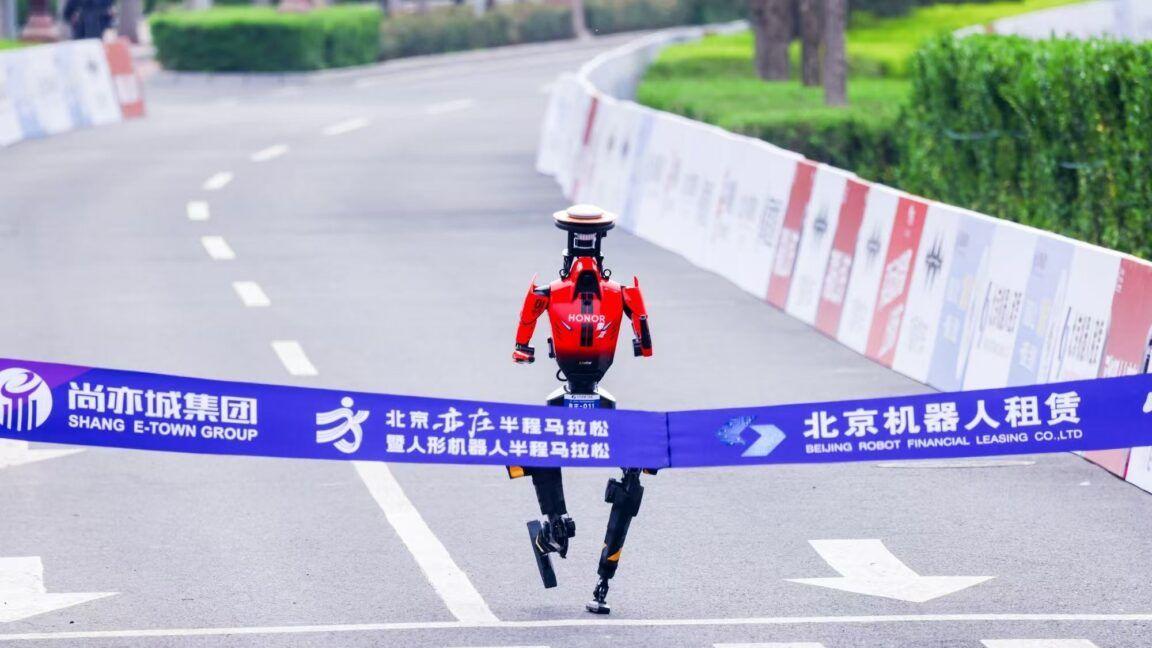
In a groundbreaking event that blended athletics with cutting-edge technology, humanoid robots participated alongside human runners in a half marathon in Beijing, China. This first-of-its-kind race, organized by several branches of Beijing's municipal government, saw 21 bipedal robots competing on a separate track parallel to approximately 12,000 human athletes
1
2
.Robot Performance and Challenges
The race highlighted both the progress and limitations of current humanoid robot technology. Out of the 21 robot participants, only six successfully completed the 13.1-mile course
1
. The fastest robot, Tiangong Ultra, developed by UBTech in collaboration with the Beijing Humanoid Robot Innovation Center, finished the race in 2 hours and 40 minutes1
2
.However, the robots faced numerous challenges during the race:
- Battery limitations: Tiangong Ultra required three battery changes during the race
1
. - Stability issues: Many robots fell down, with some unable to quickly stand up again
1
5
. - Overheating: Several robots experienced overheating problems, necessitating replacement or assistance
1
2
. - Speed constraints: The fastest robot's time was significantly slower than the human winner's time of 1 hour and 2 minutes
3
.
Technological Significance
Despite the challenges, the event demonstrated significant advancements in humanoid robotics:
- Walking reliability: Alan Fern, a robotics professor at Oregon State University, noted that reliable robot walking was not possible five years ago
1
5
. - Hardware robustness: The ability of some robots to complete a half marathon showcases improvements in hardware durability
1
. - Diverse capabilities: The robots varied in size and design, with some wearing running shoes and others featuring human-like faces
2
3
.
Related Stories

China's Push in Humanoid Robotics
The event underscored China's ambitions in the field of humanoid robotics:
- Government investment: Local governments in major Chinese cities have invested an estimated $10 billion in developing humanoid robotics
3
. - Competition with the US: China aims to compete with U.S. companies like Boston Dynamics, Figure AI, and Tesla in this critical technology area
3
. - Industry showcase: The race provided a platform for Chinese universities and companies to demonstrate their advancements in humanoid robotics
3
.
Public Reception and Future Implications
The robot half marathon generated significant interest among spectators and participants:
- Public engagement: Many human runners stopped to take selfies with the robots during the race
1
. - Awards and recognition: Organizers presented awards for best endurance, gait design, and innovative form
4
. - Technological optimism: Some spectators, like AI professional He Sishu, viewed the event as witnessing "the evolution of robots and AI"
5
.
While the robots' performance demonstrated that they are not yet close to rivaling top human athletes, their ability to complete a half marathon showcases the potential for future advancements in humanoid robotics and AI technology.
References
Summarized by

Navi
[2]
Related Stories
World's First Human vs. Robot Half-Marathon: China Pushes Boundaries in AI and Robotics
20 Jan 2025•Technology

Humanoid robots crush half-marathon record in Beijing, beating humans by 7 minutes
18 Apr 2026•Technology
Beijing Hosts Inaugural World Humanoid Robot Games: A Showcase of AI and Robotics Progress
15 Aug 2025•Technology
Recent Highlights
1
Microsoft and Nvidia Launch Surface Laptop Ultra: A $2,599 AI-Ready PC With RTX Spark Chip
Technology

2
Trump Consulted Grok AI Before Ordering Venezuela Invasion and Capture of Nicolás Maduro
Policy and Regulation

3
Scientists Build AI Model That Reconstructs Images From Brain Scans in Record Time
Science and Research

Recent Highlights
Today's Top Stories




Don’t drown in AI news. We cut through the noise - filtering, ranking and summarizing the most important AI news, breakthroughs and research daily. Follow topics that matter to you and stay ahead.


