Chinese Auto and Tech Giants Challenge Tesla's Self-Driving Dominance


4 Sources
[1]
Tesla's self-driving future under threat from China's auto, tech giants
AUSTIN, Texas June 10 (Reuters) - Chinese electric-vehicle makers led by BYD beat Tesla (TSLA.O), opens new tab in the competition to produce affordable electric vehicles. Now, many of those same fierce competitors are pulling into the passing lane in the global race to produce self-driving
[2]
Why China's auto, tech giants threaten Tesla's self-driving future
Chinese EV makers, led by BYD, are challenging Tesla in self-driving technology by offering affordable EVs with advanced driver-assistance systems. BYD's "God's Eye" undercuts Tesla's FSD, leveraging lower component costs and government support. Tesla faces challenges in China due to regulations,
[3]
Why China's auto, tech giants threaten Tesla's self-driving future
AUSTIN, Texas -- Chinese electric-vehicle makers led by BYD beat Tesla in the competition to produce affordable electric vehicles. Now, many of those same fierce competitors are pulling into the passing lane in the global race to produce self-driving cars. BYD shook up China's smart-EV industry
[4]
Why China's auto, tech giants threaten Tesla's self-driving future
AUSTIN, Texas (Reuters) -Chinese electric-vehicle makers led by BYD beat Tesla in the competition to produce affordable electric vehicles. Now, many of those same fierce competitors are pulling into the passing lane in the global race to produce self-driving cars. BYD shook up China's smart-EV
Share
Copy Link
Chinese EV makers, led by BYD, are outpacing Tesla in the race for affordable self-driving technology, threatening Tesla's future in the autonomous vehicle market.
Chinese EV Makers Challenge Tesla's Self-Driving Dominance
Chinese electric vehicle (EV) manufacturers, spearheaded by BYD, are rapidly gaining ground on Tesla in the race to produce affordable self-driving cars. This development poses a significant threat to Tesla's future in the autonomous vehicle market, particularly in China, the world's largest car market
1
2
3
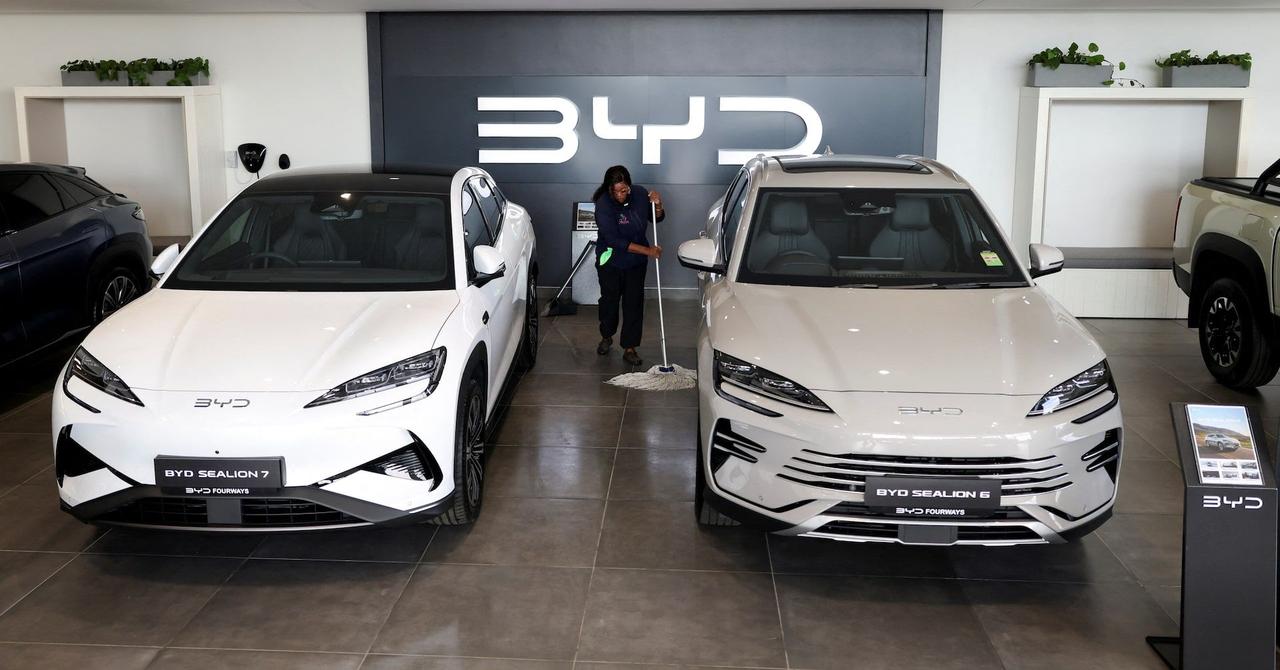
.BYD's "God's Eye" Shakes Up the Industry
Source: Reuters
BYD, a leading Chinese EV maker, has disrupted the smart-EV industry by offering its "God's Eye" driver-assistance package for free. This move undercuts Tesla's Full Self-Driving (FSD) technology, which sells for nearly $9,000 in China
1
2
3
. Taylor Ogan, a Shenzhen-based BYD investor, claims that "God's Eye" is more capable than Tesla's FSD, stating, "With God's Eye, Tesla's strategy starts to fall apart"1
2
3
.Cost-Effective Technology and Government Support
Analyses reveal that BYD's assisted-driving hardware costs are significantly lower than Tesla's. BYD's system, which includes radar and lidar sensors, costs about the same as Tesla's camera-only FSD system
1
2
3
. This cost-effectiveness is partly due to the fierce competition in China's EV market, which has led to economies of scale and lower manufacturing costs1
2
3
.Chinese EV makers also benefit from government subsidies and policy support for advanced assisted driving technology. This backing has accelerated the development and adoption of autonomous driving systems in China
1
2
3
.Tesla's Challenges in China

Source: ET
Tesla faces several obstacles in the Chinese market:
-
Regulatory hurdles: China's regulations prevent Tesla from using data collected by its cars in China to train its AI systems, putting it at a disadvantage compared to local competitors
1
2
3
. -
Intense competition: Other Chinese companies like Leapmotor, Xpeng, and Huawei are offering affordable EVs with advanced driver-assistance systems, some priced as low as $20,000
1
2
3
. -
Declining sales: Tesla's sales in China are falling amid a protracted price war among homegrown EV brands
1
2
3
.
Related Stories

Huawei's Entry into the Smart-EV Market
Huawei, the Chinese smartphone giant, has emerged as a notable player in the smart-EV industry. The company provides autonomous-driving technology to major Chinese automakers and has partnerships with numerous car manufacturers
1
2
3
.A demonstration of Huawei's technology in an Aito M9 luxury electric SUV showcased its ability to navigate complex urban environments, including seamless highway exits, cautious maneuvering around pedestrians, and autonomous parallel parking
1
2
3
.Tesla's Strategic Pivot
In response to the growing competition, Tesla has shifted its focus from mass-market EVs to self-driving robotaxis. This strategic move comes after the company reportedly abandoned plans to build a $25,000 EV
1
2
3
. Tesla is now planning to launch a robotaxi trial in Austin, Texas, with 10 to 20 vehicles, marking a critical moment for the company's autonomous driving ambitions1
2
3
.As the race for autonomous driving technology intensifies, Chinese auto and tech giants are positioning themselves as formidable competitors to Tesla, potentially reshaping the future of the global EV and self-driving car markets.
References
Summarized by

Navi
[4]
Related Stories
The Global Robotaxi Race: Tesla Faces Stiff Competition from Chinese and American Rivals
16 Jul 2025•Technology

BYD Challenges Tesla with DeepSeek AI Integration in Self-Driving Technology
11 Feb 2025•Technology

Tesla's Self-Driving Ambitions Face Hurdles in China Amid US-China Trade Tensions and Rising Competition
12 Feb 2025•Technology

Recent Highlights



Recent Highlights
Today's Top Stories






Don’t drown in AI news. We cut through the noise - filtering, ranking and summarizing the most important AI news, breakthroughs and research daily. Follow topics that matter to you and stay ahead.


