6 Sources
6 Sources
[1]
China's auto industry races to embed AI in line with Beijing mandate
BEIJING, April 24 (Reuters) - It took China 25 years to dominate the market for electric vehicles. Now, the country's auto industry is hurtling toward the next disruption: Embedding artificial intelligence in cars that will make the next generation of EVs not just network-connected, but self-reasoning machines running on Chinese chips and software. China's most recent five-year plan released earlier this year presented a blueprint for "AI Plus," a national project to embed AI systems into manufacturing, healthcare and almost every other corner of the economy. Part of that aim is to break China's dependence on high-end semiconductors - a trade chokepoint dominated by the U.S. "There's no longer a distinction between a technology company and a car company," Nissan Motor (7201.T), opens new tab China chief Stephen Ma told reporters on the sidelines of the Beijing Auto Show, which kicked off on Friday. "The AI-developed vehicle is much faster and it's quicker in China." In recent days, Chinese automakers and their suppliers have flooded the zone with investment commitments and new AI systems. Some of the immediate applications seemed incremental. Analysts say the longer-term stakes are huge. China's automakers are now so advanced they are upending the global car industry, said Francois Roudier, secretary general of the International Organisation of Motor Vehicle Manufacturers, a federation of trade groups that represents the world's auto industry. "There is no transition," Roudier told Reuters in Beijing. "It's a revolution." THE CAR IS THE AGENT Xpeng (9868.HK), opens new tab has said its updated AI model allows drivers to give the car commands - like, "park near the entrance to the shopping center" - rather than designating a spot on a map. Xpeng vehicles can use cameras to navigate even without mapping or coordinates. Xiaomi (1810.HK), opens new tab, an appliance and phone maker that stormed into the EV business three years ago, released an updated AI model just after midnight on Thursday. Xiaomi has said its AI-empowered HyperOS operating system in its cars would allow drivers to task the system with complicated to-do lists, making restaurant reservations, placing coffee orders and compiling notes from the road. The system could also detect when drivers seem stressed or agitated and adjust the lighting and music for their arrival at home. Huawei, which has pivoted from its traditional focus on telecommunications to develop businesses in chips, AI and connected cars, said it would invest more than $10 billion over the next five years to boost computing power for smart driving. While automotive sales make up a relatively small part of Huawei's portfolio, it remains the company's fastest-growing segment. Just before the auto show started, Horizon Robotics, a Chinese chipmaker that competes with Qualcomm (QCOM.O), opens new tab, launched its Starry 6 processor that integrates cockpit and driving functions with the ability to handle up to 12 screen displays in a vehicle. Some automakers used the Beijing auto show to demonstrate that they heard Beijing's message on strategic innovation loud and clear. Dongfeng Motor - one of the Big Four state-owned carmakers - said it would be building cars using "embodied AI technology" in line with China's long-term plans for the sector. Dongfeng has been working with Huawei on smart driving systems to compete with privately owned rivals. "When the nation calls, Dongfeng answers," Chairman Yang Qing said. Reporting by Ju-min Park, David Dolan, Nick Carey, Pan Che and Zhang Yan in Beijing; Writing by Kevin Krolicki; Editing by Thomas Derpinghaus Our Standards: The Thomson Reuters Trust Principles., opens new tab
[2]
Foreign car companies bet on technology to hang onto once-lucrative China auto market
BEIJING -- Foreign automakers are finally catching up with their Chinese rivals on technology, as they battle a sales slump in the world's largest car market. U.S., Korean and German automakers rushed to announce a new lineup of models for China around the Beijing auto show that kicked off Friday. "We have plans to really build this brand and return [to] where we used to be in terms of volume and [market] share," Will Stacy, vice president, Cadillac China at General Motors, told CNBC's Eunice Yoon. Cadillac on Wednesday announced its first car with driver-assist technology for China: a three-row "luxury" electric SUV, priced at 468,000 yuan ($68,000) and 508,800 yuan. Called the VISTIQ, the vehicle uses advanced driver assist software that can handle highways and city roads, as well as automatic parking. The tech was co-developed with Chinese autonomous driving startup Momenta. "We've been mostly an ICE [internal combustion engine] brand here in China, and with this vehicle that enables us to enter the game here in China," Stacy said. He said sourcing locally in China allows Cadillac to compete effectively with its local rivals -- cutting production time to 18 months -- while the brand aims to attract customers with a promise of trust on safety. Hyundai officially launched its all-electric IONIQ brand in China on Friday as the Korean automaker kicks off its most ambitious local expansion to date. "China is where the future of mobility is being defined, and Hyundai intends to help define it, in China, for China, and ultimately, for the world," José Muñoz, president and CEO of Hyundai Motor Company, said in a release. Muñoz added in an interview with CNBC's Eunice Yoon that as China has fallen from 17% to 4% of Hyundai's total sales, the automaker had to "reimagine the strategy." Hyundai's new IONIQ V also comes with advanced driver-assist co-developed with Momenta, and offers voice-control functions using an AI assistant that runs on a Qualcomm Snapdragon 8295 chipset. Muñoz told CNBC that Hyundai could export the brand to Asia-Pacific, Australia and the Middle East if sales in China do well. Hyundai's China sales in March were about a third of what they were in the same month in 2019, before the pandemic. A number of other foreign carmakers have also seen sales drop over the same period. Figures compiled by CNBC suggest Nissan sales in China in March were down 47% on March 2019, while Cadillac fell 39%. "I'm glad to see that these foreign brands are humble enough and recognize the value of the Chinese tech that they're incorporating it," said Stephen Dyer, partner and managing director and head of AlixPartners' Asia automotive and industrials consulting practice. He's less optimistic that the foreign brands can win back significant market share in China, but said they have an opportunity to bring technology from China to their home markets. "I think the technology ... will disseminate throughout the world," Dyer said. "I don't think you can keep it locked up in the bottle of China. I think it's already gone out."
[3]
At Beijing auto show, Chinese carmakers flaunt new technologies as global competition heats up
BEIJING (AP) -- China's top automakers are showcasing their latest models and technologies from intelligent driving to ultrafast charging in Beijing as they compete with global rivals in overseas markets. Analysts say the biennial auto show in China's capital, which opened to media on Friday, shows how its auto industry is setting the global pace for cutting-edge technologies in areas such as electric vehicles and batteries, eclipsing many foreign brands that used to dominate the global market. More than 1,450 vehicles are on display at this year's show, including 181 global debuts. The show runs until May 3. Chinese EV maker XPeng is showing off its latest GX model, a six-seater SUV with a third row seats that can lie completely flat, among other new displays and technologies. Huge crowds gathered for a presentation by its founder and CEO He Xiaopeng, who described more high-tech aspects of the vehicle. "When you're driving on the highway, you fall asleep, or if you feel unwell and can no longer control the vehicle, the system can detect the situation, pull over automatically and alert emergency services," He said. "Many people who have tried it say it's amazing." Chinese EV maker BYD showcased its new generation of the fast charging "blade" EV battery, first unveiled last month, which can achieve a near full charge in nine minutes, at the auto show, as well as demonstrated charging under the low temperature of minus 30 degree Celsius. Also showcased by Yijing, a EV joint venture between Chinese carmaker Dongfeng Motor Corp. and technology giant Huawei, was the X9, their flagship six‑seat SUV. According to Chairman Wang Junjun, the new model will features some of the latest auto technology, including a next-generation Qiankun intelligent driving system and a new HarmonyOS cockpit and operating system developed by Huawei. Ahead of the show, Chinese battery giant CATL unveiled on Tuesday a new version of its "Shenxing" battery, which can be charged from 10% to 98% in only about six-and-a-half minutes. The auto show showcases the "speed and aggressiveness of advancement" among Chinese automakers, said Tu Le, managing director of consultancy Sino Auto Insights. "It just reinforces that the Chinese -- whether in EVs, batteries, intelligent driving -- are setting the pace for all these important sectors," he said. "China has become one of the fastest-moving markets for deploying and iterating new vehicle technologies, giving consumers early access to some of the most advanced features," said Chris Liu, a senior analyst at research and advisory group Omdia. China has become the world's biggest car exporter, benefiting from its ability to reap cost advantages from its huge scale as well as significant government subsidies and support that helped automakers to rapidly scale up and more quickly rolling out new models and technologies than their foreign competitors. But Chinese automakers has been facing immense pressure from ferocious price wars over the past months. This year, the government has scaled back subsidies encouraging drivers to switch to EVs and plug-in hybrids, weighing on domestic demand. Sales of passenger cars in China dropped 23% in the January-March quarter from a year earlier to around 4 million vehicles, according to the China Association of Automobile Manufacturers. But exports jumped 63% to almost 2 million vehicles as Chinese cars made inroads in regions like Europe, Southeast Asia and Latin America. Omdia forecasts China's passenger vehicle exports will grow by around 14% year-on-year in 2026. The hypercompetitive Chinese market have pulled vehicle prices down by a fifth over the past two years, according to a report this week by consultancy AlixPartners. Few of the new technologies showcased at the auto show may be exported to overseas markets in the short term due to regulatory and safety challenges, Liu said. But they signal "capabilities that can be refined and adapted for global markets over time." Even as foreign automakers have been losing market share in recent years in China, some are staging a comeback, with Volkswagen Group announcing on Tuesday plans for installing "agentic" AI into its vehicles for China. It also unveiled new EV models for the Chinese market, including the new UNYX 09 electric sedan co-developed with XPeng. While the foreign car brands may try to "stabilize" their market share in China, "gaining back a significant market share they had before is, to my perspective, not realistic," said Andreas Radics, managing director at Berylls by AlixPartners specialized in the automotive industry. Meanwhile, given the growing demand and often better profitability in overseas markets, Chinese automakers have been shifting from exporting cars from China to building more factories overseas, including in Hungary and Turkey, to increase supplies abroad and avert trade friction. Chinese carmakers are likely to almost triple their overseas production by 2030 to 3.4 million vehicles from 1.2 million last year, according to AlixPartners estimates. ___ Chan reported from Hong Kong. Associated Press video producer Wayne Zhang in Beijing contributed to this report.
[4]
'Look, no hands': China chases the driverless dream at Beijing car show
As domestic sales slow manufacturers are investing in AI and seeking growth in technology and in overseas markets At the world's biggest car fair, which opened in Beijing on Friday, there were hundreds of manufacturers, more than 1,000 vehicles, hundreds of thousands of enthusiasts - and hardly anyone behind a wheel. China's car companies have cornered the domestic electric vehicle market, and are increasingly visible on the global stage. Now they're turning their attention to what they are betting is the future of mobility: autonomous driving. At the Beijing Auto Fair, a huge industry event that covers 380,000 square metres on the outskirts of the capital, the country's carmakers showed off a range of intelligent driving technologies. In China's cut-throat domestic market, nearly every big carmaker is investing heavily in the software and computing power needed to make "hands-free" driving a reality as they compete to offer additional perks and find new ways to generate revenue. And Huawei, the telecommunications group, revealed this week that it would be investing up to 80bn yuan (£8.7bn) over the next five years to develop its autonomous driving software and computing power. "The fact that almost every automaker has some version of intelligent driving makes it different to almost any market in the world," said Tu Le, the managing director of Sino Auto Insights, a consultancy. Le said that the Chinese market was so competitive that merely selling passenger vehicles domestically was no longer a viable way for Chinese companies to make money. Additional perks, such as leasing AI-powered software, are needed to boost revenues. The EV maker Xpeng said its latest AI model allows drivers to give the car commands - such as, "park near the entrance to the shopping centre" - rather than a specific spot on a map. An AI-powered operating system from Xiaomi, an appliance and phone maker, allows drivers to make restaurant reservations, compile notes while driving and place coffee orders. It can also detect when drivers seem stressed or agitated and adjust the lighting and music for their arrival at home. Domestic car sales in China have fallen sharply in recent months. The number of passenger vehicles sold in China dropped by 17% in the first three months of this year as the government phased out a subsidy programme. BYD, the leader of China's EV industry and the company seen as a bellwether for the sector, has reported seven consecutive months of declining sales. China's exports, meanwhile, soared by more than 60% in the first quarter. China's largest car exporter, Chery, has recently set its sights on the UK market. Since launching in the UK in August it has become on of the country's fastest-growing car brands, with 13,500 cars sold between September and March. On Friday, the company announced a goal for 10m global annual sales by 2030, up from 5m in 2025. Farrell Hsu, the UK country director for Chery, said: "This exceptional growth underlines Chery UK's position as a key contributor to the overall business growth by 2030." The focus on overseas sales was evident at the fair as the carmaker Geely announced plans to deploy thousands of driverless taxis globally next year through its ride-hailing arm, Caocao. Chinese companies are looking to compete with US robotaxi firms such as Waymo, which have proven successful in San Francisco and Los Angeles. Robotaxis have already been rolled out in several Chinese cities, but their widescale adoption has been limited by regulatory barriers as much as technical ones. Last week the government concluded a public consultation on a proposed new set of safety standards for autonomous cars. There are no nationwide guidelines, and Beijing has been cautious about allowing unfettered access for driverless cars on its roads. Last month several of Baidu's Apollo Go robotaxis stalled in the middle of the road in Wuhan, leaving riders stranded for hours. Nevertheless, Chinese robotaxis are expected on the streets of London this year as Lyft and Uber have announced partnerships with Baidu to use its self-driving software. Faced with tariffs in big markets, such as theUS and the EU, Chinese carmakers are focusing on smaller markets, such as the UK and Canada, to shift units. One industry professional said the UK was appealing for Chinese companies because it was seen as being "culturally agnostic" about allowing Chinese EVs on its roads - while other countries have blocked them on national security grounds.
[5]
At Beijing Auto Show, Chinese Carmakers Flaunt New Technologies as Global Competition Heats Up
BEIJING (AP) -- China's top automakers are showcasing their latest models and technologies from intelligent driving to ultrafast charging in Beijing as they compete with global rivals in overseas markets. Analysts say the biennial auto show in China's capital, which opened to media on Friday, shows how its auto industry is setting the global pace for cutting-edge technologies in areas such as electric vehicles and batteries, eclipsing many foreign brands that used to dominate the global market. More than 1,450 vehicles are on display at this year's show, including 181 global debuts. The show runs until May 3. Intelligent driving, fast charging showcased Chinese EV maker XPeng is showing off its latest GX model, a six-seater SUV with a third row seats that can lie completely flat, among other new displays and technologies. Huge crowds gathered for a presentation by its founder and CEO He Xiaopeng, who described more high-tech aspects of the vehicle. "When you're driving on the highway, you fall asleep, or if you feel unwell and can no longer control the vehicle, the system can detect the situation, pull over automatically and alert emergency services," He said. "Many people who have tried it say it's amazing." Chinese EV maker BYD showcased its new generation of the fast charging "blade" EV battery, first unveiled last month, which can achieve a near full charge in nine minutes, at the auto show, as well as demonstrated charging under the low temperature of minus 30 degree Celsius. Also showcased by Yijing, a EV joint venture between Chinese carmaker Dongfeng Motor Corp. and technology giant Huawei, was the X9, their flagship six‑seat SUV. According to Chairman Wang Junjun, the new model will features some of the latest auto technology, including a next-generation Qiankun intelligent driving system and a new HarmonyOS cockpit and operating system developed by Huawei. Ahead of the show, Chinese battery giant CATL unveiled on Tuesday a new version of its "Shenxing" battery, which can be charged from 10% to 98% in only about six-and-a-half minutes. China's 'aggressive' advancements The auto show showcases the "speed and aggressiveness of advancement" among Chinese automakers, said Tu Le, managing director of consultancy Sino Auto Insights. "It just reinforces that the Chinese -- whether in EVs, batteries, intelligent driving -- are setting the pace for all these important sectors," he said. "China has become one of the fastest-moving markets for deploying and iterating new vehicle technologies, giving consumers early access to some of the most advanced features," said Chris Liu, a senior analyst at research and advisory group Omdia. China has become the world's biggest car exporter, benefiting from its ability to reap cost advantages from its huge scale as well as significant government subsidies and support that helped automakers to rapidly scale up and more quickly rolling out new models and technologies than their foreign competitors. But Chinese automakers has been facing immense pressure from ferocious price wars over the past months. This year, the government has scaled back subsidies encouraging drivers to switch to EVs and plug-in hybrids, weighing on domestic demand. Sales of passenger cars in China dropped 23% in the January-March quarter from a year earlier to around 4 million vehicles, according to the China Association of Automobile Manufacturers. But exports jumped 63% to almost 2 million vehicles as Chinese cars made inroads in regions like Europe, Southeast Asia and Latin America. Omdia forecasts China's passenger vehicle exports will grow by around 14% year-on-year in 2026. The hypercompetitive Chinese market have pulled vehicle prices down by a fifth over the past two years, according to a report this week by consultancy AlixPartners. Few new tech expected to be exported Few of the new technologies showcased at the auto show may be exported to overseas markets in the short term due to regulatory and safety challenges, Liu said. But they signal "capabilities that can be refined and adapted for global markets over time." Even as foreign automakers have been losing market share in recent years in China, some are staging a comeback, with Volkswagen Group announcing on Tuesday plans for installing "agentic" AI into its vehicles for China. It also unveiled new EV models for the Chinese market, including the new UNYX 09 electric sedan co-developed with XPeng. While the foreign car brands may try to "stabilize" their market share in China, "gaining back a significant market share they had before is, to my perspective, not realistic," said Andreas Radics, managing director at Berylls by AlixPartners specialized in the automotive industry. Meanwhile, given the growing demand and often better profitability in overseas markets, Chinese automakers have been shifting from exporting cars from China to building more factories overseas, including in Hungary and Turkey, to increase supplies abroad and avert trade friction. Chinese carmakers are likely to almost triple their overseas production by 2030 to 3.4 million vehicles from 1.2 million last year, according to AlixPartners estimates. ___ Chan reported from Hong Kong. Associated Press video producer Wayne Zhang in Beijing contributed to this report.
[6]
The next race for the future is underway in China's automotive market
BEIJING (dpa-AFX) - In China's fiercely contested automotive market, German manufacturers are struggling to keep pace in the EV segment. They are determined not to let history repeat itself when it comes to autonomous driving functions and digital services. The Beijing Auto Show, which has just opened, demonstrates that the next race is in full swing. The outcome will be decided by software, driver assistance systems, and AI integration in the cockpit. At the same time, the trade fair opens against the backdrop of a market that has lost significant momentum. Beatrix Keim from the Center Automotive Research (CAR) speaks of a 'stagnation phase'. 'The Chinese market is not only characterized by enormous competitive intensity, it is also undergoing a harsh consolidation phase,' confirms Peter Fintl, technology expert at the consultancy Capgemini. Price war weighing on the market The multi-year price war is particularly problematic. Many manufacturers have offered their vehicles at increasingly lower prices, sometimes to the point where little to no profit could be made. This has now become a political issue, with authorities taking tougher action against 'ruinous price competition'. For German manufacturers, it will be another 'tough year', according to Keim. She believes a genuine comeback is only possible from 2027 onwards, once the latest models have gained traction with customers. Better times ahead for German manufacturers? In the past, wealthy Chinese consumers preferred to signal their status with Western premium brands such as Mercedes, BMW, or Audi. Today, the landscape has shifted. 'Chinese customers have become more patriotic,' says automotive expert Philipp Kupferschmidt from the consultancy Accenture. Combined with price differentials, many factors now favor Chinese vehicles. However, the wave of consolidation in the Chinese market should benefit the Germans, says Kupferschmidt. 'Prices are expected to rise again in the foreseeable future, and then the outlook for German automakers will improve once more,' the expert notes. Focus on connectivity The People's Republic was once the primary growth engine for German automotive groups, delivering exceptional margins. They have since had to adapt: more local development, faster model cycles, software partnerships, and technology tailored specifically to Chinese consumer preferences. Kupferschmidt sees further room for improvement: 'A small local development center with 40 people for superficial modifications is not enough. From a German perspective, one must also be able to let go,' the expert advises developers in Wolfsburg, Stuttgart, and Munich. Once again, the trade fair showcases a wealth of technology, aligned with the motto 'Future of Intelligence'. Cui Dongshu, Secretary General of the Chinese industry association CPCA, expects 'major upgrades in the next generation of vehicles' regarding autonomous driving and connectivity. The goal is to enable highly automated driving in more vehicles and across more scenarios - on highways as well as in urban traffic. Simultaneously, more Artificial Intelligence is being integrated into the vehicle. Mercedes showcases assistance system Mercedes is demonstrating this with its 'Navigation Guided Assist' (NGA), which allows the car to drive itself from point A to point B. During a test drive in Beijing's chaotic traffic, Mercedes developer Yunfei does not have to intervene for over half an hour. The Level 2++ autonomous driving assistant merely requires him to touch the steering wheel every 15 seconds. Oncoming traffic during left turns, scooters during right turns, and double-parked cars in narrow streets pose no problem for the AI-powered assistant. The group plans to offer the software nationwide by the end of the year, extending beyond metropolitan regions like Beijing and Shanghai. However, many Chinese manufacturers have already been offering such features for some time. Expert: 'We still have what it takes' Only a year ago, a fatal car accident involving an activated driving assistant called the marketing methods of some brands into question. The government intervened, reigning in manufacturers who marketed their systems too aggressively. Since then, stricter requirements for safety and advertising have been implemented, while robotaxi services are becoming more visible in everyday Chinese life. Another trend is China's push into the luxury segment. What Chinese manufacturers are demonstrating here in terms of 'customer experience, range, and fast-charging capability can compete with the world's best,' says Fintl. The automotive expert sees no chance of a return to German dominance in the Chinese market. But it is not the end, either. His conclusion: 'We still have what it takes, but we are under enormous pressure.'/jpt/DP/stk
Share
Share
Copy Link
Chinese automakers unveiled AI-powered vehicles with autonomous driving capabilities at the Beijing Auto Show, responding to Beijing's AI Plus mandate. Companies like Huawei, Xpeng, and Xiaomi demonstrated intelligent driving systems that transform cars into self-reasoning machines. The push comes as domestic sales drop 23% but exports surge 63%, with China betting on smart driving technology to maintain its edge in global competition.
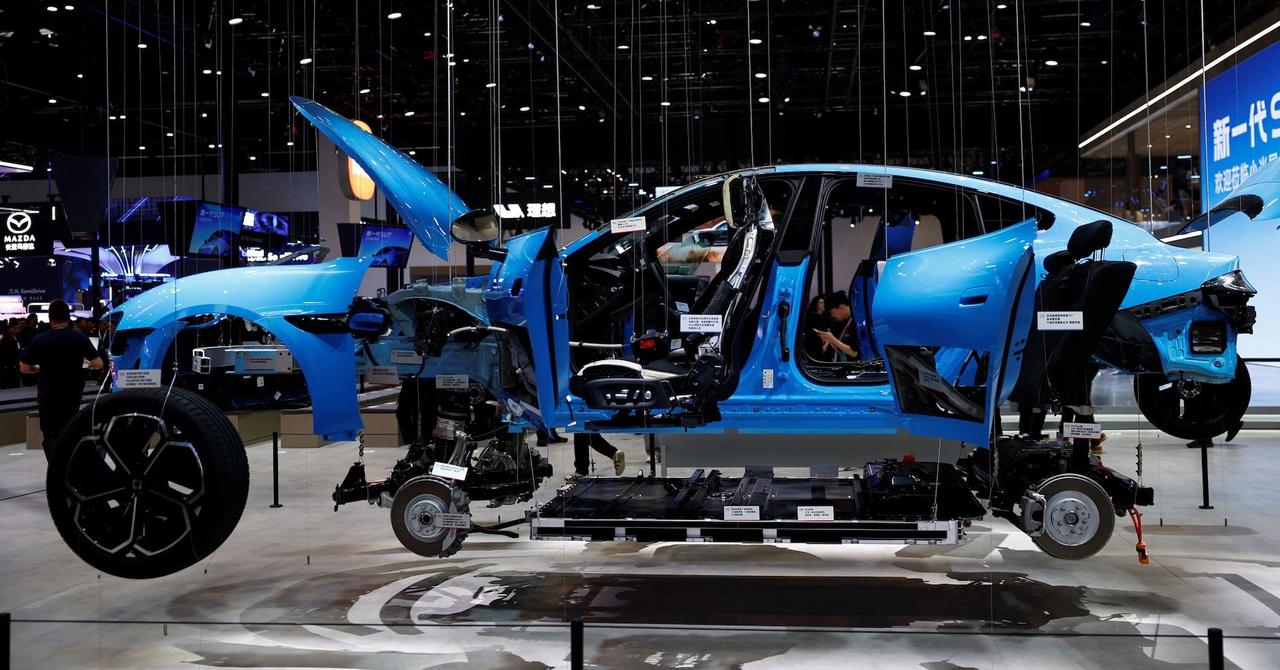
The China auto industry is undergoing a dramatic transformation as Chinese automakers race to embed artificial intelligence into vehicles, driven by Beijing's ambitious AI Plus initiative. At the Beijing auto show that opened Friday, more than 1,450 vehicles were on display, showcasing how the country that took 25 years to dominate electric vehicles is now hurtling toward making cars self-reasoning machines running on Chinese chips and software
1
.
Source: AP
China's five-year plan released earlier this year presented a blueprint for AI Plus, a national project to embed AI systems into manufacturing, healthcare, and almost every corner of the economy. Part of that aim is to break China's dependence on high-end semiconductors, a trade chokepoint dominated by the U.S.
1
. "There's no longer a distinction between a technology company and a car company," Nissan Motor China chief Stephen Ma told reporters, adding that "the AI-developed vehicle is much faster and it's quicker in China"1
.Xpeng unveiled its updated AI model that allows drivers to give cars commands like "park near the entrance to the shopping center" rather than designating a spot on a map, with vehicles using cameras to navigate even without mapping or coordinates
1
. The company's latest GX model, a six-seater SUV, features intelligent driving systems that can detect when drivers fall asleep or feel unwell, automatically pulling over and alerting emergency services3
.Xiaomi, an appliance and phone maker that entered the EV business three years ago, released an updated AI model just after midnight Thursday. The company's AI-empowered HyperOS operating system allows drivers to task the system with complicated to-do lists, making restaurant reservations, placing coffee orders, and compiling notes from the road. The system can also detect when drivers seem stressed or agitated and adjust the lighting and music for their arrival at home
1
.Huawei, which has pivoted from telecommunications to develop businesses in chips, artificial intelligence, and connected cars, announced it would invest more than $10 billion over the next five years to boost computing power for smart driving technology
1
. While automotive sales make up a relatively small part of Huawei's portfolio, it remains the company's fastest-growing segment1
.Horizon Robotics, a Chinese chipmaker competing with Qualcomm, launched its Starry 6 processor that integrates cockpit and driving functions with the ability to handle up to 12 screen displays in a vehicle
1
. The Yijing X9, a joint venture between Dongfeng Motor Corp. and Huawei, showcased a next-generation Qiankun intelligent driving system and a new HarmonyOS cockpit developed by Huawei3
.
Source: Reuters
In China's cut-throat domestic market, nearly every major carmaker is investing heavily in the software and computing power needed to make hands-free autonomous driving a reality as they compete to offer additional perks and find new ways to generate revenue
4
. "The fact that almost every automaker has some version of intelligent driving makes it different to almost any market in the world," said Tu Le, managing director of Sino Auto Insights4
.Foreign automakers are partnering with Chinese tech firms to compete. Cadillac announced its first car with advanced driver-assist systems for China, the VISTIQ, priced at 468,000 yuan ($68,000) and 508,800 yuan, using technology co-developed with Chinese autonomous driving startup Momenta
2
. Hyundai's new IONIQ V also features advanced driver-assist co-developed with Momenta and offers voice-control functions using an AI assistant running on a Qualcomm Snapdragon 8295 chipset2
.Related Stories
Despite the technological advances, domestic demand has weakened. Sales of passenger cars in China dropped 23% in the January-March quarter from a year earlier to around 4 million vehicles, as the government scaled back subsidies for EVs and plug-in hybrids
5
. However, exports jumped 63% to almost 2 million vehicles as Chinese cars made inroads in Europe, Southeast Asia, and Latin America5
.BYD, the leader of China's EV technology sector, showcased its new generation of fast charging "blade" battery, which can achieve a near full charge in nine minutes
3
. Battery giant CATL unveiled a new version of its "Shenxing" battery that can charge from 10% to 98% in only about six-and-a-half minutes3
.The hypercompetitive Chinese market has pulled vehicle prices down by a fifth over the past two years, according to AlixPartners
5
. Foreign brands have struggled to maintain market share, with Hyundai's China sales falling from 17% to 4% of total sales, Nissan down 47% compared to March 2019, and Cadillac declining 39%2
.Analysts suggest the auto show demonstrates the "speed and aggressiveness of advancement" among Chinese automakers, reinforcing that China is setting the pace in EVs, batteries, and intelligent driving
5
. While few of the new technologies may be exported to overseas markets in the short term due to regulatory and safety challenges, they signal capabilities that can be refined and adapted for global markets over time5
.Geely announced plans to deploy thousands of robotaxi vehicles globally next year through its ride-hailing arm Caocao, competing with U.S. firms like Waymo
4
. Chinese robotaxis are expected on London streets this year as Lyft and Uber announced partnerships with Baidu to use its self-driving software4
. Omdia forecasts China's passenger vehicle auto exports will grow by around 14% year-on-year in 20265
.Summarized by
Navi
[3]
18 Nov 2024•Technology

27 Apr 2025•Technology

22 Apr 2025•Business and Economy

1
Technology

2
Science and Research

3
Technology