4 Sources
[1]
Chip stocks hit rocky patch. What's next?
July 13 (Reuters) - The rough start for U.S. chip stocks in July likely points to further volatility as investors wrestle with high valuations and questions about the longevity of the AI capex boom. The Philadelphia Semiconductor index (.SOX), opens new tab has shed more than 11% since hitting a record high in June. The index is still up 83% this year, a fact that looms large in discussions of what comes next. These firms have enjoyed massive profit growth thanks to rising prices and supply-demand imbalances, but markets are nothing if not forward looking. "We've never seen this kind of extreme earnings growth. But the question then becomes, how long can we expect this to continue," Steve Sosnick, chief market analyst at Interactive Brokers, said. Here's a look at some charts as traders weigh if the chip rally has more to go: SUGAR RUSH FADES Funds tracking U.S. semiconductor stocks clocked outflows of around $11 billion in the week ended June 24, the biggest weekly outflow this century, according to LSEG Lipper data. Sentiment on the sector has been just as volatile as performance recently. The funds recorded inflows of around $12 billion in the previous two weeks. Analysts generally expect hyperscaler capex spending will remain high, with much of the anxiety about these stocks driven by what-if scenarios involving stock declines and capex cuts. Global cloud and AI infrastructure capital expenditure is expected to approach $1.5 trillion by 2027, a 40% to 50% jump year-over-year, according to a BofA Securities note this week. BULLISH BROKER VIEWS U.S. brokerages have bumped up their price targets, driven by expectations that insatiable AI demand will support earnings growth. Among the S&P 500 chipmakers, Micron (MU.O), opens new tab has the highest expected upside -- reflecting its current price vis-à-vis its consensus analyst target -- of more than 60%. Memory chipmaker Sandisk's shares (SNDK.O), opens new tab are expected to rise over 30%, based on LSEG data. Soaring memory prices due to tight supplies have boosted memory chip companies across the globe including SK Hynix (000660.KS), opens new tab, which jumped more than 10% in its U.S. trading debut on Friday following a $26.5 billion share sale. Nvidia's shares are expected to climb over 40%. But other big semiconductor companies are trading around their median 12-month price target, indicating much of the upside may be priced in. "I consider elevated price targets to be rather a consequence of the incredible momentum in semis rather than a reliable indicator of future performance," said Alexander Lis, chief investment officer at SD Ventures. BEARS CREEP BACK Data analytics company ORTEX said that bets against major semiconductor companies have been piling up over the past year and short interest now stands at a three-year high. "This is caution and hedging creeping back into the sector after a huge run, not the kind of crowded, high-conviction shorting that leads to squeezes," said Peter Hillerberg, co-founder at ORTEX. Short interest in the stocks has nearly doubled on average over the past three years, Hillerberg said, with that on Marvell (MRVL.O), opens new tab, Qualcomm (QCOM.O), opens new tab and Micron rising the most. EARNINGS TEST Earnings for companies on the S&P 1500 Semiconductors & Equipment Industry index (.SPCOMTKSM), opens new tab are expected to more than double this year, LSEG-compiled data showed, driven largely by Micron and Nvidia. However, the growth is seen moderating in 2027, with profits expected to rise 46.1%, the data showed. Uncertainty about the U.S. interest rate path and the Middle East conflict could also cast a shadow on earnings estimates. MIND THE VALUATION TRAP Nvidia, which has been at the heart of the AI rally, trades at a forward-looking price-to-earnings ratio of about 19, its lowest in more than 10 years. Micron's forward P/E touched a nine-year low of 5.4 in May. "The valuations have gotten cheaper over the last two years, and that's primarily a function of earnings growing faster than the price," said Chris Maxey, chief market strategist at Wealthspire Advisors. But forward P/E ratios for Intel (INTC.O), opens new tab, Advanced Micro Devices (AMD.O), opens new tab and Marvell Technology stand way above their longer-term averages, implying earnings expectations aren't catching up fast enough -- and potentially turning investor focus back to the commodity nature of chipmakers, particularly memory chips. "It's impossible to argue that the cyclicality of the sector will go away. I think the cycle will just get a lot longer," said Marija Veitmane, head of equity research at State Street Global Markets. Reporting by Johann M Cherian, Shashwat Chauhan, Sruthi Shankar and Medha Singh in Bengaluru, editing by Colin Barr and Mrigank Dhaniwala Our Standards: The Thomson Reuters Trust Principles., opens new tab
[2]
Market Warp :The AI Trade Enters the Eye of the Storm
The AI supercycle may not be over, but its honeymoon certainly is. Takeaways * The AI trade has entered the eye of the storm. Price action has turned violent, but the industry's underlying earnings and demand story remains largely intact. * The market is shifting from narrative to proof. Investors are no longer rewarding AI spending alone -- they want evidence that billions in capex will translate into sustainable profits and cash flow. * China is becoming the next competitive fault line. As Chinese memory producers scale up, the greatest pressure is likely to emerge in commoditised chips rather than the cutting edge of AI hardware. * The easy money has been made. The next phase of the AI cycle will reward execution over excitement, separating companies with durable economic moats from those that merely rode the boom. The Eye of the Storm Only a few weeks ago, semiconductors looked like the market's one-way express train. Every dip found another passenger, every earnings beat added another carriage, and every AI headline convinced investors the track could run forever. Now the same train is shaking hard enough to empty the dining car. South Korea has moved directly into the eye of the storm. The KOSPI collapsed 9%, triggering another trading halt, while SK Hynix (NASDAQ:SKHY) suffered a record 15% fall and Samsung Electronics dropped almost 11%. Japan's Kioxia was dragged into the downdraft as the memory complex absorbed another brutal wave of selling. Renewed US-Iran hostilities and the jump in oil provided the latest excuse to reduce risk, but geopolitics merely struck the match. The timber inside the semiconductor trade had been drying for weeks. Positioning was crowded, expectations were towering, and investors had started questioning whether the staggering sums being poured into AI infrastructure could produce returns quickly enough to justify the price already paid. Yet the violence in the share prices should not be confused with a collapse in the underlying business. The foundries are still humming. Data centres are still rising from the ground. Hyperscalers are still writing enormous cheques, while the largest semiconductor companies are expected to generate rivers of cash over the coming year. The storm is tearing through the stock market, but the factories have not lost power and the order books have not yet received the recession memo. That is the tension sitting at the heart of the selloff. Price has broken first, while the fundamental engine continues to turn. Markets often begin dismantling the scaffolding before anyone finds a serious crack in the building. But another fault line has opened beneath the memory trade. China is no longer simply part of the demand story. It is becoming a competitive threat. ChangXin Memory Technologies is preparing for its initial public offering, drawing fresh attention to China's growing ambitions in DRAM. At the advanced end of the market, the castle walls remain relatively high. Manufacturing is complex, customer approval takes time, and the largest AI buyers cannot afford unreliable supply. Commodity memory is another battlefield altogether. It has always been a business where today's shortage becomes tomorrow's glut and where every period of exceptional profit attracts another factory through the gate. Chinese producers have the capital, policy support and patience to attack that weaker flank. The established memory companies may still control the commanding heights, but the moat around the broader business is beginning to look less like a fortress and more like a sandbank at low tide. It remains visible, but the water is moving. This makes the current shakeout more complex than a simple correction in an overheated AI trade. Investors are facing two storms at once: uncertainty about the eventual return on AI spending and the prospect of Chinese capacity pressuring the industry's most commoditized products. The AI supercycle may not be over, but its honeymoon certainly is. The dreamers built the story, the momentum crowd pushed it into the clouds, and now the accountants have arrived carrying measuring tapes. The next phase will not reward every company simply because it owns a cleanroom and mentions AI on an earnings call. The market has stopped paying for blueprints. It wants occupied buildings, rental income and proof that silicon, electricity and ambition can be turned into durable profits. The storm has arrived. The machines are still running, but the market is no longer handing out umbrellas for free. Tech Supply Chain Daily: SK Hynix Has Become the AI Money Tree SK Hynix has become one of the clearest financial winners of the global AI buildout. Its grip on high-bandwidth memory, the specialist chips paired with Nvidia's processors, has turned the company into the most valuable piece of South Korea's technology supply chain and one of the most important pressure points in the entire AI investment cycle. The numbers explain the enthusiasm. With advanced memory supply expected to remain tight into 2027, SK Hynix is forecast to generate more than $300 billion in free cash flow across this year and next, comfortably ahead of Micron. That cash machine helped support a record $26.5 billion US share sale and elevated the company into the trillion-dollar club. The problem with becoming the market's golden goose is that everyone eventually wants an egg. South Korea's government sees SK Hynix as a tool for reviving investment, rebuilding industrial confidence and spreading semiconductor development beyond the established manufacturing belt south of Seoul. Washington wants more capacity built in the US. Investors want rising profits and capital returns, while households increasingly see the stock as a national wealth vehicle. Those demands are beginning to collide. SK Hynix has committed to doubling wafer capacity within five years and is considering investments far beyond the $35 billion it has already deployed in the US. Yet the company is not expanding alone. Samsung is building additional high-bandwidth memory capacity, Micron is increasing US spending and China's ChangXin Memory is emerging as a more credible competitive threat. The result could be a familiar semiconductor trap. Today's shortage encourages every producer to build at the same time. Several years later, that capacity arrives together, turning scarcity into oversupply just as demand begins to cool. Management believes the memory shortage could persist beyond 2030, but investors should remember how quickly this industry turns. SK Hynix is enjoying record profitability now, yet it was losing money only three years ago. Memory remains one of technology's most cyclical businesses, capable of moving from peak pricing to painful inventory correction within a couple of years. That cycle matters because the shareholder base has changed. South Korean retail investors have piled into the stock while global institutions sold into the rally. Many have also chased leveraged exchange-traded funds launched just as volatility began to rise, leaving them exposed not only to price declines but to the slow erosion caused by volatility decay. This turns SK Hynix into more than a semiconductor story. It is now a test of whether the AI supply chain can keep converting extraordinary demand into durable returns without repeating the industry's old boom-and-bust script. The company must satisfy governments seeking factories, investors demanding discipline and households betting that one stock can become a national pension plan. That is a heavy burden for any business, particularly one operating in a market where yesterday's shortage can become tomorrow's glut. SK Hynix has become the AI money tree. The difficult part is making sure the next wave of spending produces more fruit rather than too many branches.
[3]
AI Jitters Return as Chip Stocks Tumble Across Globe -- Update
Jitters around artificial-intelligence chip stocks returned Monday, as a sharp decline for SK Hynix in Korea heralded a global slide in the sector. In the U.S., Sandisk slid north of 8%, while Micron Technology lost 5%. Intel dropped 4.1%. The tech-heavy Nasdaq is nearly 1% lower. European chip stocks pared some losses as the morning progressed, but remained sharply lower. Chip makers Infineon Technologies and STMicroelectronics were down 4% and 1.8%, respectively, while Dutch suppliers to semiconductor makers also dropped. ASML, which makes semiconductor-printing machines and is the most valuable company in Europe, fell 2.5%. BE Semiconductor was down 4%. Declines in Europe and the U.S. came after a torrid day for chip makers in Korea. SK Hynix's Seoul-listed shares tumbled over 15% following its historic U.S. trading debut on Friday, with New York-traded depository receipts down around 6%. Despite the sharp move, there was no clear trigger for SK Hynix's fall, Raymond James's head of equity research, Amish Patel, said. "My read is that this was primarily a positioning and sentiment-driven move rather than a reaction to any material change in fundamentals," Patel said. Tumbling memory chip stocks are less a reflection of concerns around the build out of artificial intelligence, and more a product of investors pulling back from crowded bets on a small number of chip makers, according to Helen Jewell, BlackRock's international CIO for fundamental equities. Memory stocks like SK Hynix and Micron have seen huge swings in their share price in recent days. Some market watchers have sounded warnings about the use of leverage to bet on single stocks. But the bigger problem, Jewell said, is crowding. "The reason the swings are more extreme than normal is because the crowdedness is so extreme, because the returns have been so extreme," Jewell said. The fresh round of selling extends a volatile period for memory stocks. Investors are debating whether demand for memory chips is nearing a peak, or whether the rapid buildout of AI capacity will mean hyperscalers are willing to pay high chip prices for longer into the future. Chip stocks have seen a rapid run-up in value so far this year--the PHLX Semiconductor Index was up around 83% for the year to Friday's close--and some investors are choosing to cash out, resulting in wild swings in the index in recent weeks. The huge returns for memory chip are because "AI demand has somehow created the perception that a sector historically defined by boom-and-bust cycles could remain permanently in the boom phase," Swissquote senior analyst Ipek Ozkardeskaya wrote in a client note. "Volatility in memory chip prices remains far too high to call the current price action sustainable." Even without market-moving news, changes in sentiment can lead to wild price swings because of the wide-scale participation of leveraged traders, Global X ETFs investment strategist Andrew Ye said. "The challenge is trying to reconcile the long-term outlook and the short-term," with investors weighing complicated questions around the durability of demand for memory chips against the vagaries of a sentiment-driven market, Ye said. Monday's wobble comes ahead of earnings for key players in global AI supply chains this week. Taiwan Semiconductor Manufacturing Co. reports second-quarter earnings Thursday after the company notched a 6.2% on-month rise in revenue for June. ASML will report earnings Wednesday.
[4]
AI Jitters Return as Chip Stocks Tumble Across Globe
Jitters around artificial-intelligence chip stocks returned Monday, as a sharp decline for SK Hynix in Korea heralded a global slide in the sector. In U.S. premarket trade, Sandisk slid 6.8%, while Micron Technology lost 5.3%. Intel dropped 2.8%. Futures for the tech-heavy Nasdaq were 1% lower in early afternoon European trade. European chip stocks pared some losses as the morning progressed, but remained sharply lower. Chip makers Infineon Technologies and STMicroelectronics were down 1.6% and 1%, respectively, while Dutch suppliers to semiconductor makers also dropped. ASML, which makes semiconductor-printing machines and is the most valuable company in Europe, fell 1.3%. BE Semiconductor was down 2.1%. Declines in Europe and the U.S. came after a torrid day for chip makers in Korea. SK Hynix's Seoul-listed shares tumbled over 15% following its historic U.S. trading debut on Friday, with New York-traded depository receipts down around 9%. Despite the sharp move, there was no clear trigger for SK Hynix's fall, Raymond James's head of equity research, Amish Patel, said. "My read is that this was primarily a positioning and sentiment-driven move rather than a reaction to any material change in fundamentals," Patel said. The fresh round of selling extends a volatile period for memory stocks. Investors are debating whether demand for memory chips is nearing a peak, or whether the rapid buildout of AI capacity will mean hyperscalers are willing to pay high chip prices for longer into the future. Chip stocks have seen a rapid run-up in value so far this year--the PHLX Semiconductor Index was up around 83% for the year to Friday's close--and some investors are choosing to cash out, resulting in wild swings in the index in recent weeks. The huge returns for memory chip are because "AI demand has somehow created the perception that a sector historically defined by boom-and-bust cycles could remain permanently in the boom phase," Swissquote senior analyst Ipek Ozkardeskaya wrote in a client note. "Volatility in memory chip prices remains far too high to call the current price action sustainable." Even without market-moving news, changes in sentiment can lead to wild price swings because of the wide-scale participation of leveraged traders, Global X ETFs investment strategist Andrew Ye said. "The challenge is trying to reconcile the long-term outlook and the short-term," with investors weighing complicated questions around the durability of demand for memory chips against the vagaries of a sentiment-driven market, Ye said. Monday's wobble comes ahead of earnings for key players in global AI supply chains this week. Taiwan Semiconductor Manufacturing Co. reports second-quarter earnings Thursday after the company notched a 6.2% on-month rise in revenue for June. ASML will report earnings Wednesday.
Share
Copy Link
Global chip stocks experienced sharp declines as SK Hynix plunged 15% and the Philadelphia Semiconductor index shed over 11% since June. Despite the turbulence, analysts note AI infrastructure spending remains strong, with capital expenditure expected to reach $1.5 trillion by 2027. The selloff reflects investor concerns about high valuations and proof of returns rather than fundamental business weakness.
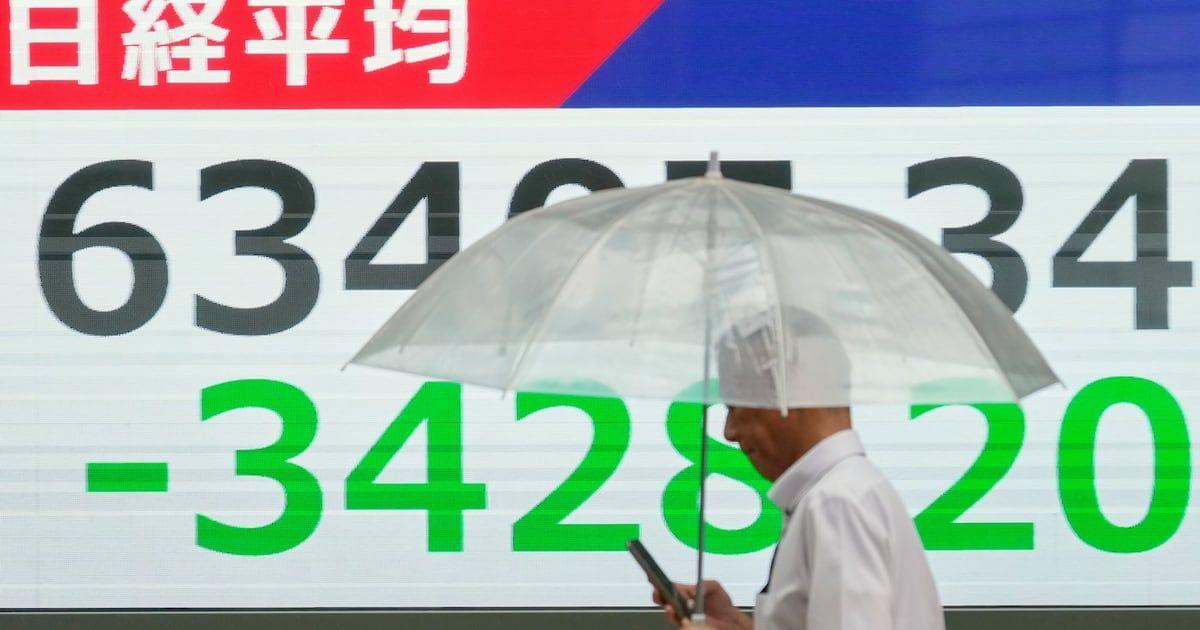
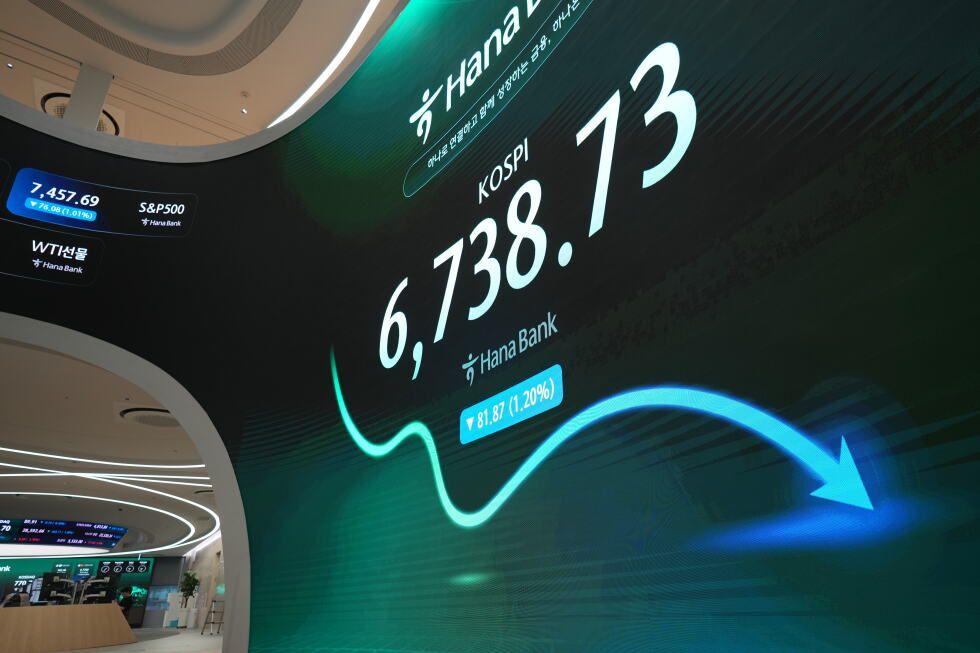
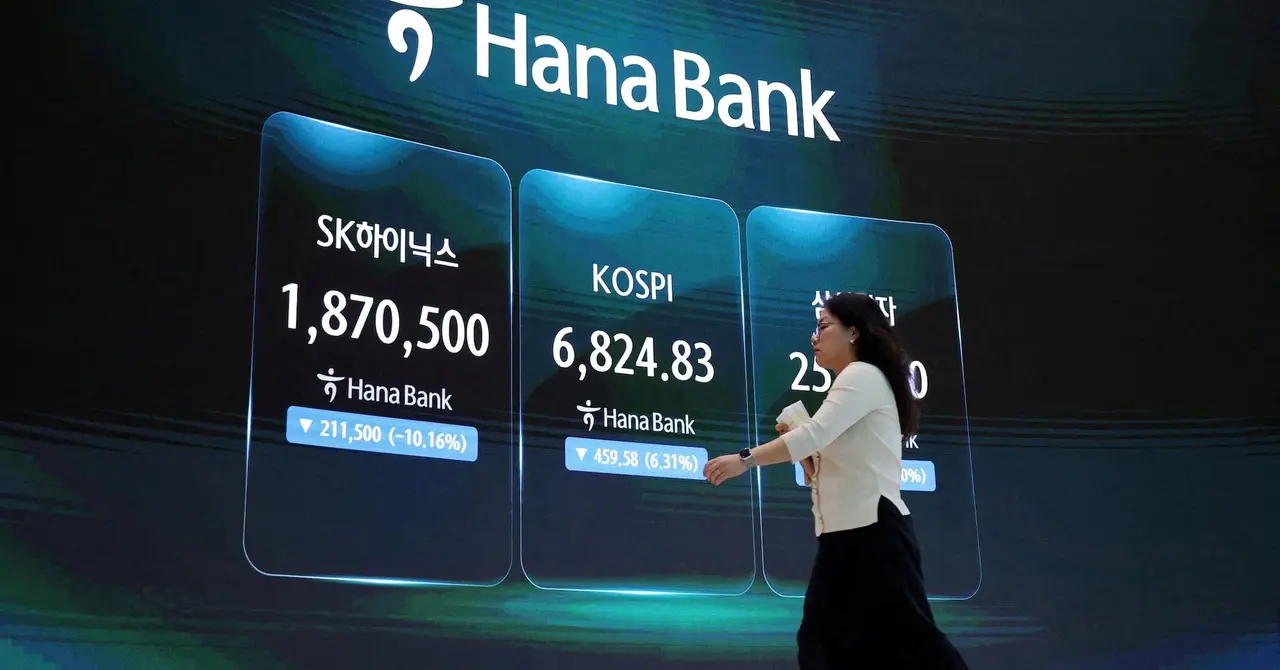
Global chip stocks entered a period of intense market volatility in July, with the Philadelphia Semiconductor index shedding more than 11% since hitting a record high in June
1
. The selloff began in South Korea, where SK Hynix suffered a record 15% fall following its historic U.S. trading debut, triggering a cascade across international markets3
. In the U.S., Sandisk dropped more than 8%, while Micron lost 5% and Intel fell 4.1%3
. European semiconductor market participants also felt the pressure, with ASML declining 2.5% and Infineon Technologies down 4%3
.The volatility in U.S. chip stocks reflects a dramatic shift in investor sentiment rather than deteriorating business fundamentals. Funds tracking U.S. semiconductor stocks recorded outflows of around $11 billion in the week ended June 24, marking the biggest weekly outflow this century
1
. Raymond James's head of equity research, Amish Patel, noted there was no clear trigger for the decline, describing it as "primarily a positioning and sentiment-driven move rather than a reaction to any material change in fundamentals"3
. BlackRock's Helen Jewell attributed the extreme swings to crowded positioning, explaining that "the reason the swings are more extreme than normal is because the crowdedness is so extreme, because the returns have been so extreme"3
.Despite the turbulence in AI-related semiconductor stocks, the underlying AI demand story remains largely intact. Global cloud and AI infrastructure capital expenditure is expected to approach $1.5 trillion by 2027, representing a 40% to 50% jump year-over-year
1
. Analysts generally expect hyperscaler capex spending will remain high, with much of the anxiety driven by what-if scenarios rather than actual spending cuts1
. The AI trade has shifted from narrative to proof, as investors now demand evidence that billions in capital expenditure will translate into sustainable profits and cash flow2
.The semiconductor market faces questions about whether current high valuations can be justified. Despite the index still being up 83% for the year, investors are wrestling with extreme earnings growth expectations
1
. Steve Sosnick, chief market analyst at Interactive Brokers, noted, "We've never seen this kind of extreme earnings growth. But the question then becomes, how long can we expect this to continue"1
. Memory chip cycles present particular challenges, as Swissquote senior analyst Ipek Ozkardeskaya observed that "AI demand has somehow created the perception that a sector historically defined by boom-and-bust cycles could remain permanently in the boom phase"4
.Related Stories
A new competitive fault line has emerged as China advances in memory production. ChangXin Memory Technologies is preparing for its initial public offering, drawing attention to China's growing ambitions in DRAM
2
. While advanced AI hardware remains protected by complex manufacturing processes, commodity memory faces greater pressure as Chinese producers gain scale with capital, policy support, and patience2
. This development adds another layer of uncertainty to the sector's outlook.Earnings reports from key players including TSMC and ASML are expected to provide clarity on the sector's trajectory
3
. Earnings for companies on the S&P 1500 Semiconductors & Equipment Industry index are expected to more than double this year, driven largely by Micron and Nvidia, though growth is seen moderating in 2027 to 46.1%1
. Geopolitical risks, including renewed U.S.-Iran hostilities and uncertainty about interest rate paths, add further complexity to the outlook2
. Short interest in major semiconductor companies has reached a three-year high, with bets against the sector nearly doubling over the past three years1
. The market has stopped rewarding AI spending alone and now demands occupied buildings, rental income, and proof that silicon and ambition can generate durable profits2
.Summarized by
Navi
[1]
[2]
[3]
[4]
06 Jul 2026•Business and Economy

04 Sept 2024

23 Jun 2026•Business and Economy

1
Technology

2
Policy and Regulation

3
Technology