Cisco and OpenAI want software to defend itself before patches arrive


3 Sources
[1]
OpenAI and Cisco Unveil AI-Assisted Linux Security Tool to Block Exploits Before Patching
OpenAI and Cisco have teamed up to launch Shirudo (meaning "shield" in Japanese), an open-source Linux runtime that allows artificial intelligence (AI) agents to defend systems without downtime. "It lets agents write dynamic eBPF controls to shield systems from exploits, giving defenders more time
[2]
Cisco and OpenAI launch Shirudo open-source infrastructure shield to prevent AI-driven cyberattacks
Cybercriminals have gained the ability to discover vulnerabilities in software and take advantage of them in seconds, and it's all thanks to artificial intelligence. Enterprises need a better way to defend themselves, so it's fitting that one of the world's top AI companies, OpenAI Group PBC,
[3]
OpenAI, Cisco Launch Open-Source Security Tool in Wake of Outages
Shirudo uses temporary safeguards to block exploits while allowing legitimate requests through, without taking services offline. OpenAI and Cisco have introduced Shirudo, an open-source security tool that protects running Linux systems from vulnerabilities without requiring software updates or
Share
Copy Link
OpenAI and Cisco have launched Shirudo, an open-source security tool for Linux that lets AI agents block exploits on running systems without a restart or any downtime
2
1
3
. It is the first project under a broader effort the two companies call the Secure Infrastructure Project, which they describe as an attempt to make AI computing infrastructure secure by design2
1
.
Source: SiliconANGLE
The reason, the companies say, is that AI has flipped the usual race between attackers and defenders. Cisco Security CTO Thomas Graf claims the mean time to exploitation has gone negative, meaning some vulnerabilities are now exploited before they are publicly disclosed
2
1
. Fixing a serious flaw in widely used software and getting it onto every affected system still takes days, weeks or sometimes months, a window he says is no longer acceptable2
1
3
. The companies claim AI models have become good at finding and exploiting software flaws, and that they improve with every generation2
1
. The same technology driving that speedup is what they are now offering as the defense.How a shield works
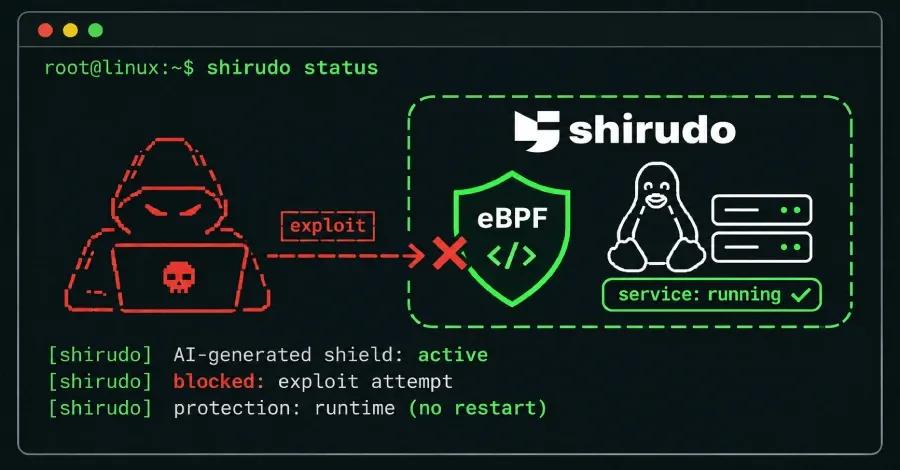
Shirudo is built on eBPF, a Linux kernel technology that runs small sandboxed programs inside the kernel, watching and changing application behavior without touching source code or rebooting
2
1
3
. It is an evolution of Tetragon, an eBPF security platform Cisco's Isovalent unit open-sourced in May 2022; the redesign for AI agents, which can inject code fixes on the fly, is the stated difference2
1
.
Source: Hacker News
Shields arrive as cryptographically signed packages, verified before loading, with a Trusted Platform Module keeping a hardware record of what has been added or removed
2
1
3
. Each one runs in monitoring mode first, so security teams can confirm it blocks exploit behavior without breaking legitimate requests, and people, not agents, decide what gets deployed1
3
.The companies demonstrated one shield, built with OpenAI's Codex coding agent, blocking the Java4Shell exploit against a running Elasticsearch service
2
1
3
. It injected bytecode that rejected malicious overwrites while the service stayed up2
1
3
. OpenAI says it already runs Shirudo in a Codex-powered control plane that can reproduce an exploit, design a mitigation and deploy signed shields across affected nodes2
.Built in the open
Graf argues security has long been treated as an afterthought, workable only while workflows ran at human speed
2
. The companies say no real alternative to eBPF exists for agent-speed defense, since human-focused consoles and policy languages are too slow for the agents and would limit their productivity2
. Cisco President and Chief Product Officer Jeetu Patel put the ambition plainly: "We need self-defending infrastructure that acts at the speed of code, learns in real time and shields itself until patches are safely rolled out."2
Because so many teams run the same software, he argued, the tools should be built in the open so improvements are shared
3
. The code is out under the Berkeley Software Distribution two-clause licence, with the eBPF programs dual-licensed under that licence and the GNU General Public License2
3
. The companies are inviting developers, kernel engineers and security researchers to contribute2
3
. Longer term, they describe plans for hardening Linux kernels, limiting workload permissions and helping systems recover after breaches3
.The evidence so far is one company-run demonstration, with no independent testing reported
2
1
. The companies themselves frame the tool as a stopgap: shields buy time, people approve them, and the real fix is still the patch. "When one team finds a better way to protect a system, others shouldn't have to start from scratch."2
Related Stories

References
Summarized by

Navi
[1]
[2]
Related Stories
Cisco launches DefenseClaw and Zero Trust security to protect the agentic AI workforce
23 Mar 2026•Technology
Cisco scans 1.8 billion lines of code in 8 weeks using AI, overhauls vulnerability disclosures
02 Jun 2026•Technology

OpenAI Codex Security scans 1.2M commits, finds 792 critical software vulnerabilities
06 Mar 2026•Technology

Recent Highlights



Recent Highlights
Today's Top Stories





Don’t drown in AI news. We cut through the noise - filtering, ranking and summarizing the most important AI news, breakthroughs and research daily. Follow topics that matter to you and stay ahead.


