Cisco unveils Silicon One G300 chip to challenge Broadcom and Nvidia in AI networking race


8 Sources
[1]
Cisco unveils 102.4T Silicon One G300 switch chip
Switchzilla leans on P4 programmability and revamped congestion controls to differentiate its latest Silicon One ASIC As AI training and inference clusters grow larger, they require bigger, higher-bandwidth networks to feed them. With the introduction of the Silicon One G300 this week, Cisco now
[2]
Cisco unveils new AI networking chip, taking on Broadcom and Nvidia
SAN FRANCISCO, Feb 10 (Reuters) - Cisco Systems (CSCO.O), opens new tab on Tuesday launched a new chip and router designed to speed information through massive data centers that will compete against offerings from Broadcom (AVGO.O), opens new tab and Nvidia (NVDA.O), opens new tab for a piece of
[3]
Making the Case for Cisco N9000 for Front-End & Back-End Networks
Cisco has done significant work in the past year to upgrade its Nexus data center switching portfolio for the AI era. Cisco N9000 Series Switches have adopted the benefits to include operational resiliency, security, and management features needed to sustain the high demands of today's networking
[4]
Cisco launches 102.4Tbps networking to scale AI data centers
At Cisco Live EMEA in Amsterdam, the company introduced the Silicon One G300, a 102.4 terabits-per-second switching chip that will power new Cisco N9000 and Cisco 8000 data center systems. Cisco says the platform is built to support massive AI clusters running training, inference, and real-time
[5]

Cisco targets high-speed AI networking with 102.4Tbps chip, liquid-cooled switches - SiliconANGLE
Cisco targets high-speed AI networking with 102.4Tbps chip, liquid-cooled switches Cisco Systems Inc. today introduced a new generation of networking silicon, systems and optical modules aimed at supporting hyperscale-class artificial intelligence infrastructure as AI workloads shift from model
[6]

Cisco unveils new AI networking chip, taking on Broadcom and Nvidia
Cisco said its Silicon One G300 switch chip, expected to go on sale in the second half of the year, will help the chips that train and deliver AI systems talk to each other over hundreds of thousands of links. Cisco Systems on Tuesday launched a new chip and router designed to speed information
[7]

Cisco Reveals New Silicon One Offering, Enhanced Nexus One At Cisco Live EMEA
"We're still at the early stages of AI buildouts. ... Cisco's here to be able to help [enterprises] really get value out of these AI technologies,' Nick Kucharewski, Cisco Silicon One's senior vice president and general manager, tells CRN. Cisco Systems is making AI infrastructure buildouts
[8]

Cisco introduces AI networking chip
Cisco Systems (CSCO) unveiled a new networking chip aimed at speeding information through large data centers that will potentially compete against products from Broadcom (AVGO) and Nvidia (NVDA). Cisco said Silicon One G300 -- a 102.4 Terabit per second, or Tbps, switching silicon -- can
Share
Copy Link
Cisco launched its Silicon One G300, a 102.4Tbps switching chip designed to compete with Broadcom and Nvidia in the booming AI infrastructure market. The chip features advanced congestion management and can support deployments of up to 128,000 GPUs using just 750 switches. Cisco claims its implementation achieves 33% better link utilization and can cut training times by up to 28%.
Cisco Takes Aim at AI Networking with Silicon One G300
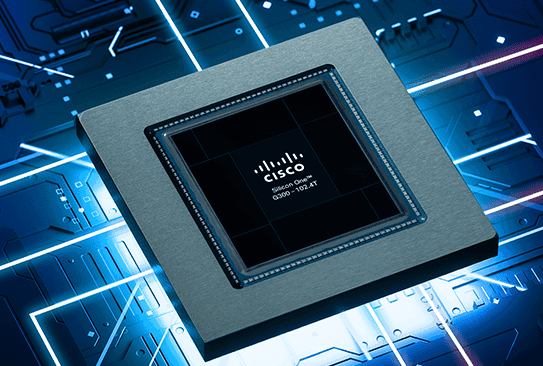
Cisco has entered the high-stakes competition for AI networking dominance with the introduction of its Silicon One G300, a 102.4Tbps networking chip unveiled at Cisco Live EMEA in Amsterdam
4
. The chip directly challenges offerings from Broadcom and Nvidia for a share of the $600 billion AI infrastructure spending boom2
. Expected to go on sale in the second half of the year, the G300 will power new Cisco N9000 and Cisco 8000 data center systems designed to support massive AI training and inference clusters running training, inference, and real-time agentic workloads4
.
Source: SiliconANGLE
The Silicon One G300 packs 512 ultra-fast 200 Gbps serializers/deserializers that can be aggregated to support port speeds of up to 1.6 Tbps
1
. This massive radix means Cisco can now support deployments of up to 128,000 GPUs using just 750 switches, where 2,500 were needed previously1
. The chip will be manufactured using Taiwan Semiconductor Manufacturing Co's 3-nanometer chipmaking technology2
.Advanced Congestion Management Drives GPU Utilization
What sets the G300 apart from competitors is its Intelligent Collective Networking engine, which features a fully shared packet buffer and path-based load balancing to mitigate network congestion
1
. According to Cisco fellow and SVP Rakesh Chopra, the lack of packet buffer segmentation allows packets to be absorbed irrespective of the port, enabling better handling of bursts in AI workloads1
. The load balancing agent monitors flows and congestion points, communicating with all other G300s in the network to build a global collective map of what is happening across the entire AI cluster1
.Cisco claims its implementation achieves 33% better link utilization and can cut training times by up to 28% compared to packet-spraying-based approaches used by Broadcom and Nvidia
1
. Martin Lund, executive vice president of Cisco's common hardware group, told Reuters that the chip expects to help some AI computing jobs get done 28% faster, in part by re-routing data around network problems automatically within microseconds2
. As data movement between GPUs now directly affects how fast AI jobs finish and how much compute capacity can be used, these efficiency gains matter significantly4
.P4 Programmability Extends Hardware Lifespan
The Silicon One G300 incorporates P4 programmability, allowing Cisco to reprogram the device to add new functionality and capabilities, deploying the same equipment in multiple different roles
1
. Chopra emphasized this is particularly valuable for extending the useful life of switches, as new features can often be added via software updates rather than requiring new hardware1
. This approach mirrors AMD's Pensando NICs strategy, which allowed the chip designer to start shipping Ultra Ethernet compatible NICs before the spec had been finalized1
.Sameh Boujelbene, vice president at Dell'Oro Group, noted that the G300 represents more than a typical incremental upgrade, as Cisco is pushing intelligence directly into switching silicon to address real pain points for large AI clusters like unpredictable east-west traffic and congestion hotspots
5
.Unified Management for Front-End and Back-End Networks
Cisco has emphasized operational resiliency across both front-end and back-end networks as critical for maximizing ROI on AI infrastructure
3
. Surbhi Paul, Director of Data Center Networking at Cisco, explained that the conversation has shifted from just bandwidth to determinism, noting that GPUs can stall with jitter and burn millions of dollars of capital expense if they sit idle for milliseconds3
. The N9000 Series includes crucial resiliency features including Priority-based Flow Control and Explicit Congestion Notification, which ensure AI training and inference operations can complete without dropping jobs3
.The Nexus Dashboard management platform provides centralized management with integrated observability features, real-time applications, and job monitoring to ensure operational resiliency across data center deployments
3
. Paul emphasized that to maximize ROI, organizations cannot treat front-end and back-end networks as islands, requiring a unified management platform to keep GPU idle time to zero3
.
Source: Cisco
Related Stories


Energy Efficiency Through Liquid Cooling and Advanced Optics
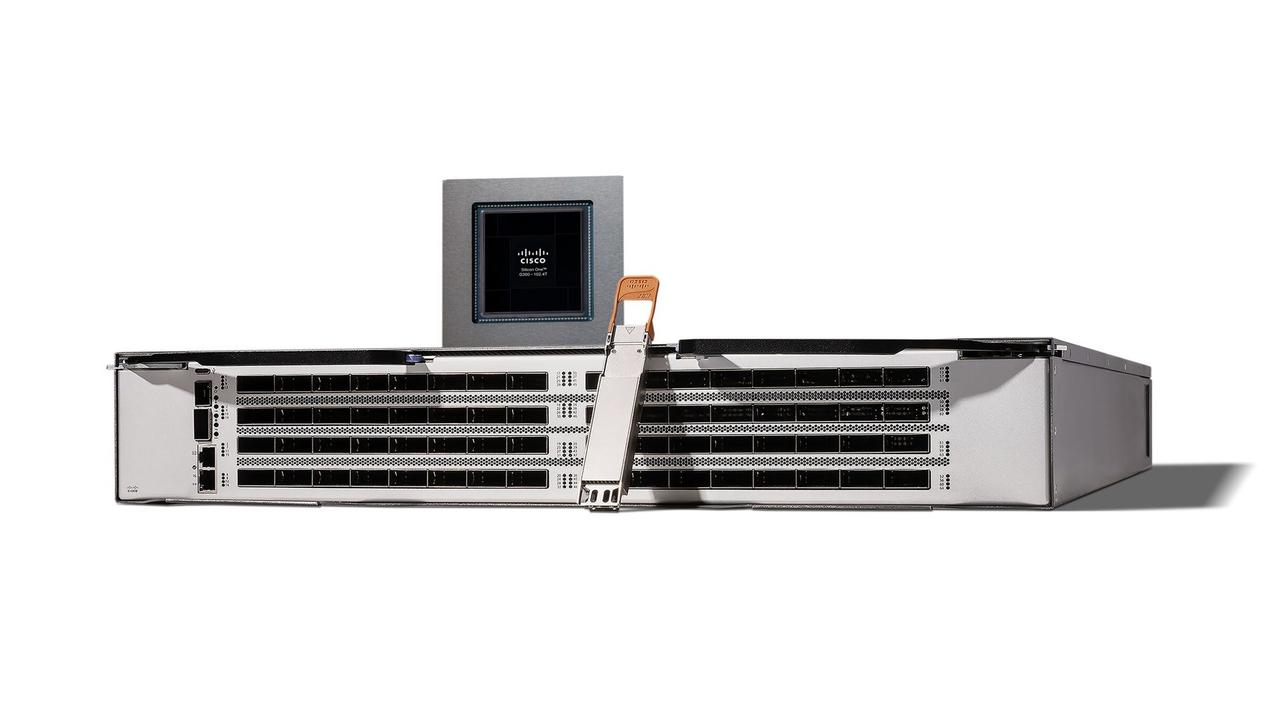
Alongside the silicon announcement, Cisco introduced new fixed and modular switching systems in its Nexus 9000 and Cisco 8000 product lines powered by the G300, available in both air-cooled and fully liquid-cooled designs
5
. The company claimed the liquid-cooled configuration can improve energy efficiency by nearly 70% compared with prior generations, delivering the same bandwidth that previously required six systems5
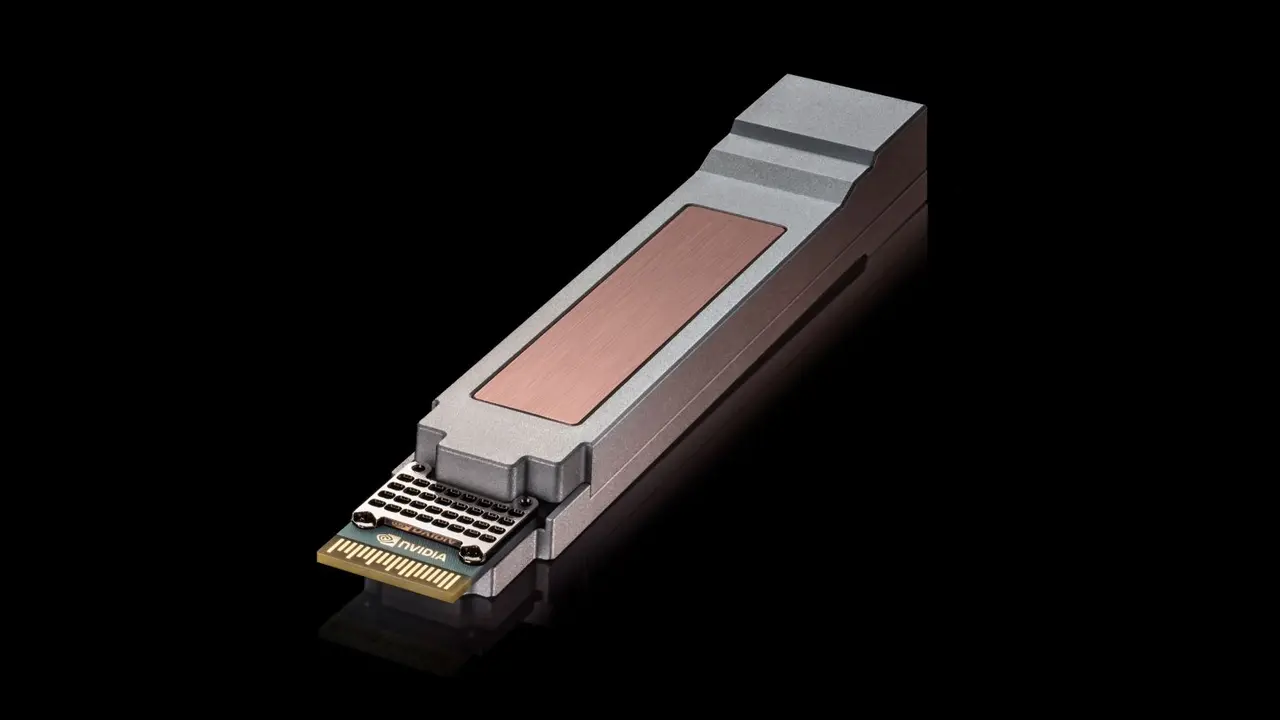
.To support these systems, Cisco is rolling out new 1.6 Tbps pluggable optics with 64 OSFP cages, which can be broken out into up to eight 200 Gbps connections
1
. The company also introduced 800 Gbps linear pluggable optics that ditch the onboard digital signal processor and retimer to cut power consumption by 50%, with overall switch power reduction of approximately 30%1
. These advances in pluggable optics become significant when considering how many may be deployed across a data center1
.
Source: Interesting Engineering
Market Shift Toward Enterprise and Inference Workloads
Kevin Wolterweber, senior vice president and general manager of Cisco's data center and internet infrastructure business, noted that the AI infrastructure market is shifting beyond hyperscale cloud providers
5
. The last two to three years focused mainly on building massive training clusters with hyperscalers, but now there's a shift toward agentic AI workloads and broader adoption within enterprise service providers5
. This expansion means enterprises, neocloud providers, and sovereign cloud operators are increasingly investing in their own AI clusters and require more efficient networking to support GPU-heavy workloads5
.As the G300 will compete directly with Broadcom in the merchant silicon arena in addition to powering Cisco's own networking appliances, the company is positioning itself to capture share across multiple customer segments
1
. With networking becoming a critical competitive field in AI—as evidenced by Nvidia unveiling a networking chip as one of six key chips in its newest systems—the stakes for scale AI data centers continue to rise2
.References
Summarized by

Navi
[1]
[4]
Related Stories
Recent Highlights
1
Microsoft and Nvidia Launch Surface Laptop Ultra: A $2,599 AI-Ready PC With RTX Spark Chip
Technology

2
Meta Muse AI Agent Surges to 6.6M Downloads Despite Privacy and Security Controversies
Technology

3
Scientists Build AI Model That Reconstructs Images From Brain Scans in Record Time
Science and Research

Recent Highlights
Today's Top Stories












Don’t drown in AI news. We cut through the noise - filtering, ranking and summarizing the most important AI news, breakthroughs and research daily. Follow topics that matter to you and stay ahead.


