3 Sources
[1]
Coherent Breaks Ground on Expanded Texas Facility, Scaling AI's Optical Backbone
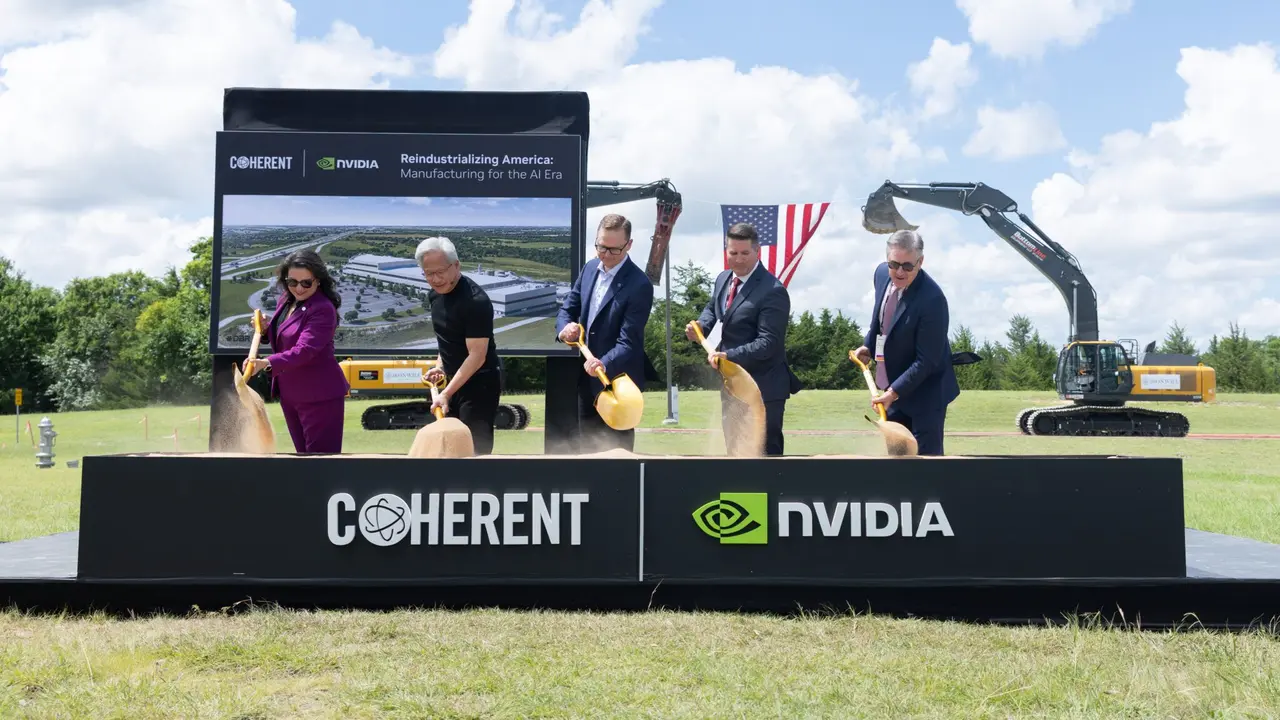
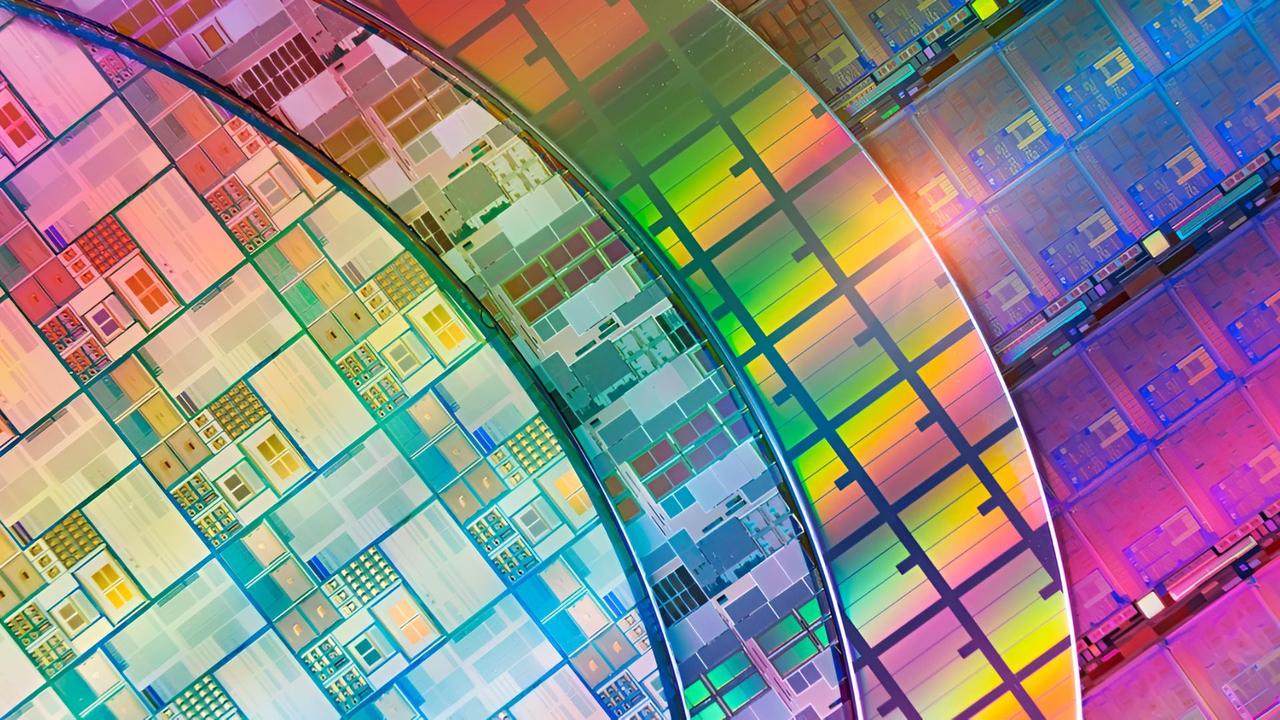
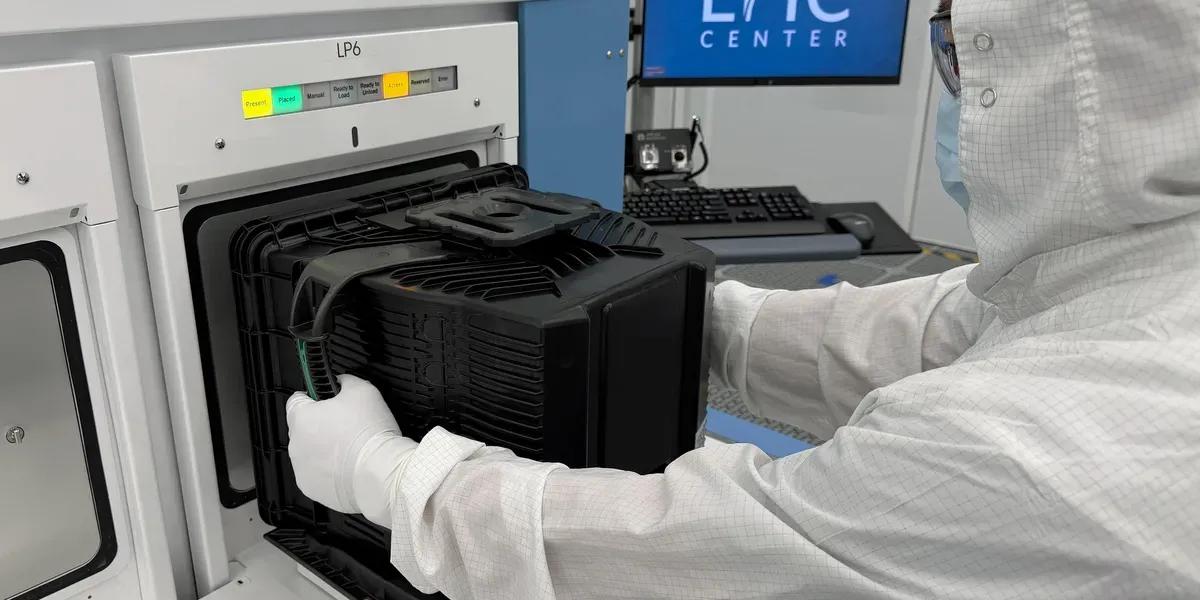
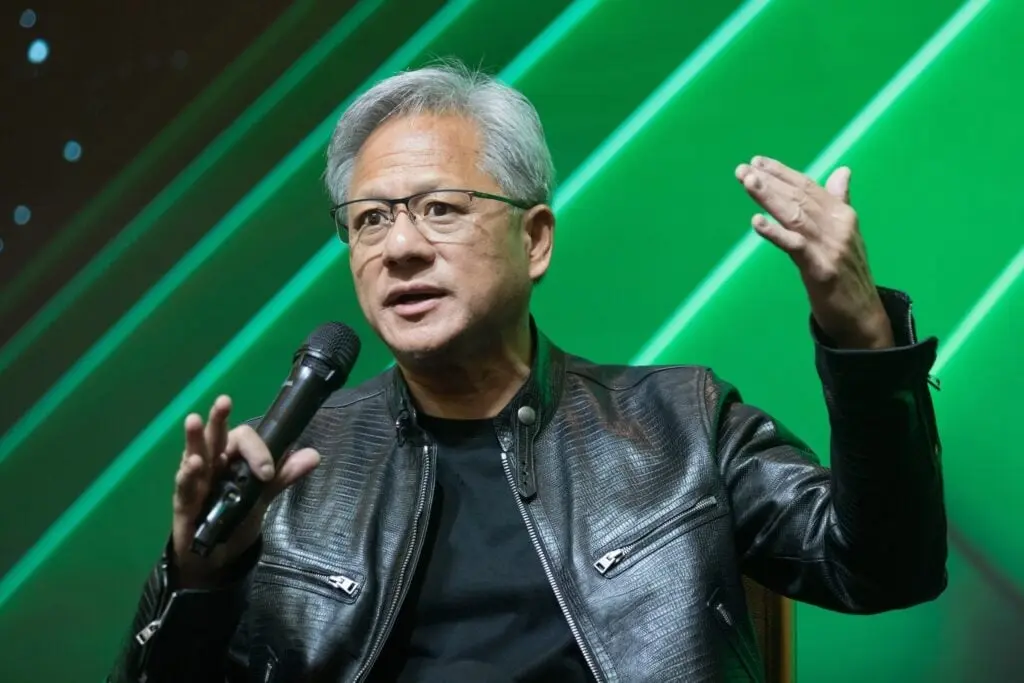
Coherent's second building at its Sherman, Texas, campus scales what it calls the world's first volume production 6-inch indium phosphide fab, a key supplier across NVIDIA's AI stack. AI runs at the speed of light. More and more, that light is made in Texas. Coherent broke ground today on an expanded manufacturing building in Sherman, Texas. The company makes the lasers, optical components and compound semiconductors that wire AI systems together -- and runs what it calls the world's first 6-inch indium phosphide fab. NVIDIA founder and CEO Jensen Huang and Coherent CEO Jim Anderson were on hand for the ceremony, joined by Sherman Mayor Shawn Temann and Adriana Cruz, executive director of Texas Economic Development and Tourism, who delivered remarks. The new building will scale production of the same InP wafers that carry data between chips, servers and data centers at the speed of light -- the optical backbone of modern AI infrastructure. It's the kind of milestone that turns a commitment into shovels in the dirt: a concrete step in expanding advanced semiconductor manufacturing in the United States. "AI is the ultimate general-purpose technology," Huang said. "Because intelligence is fundamental -- the ability to process information, to reason and solve problems -- it affects every single industry." Public programs like the CHIPS Act, funded at roughly $50 billion, were designed to bring chip manufacturing back to the U.S. As part of today's event, Coherent is announcing a $50 million CHIPS Act grant to help finance the new Sherman facility -- building on roughly $17 million in earlier support from the Texas CHIPS program and the Sherman Economic Development Corporation. NVIDIA's own commitment to produce up to $500 billion of AI infrastructure in the U.S. through industry partnerships with new sites in Arizona and Texas adds private-sector momentum. "Coherent is a world-class company, and the work you do is vital to our future, vital to the future of artificial intelligence and vital to reindustrializing the United States," Huang said during a conversation with Anderson at the groundbreaking. Compound semiconductors like indium phosphide and gallium arsenide -- the materials behind the high-speed networking and optical interconnects that modern AI runs on -- don't get the headlines that logic chips do. But their domestic supply chains have been thin for years. Today's event was an argument that the gap is closing. When 576 GPUs span eight racks and operate as a single system -- as they will in NVIDIA Vera Rubin Ultra NVL576, which links eight NVLink racks of 72 NVIDIA Rubin Ultra GPUs into one 576-GPU domain -- copper can't carry the signal across that distance. To connect hundreds of thousands of processors separated by hundreds or thousands of feet across a data center, the only way to solve that problem is silicon photonics, Huang explained. As signaling rates climb, the reach of a metal trace shrinks, and spanning eight racks in copper would burn power on retimers and signal conditioning that a data center would rather spend on compute. Optics pays a one-time penalty to move from electrical to light, but once paid, distance is nearly free. At NVL576 scale, light is the most power-efficient option. NVIDIA and Coherent aren't new to each other -- they've worked together for roughly two decades. In March, they deepened the relationship into a multiyear strategic partnership: NVIDIA is investing $2 billion in Coherent to support R&D, future capacity and U.S.-based manufacturing, alongside a multibillion-dollar purchase commitment for advanced laser and optical networking products. Sherman, a city of roughly 45,000 people an hour north of Dallas, has become the latest dateline for the AI era -- emblematic of a boom built as much on picks, shovels and manufacturing muscle as on software. "When we get to full capacity, this site will support more than 550 direct jobs -- and thousands of jobs, direct and indirect," Anderson said. What the factory ships isn't a single product dropped into a single slot. It's the lasers, transceivers and pluggable optical modules that move data across NVIDIA networking -- each enabling a different part of the system. "As AI systems grow larger and more powerful, connectivity is just as important as compute," Anderson said. "AI runs on compute, but it scales on connectivity -- and Sherman is where that connective tissue gets built." Today's event made that visible. Before the groundbreaking, guests toured the existing fab and previewed the equipment that will populate the new building once it's running. An NVIDIA rack stood on the factory floor, one of the six stops on the tour. The tour was followed by a fireside chat with Huang and Anderson, where the two CEOs discussed the partnership and what scaling domestic optical manufacturing means for the AI buildout ahead. "Today marks an important milestone -- not just for Coherent, but for American manufacturing and for the future of AI infrastructure," Anderson said. The semiconductor laser was born in U.S. labs -- Bell Labs demonstrated a room-temperature version in 1970 -- before the technology and its manufacturing largely migrated overseas. "We were founded as a manufacturing company in 1971. We've always been a U.S. manufacturing company -- and after 50 years, the most advanced 6-inch indium phosphide line in the world is right here in Sherman," Anderson said. That manufacturing gap shows up in the wafers themselves: while silicon fabs run on 12-inch wafers, most of the world's InP production is still stuck on 3- and 4-inch wafers -- lower yields and far fewer components per run. Moving to 6-inch wafers roughly quadruples the usable area of a 3-inch wafer (area scales with the square of the diameter), driving down cost and unlocking the volume the AI buildout demands. It took 50 years to build the first line, Huang said -- and in one year, they've quadrupled it, a measure of the demand for accelerated computing. Inside, the core processes are familiar: lithography, photoresist, depositing and etching materials, layer by layer. The difference is the material. On an InP substrate, engineers grow exotic compound-semiconductor layers and tune them for precise optical properties -- the physics that lets a chip emit and modulate light. Today, that InP travels inside Coherent's pluggable optics -- transceivers about the size of a USB stick that plug into the front of NVIDIA networking switches and move data between racks across the data center floor, where copper can't reach. Each module carries an indium phosphide laser. Those same modules now help enable NVIDIA Spectrum-X Photonics and Quantum-X Photonics switches with co-packaged optics: Coherent supplies the external laser module that plugs into the switch's front plate. And as NVIDIA works to keep optics from becoming the next bottleneck, demand for those lasers only climbs. "Ten years from now, I think we'll look back and realize AI is what made it possible to invest in sustainable energy, upgrade our energy grid and reconstitute a workforce," Huang said. "You can't have only information workers in an economy -- you also have to have builders. We have an opportunity over the next 10 years to reshape our communities and be much more balanced."
[2]
Nvidia Supply Chain Gets A Boost As Coherent Expands Texas AI Manufacturing Facility - NVIDIA (NASDAQ:NVD
Nvidia CEO Jensen Huang and Coherent CEO Jim Anderson were in Sherman to mark the expansion, which will boost U.S. production of lasers, optical transceivers and semiconductor technologies used to move data across AI infrastructure. Indium Phosphide Production Expands The Sherman facility includes what Coherent described as the world's first high-volume 6-inch indium phosphide manufacturing line. According to the company, the larger wafer format is expected to improve manufacturing efficiency and increase output as demand for optical technologies continues to grow. "AI runs on compute, but it scales on connectivity -- and Sherman is where that connective tissue gets built," Anderson said. Nvidia said the expansion adds domestic production capacity for a technology that has become increasingly important in the buildout of next-generation AI infrastructure. Federal And Private Investment Back Expansion Coherent said it received a $50 million CHIPS Act grant to help fund the expansion, adding to roughly $17 million previously awarded. The funding is intended to support increased domestic production of technologies used in AI networking, communications and advanced computing systems. Price Action: NVDA closed 2.37% lower on Tuesday to $207.41 and fell further by 1.93% in extended trading. COHR fell 7.50% to $382.81 and 5.31% in after-hours trading. Benzinga Edge Stock Rankings indicate NVDA has a Momentum score in the 77th percentile and a Growth score in the 98th percentile. Benzinga Edge Stock Rankings indicate COHR has a Momentum score in the 98th percentile and a Growth score in the 16th percentile. This content was partially produced with the help of AI tools and was reviewed and published by Benzinga editors. Photo courtesy: Shutterstock Market News and Data brought to you by Benzinga APIs To add Benzinga News as your preferred source on Google, click here.
[3]
Coherent's New Texas Plant Replaces Copper With Light, Powering NVIDIA's 576-GPU Vera Rubin Data Centers & The Silicon Photonics Era
Coherent, a key supplier of NVIDIA's AI stack, broke ground on its Texas facility, delivering the next generation of Optical solutions. Coherent's Expanded Texas Facility Will Scale Production of InP Wafers For NVIDIA's Optical Solutions As demand for AI drives up the supply chain, NVIDIA and its partners are witnessing immense growth. One of these partners is Coherent, who have commenced the expansion of its wafer fabrication plant in Sherman, Texas. In the presser, NVIDIA states that Coherent is responsible for making lasers, optical components, and compound semiconductors that wire AI systems together, essentially, Optical fabrics. With the new facility, Coherent plans to expand the production of its InP (6-inch indium phosphide) wafers that will carry data between chips, servers, and data centers. This is a crucial step for NVIDIA as it is racing towards achieving Silicon Photonics dominance with Co-Packaged Optical solutions. The Coherent fab will be financed through a $50 million CHIPS Act grant, delivering the promise of "Made in US". This builds upon the $17 million, which was already supported through the Texas CHIPS program and the Sherman Economic Development Corporation. NVIDIA has already said to have committed to producing up to $500 billion of AI infrastructure on US soil. Now time to get a bit more technical, and answer why Optical solutions are required for AI data-centers. NVIDIA gives the example of 576 GPUs spanning across eight racks and operating as a single system, similar to how NVIDIA's next-gen Vera Rubin Ultra NVL576 platform will look. This high-end AI datacenter solution will require something beyond copper, and that's where silicon photonics comes in. Using traditional copper links means higher cost, poor signals, and more power requirements. Optical solutions have a one-time penalty, as NVIDIA puts it, and once paid for, the cost to travel data through and forth is nearly free. This makes NVL576 with Optics a more power-efficient option, and one that we are heading towards. Coherent's pluggable optics power NVIDIA's networking switches, moving data at light speeds. Each plug carries an Indium Phosphide laser, and these are now being used across NVIDIA's Spectrum-X and Quantum-X photonics switches. The world is entering the Co-Packaged Optics era, and NVIDIA is working with its partners, such as Coherent, to scale AI datacenter deployments across the globe. Follow Wccftech on Google to get more of our news coverage in your feeds.
Share
Copy Link
Coherent has broken ground on an expanded manufacturing facility in Sherman, Texas, scaling production of indium phosphide wafers that power optical connections in AI data centers. NVIDIA CEO Jensen Huang joined the ceremony, highlighting a $2 billion partnership and $50 million CHIPS Act grant. The facility addresses a critical bottleneck as AI systems grow beyond copper's capabilities, requiring silicon photonics to connect hundreds of thousands of processors across massive data centers.
Coherent broke ground on an expanded manufacturing building at its Sherman, Texas campus, marking a concrete step in scaling domestic production of optical components that form the backbone of modern AI infrastructure
1
. NVIDIA CEO Jensen Huang and Coherent CEO Jim Anderson attended the groundbreaking ceremony alongside local officials, underscoring the strategic importance of the facility to the AI supply chain2
. The new building will scale production of indium phosphide wafers that carry data between chips, servers and data centers at the speed of light, addressing a critical need as AI systems grow exponentially larger1
.
Source: NVIDIA
Coherent announced a $50 million CHIPS Act grant to help finance the Sherman facility expansion, building on roughly $17 million in earlier support from the Texas CHIPS program and the Sherman Economic Development Corporation
1
2
. This federal funding aligns with NVIDIA's broader commitment to produce up to $500 billion of AI infrastructure in the United States through industry partnerships, with new sites planned in Arizona and Texas1
. The expansion reflects a deepened relationship between NVIDIA and Coherent, formalized in March through a multiyear strategic partnership that includes a $2 billion investment from NVIDIA to support research, future capacity and U.S.-based semiconductor manufacturing, alongside a multibillion-dollar purchase commitment for advanced lasers and optical transceivers1
.The Sherman facility houses what Coherent describes as the world's first high-volume 6-inch InP wafers manufacturing line, a technology that becomes essential as AI systems scale beyond copper's physical limitations
2
3
. Jensen Huang explained why optical interconnects for AI have become non-negotiable: when 576 GPUs span eight racks and operate as a single system, as they will in NVIDIA's Vera Rubin Ultra NVL576 platform, copper cannot carry the signal across that distance without burning excessive power on retimers and signal conditioning1
3
. Silicon photonics pays a one-time penalty to convert from electrical to light signals, but once paid, distance becomes nearly free, making it the most power-efficient option at NVL576 scale1
.
Source: Benzinga
Related Stories
Coherent produces the lasers, optical components and compound semiconductors that wire AI systems together, technologies that don't receive the headlines that logic chips do but remain vital to advanced computing
1
. Jim Anderson emphasized this point: "AI runs on compute, but it scales on connectivity -- and Sherman is where that connective tissue gets built"2
. The factory ships lasers and optical transceivers that move data across NVIDIA networking switches at light speeds, with each plug carrying an indium phosphide laser now deployed across NVIDIA's Spectrum-X and Quantum-X photonics switches3
. This Nvidia supply chain boost comes as the industry enters what experts call the co-packaged optics era, where optical solutions replace traditional copper links to deliver better signals, lower costs and reduced power requirements3
.When the facility reaches full capacity, the Sherman site will support more than 550 direct jobs and thousands of indirect positions, Anderson said
1
. The larger 6-inch indium phosphide wafer format is expected to improve manufacturing efficiency and increase output as demand for optical technologies continues to grow2
. Huang framed the expansion as part of a broader mission: "Coherent is a world-class company, and the work you do is vital to our future, vital to the future of artificial intelligence and vital to reindustrializing the United States"1
. The groundbreaking represents a tangible milestone in bringing advanced semiconductor manufacturing back to American soil, addressing supply chain vulnerabilities that have persisted for years in compound semiconductors like indium phosphide and gallium arsenide1
. As AI systems grow larger and more powerful, the Sherman facility positions the United States to maintain domestic production capacity for technologies that enable Vera Rubin data centers and future generations of AI infrastructure2
.Summarized by
Navi
[2]
02 Mar 2026•Business and Economy

12 Mar 2026•Technology

25 Aug 2025•Technology

1
Policy and Regulation

2
Business and Economy

3
Technology