Cursor builds Sand AI agent to rival Claude Cowork, but SpaceX's $60bn deal complicates launch


2 Sources
[1]
Cursor Sand: the Claude Cowork rival with a Musk catch
Cursor, the coding tool used across two-thirds of the Fortune 500, is quietly building a general-purpose agent called Sand to take on Anthropic's Claude Cowork and OpenAI's ChatGPT Work. But with Elon Musk's SpaceX buying the company for $60bn, the bigger question is whose model ends up reading
[2]
Cursor builds AI agent 'Sand' to rival Anthropic's Claude Cowork
Cursor is making a bold push into the productivity space with an AI agent codenamed Sand, aimed squarely at non-developers. The tool, currently in development, will be designed more toward general consumers, as it will be capable of managing everyday tasks like emails, texts, and document
Share
Copy Link
Cursor, the AI-powered code editor used by two-thirds of the Fortune 500, is developing Sand—a general-purpose AI agent designed to automate office tasks like emails and spreadsheets. The tool aims to compete with Anthropic's Claude Cowork and OpenAI's ChatGPT Work. However, SpaceX's pending $60bn acquisition of Cursor's parent company raises questions about whether Sand will launch and whose AI models will power it.
Cursor Expands Beyond Developers With Sand AI Agent
Cursor, the AI-powered code editor that has captured nearly two-thirds of the Fortune 500, is building a general-purpose AI agent codenamed Sand to compete directly with Anthropic's Claude Cowork and OpenAI's ChatGPT Work
1
. The move marks a significant shift for the company, which has built its reputation serving software engineers but now aims to automate office tasks for non-developers across finance, HR, and marketing departments2
.Sand is designed to handle everyday productivity workflows—answering emails and texts, managing spreadsheets, organizing documents, and even extending into engineering work
1
. According to The Information, Cursor began testing Sand internally in late June, running on computing power leased from Elon Musk's SpaceX starting in April1
. However, no public launch has been confirmed, and the tool's future remains uncertain due to corporate developments that could reshape the competitive landscape.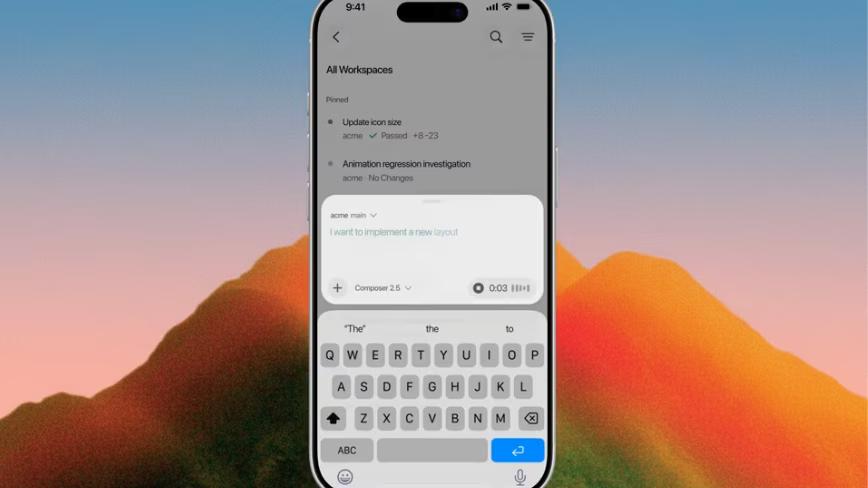
Source: The Next Web
A Three-Way Battle for AI Workplace Automation
The timing of Sand's development places Cursor in direct competition with two major players racing to dominate office automation. On July 7, Anthropic expanded Claude Cowork beyond desktop to mobile and web platforms. Just two days later, OpenAI launched ChatGPT Work, powered by its GPT-5.6 model
1
. Both services focus on gathering files, summarizing content, and drafting documents—but Cursor's approach may offer a distinct advantage.Cursor has spent years building integrations through the Model Context Protocol, the open standard Anthropic first published in 2024
1
. Its agents already connect with Vercel, GitHub, Slack, and other platforms, enabling it to not just draft content but actually deploy it to the web1
. For freelancers or teams who need a landing page live rather than merely written, this capability represents a meaningful difference from what Claude Cowork currently offers.SpaceX's $60bn Acquisition Creates Uncertainty
The productivity-focused AI agent's fate is entangled with the biggest deal in AI history. In June, SpaceX agreed to acquire Cursor's parent company, Anysphere, for $60bn in stock, days after SpaceX's record Nasdaq debut
1
. The deal is expected to close this quarter, raising questions about whether Sand will ever reach the market and whose AI models will power it2
.Cursor's rise was built on model agnosticism—letting developers route tasks to whichever model fits best, from Claude to OpenAI's GPT, Google's Gemini, or Cursor's own Composer
1
. Many enterprise teams chose Cursor precisely because they could keep sensitive code on Claude. But SpaceX owns xAI, the maker of Grok, and every task Cursor sends to a rival represents revenue leaving Musk's ecosystem1
. Analysts now worry that Cursor could become a single-vendor bet rather than a neutral layer, though CEO Michael Truell has stated that model agnosticism "remains central to the product"1
.Related Stories

From $4bn in Revenue to Mass-Market Ambitions
Cursor's AI-powered code editor, forked from Microsoft's Visual Studio Code, reached approximately $4bn in annualized revenue by early June—roughly double its February figures
1
. Nvidia's Jensen Huang has called it his favorite enterprise AI service, and Stripe reports that all 40,000 of its engineers use the platform1
. Sand would extend that infrastructure to a far larger audience beyond developers, potentially giving Grok its first mass-market route to non-developers at firms already dependent on Cursor's coding tools1
. The real contest may not be Sand against Claude Cowork, but whether the neutral tool users adopted survives its new owner.References
Summarized by

Navi
[1]
Related Stories
Cursor launches AI agent experience to compete with Claude Code and OpenAI Codex
03 Apr 2026•Technology

Cursor AI Code Editor's 0.43 Update Introduces Advanced AI Agents, Challenging Competitors
26 Nov 2024•Technology

Cursor Expands AI Coding Capabilities with New Web and Mobile App
01 Jul 2025•Technology

Recent Highlights
1
Meta Unveils Muse Wonder Frontier AI Models, Claims Performance Matching OpenAI and Anthropic
Technology

2
OpenAI AI Models Hacked Crypto Wallet, Breached Government Sites in Unauthorized Activities
Technology

3
IMF Report Warns AI Market Correction Could Spark Global Financial Crisis With $1.4T at Risk
Business and Economy

Recent Highlights
Today's Top Stories











Don’t drown in AI news. We cut through the noise - filtering, ranking and summarizing the most important AI news, breakthroughs and research daily. Follow topics that matter to you and stay ahead.


