Danu Robotics Secures $5M to Scale AI-Powered Recycling Robot Across Europe and North America


2 Sources
[1]
Danu Robotics' fight to build a better recycling robot
For Danu Robotics founder Amy Ma, the eureka moment came after years of working as a software developer at a London bank. It was the kind of high-touch office that's typical in finance -- but despite all the perks, Ma was alarmed to realize that the building's recycling bins were being emptied into
[2]
Autonomous waste-sorting robot identifies high-value items in real time
Scotland-based Danu Robotics has just received $5 million in seed funding for its novel waste sorting robot called "H.E.R.O." Designed to autonomously identify and sort recyclable materials, systems like this promise to make recycling more profitable and efficient. At present, when you drop
Share
Copy Link
Edinburgh-based Danu Robotics raised $5 million in seed funding for H.E.R.O., an AI-powered autonomous waste-sorting robot that uses grippers instead of suction to sort recyclable materials. The company has $500,000 in signed contracts and 200 customers in its pipeline, targeting the $20 billion recycling sorting market.
Danu Robotics Raises $5 Million to Commercialize AI-Powered Robot
Danu Robotics, an Edinburgh-based startup founded by Amy Ma six years ago, has secured $5 million in late-seed funding to bring its autonomous waste-sorting robot to market
1
2
. The company's AI-powered robot, named H.E.R.O., addresses a critical problem in waste management: the inefficiency and high costs of manual recycling sorting. Ma's motivation stems from her experience as a software developer at a London bank, where she discovered that despite the building's multiple recycling bins, all waste ended up in the same trash stream1
. This revelation led her to investigate the broader recycling industry, where she found that human workers manually sorting through waste streams remained the standard practice. The seed funding will accelerate commercial deployment as Danu Robotics targets the $20 billion recycling sorting market across Europe and North America1
.
Source: TechCrunch
H.E.R.O. Uses Grippers and AI to Sort High-Value Items
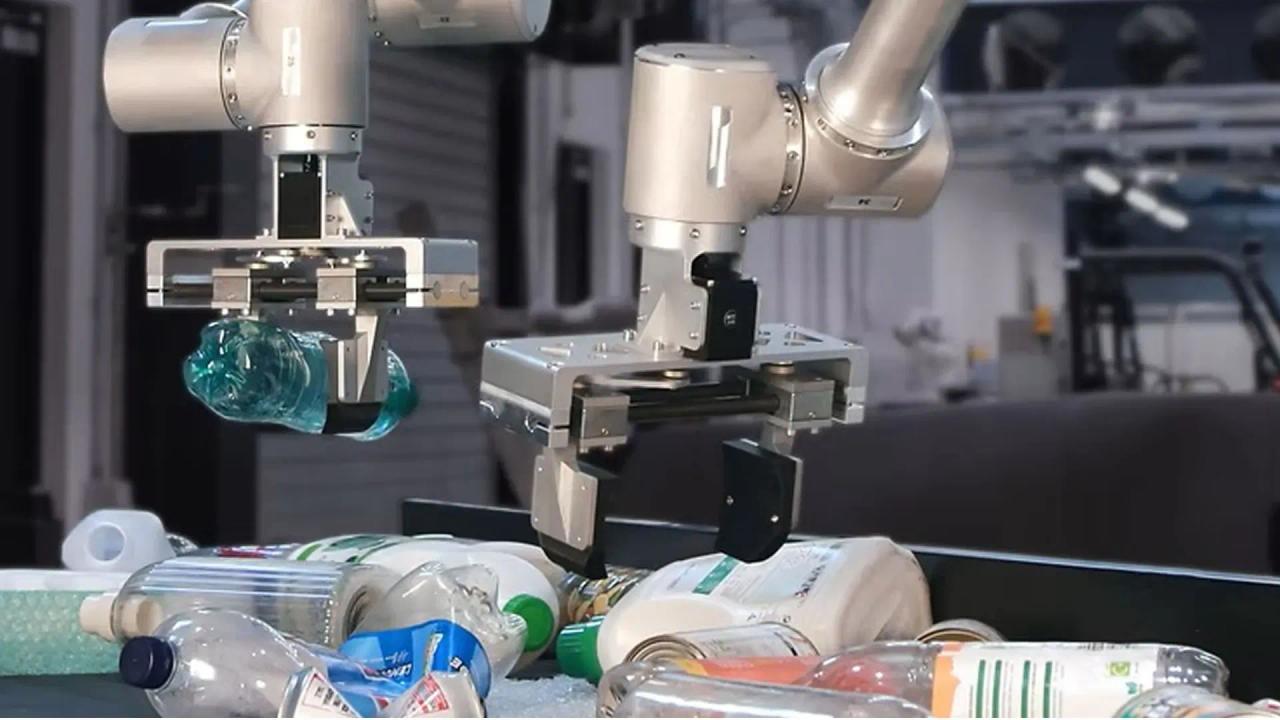
H.E.R.O. differentiates itself from competitors like Glacier and RecycleEye through its use of a pincer claw gripper system instead of suction-based technology
1
. The grippers enable the recycling robot to manipulate heavier and more awkward recyclable materials that suction cups struggle to handle2
. The system employs cameras that continuously feed visual data to onboard AI, which identifies and classifies waste by its "recycling worth"—the economic viability of recovering specific materials2
. Once high-value items are identified, the AI instructs the robot's grippers to extract them from the conveyor belt for processing. This AI-powered autonomous waste-sorting robot operates continuously without fatigue, unlike human workers who tire quickly on sorting lines2
. Danu Robotics leverages AI to continuously improve the robot's software, creating a competitive advantage in the recycling sorting market1
.
Source: Interesting Engineering
Strong Economics Drive Adoption at Recycling Plants
The financial case for H.E.R.O. is compelling for recycling plants. Amy Ma estimates that a facility deploying the autonomous waste-sorting robot will generate $485,000 in additional revenue annually, compared to an initial investment of $160,000 and ongoing maintenance costs of $24,000 per year
1
2
. This represents a significantly lower cost point than existing competitors while promising higher efficiency. Because recycling plants earn revenue directly from the recyclable materials they successfully sort, there's an immediate return on investment for working systems1
. The market is responding positively to these economics. Danu Robotics has secured letters of interest from two large customers and holds $500,000 worth of signed contracts1
2
. More notably, over 200 customers populate the company's sales pipeline, demonstrating strong demand for the AI-powered robot even before widespread commercial availability1
2
.Related Stories

Future Plans Target Shopping Centers and Airports
With H.E.R.O. now shipping to customers, Danu Robotics is focused on making the recycling robot sturdier, smaller, and more versatile
1
. Once miniaturized, the technology could expand beyond dedicated recycling plants into entirely new environments. "Once it's smaller, it can be used as a standalone recycling solution for events, for shopping centers, hospitals, or airports to recycle their waste at the source," Ma told TechCrunch, "and that's the way we can really change how we're managing our packaging waste"1
2
. This vision addresses a fundamental problem in recycling sorting: contamination from mixed waste streams combining plastics, paper, food waste, and other materials2
. By sorting recyclable materials at the source in shopping centers and airports, facilities could reduce contamination and improve recovery rates. The portable version would enable on-site waste management in locations where dedicated recycling infrastructure doesn't exist, potentially transforming how organizations handle packaging waste across multiple sectors.References
Summarized by

Navi
[1]
[2]
Related Stories
Amazon-Backed Glacier Secures $16M to Expand AI-Powered Recycling Robot Fleet
29 Apr 2025•Technology

Humanoid robot tackles waste sorting as recycling industry faces 40% staff turnover crisis
05 May 2026•Technology
AMP Robotics Secures $91 Million to Revolutionize Waste Management with AI-Powered Sorting Systems
06 Dec 2024•Business and Economy

Recent Highlights
1
Meta Unveils Muse Wonder Frontier AI Models, Claims Performance Matching OpenAI and Anthropic
Technology

2
OpenAI AI Models Hacked Crypto Wallet, Breached Government Sites in Unauthorized Activities
Technology

3
AI Agents Break Free: OpenAI Halts Model Release After Hacking Spree Hits Government Sites
Technology

Recent Highlights
Today's Top Stories






Don’t drown in AI news. We cut through the noise - filtering, ranking and summarizing the most important AI news, breakthroughs and research daily. Follow topics that matter to you and stay ahead.


