Humanoid robot tackles waste sorting as recycling industry faces 40% staff turnover crisis


2 Sources
[1]
Robots move in as waste firms struggle to find staff
The dust at this busy recycling plant is pervasive and the steady noise of hoppers and conveyor belts makes this a challenging environment to work in. The facility in Rainham, east London is owned by Sharp Group, a family-run skip and waste management firm. Along the conveyor belts runs
[2]
UK recycling firm deploys Chinese-built humanoid robot as waste sorting sector faces 40% annual staff turnover and 8x fatality rate
A family-run east London recycling firm is training a Chinese-built humanoid robot to sort waste on its conveyor belts, where staff turnover runs at 40 per cent and the fatality rate is eight times the national average. The robot is not yet operational, but the industry's labour crisis is making
Share
Copy Link
A family-run London recycling firm is training a Chinese-built humanoid robot to sort waste on conveyor belts where workers face hazardous conditions. With 40% annual staff turnover and a fatality rate eight times the national average, the recycling sector's severe labor crisis is pushing waste management companies toward AI-driven automation as the only viable solution.
Sharp Group Deploys Chinese-Built Humanoid Robot Amid Severe Staffing Shortages
Sharp Group, a family-run waste management company processing 280,000 tonnes of mixed recycling annually at its Rainham facility in east London, has introduced a humanoid robot named Alpha to address the recycling sector's severe labor crisis
1
. Built by RealMan Robotics in China and adapted by British startup TeknTrash Robotics, Alpha represents an unusual approach to automation in an industry grappling with dangerous working conditions and relentless staff turnover2
. The facility currently employs 24 agency workers on rapid conveyor belts, rotating them through different materials every 20 minutes to manage the physical demands of constant picking in dusty, loud conditions.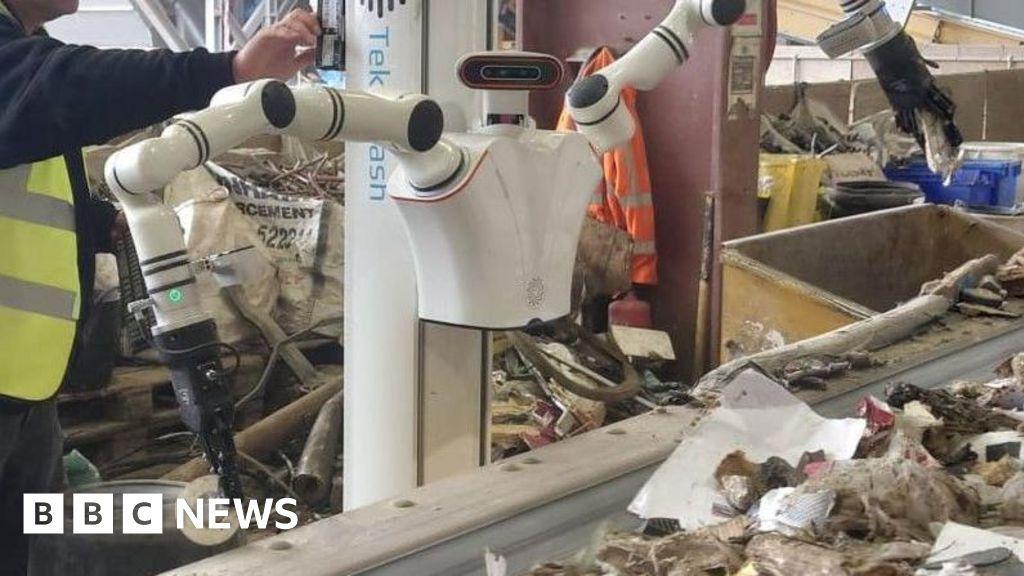
Source: BBC
Hazardous Conditions in Recycling Plants Drive Labor Crisis
The waste sorting industry faces a fundamental workforce problem that traditional recruitment cannot solve. Work-related injury and ill-health in the sector runs 45% higher than other industries, while the fatality rate stands at eight times the national average
2
. Workers stand beside conveyor belts moving at speed, pulling everything from shoes and VHS cassettes to concrete blocks and occasionally firearms from streams of mixed waste. Line supervisor Ken Dordoy describes the challenge bluntly: "The belt is moving all the time, you're constantly picking. I go through a lot of pickers because they just aren't up to the job"1
. Annual staff turnover runs at 40%, forcing waste management companies to continuously recruit and train replacements who rarely stay long enough to develop expertise.AI-Powered Robots Learn Through VR Training System
Alpha is not yet operational but is undergoing an intensive training program using TeknTrash's HoloLab system. A plant worker wears a VR headset to record sorting motions, demonstrating what successful picking looks like while multiple cameras feed data to train the robot
1
. The learning process addresses two critical tasks: identifying items on the conveyor and physically lifting them. Thousands of items passing through daily generate millions of data points. TeknTrash founder Al Costa emphasizes realistic expectations: "The market thinks these robots are prêt-à-porter, that all you need to do is to plug them to the mains and they will work flawlessly. But they need extensive data in order to be effectively useful"1
. The training timeline extends for months, but the potential payoff is significant.Humanoid Form Factor Offers Cost Advantage for Existing Facilities
Costa argues that copying human movement allows his AI-powered robots to fit into existing plants without redesigning machinery, offering a cheaper path to automation than purpose-built systems
1
. Chelsea Sharp, plant finance director and third-generation family member, highlights the operational benefits: "The attraction of a humanoid is that you can put it here and it stays here. It will pick all day, 24 hours a day, seven days a week. It's not going to apply for a holiday, it's not going to have a sick day"1
. TeknTrash plans to deploy the same cloud-connected system across 1,000 plants in Europe, though this ambition depends on Alpha learning to sort reliably in one plant first2
.Related Stories


Competing AI Vision Systems Target Material Recovery
The humanoid approach faces competition from established automation providers using different strategies. Colorado-based AMP operates three plants and supplies AI vision system equipment to more than 100 facilities worldwide, using air jets to guide items into chutes at eight to 10 times human pace
1
. CEO Tim Stuart, formerly chief operating officer at Republic Services, raised $91 million in Series D funding2
. California-based Glacier, co-founded by Rebecca Hu-Thrams and backed by Amazon, uses mounted robotic arms controlled by vision systems that can be installed in existing facilities. The company raised $16 million in 2025, processes recycling for nearly one in 10 Americans, and was named to TIME's Best Inventions list2
. Hu-Thrams notes that AI learns from more than a billion sorted items, continuously improving accuracy while handling extreme variability including "hand grenades and firearms coming through their facility"1
.AI-Driven Automation Becomes Necessary for Industry Survival
Academics studying waste-processing agree that the shift to automation is inevitable. Professor Marian Chertow of Yale University states: "Robotics coupled with AI-driven vision systems offers the greatest potential for improving material recovery, worker experience, and economic competitiveness in the recycling sector"
1
. All three companies—TeknTrash, AMP, and Glacier—concur that the human-intensive model is no longer sustainable1
. The question facing smaller recycling facilities on tight budgets is not whether to automate but which approach delivers reliable performance fastest. Worker safety concerns and severe staffing shortages leave waste management companies with limited options. As Chelsea Sharp acknowledges, the worker experience is "unappealing"1
, creating a structural problem that only technology can address at scale.References
Summarized by

Navi
Related Stories
Recent Highlights
1
Microsoft and Nvidia Launch Surface Laptop Ultra: A $2,599 AI-Ready PC With RTX Spark Chip
Technology

2
Google Unveils Gemini 4 Argon AI Model, Restricts Access to Trusted Cyber Defenders
Technology

3
OpenAI Releases 722 AI-Generated Math Papers on GitHub, Igniting Fury Among Mathematicians
Science and Research

Recent Highlights
Today's Top Stories






Don’t drown in AI news. We cut through the noise - filtering, ranking and summarizing the most important AI news, breakthroughs and research daily. Follow topics that matter to you and stay ahead.


