10 Sources
[1]
Databricks wanted to raise $1B, investors wanted $15B. It settled on $5B at a $190B valuation.
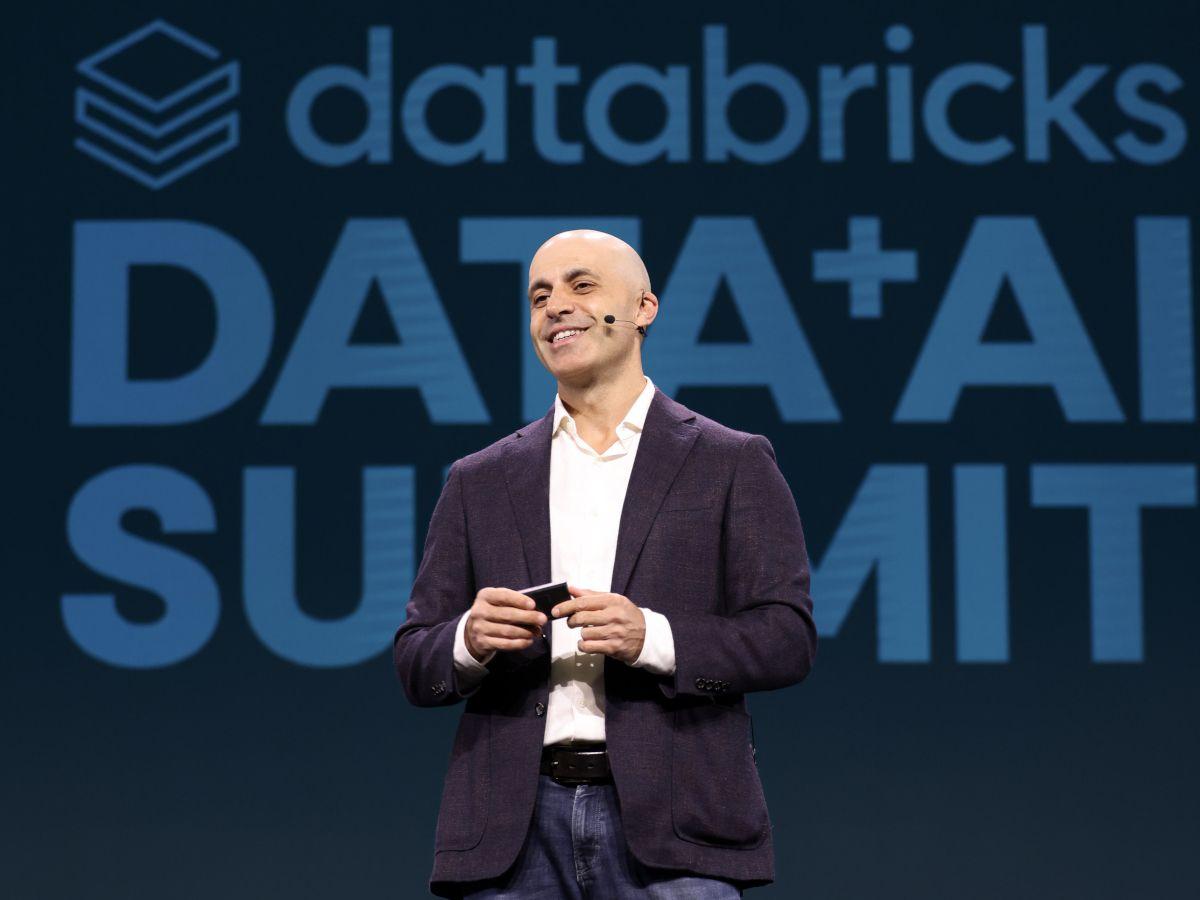
There's a funny kind of game that the latest of late-stage startups must play when raising money. They often have to sell more shares than they want or risk offending some of their existing VCs. This scenario recently played out with AI big-data company Databricks and its latest $5 billion raise announced Thursday, co-founder and CEO Ali Ghodsi (pictured above) told TechCrunch. "We wanted to raise $1 billion, but then The Information printed this article saying that Databricks is doing a big fundraise. They did that in the middle of our conference. We were heads down with our conference, and we were not actually at all focused on fundraising," Ghodsi recalled, referring to a conference that took place in June. "As soon as that article went out, there was a long line of investors that started calling. My phone blew up. It was like the worst timing for us because we were busy with our conference," he said. It was an enviable problem that turned the news report into a self-fulling prophecy. "The interest level was just insane. Just from this select group of investors that we looked at, there was $15 billion of interest," he said. When there's that much desire to get into a deal, telling some long-term backers no is a recipe for hard feelings. Databricks decided to issue more stock, and in July, sent out a press release announcing it had closed its new round at a $188 billion valuation. (The company didn't disclose at the time how much it had raised) On Thursday, Databricks shared it raised $5 billion from a paragraph worth of VCs that it let in on the deal and that its valuation pushed higher to a nice round $190 billion. The $5 billion round was led by Coatue and several others, including Blackstone, MGX, various accounts associated with various arms of T. Rowe Price, and new investor Sixth Street Growth. (Sixth Street is the firm founded by former Goldman Sachs chief investment officer Alan Waxman.) About two dozen VCs were named as participants. Why were they all so eager? Databricks seems like a sure bet. Ghodsi said his company has hit $7 billion of annualized run rate revenue, which is currently growing at 80% and is cash-flow positive. Its core product, a cloud data warehouse, is $1.5 billion of that run-rate, and still growing at 100% year-over-year, he said. Plus, Databricks has the magic AI pixie dust. It's database for agents, Lakebase, launched in June, 2025, and has hit $100M revenue run-rate. Its AI chatbot tool Genie, that can do business analysis on the spot, "is insanely popular," he said. So, if the business is doing so well, why raise more capital? The company had already raised $20 billion over the past 20 months. AI is expensive, Ghodsi said. Databricks has multi-billion dollar cloud commitments with all three of the major hyperscalers. On top of that, "AI research is very expensive," he said, adding that the company has an AI research team of 100 people, a highly competitive area. Plus, Databricks is shopping. "We do a lot of M&A." Ghodsi said, referencing an acquisition the company announced this week of Electric, the company that makes the lightweight Postgres database PGlite, a means for agents to spin up databases (terms undisclosed). In June, it bought AI cybersecurity company Panther; In March, it bought two startups. There was a time when a $1 billion round was considered a massive and difficult raise. In this age of AI spending, where startups are raising $1 billion for a seed/Series A right out of the gate, that amount is now a pittance. Still, Databrick's private fundraising, instead of going public, has become something of a meme among the Valley. When it announced this round last month, people joked online that it has raised so many, it was running out of letters of the alphabet. Ghodsi told CNBC that he still wants to take the company public one day. With such a giant roster of investors who will want to cash out one day, how can he promise anything else? But today, he wants to focus on investing in AI, he said. Given the expenses involved in that, perhaps doing so out of the public eye is a wise idea. Plus, when he can command an instant $15 billion of interest, and on his own terms, what's the rush?
[2]
Databricks raises $5 billion at $190 billion valuation in 2026
The data and AI company also crossed a $7 billion revenue run rate, growing more than 80% year over year in its second quarter Databricks closed a $5 billion funding round at a $190 billion valuation on Thursday, with proceeds earmarked for investment in products designed to help businesses build and manage AI agents. The round was led by Coatue and included Blackstone, MGX, and accounts advised by T. Rowe Price $TROW Associates, Inc. and T. Rowe Price Investment Management, Inc., along with new investor Sixth Street Growth, the company said. Other new investors included BOND, Clearlake Capital, Point72, Premji Invest, and TPG. Existing investors Andreessen Horowitz, Dragoneer, Goldman Sachs $GS Alternatives, and Thrive Capital, among others, also participated. The San Francisco company said it crossed a $7 billion annualized revenue run rate in its second quarter, reflecting more than 80% year-over-year growth. The company also said it has kept its cash flow in the black on an adjusted basis for each of the past 12 months. More than 1,000 customers are consuming at over $1 million in annualized revenue, and more than 100 are consuming at over $10 million. The company said it will direct the funding toward three products: Lakebase, a database for AI agents; Genie, an AI assistant that draws on business data; and Unity AI Gateway, a platform for managing model use and controlling costs. The Lakebase product has crossed the $100 million revenue run-rate threshold, and the Lakehouse data warehousing business has climbed past $1.5 billion in annualized revenue, with year-over-year growth exceeding 100%. Co-founder and CEO Ali Ghodsi pointed to demand from businesses deploying AI agents as a central driver of the company's momentum. "Enterprises don't just want AI that talks. They want agents working across their business that remember context, deliver accurate answers, and execute work without blowing through their budgets," Ghodsi said in a statement. Ghodsi told CNBC that rising AI computing costs are driving demand for Databricks' cost-control tools and open-source model options. He said that as token expenses rise, clients who once ruled out Chinese AI models are growing more open to them. "What has happened is that this token maxing has freaked out the CFOs," he said. According to CNBC, the new financing arrives about half a year after the company secured $5 billion at a $134 billion valuation in an earlier round. Ghodsi said an eventual public offering remains part of the plan, though he downplayed any urgency around timing. "We're not just a company that wants to stay in the private, but right now I just think there would be too much distraction in the public market," he said.
[3]
Databricks valuation hits $190bn after second $5bn raise in 2026
The data and AI company's valuation has jumped from $134bn to $190bn in just six months. San-Francisco's Databricks has closed a $5bn strategic funding round led by Coatue at a $190bn valuation. The company says the fresh funds will drive continued innovation across Lakebase, its database warehousing product, Genie, its "AI coworker" and its Unity AI Gateway for multi-AI governance and cost controls. Blackstone and MGX joined Coatue in this round, and new investors included Sixth Street Growth, BOND, Clearlake Capital, Point72, Premji Invest, and TPG, joining existing investors like Andreessen Horowitz, Dragoneer, Fidelity Management & Research Company and Thrive Capital. "Enterprises don't just want AI that talks," said Ali Ghodsi, co-founder and CEO of Databricks. "They want agents working across their business that remember context, deliver accurate answers, and execute work without blowing through their budgets,". "That requires real-time operational data with Lakebase, context from across the business with Genie, and multi-AI cost controls with Unity AI Gateway. The tremendous investor demand for this round shows that our AI strategy is winning the market and building what every business needs to maximise their impact with agents." "Databricks has spent a decade being early to where AI was headed," said Thomas Laffont, co-founder of Coatue. "Now it's the infrastructure the industry builds and scales AI on. What stands out most is the pace: they've compressed R&D timelines that used to take years into months, more like a research lab than a typical software company. "We've been investors since 2019, and results like that are why we're proud to lead this round today and keep building with them," he added. Databricks says the financial momentum has been strong with an 80pc increase year-on-year in its growth, surpassing a $7bn revenue run-rate. The funding round comes just six months after a previous raise of $5bn in February that valued the company at $134bn. The data and AI company founded in 2013 today works with over 20,000 organisations and 70pc of the Fortune 500, including big names like Adidas, AT&T, Bayer, Block, Mastercard and Unilever. Headquartered in San Francisco, Databricks has over 30 offices globally. It employs over 500 staff across the UK and Ireland as part of its EMEA operations, headquartered in London. Don't miss out on the knowledge you need to succeed. Sign up for the Daily Brief, Silicon Republic's digest of need-to-know sci-tech news.
[4]
Databricks raises another $5B after annualized revenue tops $7B
Databricks Inc. today announced that it has raised $5 billion in funding at a $190 billion valuation. The round was led by Coatue, Blackstone, MGX, T. Rowe Price and Sixth Street Growth. The funds were joined by more than a half dozen other backers, most of which are returning investors. The raise follows a quarter in which Databricks' annualized recurring revenue jumped more than 80% year-over-year to north of $7 billion. More than a fifth of the sum, or $1.5 billion, came from the company's year-old Lakehouse service. It's a managed version of the open-source PostgreSQL relational database. Lakehouse extends the upstream project with an autoscaling mechanism and data protection features. Additionally, it includes a so-called branching capability. The technology enables developers to create copies of a production database without incurring downtime. Database replicas can be used to test configuration changes and build new applications. Databricks stated today that a portion of its funding round will go towards enhancing Lakebase. Some of the enhancements will presumably use technology from Electric DB Inc., a startup that the company acquired on Tuesday. Electric developed a platform that makes it easier to manage artificial intelligence agents. AI agents often run in sandboxes that isolate them from sensitive systems and contain various software tools. Electric has developed a database called PGlite that is specifically optimized to run in such sandboxes. It's a lightweight version of PostgreSQL, the relational store that powers Lakebase. Electric's platform pairs PGlite with tools that ease tasks such as syncing information to external systems. Databricks plans to combine PGLite with Lakehouse. According to the company, customers will gain the ability to sync records between AI agents' local PGLite databases and Lakehouse environments. Databricks says that such data sharing eases the task of coordinating AI agents' work. Lakehouse is not the only focus of Databricks' engineering push. The company stated that its new funding round will also finance improvements to its Genie and Unity AI Gateway products. Genie is a set of AI tools designed to speed up tasks such as querying records stored in Databricks. Unity AI Gateway, which became generally available last week, creates a centralized catalog of a company's AI models and the tools they use. The software enables administrators to track metrics such as inference-related infrastructure usage. Databricks disclosed today that more than 1,000 organizations spend north of $1 million on its software per year. About a fifth of those customer accounts are worth more than $10 million annually.
[5]
AI firm Databricks valued at $190 billion as it bags $5 billion in funding
The funding comes six months after Databricks was valued at about $134 billion in a previous round, as investor demand for companies tied to the AI boom remains strong. Databricks said on Thursday it had raised $5 billion at a $190 billion valuation, as the data and artificial intelligence software company looks to expand investments in products that help businesses build and manage AI applications. The funding comes six months after Databricks was valued at about $134 billion in a previous round, as investor demand for companies tied to the AI boom remains strong. The latest round was led by existing investors Coatue, Blackstone, MGX and accounts advised by T. Rowe Price, along with new investor Sixth Street Growth. Databricks also said it had surpassed a $7 billion annualized revenue run-rate and posted more than 80% year-over-year revenue growth in the second quarter. The company said it remained cash-flow positive on an adjusted basis over the last 12 months. Founded in 2013, Databricks provides software that helps companies store, manage and analyze data, as well as develop AI applications. The company competes with Snowflake and is widely viewed as a candidate for a future stock market listing. The San Francisco-based company said it would use the proceeds to invest in products, including its Lakebase database, Genie AI assistant and Unity AI Gateway platform. Its Lakebase product has exceeded a $100 million revenue run-rate, while its Lakehouse data warehousing business surpassed a $1.5 billion revenue run-rate, the company said.
[6]
Databricks Raises $5B In Latest Funding Round, Discloses Latest Financial Performance Stats
The fast-growing data and AI tech company's annual revenue run rate surpassed $7 billion in Q2, representing 80 percent year-over-year growth. Data and AI platform developer Databricks has raised $5 billion in a new strategic funding round that boosts the company's valuation to $190 billion, the company said Thursday. The fast-growing company also disclosed that during its recently completed second fiscal quarter (ended July 31) it recorded a $7 billion annual revenue run rate, representing 80 percent year-over-year growth, and delivered a positive adjusted free cash flow over the last 12 months. Databricks, which many anticipate will go public in the near future, said its Lakehouse data warehouse product is generating revenue at a $1.5 billion run rate at a 100 percent year-over-year growth rate. And its Lakebase database product, just introduced in 2025, has already exceeded a $100 million revenue run rate. [Related: Meeting The Demands Of AI: The 2026 CRN Big Data 100] "Enterprises don't just want AI that talks. They want agents working across their business that remember context, deliver accurate answers, and execute work without blowing through their budgets," said Databricks CEO and co-founder Ali Ghodsi in a statement announcing the new funding and financial performance statistics. "That requires real-time operational data with Lakebase, context from across the business with Genie, and multi-AI cost controls with Unity AI Gateway," Ghodsi said. "The tremendous investor demand for this round shows that our AI strategy is winning the market and building what every business needs to maximize their impact with agents." (Genie is Databricks' conversational "AI coworker" agent technology and the Unity AI Gateway is the company's runtime governance layer and control plane for managing enterprise AI systems.) The latest numbers illustrate Databricks' rapid growth: In February the company put its annual revenue rate at $5.4 billion after recording 65 percent year-over-year growth in its fiscal 2026 fourth quarter (ended Jan. 31). At that time the company's valuation stood at $134 billion. Databricks, headquartered in San Francisco, also said Thursday that it now has more than 1,000 customers spending more than $1 million a year on the company's products and services and more than 100 customers doing so at more than $10 million a year. Altogether the company said it has more than 20,000 customers globally, including 70 percent of the Fortune 500. Databricks said it will use the capital from its latest funding round to accelerate its technology development efforts. In February Databricks announced the general availability of Zerobus Ingest, a fully managed data streaming service, and in March the company debuted Lakewatch, an agentic SIEM cybersecurity product built on the company's core Data Intelligence Platform. The new funding round was led by existing investors Coatue, Blackstone, MGX, accounts advised by T. Rowe Price Associates, and T. Rowe Price Investment Management, along with new investor Sixth Street Growth. The funding round included additional new investors BOND, Clearlake Capital, Point72, Premji Invest and TPG, along with some 15 existing investors such as Andreessen Horowitz, Morgan Stanley Investment Management, and Franklin Templeton.
[7]
Databricks Raises $5 Billion at $190 Billion Valuation Amid AI Frenzy
Databricks has closed a fresh $5 billion strategic financing at a $190 billion valuation, as the AI company surpassed a $7 billion revenue run-rate, growing more than 80% year over year in its fiscal second quarter. Coatue led the round with participation from Blackstone, MGX, accounts advised by T. Rowe Price, and new backer Sixth Street Growth. The fresh capital will go toward building out Lakebase, Genie, and Unity AI Gateway -- products it positions as core infrastructure for deploying AI agents inside large organizations. Databricks CEO: 'This Round Shows Our Strategy Works' Lakebase, a serverless Postgres database designed for AI-agent workloads, has surpassed a $100 million revenue run-rate. The company also generated positive adjusted free cash flow over the past 12 months. Its Lakehouse data warehousing product reached a $1.5 billion revenue run rate and grew more than 100% year over year. Databricks added that more than 1,000 customers are now consuming at an annual rate above $1 million, and more than 100 are consuming at an annual rate above $10 million. Fighting Fire With Fire Databricks is known as a cloud-based data intelligence platform. For Thomas Laffont, Coatue's co-founder, Databricks became a key layer for building and scaling AI. "What stands out most is the pace: they've compressed R&D timelines that used to take years into months, more like a research lab than a typical software company," Laffont said. Databricks said other new investors in the round include BOND, Clearlake Capital, Point72, Premji Invest, and TPG. Existing backers include Andreessen Horowitz, Dragoneer, Fidelity, Franklin Templeton and GIC. In June, the San Francisco-based company acquired Panther Labs for an undisclosed price, as it looks to expand the company's footprint in cybersecurity. At Databricks' Data + AI Summit in San Francisco, Ghodsi argued that AI has accelerated how quickly attackers can turn software flaws into real intrusions and said older alert-and-log workflows were "dead." "If they're going to attack you with agents, you have to defend with agents," Ghodsi told Reuters. "You have to fight fire with fire." Despite operating for 13 years, Databricks has repeatedly delayed an IPO, choosing instead to raise private funding and facilitate secondary share sales. Ghodsi told investors that the company remains on track for an IPO, potentially as early as next year. This content was partially produced with the help of AI tools and was reviewed and published by Benzinga editors. Market News and Data brought to you by Benzinga APIs To add Benzinga News as your preferred source on Google, click here.
[8]
Databricks Raises $5 Billion to Expand Enterprise AI Agent Platform | PYMNTS.com
The new valuation is up from the $134 billion at which it was valued in a February funding round and the $62 billion at which it was valued in a January 2025 funding round. Databricks will use the new funding to support continued development of its serverless Postgres database for AI agents, Lakebase; its AI coworker, Genie; and its gateway for multi-AI governance and cost controls, Unity AI Gateway, according to the Thursday press release. Together, these solutions deliver the foundation, context, smart routing and cost controls companies need to deploy AI agents, the release said. Databricks also announced Thursday that it has surpassed a $7 billion revenue run-rate and that it delivered 80% year-over-year growth in the second quarter. Databricks Co-Founder and CEO Ali Ghodsi said in the release that enterprises want AI agents working across their business and that Databricks offers the foundation they need. "The tremendous investor demand for this round shows that our AI strategy is winning the market and building what every business needs to maximize their impact with agents," Ghodsi said. Databricks' latest funding round was led by Coatue. Coatue Co-Founder Thomas Laffont said in the release: "Databricks has spent a decade being early to where AI was headed. Now it's the infrastructure the industry builds and scales on." Databricks said in a July 16 press release that it was raising a round of strategic funding at a $188 billion valuation and that it expected the round to close by the end of summer. The company said at the time that in addition to investing in its products, it would use the new capital to support future AI acquisitions and deepen AI research. Databricks announced July 23 that it expanded its decade-long partnership with Microsoft through the 2030s to scale enterprise AI. Databricks will deepen its use of Azure Databricks to run core business operations and will leverage Azure Cobalt to improve performance and efficiency, while Microsoft will continue integrating the Databricks platform across its products, the company said.
[9]
Databricks Grows >80% YoY, Surpasses $7B Revenue Run-Rate, Scales Lakebase, Genie, and Unity AI Gateway
Closes $5 billion strategic funding at a $190 billion valuation, led by Coatue, along with Blackstone, MGX, T. Rowe Price, and new investor Sixth Street Growth Databricks today announced it crossed a $7 billion revenue run-rate, delivering >80% year-over-year growth during its Q2. Building on this momentum, the company closed a $5 billion strategic funding round at a $190 billion valuation. The investment will drive continued innovation across Lakebase, its serverless Postgres database built for AI agents, Genie, Databricks' AI coworker that turns business data into trusted answers and actions, and Unity AI Gateway, for multi-AI governance and cost controls. The round was led by Coatue, along with Blackstone, MGX, accounts advised by T. Rowe Price Associates, Inc. and T. Rowe Price Investment Management, Inc., and new investor Sixth Street Growth. Other new investors included BOND, Clearlake Capital, Point72, Premji Invest, and TPG alongside existing investors Andreessen Horowitz, Dragoneer, Fidelity Management & Research Company, Franklin Templeton, GIC, Growth Equity at Goldman Sachs Alternatives, Insight Partners, J.P. Morgan Private Capital, Kinetic, Morgan Stanley Investment Management, NEA, Ontario Teachers' Pension Plan, Temasek, Thrive Capital, and WCM Investment Management. The Future of Data + AI Today, companies have a new set of employees to support: AI agents. To do their jobs, agents need a reliable, scalable foundation, clear, accurate answers from enterprise data, and the ability to easily forecast budgets and switch to more cost-effective models to avoid burning through expensive tokens. The Databricks Data + AI Platform delivers the foundation with Lakebase, enterprise context with Genie, and smart routing and cost controls with Unity AI Gateway, giving teams a simple way to build AI that actually works. Databricks' Financial Momentum This funding follows Databricks' continued business momentum, including: * Growing >80% year over year, surpassing $7B revenue run-rate * Continuing to deliver positive adjusted free cash flow over the last 12 months * Surpassing $1.5B revenue run-rate for Lakehouse, its data warehousing product, growing over 100% year over year * Exceeding $100M revenue run-rate for Lakebase * >1,000 customers consuming at over $1 million revenue run-rate * >100 customers consuming at over $10 million revenue run-rate "Enterprises don't just want AI that talks. They want agents working across their business that remember context, deliver accurate answers, and execute work without blowing through their budgets," said Ali Ghodsi, Co-founder and CEO of Databricks. "That requires real-time operational data with Lakebase, context from across the business with Genie, and multi-AI cost controls with Unity AI Gateway. The tremendous investor demand for this round shows that our AI strategy is winning the market and building what every business needs to maximize their impact with agents." "Databricks has spent a decade being early to where AI was headed. Now it's the infrastructure the industry builds and scales AI on," said Thomas Laffont, Co-founder of Coatue. "What stands out most is the pace: they've compressed R&D timelines that used to take years into months, more like a research lab than a typical software company. We've been investors since 2019, and results like that are why we're proud to lead this round today and keep building with them."
[10]
Databricks valued at $190 billion in latest funding round
Aug 13 (Reuters) - Databricks said on Thursday it had closed a $5 billion strategic funding round at a $190 billion valuation as the data and AI software company looks to expand investments in products for AI agents. The round was led by Coatue with participation from Blackstone, MGX, accounts advised by T. Rowe Price Associates and T. Rowe Price Investment Management and new investor Sixth Street Growth. The company also said it had surpassed a $7 billion annualized revenue run-rate, delivering more than 80% year-over-year growth in the second quarter. Databricks, which helps enterprises analyze data and build AI applications, competes with Snowflake and is widely regarded by analysts as one of the most prominent private companies likely to pursue an eventual initial public offering, alongside OpenAI and Anthropic. (Reporting by Rashika Singh in Bengaluru; Editing by Vijay Kishore)
Share
Copy Link
Databricks closed a $5 billion strategic funding round led by Coatue at a $190 billion valuation, marking its second $5 billion raise in six months. The data and AI company surpassed $7 billion in annualized revenue with over 80% year-over-year growth as investor demand for AI infrastructure intensifies.
Databricks closed a $5 billion strategic funding round at a $190 billion valuation, with the data and AI company initially planning to raise just $1 billion before overwhelming investor interest pushed the round significantly higher
1
. Co-founder and CEO Ali Ghodsi revealed that investor demand reached $15 billion from a select group of backers, forcing the company to issue more stock than originally intended to avoid offending long-term investors1
. The round was led by Coatue, with participation from Blackstone, MGX, accounts advised by T. Rowe Price, and new investor Sixth Street Growth2
. Additional new investors included BOND, Clearlake Capital, Point72, Premji Invest, and TPG, alongside existing backers like Andreessen Horowitz, Dragoneer, Goldman Sachs Alternatives, and Thrive Capital2
.
Source: Silicon Republic
The latest funding round marks Databricks' second $5 billion raise in 2026, with the Databricks valuation surging from $134 billion in February to $190 billion
3
5
. The San Francisco-based AI infrastructure provider has raised $20 billion over the past 20 months, demonstrating sustained investor confidence in companies tied to the AI boom1
5
. Thomas Laffont, co-founder of Coatue, highlighted that Databricks has compressed research and development timelines that traditionally took years into months, operating more like a research lab than a typical software company3
.
Source: CXOToday
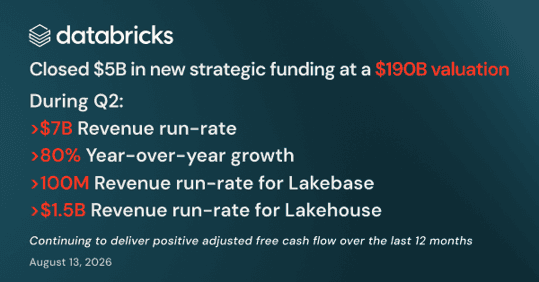
Databricks surpassed a $7 billion annualized revenue run-rate in its second quarter, reflecting more than 80% year-over-year growth while maintaining positive cash flow on an adjusted basis for the past 12 months
2
4
. The company's Lakehouse data warehousing business surpassed a $1.5 billion revenue run-rate with year-over-year growth exceeding 100%2
5
. Lakebase, the database for AI agents launched in June 2025, crossed the $100 million revenue run-rate threshold1
5
. More than 1,000 customers are consuming over $1 million in annualized revenue, with more than 100 consuming over $10 million2
4
.Related Stories
Databricks will direct the funding toward three AI-focused products: Lakebase, a database for AI agents; Genie, an AI assistant that draws on business data; and Unity AI Gateway, a platform for managing model use and controlling costs
2
5
. Ali Ghodsi emphasized that enterprises want agents working across their business that remember context, deliver accurate answers, and execute work without excessive costs2
3
. The data and AI company acquired Electric DB Inc. this week, which developed PGlite, a lightweight PostgreSQL database optimized for AI agent sandboxes4
. Databricks plans to combine PGlite with Lakehouse to enable customers to sync records between AI agents' local databases and Lakehouse environments4
.
Source: Benzinga
Ghodsi told CNBC that rising AI computing costs are driving demand for Databricks' cost-control tools and open-source model options, with clients growing more open to Chinese AI models as token expenses climb
2
. The company maintains multi-billion dollar cloud commitments with all three major hyperscalers and operates an AI research team of 100 people in a highly competitive area1
. Unity AI Gateway, which became generally available last week, creates a centralized catalog of a company's AI models and enables administrators to track metrics such as inference-related infrastructure usage4
. Founded in 2013, Databricks works with over 20,000 organizations and 70% of the Fortune 500, including Adidas, AT&T, Bayer, Block, Mastercard, and Unilever3
. While Ghodsi confirmed that an eventual public offering remains part of the plan, he downplayed urgency around timing, stating that the company wants to focus on investing in AI without the distraction of public markets2
.Summarized by
Navi
[1]
[3]
[4]
19 Aug 2025•Business and Economy

09 Feb 2026•Business and Economy

09 Sept 2025•Business and Economy

1
Policy and Regulation

2
Technology

3
Technology