Datacenters are outgrowing the US grid, and the workarounds are slow


2 Sources
[1]
US bit barn boom sees energy needs grow 10x as fast as grid capacity
Operators face longer connection waits and a growing need to bring their own electricity Datacenter power consumption in the US is growing roughly ten times faster than grid capacity, meaning facilities may soon need to find a large chunk of their own electricity from other sources. Surging
[2]
US data center power demand outpaces supply by 10x and could bring the AI boom to a grinding halt by 2030 -- with AI companies funneling millions into gas turbine generators and modular nuclear reactors to stay online
* United States data center power demand currently outstrips supply by ten times * The problem could cause the AI boom to collapse by 2030 if new power sources are not brought online * AI companies are turning to nuclear reactors and gas turbine generators to bring new developments online, but
Share
Copy Link
US datacenter power demand is growing ten times faster than the grid can expand, per Howden. AI companies are turning to gas turbines and nuclear reactors, but those fixes carry their own costs and delays.
The power demand from US datacenters is growing about ten times faster than the grid's capacity to supply it, according to new analysis from Howden, an insurance broker
1
2
. That gap is driving operators to look beyond the grid, as Howden frames it.
Source: The Register
Why the gap exists
The mismatch predates the AI boom. Since 2000, power fed to US datacenters has risen 19% a year on average
1
2
. Grid capacity expanded only 2% annually, per Howden's analysis of US Energy Information Administration and S&P Global data1
2
. Datacenters accounted for about 5% of US grid capacity in 2025, up from 0.1% in 20001
2
.Howden frames the work as an assessment of how developers can secure electricity as AI infrastructure demand accelerates
1
. By its estimate, datacenters would need up to 58% of their power from off-grid sources by 2030 merely to hold their current share of grid demand steady1
2
. Howden warns that grid connection waits of two to six years could leave the largest projects $800 million to $2.4 billion short of revenue1
."As demand for AI infrastructure accelerates, developers are increasingly looking beyond traditional grid connections to secure the electricity they need," said Stuart Adam, Howden's head of Natural Resources
1
.The workarounds, and their costs
Per TechRadar, Anthropic is investing $3.4 billion in on-site gas turbine generators
2
. Per the same outlet, that reliance leaves the company exposed to natural gas prices, which have spiked amid Middle East conflict and shifting consumption from other industries2
. Nearby residents have complained too: turbine noise has been compared to an international airport, and a low hum has been linked to unexplained illnesses, per TechRadar's reporting2
.
Source: TechRadar
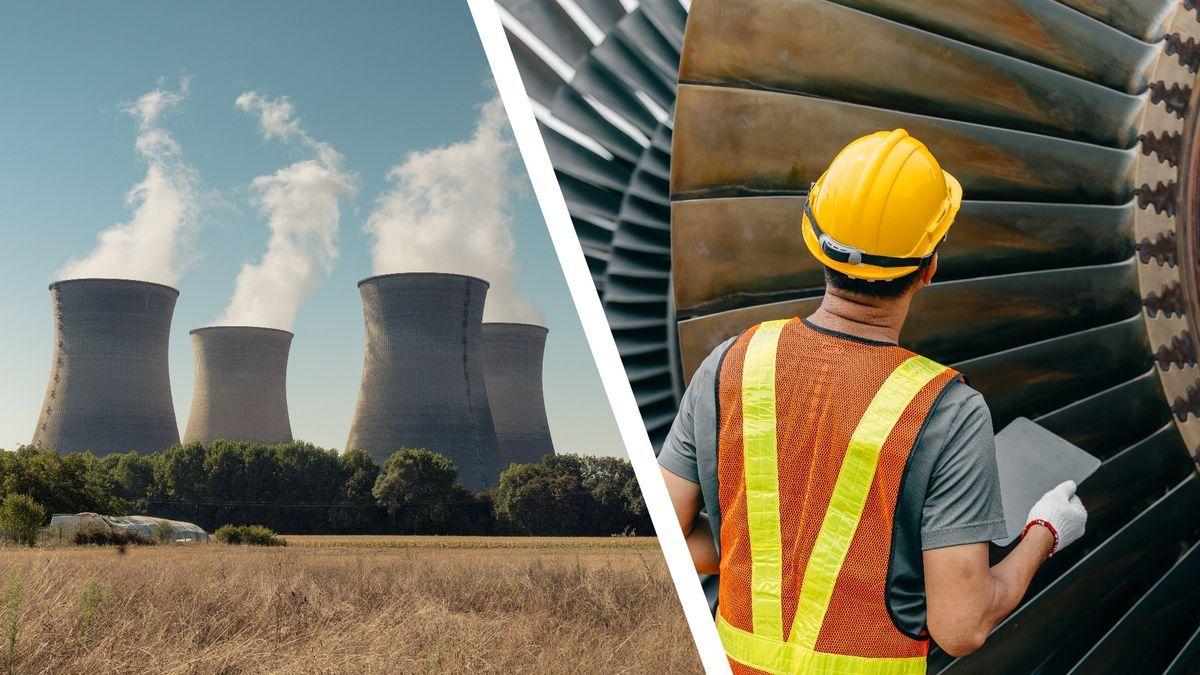
Nuclear is the other path. Per TechRadar, three reactors in Michigan, Pennsylvania and Iowa are set to share $4.4 billion in federal grants for recommissioning, with Microsoft and Google first in line for the power
2
. Amazon is looking to buy more than 960 MW from 12 planned small modular reactors in Iowa, at a cost likely exceeding $1 billion2
. The sites are not yet approved and may not run until the mid-2030s2
. Per TechRadar, the US has approved the first small nuclear reactor plan built specifically for a data center, in Tennessee, with each modular reactor providing up to 300 MW2
. None of the nuclear routes is quick or cheap, since recommissioning or building reactors takes billions to meet safety requirements and expected operating lifetimes2
.Related Stories
How alarmed should anyone be
Gartner warned in June that AI datacenter energy use is on track to grow 26% this year
1
2
. It questioned whether grid supply can keep pace by the end of the decade1
2
. The charts behind the alarm use different scales, 1,400 GW for the grid against 80 GW for datacenters, so datacenters are not about to swallow the US electricity system1
. Households may feel it regardless. Per experts cited by TechRadar, power costs in some states could climb as much as 50% by 2030, and grid expansion is typically paid for through household bills2
. Howden, whose business is insurance, also flags that on-site generation leaves operators carrying new operational and financial exposures1
.Howden estimates that holding datacenters at 5% of grid capacity would take about 110 GW of behind-the-meter capacity by 2030, an expansion it considers unlikely
1
. It expects a mix instead: more grid reliance, slower building at power-short sites, and alternative supplies sharing the load1
. "Power availability is becoming one of the defining challenges of the datacenter boom," said Stuart Adam, Howden's head of Natural Resources1
.References
Summarized by

Navi
Related Stories
AI Data Centers Drive $580 Billion Investment Surge as Power Grid Struggles to Keep Pace
10 Nov 2025•Business and Economy
AI energy consumption strains power grid as data center demand drives costs up for manufacturers
06 Jul 2026•Policy and Regulation
AI Data Centers Hit Power Grid Limits as Energy Demand Outpaces Infrastructure Growth
15 Sept 2026•Policy and Regulation

Recent Highlights


Recent Highlights
Today's Top Stories








Don’t drown in AI news. We cut through the noise - filtering, ranking and summarizing the most important AI news, breakthroughs and research daily. Follow topics that matter to you and stay ahead.


