5 Sources
[1]
Is AI the energy technology the world has been waiting for?
AI could become the technology that finally makes the grid work the way it always should have. The most consequential energy technology of the coming decade may not look like a power plant at all. It may look like an 'AI factory' or what NVIDIA's CEO, Jensen Huang, calls the new generation of computing campuses that specialize in producing tokens of artificial intelligence. Calling AI a revolutionary energy technology sounds strange. The dominant narrative about AI and energy is the opposite: AI has a voracious appetite for energy and represents a looming crisis that could break the grid and raise everyone's power bills. Data centres already consume roughly 6% of all electricity in the United States and the United Kingdom. The International Energy Agency projects that global AI data centre electricity demand could more than quadruple by 2030. No industrial energy load in modern history has grown like this. But the framing of 'AI as load' is wrong. AI is not just an unusually large new load. It is the most software-defined, the most controllable and the most spatially mobile workload ever to consume electricity on an industrial scale. Orchestrated carefully, power-flexible AI factories -- data centres engineered to modulate their own electricity use in real-time -- become a new energy technology and could become one of the most consequential in history. They could reduce power bills, protect grid reliability and unlock massive power capacity to turbocharge the AI revolution. Consider what we usually mean by an 'energy technology.' Some energy technologies create new supply - solar panels, nuclear plants and the fusion reactors that are on the horizon. Others reshape how energy moves and is stored -- high-voltage transmission, lithium-ion batteries. A third, quieter category transforms how energy is consumed: heat pumps replaced furnaces, variable-speed motors replaced fixed-speed ones, LED light bulbs displaced incandescents. AI belongs in that third category, and it could have even more potential than its predecessors. Through intelligent and flexible energy management, AI factories become precise and controllable assets on the power grid. As the grid approaches peak energy demand on a hot summer day, AI factories can dynamically slow down AI jobs that are inherently flexible, whether research workloads, model fine-tuning or batchable inference jobs that can be paused and rescheduled. Even the workloads that must run in real time -- a chatbot query, an autonomous agent's action -- can be routed at the speed of light to a region where power is plentiful. No other large industrial load has this combination of flexibility across both time and geography. A steel mill cannot relocate from Phoenix when Texas peaks. A semiconductor fab cannot slow or pause for two hours and resume seamlessly. AI can, while meeting the performance requirements of its users. To be sure, at first glance, the economics make this sound impossible. A one-gigawatt AI campus spends roughly $5 billion a year servicing the cost of its GPUs and another $2.6 billion on the building and network around them. Its annual electricity bill -- about $590 million -- is more than ten times smaller. Why would any operator ever throttle billions of dollars of accelerators to chase a discount on a comparatively cheap input? But this objection misunderstands the scale of the opportunity for AI to serve as a revolutionary energy management technology. AI factories can unlock billions of dollars of annual value by generating tokens of artificial intelligence, far outweighing the rare cases when flexibly throttling power can ease the grid's peak strain. Power systems are built to peak, which means they sit underused most hours of every year. Flexible AI factories monetize that latent capacity. Independent analyses by Duke University put the unlock at roughly 100 gigawatts on the existing U.S. grid alone -- enough to absorb several years of AI growth without a single new transmission line. And, by avoiding expensive new grid upgrades while better utilizing existing grid infrastructure, flexible AI factories can actually reduce power bills for local communities - curbing the powerful political backlash currently brewing against AI infrastructure that could raise local power bills. Renewable generation is cheap and abundant but uneven and the grid needs demand that can absorb surpluses and step back during shortfalls. The flexibility tools we have today - utility-scale batteries and a thin set of legacy industrial demand-response programmes - are either expensive, slow or both. Flexible AI factories can flex faster and at greater scale than either. There is a still deeper implication. The world's AI factories are increasingly interconnected by fibre, software and shared standards. They are starting to behave less like isolated industrial sites and more like nodes on a single, planet-spanning network -- a kind of complementary grid sitting on top of the public power grid. The electric grid moves electrons. The AI grid moves computation. When those two grids are designed to talk to each other, they become more useful than either could be alone: power can be routed to where computation is and computation can be routed to where power is. AI flexibility is not just a theory. At Emerald AI, we have demonstrated grid-responsive AI infrastructure at five commercial data centres worldwide over the past year, including on the latest NVIDIA Blackwell Ultra systems. We have shown live, on real workloads, that AI factories can cut power on command in seconds and sustain reductions for hours without losing performance on the most crucial workloads. Silicon Valley Power (SVP), the municipal utility of Santa Clara, has launched a first-of-its-kind programme in which Emerald administers flexibility for major data centres in the heart of Silicon Valley, allowing SVP to offer upsized capacity to customers it could not previously serve, while protecting rate affordability for residents. And, later in 2026, NVIDIA, Digital Realty and Emerald AI will bring online the world's first commercial-scale, power-flexible AI factory -- a 96MW facility in Virginia capable of modulating its power use in response to signals from the grid. Google has run a carbon-intelligent computing platform for several years, shifting non-urgent workloads in time and across regions to match cleaner grid hours. The Electric Power Research Institute's DCFlex initiative, launched in 2024 with more than twenty utilities and hyperscalers, is running multi-site demonstrations of data-centre flexibility on real grids. The opportunity is most acute outside the United States. Ireland's grid operator has restricted new data-centre connections in the Dublin region. Singapore lifted its moratorium only after introducing strict efficiency standards. India is forecasting data-centre capacity to roughly triple by 2030 while simultaneously electrifying industry and transport. The countries that figure out how to make AI infrastructure flexible by default will have a structural advantage in attracting compute investment without sacrificing reliability or affordability for the rest of the grid. The Forum's Centre for Energy and Materials is already convening utilities, regulators and hyperscalers around precisely this question; that work needs to accelerate. Taken seriously, this reframes the AI energy story. Yes, AI will require enormous quantities of electricity. But because AI is software-defined, those same workloads can be made to align with the grid, rather than fight it. Flexibility does not shrink AI's appetite for power; it reshapes it. What strains a grid -- driving up bills and prompting the connection moratoria now seen from Dublin to Singapore -- is not the total electricity a region consumes over a year, but the load it draws at the system's tightest and most expensive hours. By pulling back when the grid is scarce and leaning in when power is abundant, flexible AI factories can add their enormous new demand without piling onto that peak: easing, rather than worsening, the risk of blackouts and rate increases and sparing communities the cost of generation and wires that would otherwise sit idle most of the year. In the United States, where data centres are on course to account for nearly half of all growth in electricity demand this decade, that difference is the difference between a grid that buckles and one that absorbs the boom. More power generation, like nuclear reactors, is essential, but the largest, most controllable and most rapidly scaling new participant on the world's electricity grids today is not a power plant. It is computation itself. If we design AI infrastructure to be flexible by default -- and if regulators and utilities reward that flexibility with faster interconnection and access to grid-services markets -- AI will be remembered not as the crisis that overwhelmed the grid, but as the technology that finally made the grid work the way it always should have. A new energy technology has arrived. It is made of GPUs, fibre and code. And it is just getting started.
[2]
'The challenge is no longer only how much power is needed, but whether it can be delivered reliably': Report finds AI data centers are draining more power than the grid can provide
* Electricity demand is now growing faster than energy suppliers can keep up with * Volatile AI workloads cause unpredictable peaks and troughs in demand * AI could actually help predict, despite also being the cause With three in four (77%) electricity execs now believing that data center energy demand will grow faster than utilities can keep up with, two-thirds (68%) expect electricity shortages to become more commonplace as demand for AI soars. New data from a Capgemini report reveals just how unpredictable AI energy demands can be, with 77% admitting they struggle to accurately forecast demand amid volatile AI workloads. Not only is this leading to more constrained energy supply, but also more extreme and less predictable demand spikes. Data center energy demand is a whole new ball game All of this comes as local opposition continues to mount against data centers, with residents increasingly concerned about power outages and rising energy costs. Just last week, a county in Virginia told data centers to revert to backup generators to free up grid capacity for local residents, with an ongoing heatwave causing a spike in electricity demand for air conditioning units. Even data center companies are struggling to anticipate how much they could consume, with 67% of electricity execs reporting speculative applications for future capacity. Around a fifth (19%) of these don't even materialize, creating what Capgemini calls 'phantom demand,' forcing utilities to either overinvest unnecessarily or underinvest and create capacity shortages. "The challenge is no longer only how much power is needed, but whether it can be delivered reliably, where and when it is required," Capgemini Global Head of Energy and Utilities Claire Gauthier wrote, citing AI's potential in helping to predict demand despite also being the cause of fluctuating and high demand. However, at the moment fewer than half (45%) currently use AI for grid optimization. Looking ahead, most (87%) data center operators expect electricity consumption to rise over the next three to five years by an average of 30%. Follow TechRadar on Google News and add us as a preferred source to get our expert news, reviews, and opinion in your feeds.
[3]
Why AI's energy future depends on power from space
Global electricity demand from data centres will more than double by 2030, according to the International Energy Agency (IEA). New analysis from United Nations University suggests that if data centre growth continues on its current trajectory, power demand could approach three times the combined annual electricity consumption of Pakistan, Bangladesh and Nigeria this decade. AI is forcing an urgent question onto the global agenda: Where will all the power come from? Tech executives are blunt about the current energy supply bottleneck. "Power is my problem today," Microsoft CEO Satya Nadella said on a recent podcast. The scramble for power is already reshaping infrastructure decisions. Market intel firm Cleanview has identified 84 GW of proposed data centre projects that plan to deploy onsite gas-fired generation as developers rush to develop power sources. When companies are willing to deploy gas turbines just to get access to electricity faster, it becomes clear how valuable new sources of power could be. But data centres' need for massive amounts of reliable, always-on power is colliding with slow grid expansion, transmission bottlenecks and the realities of building new infrastructure. Those same pressures will also come for the rest of the global economy in the years ahead. The scale of innovation has always depended on the scale of energy. Space now presents a critical new domain for energy access. For decades, space infrastructure has quietly supported life on Earth through communications, navigation, weather forecasting, remote sensing and national security. Now space is expanding from being an information layer to become an energy layer as well. With mounting pressure on terrestrial infrastructure, new technologies can take advantage of continuous solar energy, one of space's most abundant resources. Solar panels have become indispensable in space, powering satellites long before they became commonplace on Earth. Now, advances in launch, optics and manufacturing could make it practical for space to power Earth For most of the commercial space era, the industry's defining challenge was access to orbit. SpaceX has dramatically lowered the cost of reaching orbit, and now companies are shifting to creating meaningful value for Earth once they're there. AI and energy demand are an urgent driver. Companies like Starcloud and SpaceX are exploring whether AI workloads should be co-located with the abundant energy in orbit. The appeal is obvious. Moving compute closer to a virtually continuous energy source could reduce dependence on increasingly constrained power infrastructure and siting environments. The tradeoff is that energy is only one part of the equation. Latency, thermal management, maintenance and hardware replacement are central problems to solve in the architecture. Cooling is a good example. Modern AI systems generate enormous amounts of heat and operating those systems in orbit introduces a different set of challenges than operating them on Earth. Rather than relocating demand, space solar energy expands the supply of available energy on Earth by delivering power from space directly into terrestrial electricity systems. That creates opportunities to build on infrastructure that already exists. For example, Overview Energy is designing the technology to use utility-scale solar projects as receiving infrastructure. It collects energy in orbit and transmits it using safe, invisible, near-infrared light optimized for photovoltaic panels, allowing solar assets to generate electricity at any hour. Energy from orbit then flows into infrastructure that is already connected to the grid rather than requiring entirely new sites. That matters in a world increasingly obsessed with speed to power. The remaining questions are primarily industrial: how quickly these systems can be manufactured, deployed and scaled at the right price point. Data centres are receiving most of the attention right now, but economies will continue to need more reliable electricity for other uses. Advanced manufacturing, industrial electrification, desalination, hydrogen production and future digital infrastructure will all require abundant electricity. And access to power shapes what gets built and where. The industry has spent the last decade building a huge amount of renewable infrastructure. The largest hyperscalers alone have contracted roughly 30 GW of solar capacity. Today, those assets generate electricity only when sunlight is available. That's one of the most compelling parts of delivering energy from space straight to solar projects. Instead of building an entirely new class of energy asset, you increase the utilization of one that already exists. A solar project that generates power for more hours of the day produces more energy, creates more value for the grid and improves the economics of infrastructure that has already been built. Every major wave of innovation eventually encounters physical constraints. Energy is the constraint of our era. Meeting that challenge will require expanding access to reliable power in ways that were difficult to imagine even a decade ago. For decades, space infrastructure has helped move information around the world. In the future it will move energy.
[4]
The world's biggest battery maker on AI's energy demand
Engaging the whole system and co-designing from the outset are increasingly regarded as key to long-term success. For many leaders, businesspeople and policy-makers worldwide, the future of AI, including how it will be powered, is one of uncertainty, high costs, and some degree of anxiety. Pushing back against this prevailing sentiment is Robin Zeng, Founder, Chairman and Chief Executive Officer, Contemporary Amperex Technology (CATL), who provided a very different vision while speaking at the Annual Meeting of the New Champions in Dalian, China. In "No Power, No AI", Zeng revealed that in China the demand on the grid from the country's burgeoning number of data centres is small, relative to the country's grid growth. "The energy system is so mature... the AI data centre consumes not much electricity compared to China's growth. So, the grid is no problem." Instead, he argued that the real question for China's business and political leaders isn't one of capacity, it's how the power is sourced. Regulation in China dictates that all new data centres must employ 80% renewable energy, a situation that is accelerating research into grid stability and battery technology, with energy storage a key issue. According to Zeng, there are three phases to consider when assessing the maturity of energy storage solutions: technology capability - can the supplier provide a reliable and constant supply of energy to support a big data centre (1 gigawatt of power year-round); is it cost-effective (cost must be equal or lower than traditional energy to be competitive); and long-term reliability and performance. Currently, nearly one in five large-scale energy storage power stations worldwide are underperforming, underscoring why continuing innovation in this area is vital. Concurrently, supply chain reliability is another pressing issue. CATL is developing sodium-ion batteries to help reduce China's dependence on lithium (defined as a critical mineral). Zeng revealed that his company has already produced a sodium-ion battery that can be deployed on a large scale, and in three to five years, he expects these batteries will be able to reach 100 gigawatt-hours every year. In doing so, they will be able to fully support a modern data centre. "We can produce a large-scale sodium battery for energy storage, so we get rid of the lithium dependence." China is already using AI to optimize the efficiency (particularly energy usage) of its data centres. AI systems purchase electricity when prices are low, while also maintaining operational stability at facilities. Speaking about CATL's AI usage, Zeng revealed that the company is already making savings of approximately 30% on its electricity bills: "We're already using [it] for some data centres. We can have the AI auto-bidders buy... low-cost electricity from grid supply to our manufacturing plants, and also keep the manufacturing plants very stable." Zeng's vision for the not-so-distant future is one of even greater integration. Vehicle-to-grid technology already allows EVs to supply electricity back to the grid, which for a country where, according to Zeng, there are already more than 40 million EV cars, is a very attractive proposition. At battery swapping stations, there are batteries with large capacities that can store energy, particularly overnight, helping to balance renewable energy and supply. Zeng revealed a future where EVs are a lot more than just a transport option, but instead become "tokens" with their valuable battery and computing resources used in energy and digital systems when not in use by the owner. "You didn't use your battery, didn't use your chips, didn't use your computing power - so you can use that as a token, if you do the technology right." This becomes a societal win-win, with EV car ownership supporting wider grid and digital stability and power, while also benefitting the car owner. Zeng is certainly not alone in envisioning a future where AI and the data centres that power them return power to the grid. Vanessa Chan, Inaugural Vice-Dean Innovation and Entrepreneurship, University of Pennsylvania, raised the issue of "new architectures", which focus on innovation in the way in which systems are approached, communities engaged, regulation and taxation addressed, and technology applied. Like Zeng, Chan argued that we shouldn't regard data centres as a drain on the grid, but instead a dynamic system, which can "flex". "We think too much about the wires and all that, but flexibility itself becomes an actual asset. An AI centre could be a flexible place to bring energy back into the grid." For Chan, however, a starting point is the re-evaluation of not just energy supply but also demand. How can large users, like data centres, consume less? Chan and her colleagues are researching ways to make data centres more efficient, for example, by replacing general AI models responding to tasks with specialized ones that are more energy efficient. Chip configurations are also being studied, including researching monolithic 3D configurations, which are four times faster than the current 2D ones, while battery technology - particularly storage and distribution - is being doggedly pursued. In the US, policy-makers are increasingly demanding that tech giants such as Google develop local energy infrastructure and support grid modernization, as well as "start funding batteries, heat pumps and electric vehicle charging". In Virginia, state authorities have been creating "complicated and sophisticated" large load tariffs, while in Georgia, large customers help fund new clean energy resources, receiving energy value credits in return. "We need to think about how distributed energy resources are not just market participants, but are actual planning assets that are helping with the grid and... some of the load challenges." There's also been a shift towards "grayscaling," where data centres take on stranded assets like retired coal plants and transform them into digital hubs designed to serve the local community. "If there's ways to repurpose assets that are stranded, that's another win for a community." This shift to engaging far wider ecosystems requires much broader thinking. Reflecting this, co-designing is becoming more common. Instead of designing everything in isolation, power, storage and computing need to be co-designed from the outset, a situation that participants agreed would boost energy affordability, ideally in a way that's beneficial to the wider community.
[5]
AI's energy appetite is reshaping the electric grid
The five largest technology companies on earth spent more than $400 billion on capital expenditure in 2025, most of it toward AI. Chips, data centers, servers, and software pipelines absorbed capital at a pace the technology industry had never seen. The constraint holding the whole machine back has almost nothing to do with any of those things. According to the International Energy Agency, global data center electricity consumption is on track to roughly double by 2030, reaching levels equivalent to Japan's entire annual power demand today. In the United States, data centers are projected to account for nearly half of all electricity demand growth through the end of the decade. That shift is creating a secondary investment cycle in energy infrastructure that is reshaping which companies and regions matter most to AI's next phase. Electricity is becoming as strategic as semiconductors. Training and deploying frontier AI models burns through electricity at a scale that was barely imaginable a decade ago. The largest data center campuses consume as much power as small cities, and the demand is accelerating faster than grid infrastructure can accommodate. Utilities are scrambling. Permitting timelines are stretching. The IEA estimates that roughly 20% of planned data center projects globally are already at risk of delays caused by grid constraints. Transformer and cable delivery lead times have doubled in the past three years. Building new transmission lines typically takes four to eight years in advanced economies. Leo Fan, founder of Cysic, believes the bottleneck is now physical rather than technical. "Yes. The constraint is no longer just chips or capital. It is deliverable power, which includes generation, transmission, cooling, interconnection and more. AI growth will increasingly depend on who can secure reliable electricity," Fan said in an interview with TheStreet. The shift is already visible in the data. Goldman Sachs Research projects US data center power demand will more than double to 66 gigawatts by 2027 from 31 gigawatts today. PJM, the grid operator covering a large stretch of the northeastern United States, projects that data centers will account for 30 of the next 32 gigawatts of load growth by 2030. That is not an AI story. It is an infrastructure story. The connection problem that generation alone won't solve The instinct when power demand rises is to build more generation. The people working closest to grid infrastructure say that instinct is missing the actual problem. Samuel Videau, chief technology officer at Genius, put it plainly. "Everyone talks about generation. That's not the bottleneck. The bottleneck is connection. When a hyperscaler tries to buy a [digital] miner just to skip the interconnection queue, that tells you everything. Transmission and permitting are the real constraints. Connected megawatts trade at a premium to everything else in the sector," Videau said in an interview with TheStreet. The CoreWeave story makes his point concrete. CoreWeave's Core Scientific deal was structured primarily to secure 1.3 gigawatts of grid-connected power capacity. The $9 billion price tag was not for computing equipment. It was for an existing grid connection that would have taken years to permit and build from scratch. Goldman Sachs Research estimates the grid itself may require approximately $720 billion in spending through 2030 to meet rising data center demand. The transmission bottleneck is not a side issue. It is the rate-limiting step. A decade of tight power markets and the investor opportunity For investors trying to position around AI growth, the electricity constraint is gradually reframing which companies matter. Michael Heinrich, CEO of 0G Labs, argues the scale of what is coming is still not fully priced into how the market is thinking about AI infrastructure. "Power is quietly becoming the hard ceiling on AI. The four largest hyperscalers spent over 500 billion dollars on capex in 2025, and AI is on track to double US data center electricity use by 2030. You cannot permit, finance, and build gigawatts of new generation as fast as model demand is growing, so the grid, not the GPU, is the bottleneck," Heinrich told TheStreet. He argues the policy response has been too narrowly focused on new centralized generation. The more valuable near-term opportunities are in the physical infrastructure that shortens the time between planning and operational power capacity. Where new capital is beginning to flow in energy infrastructure: * On-site natural gas generation: Around one-fifth of US data center projects under development are now building their own gas-fired power to bypass grid connection delays, according to IEA analysis. This is creating new supply chain demand for turbine manufacturers and fuel suppliers. * Small modular reactors: Microsoft, Google, and Amazon have all signed offtake agreements with nuclear developers. The IEA projects the first SMRs come online around 2030, partly to serve data center demand for reliable, always-on power. * Grid equipment: Transformer and cable shortages are now a standalone bottleneck. Delivery lead times for critical grid components have doubled over the past three years, and equipment manufacturers are running full order books years out. * Battery storage inside data centers: The IEA projects 20-25 gigawatts of battery storage could be installed inside data centers globally by 2030, potentially making them stabilizing assets to the broader grid rather than purely consumers of it. * Demand response markets: Grid operators are placing increasing value on industrial loads that can power down quickly during grid stress. As AI data centers require near-constant uptime, other large electricity consumers with flexible loads are becoming more valuable, not less, as grid pressure mounts. Fan, the founder of Cysic, sees the investment cycle lasting years, not quarters. He expects utilities to benefit from significant capital spending opportunities, but warns that grids will face higher congestion, more price volatility, and reliability pressure if investment lags behind demand. Getting the timing right matters as much as getting the direction right. "Expect a decade of tight power markets, rising baseload value, and a scramble for anything that shortens time to energized capacity. The opportunity is in the picks and shovels of power delivery," Heinrich added. How energy-intensive computing is already reorganizing around power The pressure on grid capacity is not only changing where new AI data centers get built. It is also reshaping operators across the broader computing industry who have long competed for large blocks of cheap electricity. AI hyperscalers are now paying premium prices for reliable, grid-connected capacity, changing the economics for every other large electricity consumer in the market. Many of the physical sites best positioned for AI workloads currently run other types of compute operations. Those operators are weighing the economics differently as the gap between what hyperscalers will pay and what traditional computing workloads generate continues to widen. Some are converting existing sites. Others are moving toward stranded energy sources, curtailed renewable generation, and behind-the-meter power projects that AI data centers cannot easily reach. Bitcoin mining is worth understanding in this context. At its peak, the global Bitcoin network consumed more electricity than many mid-sized countries, an estimated 120 to 150 terawatt-hours annually. Mining operators built large-scale power infrastructure specifically designed for high-density, continuous compute loads. They negotiated long-term contracts with utilities, developed expertise in managing enormous electricity demand, and in many cases secured grid connections that took years to establish. That physical infrastructure, built for one form of intensive computation, is now being evaluated by operators running a very different one. The economics are shifting fast. AI workloads pay considerably more per megawatt than proof-of-work mining at current prices, so grid-connected mining sites with existing utility contracts are attractive acquisition targets. Some operators are converting capacity directly. Others are holding their positions and leasing to AI tenants. The result is a quiet reorganization of who controls the grid-connected compute capacity that AI companies need most urgently. "The map is splitting. Grid-connected US sites convert to AI, and hash rate chases stranded power in Paraguay, Ethiopia, the Gulf," Videau added. The distributed, behind-the-meter opportunities that geographic dispersal creates are the same ones Heinrich identifies as a natural home for decentralized AI infrastructure. Spreading compute load across a wider range of power sources, rather than concentrating everything in a handful of large campuses, could reduce pressure on the existing grid while opening capacity in places the major hyperscalers have not yet reached. For investors, the energy and technology sectors are converging on the same conclusion. AI capacity is increasingly an infrastructure story as much as a technology one. The companies positioned to deliver reliable power, build grid connections, manufacture critical equipment, and upgrade transmission networks may define as much of AI's next chapter as the companies building the models themselves. The Arena Media Brands, LLC THESTREET is a registered trademark of TheStreet, Inc. This story was originally published July 6, 2026 at 9:33 AM.
Share
Copy Link
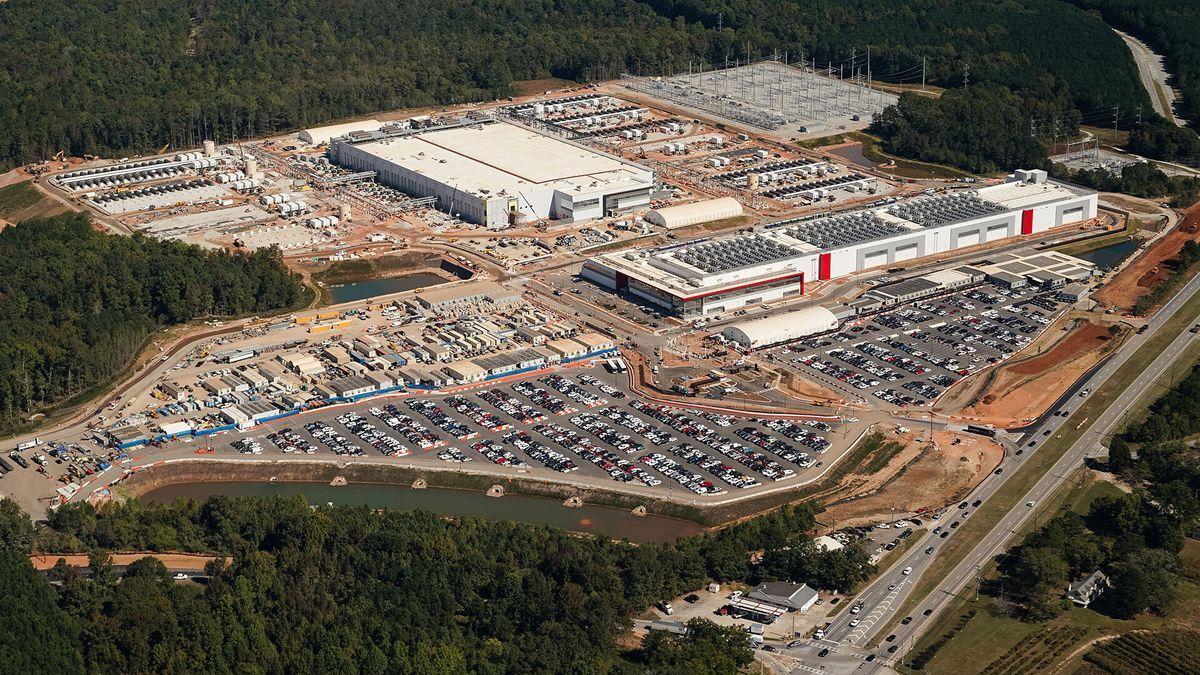
Global data center electricity consumption is projected to double by 2030, driven by AI's voracious energy needs. The challenge extends beyond generation to transmission bottlenecks and grid connections. While flexible AI factories could help balance the grid, utilities struggle to keep pace with demand that's growing faster than infrastructure can support.
The five largest technology companies spent more than $400 billion on capital expenditure in 2025, primarily directed toward AI infrastructure
5
. Yet the constraint holding back AI's expansion has shifted from semiconductors to something more fundamental: deliverable electricity. Data centers already consume roughly 6% of all electricity in the United States and the United Kingdom, and the International Energy Agency projects that global AI data center electricity demand could more than quadruple by 20301
. This surge in AI's energy consumption is forcing an urgent reckoning with the electric grid's capacity to support the AI revolution.
Source: TechRadar
The scale of this challenge becomes clear when examining specific projections. Global electricity demand from data centers will more than double by 2030, according to the IEA, reaching levels equivalent to Japan's entire annual power demand today
5
. In the United States alone, AI data centers are projected to account for nearly half of all electricity demand growth through the end of the decade. Goldman Sachs Research projects US data center power demand will more than double to 66 gigawatts by 2027 from 31 gigawatts today5
. PJM, the grid operator covering the northeastern United States, projects that data centers will account for 30 of the next 32 gigawatts of load growth by 2030.The power grid strain has reached critical levels, with three in four electricity executives now believing that data center energy demand will grow faster than utilities can keep up with
2
. Two-thirds of these executives expect power shortages to become more commonplace as demand for AI soars. The challenge extends beyond generation capacity to transmission and connection infrastructure. Samuel Videau, chief technology officer at Genius, emphasized that "the bottleneck is connection" rather than generation alone, noting that "connected megawatts trade at a premium to everything else in the sector"5
.The IEA estimates that roughly 20% of planned data center projects globally are already at risk of delays caused by grid constraints
5
. Transformer and cable delivery lead times have doubled in the past three years, while building new transmission lines typically takes four to eight years in advanced economies. This infrastructure bottleneck has become so severe that CoreWeave structured a $9 billion deal primarily to secure 1.3 gigawatts of grid-connected power capacity5
. The price tag wasn't for computing equipment but for an existing grid connection that would have taken years to permit and build from scratch.The volatile nature of AI workloads creates unpredictable peaks and troughs in demand, with 77% of electricity executives admitting they struggle to accurately forecast demand
2
. This volatility is compounded by speculative applications, with 67% of electricity executives reporting requests for future capacity, of which roughly 19% don't materialize, creating what industry analysts call "phantom demand"2
.Yet AI factories could transform from problem to solution through intelligent energy management. These facilities represent the most software-defined, controllable, and spatially mobile workload ever to consume electricity on an industrial scale
1
. As the grid approaches peak demand on hot summer days, AI factories can dynamically slow down flexible AI jobs, whether research workloads, model fine-tuning, or batchable inference tasks. Independent analyses by Duke University estimate this flexibility could unlock roughly 100 gigawatts on the existing U.S. grid alone, enough to absorb several years of AI growth without a single new transmission line1
.The energy infrastructure response is taking multiple forms as companies race to secure power. Around one-fifth of US data center projects under development are now building their own on-site gas-fired generation to bypass grid connection delays
5
. Market intelligence firm Cleanview has identified 84 GW of proposed data center projects planning to deploy onsite gas-fired generation3
. Meanwhile, Microsoft, Google, and Amazon have all signed offtake agreements with small modular reactors developers, signaling a shift toward nuclear power5
.Goldman Sachs Research estimates the grid itself may require approximately $720 billion in spending through 2030 to meet rising data center demand
5
. This massive investment cycle is reshaping which companies and regions matter most to AI's next phase, with electricity becoming as strategic as semiconductors.China's approach offers insights into managing AI's energy appetite within grid constraints. Robin Zeng, Founder and CEO of CATL, the world's biggest battery maker, revealed that regulation in China dictates all new data centers must employ 80% renewable energy
4
. This requirement is accelerating research into grid reliability and battery technology, with energy storage solutions becoming critical.CATL is developing sodium-ion batteries to reduce dependence on lithium, with Zeng revealing that in three to five years, these batteries will reach 100 gigawatt-hours annually, sufficient to fully support modern data centers
4
. The company is already using AI to optimize energy management, achieving approximately 30% savings on electricity bills through AI auto-bidders that purchase low-cost electricity from grid supply4
.Related Stories
As terrestrial energy infrastructure struggles to keep pace, space-based solar power is emerging as a potential game-changer. Companies like Overview Energy are designing technology to collect energy in orbit and transmit it using safe, near-infrared light optimized for photovoltaic panels, allowing solar assets to generate electricity at any hour
3
. This approach builds on existing infrastructure rather than requiring entirely new sites, addressing the critical need for speed to power.The appeal extends beyond data centers to broader industrial electrification needs. Advanced manufacturing, desalination, hydrogen production, and future digital infrastructure will all require abundant electricity
3
. By increasing the utilization of existing solar projects, space-based power could improve the economics of infrastructure already built while expanding available energy supply.Local opposition continues to mount against data centers as residents grow increasingly concerned about power outages and rising energy costs
2
. A county in Virginia recently told data centers to revert to backup generators to free up grid capacity for local residents during a heatwave that spiked electricity demand for air conditioning. This political backlash could significantly impact future data center development if not addressed through solutions that reduce power bills rather than raise them. Flexible AI factories that avoid expensive new grid upgrades while better utilizing existing infrastructure could help curb this opposition1
.Summarized by
Navi
[5]
15 Aug 2025•Business and Economy

27 Jun 2025•Technology
15 Oct 2024•Technology

1
Policy and Regulation

2
Policy and Regulation

3
Policy and Regulation