2 Sources
[1]
Decart's new world model can simulate hours of photorealistic driving -- with some caveats
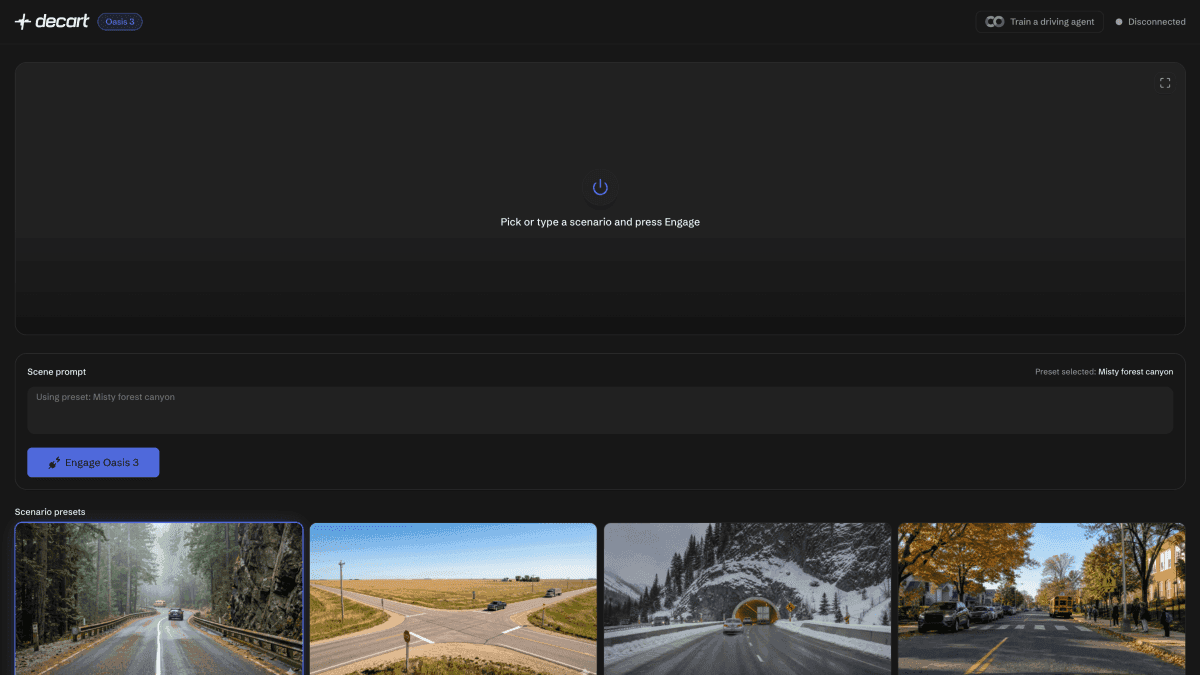
AI startup Decart on Wednesday unveiled Oasis 3, its latest interactive world model that can generate photorealistic driving environments in real time, TechCrunch has exclusively learned. The model is currently available via API. The startup is initially targeting autonomous vehicle companies that need to simulate rare driving scenarios at scale, and plans to expand into robotics and other physical AI applications. But the bigger bet is on developers: By offering API access from day one, Decart is trying to build a developer ecosystem around world models much like how OpenAI did with language models. "It's going to be the first usable world model that people can actually program on top of," Dean Leitersdorf, co-founder and CEO of Decart, told TechCrunch. "I think there's going to be an entire developer community that emerges on top of this." The startup already has a community of more than 100,000 developers, many of whom are building products on top of its real-time video model Lucy, largely in e-commerce and live streaming. Oasis 3 is based on that foundation model, and it represents the company's push into physical AI. Access is priced at $0.02 per second, and enterprise pricing depends on use cases, Decart said. Decart is playing in an increasingly packed world model arena. Last year, Google released Genie 3 in research preview, Fei-Fei Li's World Labs launched Marble for commercial use cases, and video generation startups like Luma and Runway are also translating their physics-aware video models into world models. Oasis 3's release comes a few weeks after two-year-old Decart raised $300 million, which Leitersdorf says followed "huge demand increases for the models we built" in e-commerce, live streaming and physical AI. The round boosted Decart's valuation to nearly $4 billion, and brought a series of strategic investors such as Toyota, Adobe and eBay. All of these companies are potential customers, says Leitersdorf. Nvidia, an existing investor, also participated in the round. Oasis 3's edge lies in the photo-realism of its models and infinite generation capability. That's due to some efficiency wizardry on Decart's part, powered by the company's other main product: the DOS (Decart Optimization Stack) software that allows models to run efficiently on Nvidia, Amazon and Google hardware, making its models far less expensive to run than competitors. "This is built on top of our entire real-time stack, which we optimize all the way down to the hardware," Leitersdorf said. "By being so vertically integrated, we're able to be more than an order of magnitude cheaper than anyone else in the industry in order to run these models." The startup's models are so efficient, per Leitersdorf, that it has burned through "drastically less" than $100 million in its lifetime. Oasis 3 generates physically accurate, multi-camera environments -- one front-facing and two-side facing -- for training and testing systems. And instead of offering limited demos and research previews, Decart allows developers to generate scenarios infinitely. Compared to other models I've tried, like Google's Genie 3 or World Labs's Marble, Oasis 3 delivers the most photorealistic environments from a single text prompt I've seen. And the fact that you can interact with them for hours suggests a level of efficiency that Decart's rivals might lack. But by letting you generate a world for so long, the model also degrades significantly. In my testing, I found the system could consistently set up a strong initial scene that matches the prompt, but the thematic integrity degraded rapidly as I moved through the world. I prompted it to generate a New York City street in the morning, it did so, beautifully. But as I drove along, the environment looked less like New York and more like a standard version of any urban, Western city. When I tried to turn around and make my way back to the initial intersection, it was gone, replaced by an entirely new environment. On top of that, the controls aren't very responsive, and I often lost control over where the car was moving (again, a drawback shared by other world models I've tested). The experience felt less like a coherent simulation and more of a dream-like, disjointed stream of consciousness that quickly grows nonsensical. Another issue, which I've also seen in other world models, is that the car will just drive through other cars, meaning the model doesn't simulate physics properly in the environment. Leitersdorf calls this a "major research problem that we're cracking now," attributing it to the fact that "there's drastically more data on good driving compared to accidents." Part of what makes this physics consistency difficult is fundamental to how this world model works. Oasis 3 is auto-regressive, meaning it generates one frame at a time, and looks back at what it previously generated to decide what comes next. This is a key architectural feature of many world models, and it is a compute-intensive one, too. In order to maintain consistency, Leitersdorf says the Decart team is working to improve the length of the model's memory. "Every frame we generate is roughly 8,000 tokens," he said. "Generating this at tens of frames per second -- that's hundreds of thousands of tokens per second. The context window fills up very quickly. We're researching how to do longer context to store millions more tokens, and how to compress the memory into fewer tokens." Leitersdorf thinks the consistency issue might be partially solved in the model's next version, which will allow users to start generating worlds based on a video of an environment rather than an image. He acknowledged that world models as a field are still early. Still, the founder is less focused on the current limitations of his tech than what will happen when developers get their hands on it. "It takes me back to the early days of LLMs, when OpenAI invented the API for models," he said, pointing to the emergence of a developer community that advanced the field by finding and building new use cases. "When we talk again in three months, we'll be like, 'Here's 100 developers that all built 100 different applications with Oasis that surprised all of us,'" he said.
[2]
Decart lays the foundation for physical AI systems with Oasis 3
Decart might not yet have the same kind of brand recognition as AI industry peers like OpenAI, Anthropic or Gemini, but its impact on the world could be just as monumental. The AI startup is investing heavily in laying the foundations of "physical AI," essentially a future in which autonomous robots will live and work side-by-side with humans. It's a pioneering frontier lab that's focused on the development of world models and real-time landscape generation, and it's on the verge of fulfilling that vision with the recently announced release of Oasis 3. The third generation of its world model series, Oasis 3 has dropped just weeks after Decart raised $300 million in funding from investors like Nvidia and Toyota, in a move that could position it as a vital infrastructure player at the heart of AI automation. From generative video to world models Oasis 3 represents a significant advance in the evolution of world models, introducing unprecedented real-time, action-conditioned video generation capabilities. It's designed to enable the hyper-realistic simulations needed to create the heavy-duty training environments that autonomous systems need to sharpen their skills for real-world deployment. Accessible through a live API, developers can use Oasis 3 to generate endless simulations of the realistic, physics-based real-world environments necessary to scale robotic reinforcement learning training loops. Decart has come a long way in a very short space of time. The company's original world models made a big splash in AI circles, but faced significant limitations that hampered their usefulness for robotics training. The first iteration of Oasis was introduced back in October 2024, earning much acclaim for its ability to quickly spin up interactive and playable sandbox environments that bore a resemblance to open-world games like Minecraft. Remarkably, Oasis 1 didn't generate any code to create these interactive worlds. Instead, Decart opted to use a next-frame prediction model that had been trained on millions of hours of videos of people playing computer games. Oasis 1 was impressive, but it was mostly remarkable as a novel proof of concept. That changed with the debut of Oasis 2 in September 2025. This iteration introduced significant upgrades in areas such as frame rate stability, visual fidelity and contextual memory, allowing users to change the camera perspective and then return to their original position and see that everything was in the same place. It was proof of Decart's ability to solve the challenge of long-term coherence. At the same time, Decart was also putting a lot of effort into improving the realism of its generative world models. The company launched its flagship video transformation model Lucy 1 at the same time as Oasis 2's arrival, giving users the ability to generate highly-realistic video footage and edit it in real time without any errors caused by model drift. With the subsequent release of Lucy 2.0 earlier this year, Decart added further refinements in moves that demonstrated its growing mastery of low-latency video generation, and it's these breakthroughs that led to the photorealistic detail now seen in Oasis 3. Cutting-edge specs ready for training Oasis 3 represents the culmination of Decart's advancements in both world models and generative video streams, enabling it to deliver the high-performance specifications required to enable accurate physical AI training. Thanks to the progress made in terms of stability, the model is now able to generate "endless" 3D worlds without any limitations on duration, and it can do so at an impressive throughput of 22 frames per second and at 768px resolution. While not quite at the level of detail of 4K video generators, this is a viable balance of efficiency and visual clarity required for robotics training pipelines. The company has made equally impressive gains in terms of latency, which has dropped to less than 200 milliseconds, enabling robots to interact with the simulations and instantaneously receive feedback. This immediate response is what makes reinforcement training loops possible. Some of the most notable improvements are not visual clarity or responsiveness, but in the model's ability to accurately simulate the physics of the real world. Thanks in part to its innovative multiview camera synchronization, Oasis 3 can output three camera angles simultaneously to ensure that frames generated across each perspective are always perfectly aligned. This is critical for robots to be able to perceive depth and peripheral awareness. Human imagination that informs physical reality Oasis 3 is poised to unlock some serious advances in the capabilities of autonomous robots and vehicles. The Decart API makes it simple to integrate the model's interactive generative environments into existing development pipelines and adapt them on the fly using natural language prompts. The idea is that developers will be able to create multiple driving scenarios, introduce different weather phenomena and even hazards such as other vehicles skidding over snowdrifts and breaking down, giving the autonomous car's underlying models the chance to learn how to deal with them. Traditionally, the only way for developers to train AI models on these edge use cases has been to invest in recreating such scenarios in the real world, so that humans can create the realistic training data required. But such a slow and expensive approach simply cannot be scaled to any useful degree. With Oasis 3, on the other hand, it's possible to generate an infinite number of training environments depicting just about every kind of risk one could conceivably face while out on the road. Decart says this infrastructure can be applied to almost any kind of physical AI use case. So not just self-driving cars, but also industrial drones, off-road vehicles, autonomous boats and the kinds of unique hazards they'll be exposed to. It's also perfect training fodder for humanoid robots, enabling developers to imbue them with the fine motor skills needed to manipulate different kinds of objects with their bare hands. In every case, Decart's infrastructure promises to massively increase the output of training data required to bring physical AI from the realms of science fiction into the real world.
Share
Copy Link
AI startup Decart has unveiled Oasis 3, an interactive world model that generates photorealistic driving environments in real time. Available via API at $0.02 per second, the model targets autonomous vehicle companies needing to simulate rare driving scenarios at scale. The launch comes weeks after Decart raised $300 million at a nearly $4 billion valuation, with backing from Toyota, Nvidia, and Adobe.
Decart has launched Oasis 3, its latest interactive world model designed to generate photorealistic driving environments in real time for autonomous vehicle companies and robotics developers
1
. The AI startup made the model available via API, marking a strategic push to build a developer ecosystem around world models similar to how OpenAI cultivated its community around language models. Access is priced at $0.02 per second, with custom enterprise pricing available depending on use cases1
.The release comes just weeks after the two-year-old company raised $300 million in funding, boosting its valuation to nearly $4 billion
1
. Strategic investors including Toyota, Adobe, eBay, and existing backer Nvidia participated in the round, positioning themselves as potential customers for Decart's physical AI systems1
.
Source: TechCrunch
Oasis 3 represents a significant leap in action-conditioned video generation capabilities, delivering what Decart CEO Dean Leitersdorf calls "the first usable world model that people can actually program on top of"
1
. The model generates physically accurate, multi-camera environments with one front-facing and two side-facing views, operating at 22 frames per second at 768px resolution with less than 200 milliseconds of latency2
.Unlike competitors offering limited demos and research previews, Decart allows developers to generate scenarios infinitely through real-time generation capabilities
1
. This unlimited duration capability stems from Decart's Optimization Stack (DOS) software, which enables models to run efficiently on Nvidia, Amazon, and Google hardware. The vertical integration makes Decart's models "more than an order of magnitude cheaper than anyone else in the industry," according to Leitersdorf1
.Decart is initially targeting autonomous vehicle companies that need to simulate rare driving scenarios at scale, but plans to expand into robotics and other physical AI applications
1
. The company already has a community of more than 100,000 developers building products on top of its real-time video model Lucy, largely in e-commerce and live streaming1
. Oasis 3 builds on that foundation model, representing the company's push into AI automation and autonomous robots2
.The model's multiview camera synchronization ensures frames generated across each perspective remain perfectly aligned, which is critical for robots to perceive depth and peripheral awareness
2
. Developers can integrate Oasis 3's interactive generative environments into existing development pipelines and adapt them using natural language prompts2
.Related Stories
Despite delivering the most photorealistic environments from a single text prompt compared to competitors like Google's Genie 3 or World Labs's Marble, Oasis 3 faces notable limitations
1
. Testing revealed that while the system consistently sets up strong initial scenes matching prompts, thematic integrity degrades rapidly during extended use. A New York City street scene, for instance, gradually transformed into a generic urban Western city, with the original intersection disappearing entirely when attempting to return to it1
.Physics simulation presents another challenge, as vehicles in the simulation drive through other cars rather than colliding with them. Leitersdorf acknowledges this as "a major research problem that we're cracking now," attributing it to the fact that "there's drastically more data on good driving compared to accidents"
1
. The issue stems partly from Oasis 3's auto-regressive architecture, which generates one frame at a time by looking back at previously generated content1
.Decart is playing in an increasingly competitive arena, with Google releasing Genie 3 in research preview, Fei-Fei Li's World Labs launching Marble for commercial use cases, and video generation startups like Luma and Runway translating their physics-aware video models into world models
1
. The startup's efficiency advantage and developer ecosystem strategy may determine whether it can establish itself as vital infrastructure for the emerging physical AI industry.Summarized by
Navi
[1]
19 May 2026•Technology

20 Dec 2024•Technology

19 Dec 2024•Technology

1
Technology

2
Business and Economy

3
Health