Decart raises $300M to scale world models and real-time AI across Amazon, Nvidia, and Google chips


2 Sources
[1]
Decart raises $300M to put a real-time world model in front of Amazon's chips
Radical Ventures led the round, with Nvidia, Sequoia, Benchmark, Adobe, and Toyota alongside. Andrej Karpathy, Michael Eisner, and the Nintendo family are angels. Total raised is now over $450m. Decart, the AI research lab building real-time video and world models, announced on Monday it had
[2]
Decart raises $300M for its AI optimization software, world models - SiliconANGLE
Decart raises $300M for its AI optimization software, world models Artificial intelligence developer Decart.ai Inc. today announced that it has raised $300 million in funding at a nearly $4 billion valuation. Radical Ventures led the round with participation from Nvidia Corp., Adobe Ventures,
Share
Copy Link
Decart raises $300M in funding led by Radical Ventures, with backing from Nvidia, Sequoia, Adobe, and Toyota. The AI research lab is deploying real-time world models across gaming, retail, and robotics, with its Lucy2 model now running on Amazon's Trainium3 chips. The round values the two-year-old company at nearly $4 billion.
Decart Secures $300M to Accelerate Real-Time AI Deployment
Decart, the AI research lab building real-time video and world models, announced it has raised $300 million in new funding led by Radical Ventures
1
. The round brings the two-year-old company's total funding past $450 million and values it at nearly $4 billion2
. Nvidia, Atreides Management, Valor Equity Partners, Adobe Ventures, Toyota Ventures, and eBay Ventures joined as new investors alongside returning backers Sequoia Capital, Benchmark, and Zeev Ventures1
. The angel investor list signals the company's strategic positioning across media, gaming, and infrastructure, featuring OpenAI co-founder Andrej Karpathy, former Disney chief executive Michael Eisner, the Nintendo family, and gaming investor Moritz Baier-Lentz1
2
.DOS Platform Drives AI Training and Inference Across Multiple Chip Architectures
Decart's AI optimization software centers on its DOS platform, the Decart Optimization Stack, which runs across Nvidia GPUs, Google TPUs, and Amazon Trainium chips
1
. The company claims DOS delivers 1,600 tokens per second for agentic inference against an industry average of around 200, plus full-HD video inference at up to 100 frames per second1
. DOS 2.0, announced alongside the funding, enables AI agents to process over 1,600 tokens per second—eight times the industry average—and allows world models to process up to 100 frames of high-definition video per second2
. The platform addresses a critical bottleneck: developers typically spend months optimizing neural networks for each chip they plan to use, but DOS compresses this workflow into a few weeks2
. Decart says it's generating "significant revenue" from DOS licensing agreements with cloud providers and AI labs, though specific run-rate revenue figures were not disclosed1
2
.Lucy Enables Real-Time Video Modifications for Retail and Streaming
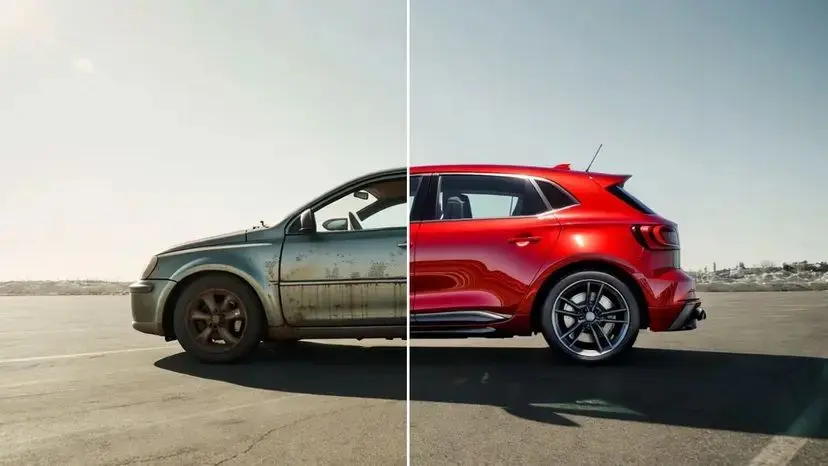
Lucy, Decart's world model for immersive experiences, responds to user input in under 30 milliseconds and is now deployed across virtual try-on, live streaming, and dynamic advertising
1
. The model takes a video stream as input and modifies depicted objects in real-time—enabling department stores to power smart mirrors for virtual clothing trials or interior design firms to generate different furniture combinations2
. Lucy addresses a persistent challenge in video models: quality issues that cascade across frames. Decart equipped Lucy with the ability to catch and fix such issues early by showing the model its "own imperfect outputs" during training2
. Lucy is in production with retailers and streaming platforms, according to the company1
. Lucy 2.5 is expected in the coming weeks1
.Amazon Partnership Validates Physical AI Applications
The Amazon partnership represents substantive commercial validation for Decart's technology. The company describes itself as one of the first to deploy real-time AI models of this class and scale on AWS Trainium, with its Lucy2 model running on Trainium3
1
. Nafea Bshara, vice-president of Amazon's Annapurna Labs, said Lucy2 exceeds 80% Model FLOPS Utilisation, meaning more of the chip's raw power is doing productive work1
. This positions Decart as a public reference point for Amazon Trainium and Google TPU, even as the company remains a Nvidia portfolio asset1
.Related Stories

Oasis Targets Robotics and Autonomous Systems
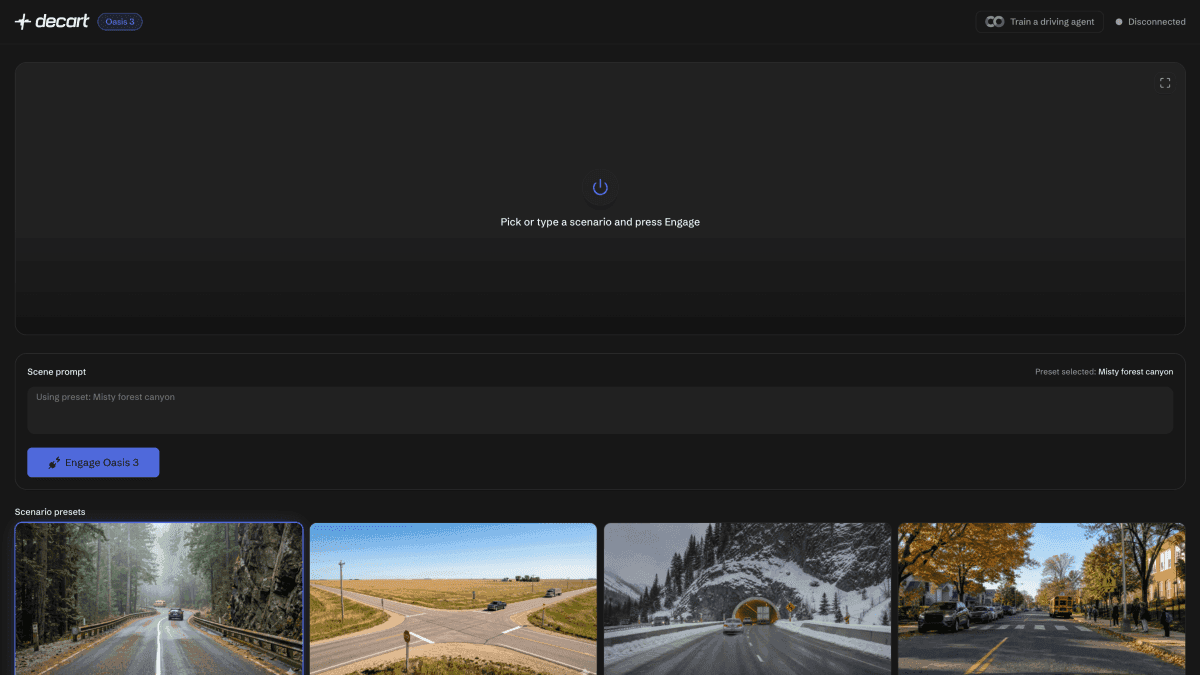
Oasis, Decart's parallel product for physical AI applications, has been positioned toward robotics and autonomous systems customers since its original real-time Minecraft-style demo went viral in October 2024
1
. The model generates three-dimensional environments such as simulated warehouses for logistics automation2
. Lucy can generate training data for robots by creating videos showing robotic arms picking up different packages, automatically generating numerous parcel variations2
. Robot developers with advanced requirements can combine Lucy with Oasis to create comprehensive training environments2
. Oasis 3 is expected in the coming weeks1
.Strategic Positioning Amid Real-Time AI Bottleneck
Decart CEO Dean Leitersdorf described world models as "the key to moving AI from the virtual world into the physical world," arguing that language models "fundamentally operate in text" and "don't understand how the physical world behaves"
1
. The company's funding trajectory reflects rapid market validation: Decart closed a $32 million Series A at a $500 million valuation in December 2024, four months after its $21 million seed; Fortune reported in August 2025 that Decart had raised $100 million at a $3.1 billion valuation1
. Leitersdorf and co-founder Moshe Shalev have been building the company since 2023, articulating a thesis that vertically integrated optimization, rather than larger models, is the missing layer of the real-time AI stack1
. As the industry conversation around AI-generated media moves from possibility to procurement decisions, real-time, low-latency inference at production scale remains the bottleneck most existing video models have not solved1
.References
Summarized by

Navi
Related Stories
Decart Secures $32M in Series A Funding, Pioneering Real-Time Generative AI and Efficient AI Infrastructure
20 Dec 2024•Technology

Decart Secures $100M Funding at $3.1B Valuation, Pushing Boundaries of Real-Time Creative AI
08 Aug 2025•Technology

Decart launches Oasis 3 world model to simulate photorealistic driving for autonomous vehicles
10 Jun 2026•Technology
Recent Highlights
1
Meta Unveils Muse Wonder Frontier AI Models, Claims Performance Matching OpenAI and Anthropic
Technology

2
IMF Report Warns AI Market Correction Could Spark Global Financial Crisis With $1.4T at Risk
Business and Economy

3
OpenAI Releases 722 AI-Generated Math Solutions, Triggering Existential Crisis in Mathematics
Technology

Recent Highlights
Today's Top Stories








Don’t drown in AI news. We cut through the noise - filtering, ranking and summarizing the most important AI news, breakthroughs and research daily. Follow topics that matter to you and stay ahead.


