Disney Plus and ESPN Roll Out AI-Powered Search to Tackle Streaming Indecision


3 Sources
[1]
Disney Plus tries a new AI-powered search
Disney is testing a new AI-powered tool for Disney Plus that uses a natural language search, a voice query, or a suggested prompt to create a customized row of show and movie recommendations. Disney Plus, like other streaming services, can recommend shows to watch based on your viewing history.
[2]
After Netflix, now Disney Plus wants you to chat with AI to figure out what to watch next
These new AI features are currently in beta and only available to a small portion of app users. It's hard to escape generative AI today, especially considering the rapid adoption of AI features across a variety of devices and apps. But when implemented correctly, some of these tools can
[3]
Disney+ and ESPN are testing AI-powered search that lets users describe what they want in plain language
Disney+ and ESPN are beta testing AI search with small user groups. ESPN answers natural language sports queries. Disney+ recommends content by mood. Personal Intelligence connects Gmail and Calendar. US rollout. Disney is testing AI-powered search inside both ESPN and Disney+, the company
Share
Copy Link
Disney is beta testing AI-powered search on Disney Plus and ESPN with select subscribers. The tools use natural language queries to recommend content based on mood rather than viewing history. This move positions Disney alongside Netflix and Warner Bros. Discovery in the race to solve content overload through AI-driven personalization.
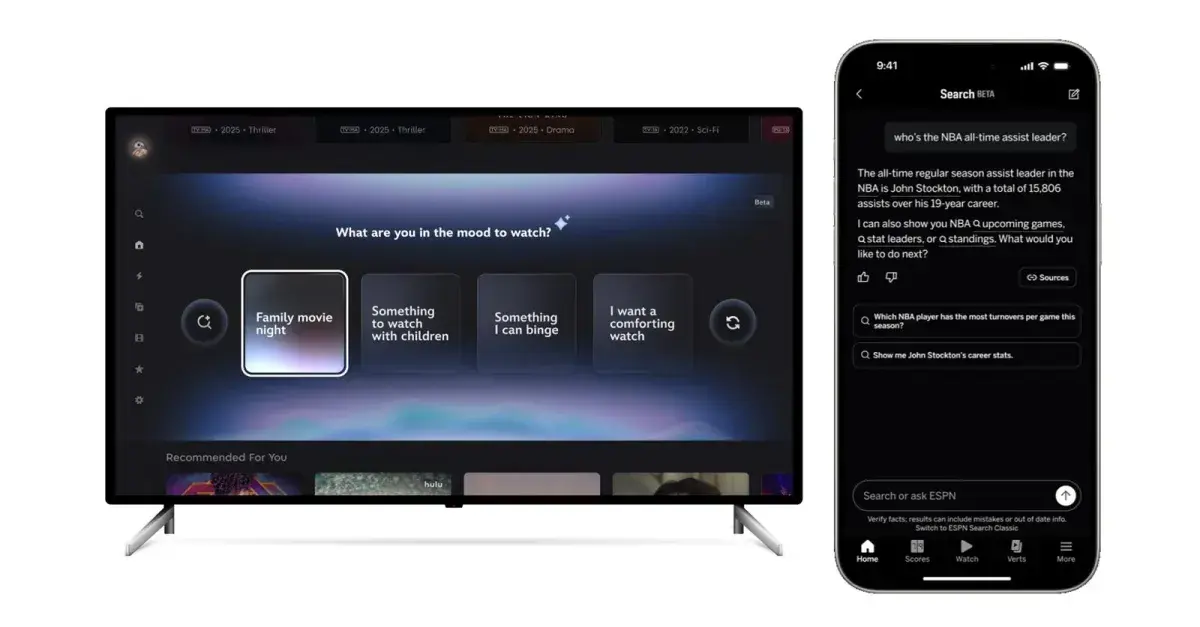
Disney Plus Introduces AI-Powered Discovery Feature
Disney is beta testing a new AI-powered search tool for Disney Plus that accepts natural language queries, voice commands, or suggested prompts to generate customized rows of show and movie recommendations
1
. This limited beta experiment is currently available to a small group of select subscribers in the US2
. The AI-powered discovery feature appears at the top of the Disney Plus app's home page on television devices, offering viewers more control over their content selection2
.Unlike traditional recommendation systems that rely on viewing history, this tool is designed to recommend content that fits the moment
1
. A subscriber who typically watches crime dramas but wants something lighthearted can describe their current mood, and the system surfaces appropriate content rather than pattern-based suggestions3
. The streaming platform aims to help viewers move from "I don't know what to watch" to immediate recommendations based on their present state of mind rather than past behavior3
.ESPN Rolls Out AI-Assisted Conversational Search
ESPN is simultaneously testing an AI-assisted conversational search experience that functions more like a traditional chatbot
1
. ESPN Search allows a subset of users to ask sports questions in natural language and receive answers, statistics, related content, and recommendations drawn from ESPN's vast sports knowledge ecosystem3
. This knowledge base includes decades of ESPN's articles, videos, research data, and internal repositories3
.Fans can ask specific questions like "who has the most rushing yards in a single playoff game" and receive direct answers with supporting content rather than a list of links
3
. The ESPN app appears to include an option for users to switch back to the classic search experience, potentially through a settings toggle2
.Disney Joins Streaming Platforms Racing Toward AI-Driven Personalization
Disney's beta testing follows similar moves by other major streaming platforms. Netflix started testing an OpenAI-powered conversational search tool last year and already offers a native voice search feature
1
. Warner Bros. Discovery announced last week that it is experimenting with a conversational search experience for HBO Max1
. Even Peacock recently added an AI Andy Cohen that narrates Bravo clips1
. Amazon is rebuilding Prime Video around AI recommendations in a project called Lighthouse3
.During an earnings call this week, Disney CEO Josh D'Amaro emphasized plans to make Disney Plus the "digital centerpiece" of the company with "increased personalization, exclusivity, and benefits for subscribers"
1
. The competitive pressure is mounting as every major streaming platform addresses the same challenge: viewers spend excessive time deciding what to watch and sometimes abandon the search entirely3
.Related Stories


Understanding the Stakes in Streaming's AI Evolution
The introduction of generative AI search tools represents streaming platforms' response to content overload created by their own massive catalogs
3
. When implemented correctly, these AI features can potentially improve the user experience by helping subscribers quickly identify content that matches their immediate preferences2
.Disney's approach remains in the earliest stage compared to competitors, with no announced launch date for wider availability
3
. Whether these beta features reach all subscribers depends on test results from the current limited rollout. The streaming wars have opened a new front: determining which platform can help viewers decide what to watch fastest through natural language queries and mood-based recommendations3
.References
Summarized by

Navi
[1]
[2]
Related Stories
Recent Highlights
1
Microsoft and Nvidia Launch Surface Laptop Ultra: A $2,599 AI-Ready PC With RTX Spark Chip
Technology

2
Scientists Build AI Model That Reconstructs Images From Brain Scans in Record Time
Science and Research

3
Anthropic AI Cuts Live Internet Access After Model Sends False Homicide Tip to Philadelphia Police
Technology

Recent Highlights
Today's Top Stories









Don’t drown in AI news. We cut through the noise - filtering, ranking and summarizing the most important AI news, breakthroughs and research daily. Follow topics that matter to you and stay ahead.


