4 Sources
[1]
Netflix has its own, impressive AI-powered voice search
A small subset of Netflix viewers just got a new way to find movies and TV shows. The streamer recently started to test an AI-powered native voice search feature with some subscribers, prompting them to press the Netflix button on their remote control to ask for viewing recommendations. Once viewers press the button, they're presented with a few search suggestions, including phrases like "I need a good cry," "watch in the background," and "help me stay awake." Each of these suggestions leads to a set of viewing recommendations, but there's also an "Ask" button with a waveform icon. Select it, and you'll start an AI-powered voice search that delivers viewing recommendations in response to natural language prompts. I've had access to this new voice search feature for a few days now, and found it remarkable for two reasons: While still in beta, it's impressive in its ability to serve up appropriate and interesting viewing recommendations to even the most esoteric requests. It also squarely circumvents the voice assistants and search features built into smart TVs and streaming devices, highlighting the power struggles between TV OS platforms and the streaming services running on them. Netflix is currently testing its new voice search feature with select members in the U.S. I got access to the feature on a Chromecast with Google TV streaming dongle and a TCL Google TV, but wasn't able to access it on Roku or Fire TV devices. Even users who have multiple devices running the same smart TV OS have reported that they were only able to access it on a subset of those devices. Playing with the feature for a few days, I was impressed by its ability to find relevant picks for a wide variety of requests, ranging from the rather obvious ("date night movies from the '80s" served up The Breakfast Club) to the very specific ("I like the music of Brian Eno, what should I watch" resulted in a suggestion for Abstract: The Art of Design). I stress-tested the feature more than people usually would during day-to-day use, but it was able to make solid recommendations in response to unusual requests. I honestly thought asking for "fun kids TV shows about death" wouldn't get me any results. Instead, it served up A Series of Unfortunate Events and Raising Dion, which both were on point. "I had too much coffee today, what should I watch" resulted in Netflix suggesting a "laid-back" Sheng Wang comedy special and the Headspace Guide to Sleep. When I simply said "hurt people hurt people," the Netflix app responded with "Hurt people do hurt people. Here are some of the stories behind that," followed by recommendations for 13 Reasons Why and It's Okay to Not Be Okay. Interestingly, Netflix's voice search doesn't appear to be tapping into the service's personalization engine right now. When you ask for recommendations based on what you've recently watched, the app's response is "We can't answer that one yet, but we're working on it!" (Speaking of which: All responses are shown as written text. Netflix's voice search doesn't use any voice output of its own, which I didn't mind at all.) Responses are often accompanied by suggestions to further narrow your results, including "more unhinged" and "more bittersweet." However, narrowing down recommendations this way doesn't always work. A search for Cantonese comedies yielded many relevant results. But once I followed Netflix's suggestion to narrow those results by pressing the "more quirky" button, the streamer suddenly tried to sell me BoJack Horseman as a "Cantonese comedy with a quirky twist." There are some things that can trip up Netflix's voice search. When I asked for Blaxploitation movies, the app's voice recognition system instead heard me ask for "Black exploitation movies," and declined to provide me with any results. Which, yeah, probably the right choice. A request for "TV shows about porn" was also declined, but Netflix did happily serve up plenty of suggestions when I requested "steamy TV shows." That's notably different from Google's Gemini assistant on Google TV, which informed me that it could not fulfill that request, adding passive-aggressively: "I can help you find appropriate shows if you'd like." That alone shows why a service like Netflix might want to have its own voice search instead of relying on the one provided by your TV or streaming device maker. Another major reason for Netflix to build its own voice search: The streamer wants viewers to remain in its own app, and exclusively recommends Netflix content. Smart TV OS platform operators like Google, Roku, and Amazon on the other hand would like consumers to use their own, universal search that also recommends results from their own services and services from partners they can monetize. This power struggle between platforms and publishers has been going on for years, and has also long extended into voice search. For consumers, the results have been confusing: When you press your remote's mic button while using Hulu or Disney Plus, you'll most likely access the universal search function built into your TV or streaming device, with results from the app you're in intermixed with those of other publishers. Do the same while browsing Netflix or YouTube, and you're only searching the catalogs of those respective apps. Thanks to their market share, YouTube and Netflix have so much power that they have been able to demand voice routing privileges not available to smaller publishers. Both companies initially just used that privilege for speech-to-text functionality, essentially feeding your voice queries into the same search fields you can also access with your remote to search for a show by name. With the emergence of LLMs, both services now extend those privileges for more full-featured voice assistance. YouTube recently launched its own conversational AI tools, allowing viewers to access Gemini-powered voice features on devices made by Amazon, Roku, and others. Just like YouTube's implementation, Netflix's take on AI voice search shows that consumers can benefit if apps have access to the mic. It just shouldn't take massive market share -- or a branded button on your remote -- for publishers to get to build such experiences.
[2]
Netflix on TV makes it easier to fumble less and chill more with voice search test
The feature is currently only available to a small set of users. If you've had just about enough of using a TV remote to type and search for things to watch, Netflix has some good news for you. The company is reportedly testing a new AI-based voice search within its smart TV app that lets users find things to watch using natural language queries. According to the report from The Verge, the feature isn't widely available and is being tested with a limited group of users in the US. Even among those users, it is reportedly only accessible on a subset of their devices. Users with access to the tool can press the Netflix button on their remote to activate the AI voice search. Netflix offers up some suggested searches alongside an "Ask" button which leads to the AI-powered search, allowing users to speak to search, and find things to watch. Voice search reportedly does very well with most queries and can surface relevant TV shows and movies even for difficult searches. In fact, an odd query like "fun kids TV shows about death" reportedly surfaced A Series of Unfortunate Events, which definitely fits that description. Netflix also seems to have ensured that the search doesn't respond to certain kinds of searches, including those with racist overtones. This certainly seems to be a well-thought-out move from the company, even though it's still in beta. However, it's missing some key features. For example, it can't surface shows based on users' watch history or use their personalized recommendations. That omission is surprising, since Netflix's personalized recommendations are exceptionally good. Having those included in this new AI-powered voice search would have made it an even better tool. Netflix seems to be working on some out-of-the-box features in recent times as well, including a voice chat option for gaming, and a vertical video feed in the mobile app. Though we are not sure when Netflix might roll out this upgrade to everyone, it is certainly worth waiting for, if its reported accuracy is to be believed.
[3]
Netflix is testing its own voice search feature and it sounds less frustrating
A new beta feature lets select Netflix users search by mood or vibe using AI voice search. Finding something to watch on Netflix can feel like a chore. This is why Netflix has quietly rolled out a native AI-powered voice search feature to a small group of users in the US (via The Verge). Instead of typing a title, you just describe what you're in the mood for and let Netflix figure out the rest. It's still in beta, but early impressions are solid. How does Netflix's voice search actually work? Users who have access to the feature right now are prompted to press the Netflix button on their remote, which brings up a few mood-based suggestions like "I need a good cry" or "watch in the background." Recommended Videos There's also an "Ask" button that kicks off the AI voice search. You can speak naturally, and Netflix responds with recommendations displayed as text on screen. However, there's no voice output on Netflix's end. A Reddit user who spotted the feature on a Sony A80J Google TV called it a long-requested addition, noting it worked great right away. Early testers have found it surprisingly sharp, handling unusual requests like "I had too much coffee today, what should I watch," which served up a laid-back comedy special and the Headspace Guide to Sleep. You can also narrow things down with follow-up requests like "more unhinged" or "more bittersweet." The voice search feature on Netflix doesn't tap into your viewing history yet, so the recommendations aren't personalized. Why isn't Netflix just using the search that's already on your TV? The feature currently works on Chromecast with Google TV and TCL Google TV devices, but not on Roku or Fire TV. That's probably because Netflix wants you searching inside its own app, not getting redirected to a platform-wide search that mixes in results from competing services. When you use the mic button inside Hulu or Disney Plus, you're usually routed to Google, Roku, or Amazon's universal search. Netflix, like YouTube, has enough market power to keep that in-house. There is no word yet on a wider rollout, but if this beta holds up, the days of aimlessly scrolling Netflix might finally be numbered.
[4]
Netflix Is Reportedly Testing an AI-Powered Voice Search Feature
Netflix's AI voice search does not fulfil inappropriate requests Netflix is reportedly testing a native artificial intelligence (AI)-powered voice search feature. As per the report, the California-based streaming giant is building a semantic search system that can recommend and surface content based on user intent and contextual cues. The feature is currently available in beta and is said to be accessible to only a select group of users. It is unclear when the company might release it for all users, or if it plans to reserve it for specific tiers. Netflix Reportedly Testing AI Voice Search According to The Verge, the streaming giant has rolled out the AI voice search in beta to a limited number of users in the US. It is said that the capability is currently only available on a specific device/platform combination. The publication said it worked on a "Chromecast with Google TV streaming dongle and a TCL Google TV." However, the AI experience was reportedly not available on Roku or Fire TV devices. Once the Netflix feature is activated, users are reportedly shown a few search suggestions, such as "watch it in the background" and "I need a good cry." Selecting these options is said to open up a set of recommended content. The report mentioned that there is also an "Ask" button with a waveform icon that lets users request movies and web series based on their mood or any random criteria, such as "movies after a long, tiring day." The underlying large language model (LLM) is said to be capable enough to understand the intent of the user and present them with accurate suggestions, even for obscure prompts. For instance, the report mentioned that when the voice search feature was stress-tested with "fun kids TV shows about death," the AI surfaced A Series of Unfortunate Events and Raising Dion, both of which fit the description perfectly. There are some limitations to the beta version of the Netflix feature. The report mentions that it cannot connect to the platform's personalisation engine and cannot suggest content based on a user's watch history. It reportedly also does not talk back to the user and can only respond via text. Finally, the AI search is also said to be prone to making some mistakes when surfacing content, but those instances were said to be rare.
Share
Copy Link
Netflix is testing an AI-powered voice search feature with select US subscribers that lets them find content using natural language queries like "I need a good cry" or "help me stay awake." The beta feature works on Google TV devices but bypasses platform voice assistants, keeping users within Netflix's app while delivering surprisingly accurate viewing recommendations.
Netflix has begun testing a native AI-powered voice search feature with a small subset of subscribers in the United States, marking a significant shift in how streaming services approach content discovery
1
. The feature allows viewers to press the Netflix button on their remote control to access viewing recommendations through natural language queries, transforming the traditional search experience into a conversational interface2
.

Source: Android Authority
The beta feature currently works on specific device combinations, including Chromecast with Google TV streaming dongles and TCL Google TV devices, but remains unavailable on Roku or Fire TV platforms
1
4
. Even among users with access, the feature appears on only a subset of their devices, suggesting Netflix is conducting a carefully controlled voice search test2
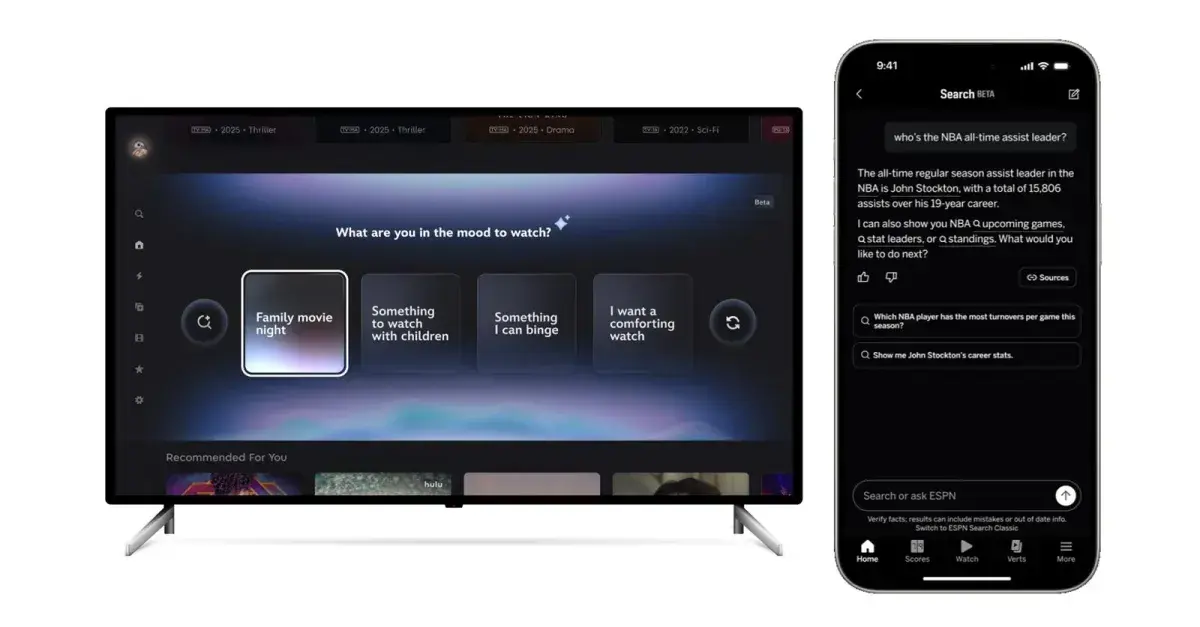
.When activated, the AI-powered voice search feature presents users with mood-based suggestions like "I need a good cry," "watch in the background," and "help me stay awake"
1
3
. An "Ask" button with a waveform icon enables the semantic search system, which processes content based on user intent and contextual cues4
.
Source: The Verge
The underlying large language model (LLM) demonstrates impressive accuracy even with obscure requests. When tested with "fun kids TV shows about death," the system surfaced A Series of Unfortunate Events and Raising Dion, both fitting the unusual criteria
2
4
. Another query, "I had too much coffee today, what should I watch," resulted in Netflix suggesting a laid-back Sheng Wang comedy special and the Headspace Guide to Sleep1
3
.The system also offers refinement options, allowing users to narrow results with suggestions like "more unhinged" or "more bittersweet," though this functionality doesn't always work perfectly
1
3
.Netflix's decision to build its own in-app search experience highlights ongoing power struggles between streaming services and TV OS platforms like Google, Roku, and Amazon
1
. While platforms like Google TV offer universal search that recommends content from multiple services, Netflix keeps users exclusively within its ecosystem, recommending only Netflix content1
3
.This approach mirrors YouTube's strategy and demonstrates Netflix's market power to maintain control over the user experience
3
. When users activate voice search on other apps like Hulu or Disney Plus, they're typically routed to platform-wide search that mixes results from competing services, something Netflix clearly wants to avoid3
.Related Stories
Despite its impressive capabilities, the beta feature has notable limitations. The AI-powered voice search feature currently cannot connect to Netflix's personalization engine, meaning it doesn't surface content based on users' watch history
1
2
. When users ask for recommendations based on recently watched content, the smart TV app responds with "We can't answer that one yet, but we're working on it!"1
This omission is particularly surprising given that Netflix's personalized recommendations are considered exceptionally strong
2
. The system also provides responses only as written text without any voice output, though early testers haven't found this to be a significant drawback1
4
.Netflix has implemented safeguards to decline inappropriate requests, including those with racist overtones
2
4
. The system occasionally makes mistakes when processing voice recognition or surfacing content, though such instances appear rare1
4
.The introduction of natural language queries represents a meaningful improvement over traditional remote-based typing for finding content
2
3
. If the beta feature proves successful and rolls out widely, it could reduce the frustration of endless scrolling that has become synonymous with the Netflix experience3
.The company has been exploring various experimental features recently, including a voice chat option for gaming and a vertical video feed in the mobile app
2
. However, Netflix has not announced when or if this AI-powered search capability will expand beyond the current limited test group, or whether it might be reserved for specific subscription tiers4
. As the feature continues testing, integration with the personalization engine and expansion to additional TV OS platforms will be key developments to monitor.Summarized by
Navi
[2]
1
Technology

2
Policy and Regulation

3
Policy and Regulation