Trump backs AI safety rules but warns against letting US fall behind China in tech race


3 Sources
[1]
Trump says AI risks can be managed, signals openness to guardrails
Nov 8 (Reuters) - US President Donald Trump said the risks posed by artificial intelligence can be managed but signaled an openness to safeguards, telling CBS's "60 Minutes" that he "doesn't mind guardrails." Asked whether the United States should accept the risks of artificial intelligence in
[2]
Trump Says AI Risks Can Be Managed, Signals Openness to Guardrails
Nov 8 (Reuters) - US President Donald Trump said the risks posed by artificial intelligence can be managed but signaled an openness to safeguards, telling CBS's "60 Minutes" that he "doesn't mind guardrails." Asked whether the United States should accept the risks of artificial intelligence
[3]
Trump Backs AI Safety Rules but Wants the US to Stay Ahead of China
US President Donald Trump has expressed support for AI safety guardrails but warned against rules that could weaken America's tech lead over China. His remarks signal openness to regulation without confirming any new policy. US President Donald Trump has said he is fine with putting guardrails on
Share
Copy Link
US President Donald Trump expressed openness to AI regulation and guardrails during a CBS 60 Minutes interview, signaling potential bipartisan collaboration on safety measures. However, he cautioned that excessive regulation could weaken America's competitive edge against China in artificial intelligence development.
Trump Shifts Stance on AI Regulation
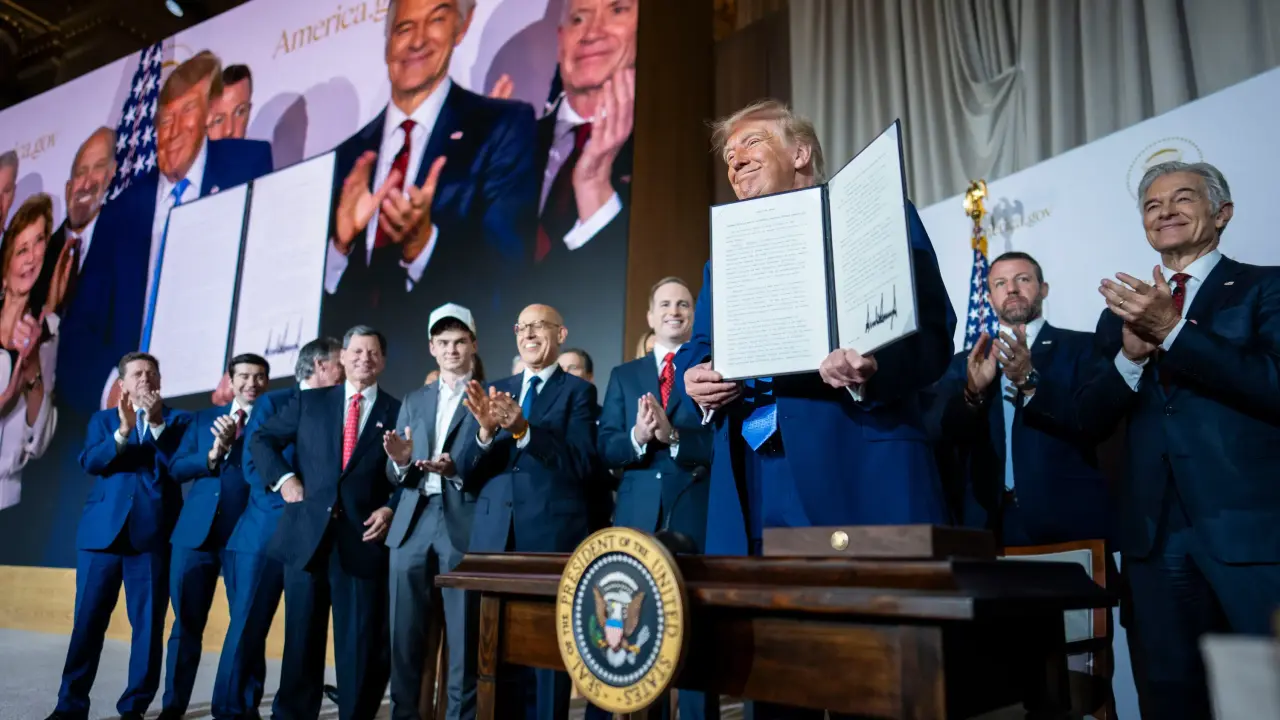
US President Donald Trump expressed openness to guardrails for artificial intelligence during a CBS 60 Minutes interview that aired on November 8, marking a notable shift from his previous preference for self-regulation by tech companies
1
. When asked whether the United States should accept AI risks to maintain its lead over China, Trump stated that the dangers were manageable and indicated willingness to work with Democrats on safeguards2
."I don't mind guardrails," Trump told CBS, though he emphasized that any AI safety rules must not place the United States in "a deep second position" behind China
1
. His comments suggest that while Donald Trump is open to some form of government oversight of AI risks, he remains cautious about implementing measures that could disadvantage American tech companies in the intensifying US-China competition.Balancing Safety and Competitive Advantage
The President's remarks highlight the delicate balance policymakers face between protecting citizens and maintaining technological leadership. Trump noted that China operates with fewer restrictions on artificial intelligence development, raising concerns that excessive regulation in the United States could handicap domestic innovation
3
. This perspective reflects broader anxieties about geopolitical competition in AI, where national security and economic dominance are increasingly intertwined.Trump has historically favored letting technology companies police themselves rather than imposing sweeping government restrictions
1
. His latest comments represent a potential evolution in thinking, though he stopped short of endorsing specific policies or frameworks. The administration has not announced any concrete plans for AI regulation, leaving the extent and nature of potential safeguards unclear3
.Potential for Bipartisan Policy Development
Trump's expressed willingness to collaborate with Democrats on AI safety measures could open pathways for bipartisan policy discussions
2
. Lawmakers across party lines have been studying the risks posed by advanced AI systems, and a shared approach might accelerate legislative progress on this critical issue. Areas that could emerge in future discussions include safety testing protocols, transparency requirements, and corporate responsibility standards for AI development3
.The challenge lies in crafting rules that protect people while preserving space for innovation. Policymakers must determine how to implement meaningful safeguards without stifling the technological advancement that keeps the US ahead in the global AI race. Trump's acknowledgment that AI risks can be managed suggests confidence that appropriate measures can mitigate dangers without compromising competitiveness.
Related Stories

What This Means for AI Development
The President's comments arrive at a pivotal moment when artificial intelligence capabilities are expanding rapidly and concerns about safety, bias, and misuse are mounting. His openness to guardrails, even while prioritizing American technological dominance, indicates recognition that some level of oversight may be necessary. However, the lack of specific proposals means stakeholders—from tech companies to civil society groups—remain uncertain about what form regulation might take.
For now, Trump's stance represents openness rather than confirmed policy change
3
. Whether this translates into actual legislation or regulatory frameworks depends on forthcoming negotiations and whether bipartisan consensus can be reached. The US continues to view China as its primary rival in artificial intelligence, making the intersection of national security, technology leadership, and AI safety central to any regulatory debate. Watch for signals about specific safety measures the administration might support and how tech companies respond to potential oversight requirements.References
Summarized by

Navi
[3]
Related Stories
Trump Backs AI Self-Regulation as Tech Giants Sign Voluntary Agreement, Rejects China Partnership
29 Sept 2026•Policy and Regulation
Trump's AI strategy prioritizes military adoption and cybersecurity over industry regulation
06 Jun 2026•Policy and Regulation

Trump backs AI safeguards in banking system, acknowledges risks after cybersecurity warnings
15 Apr 2026•Policy and Regulation

Recent Highlights
1
Anthropic AI Development Doubles Speed as Self-Improving Systems Near Breakthrough
Technology

2
Google's AI Policy Forces Schools to Accept AI Overviews or Lose Search Access Entirely
Technology

3
Nvidia Opens Investigation as Jensen Huang Faces Chinese Spy Allegations Linked to $2B Chip Smuggling
Policy and Regulation
Recent Highlights
Today's Top Stories







Don’t drown in AI news. We cut through the noise - filtering, ranking and summarizing the most important AI news, breakthroughs and research daily. Follow topics that matter to you and stay ahead.


