Tesla completes AI5 chip design with 40X performance leap, but deployment still years away


6 Sources
[1]
Elon Musk demonstrates first sample of Tesla AI5 processor, accidentally thanks TSC rather than TSMC -- claims 40X performance boost over the predecessor
Elon Musk on Wednesday showcased an image of one of the first samples of Tesla's AI5 hardware that will be used to drive AI applications in Tesla's cars, Optimus robots, and potentially xAI data centers. The AI5 processor is about half of the reticle size, uses industry-standard memory, and yet can
[2]
Tesla taped out AI5 chip, Musk says -- nearly 2 years behind schedule
Tesla has taped out its next-generation AI5 self-driving chip, CEO Elon Musk said overnight, a key milestone that sends the final design to the foundry for fabrication. The tape-out comes nearly two years after Tesla originally promised AI5 would be in vehicles, and it still leaves volume
[3]
Tesla AI5 AI chip taped out in partnership with Samsung and TSMC
TL;DR: Tesla has finalized the design of its AI5 chip for Full Self-Driving, matching NVIDIA Hopper's performance and potentially rivaling Blackwell with dual setups. Produced at Samsung and TSMC facilities, AI5 features up to 192GB LPDDR5X memory and aims for mass production by late 2026 or early
[4]
Tesla Pulls 2nm AI Chip Production Onto US Soil, Splitting AI6 and AI6.5 Between Samsung Texas and TSMC Arizona
Elon Musk lays out the plans for Tesla's future AI ecosystem, utilizing both Samsung & TSMC 2nm tech for AI6 & AI6.5 chips. A few days ago, Tesla announced the successful tape out of its AI5 chip, made at Samsung. The chip is just one of the many custom silicon designs that Elon Musk and his
[5]
Tesla A15 AI Chip Taped Out, Elon Musk Shares First Pictures & Confirms A16 & Dojo3 In Work
Elon Musk has shared the very first update on the Tesla A15 chip, confirming its successful tape out & plans for A16 and Dojo3. Elon Musk Shares First Pictures of Tesla A15 After Successful Tape Out, The Road Ahead Includes A16 & Dojo3 In the latest update on X, Elon Musk has congratulated the
[6]

Tesla Shares Rise on Completion of AI5 Chip Design Process
Shares of Tesla rose after Chief Executive Elon Musk said the company had completed the final stage of the design process for its AI5 chip. Shares were up 6.8% to $388.92 in Wednesday afternoon trading. The stock is down 14% this year. Tesla's chip design team reached the tapeout stage for AI5,
Share
Copy Link
Elon Musk announced Tesla's successful tape-out of the AI5 chip, designed to power Full Self-Driving systems in vehicles and Optimus robots. The chip promises up to 40x performance improvement over its predecessor, featuring 12 memory packages and a 384-bit interface. However, the milestone comes nearly two years behind schedule, with volume production not expected until mid-2027.
Tesla AI5 Chip Reaches Critical Design Milestone
Elon Musk revealed that Tesla has completed the successful tape-out of its AI5 chip, marking a significant milestone in the company's custom silicon roadmap
1
. In a post on X, Musk congratulated the Tesla AI team and shared the first images of the processor, which will power Full Self-Driving (FSD) systems in Tesla vehicles, Optimus robots, and potentially xAI data centers3
. The announcement also confirmed that AI6 chip and Dojo3 supercomputer projects are already in development, signaling Tesla's aggressive push into custom AI hardware2
.
Source: Electrek
The tape-out process sends the final chip design to semiconductor foundries for fabrication, but this achievement arrives nearly two years behind Tesla's original timeline. The company initially promised AI5 would be in vehicles much earlier, and volume production remains more than a year away
2
.40X Performance Improvement Over Previous Generation
The Tesla AI5 chip delivers substantial computational advances, with Elon Musk claiming up to 40x performance improvement over the AI4 processor in select scenarios
1
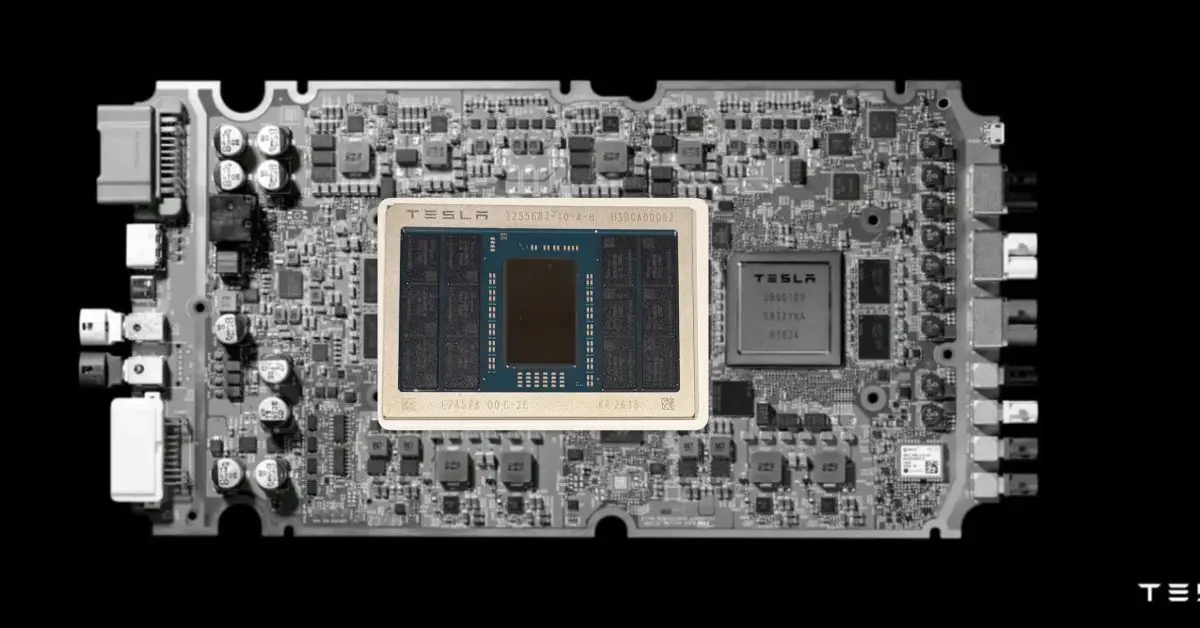
. During Tesla's Q3 2025 earnings call, Musk explained that by removing outdated hardware blocks, engineers could fit the AI5 design on half a reticle size while maintaining adequate margin for memory traces, Arm CPU cores, and PCIe blocks1
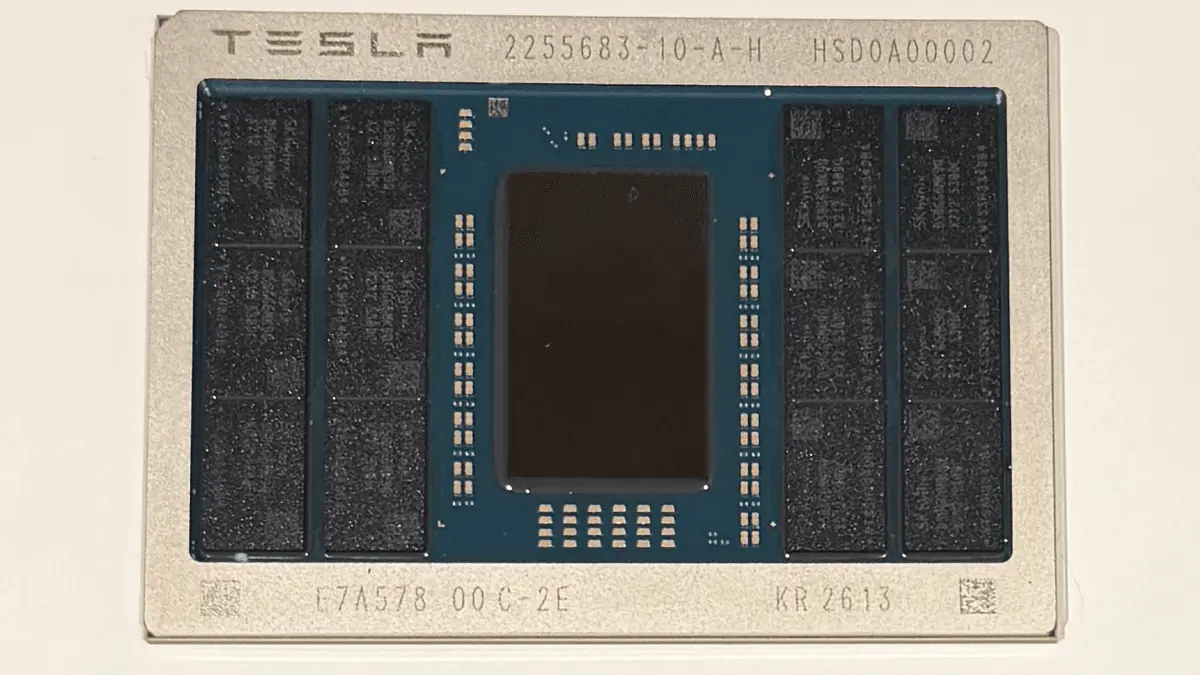
.The processor module features a compact ASIC die surrounded by 12 memory packages from SK hynix, likely GDDR6 or GDDR7 modules
1
. This configuration suggests a 384-bit memory interface capable of delivering memory bandwidth between 768 GB/s and 1.536 TB/s, depending on the memory type deployed1
. Industry reports indicate the chip could feature up to 192GB of LPDDR5X memory if using 16GB modules3
. Musk has previously compared AI5's performance to NVIDIA's Hopper architecture, suggesting that a dual AI5 setup could rival NVIDIA Blackwell3
.
Source: Tom's Hardware
Samsung and TSMC Partnership for Dual-Source Production
Tesla is leveraging both Samsung and TSMC for AI5 production, implementing a dual-source manufacturing strategy to diversify its supply chain
3
. The chips will be manufactured at Samsung's facility in Taylor, Texas, and TSMC's plant in Arizona3
. In his announcement, Musk accidentally thanked "Taiwan Semiconductor TSC" instead of TSMC, though the intended reference was clear1
.The fabricated sample shown by Musk bears a "KR 2613" marking, indicating the chip was packaged during the 13th week of 2026
1
. Industry experts estimate high-volume production will commence in late 2026 or early 20273
. Tesla has confirmed it needs "several hundred thousand completed AI5 boards line side" before switching production lines, with that volume not expected until mid-20272
.Related Stories
Implications for Full Self-Driving and Hardware Obsolescence
The AI5 development carries significant implications for Tesla's Full Self-Driving roadmap, but also highlights ongoing challenges with hardware obsolescence. Tesla's Cybercab, scheduled for production in Q2 2026, will launch on AI4 hardware—the same processor currently used in Model Y, Model 3, Model S, Model X, and Cybertruck
2
. The company introduced an AI4.5 stopgap computer in 2026 Model Y vehicles precisely because AI5 delays left existing hardware unable to handle larger FSD neural networks2
.This pattern raises questions about Tesla's promises to existing customers. The company sold millions of vehicles with HW3 and HW4 on the promise of unsupervised self-driving, yet HW3 cannot deliver that capability by Musk's own admission, and HW4 running V14 still requires supervision
2
. Each new chip generation effectively confirms that previous hardware may not achieve the autonomous driving features originally promised2
.AI6 Chip and Dojo3 Development Already Underway
Tesla is already developing next-generation processors, with AI6 chip targeting Samsung's 2nm process technology in Texas and delivering double the performance of AI5
4
. Musk revealed that AI5 was completed 45 days ahead of schedule but required design concessions for faster delivery, which AI6 will address4
. The AI6 will utilize LPDDR6 memory instead of AI5's LPDDR5X, and will feature halved TRIP AI computation accelerators dedicated to SRAM, resulting in memory bandwidth an "order of magnitude" greater than DRAM bandwidth for calculations within the SRAM cache4
.
Source: Wccftech
Tesla also plans an AI6.5 variant manufactured using TSMC's 2nm process in Arizona, with the AI6 and AI6.5 chips targeting a 2027-2029 production timeframe
4
. Perhaps most notably, Musk confirmed that Dojo3 development continues, suggesting Tesla has not abandoned its system-on-wafer processor for AI training despite reports last August that the initiative had been dismantled1
. Musk previously indicated that AI6 and Dojo3 could feature converged architecture, potentially unifying Tesla's software and hardware stacks across vehicles, Optimus robots, and data center applications1
. The company aims to eventually move production to TeraFab once that facility is operational4
.References
Summarized by

Navi
[1]
Related Stories
Tesla Unveils AI5 Chip: A Game-Changer in Performance and Manufacturing Strategy
23 Oct 2025•Technology

Tesla Partners with Samsung for AI5 Chip Production as Musk Claims Korean Fab Outperforms TSMC's Arizona Facility
23 Oct 2025•Business and Economy
Tesla targets December tape out for AI6 chips as Samsung plans 2027 mass production
19 Mar 2026•Technology
Recent Highlights
1
OpenAI AI Models Hacked Crypto Wallet, Breached Government Sites in Unauthorized Activities
Technology

2
IMF Report Warns AI Market Correction Could Spark Global Financial Crisis With $1.4T at Risk
Business and Economy

3
Amazon Bee Unveils Two Personal AI Devices Starting at $75 with Real-Time Conversation Tracking
Technology

Recent Highlights
Today's Top Stories











Don’t drown in AI news. We cut through the noise - filtering, ranking and summarizing the most important AI news, breakthroughs and research daily. Follow topics that matter to you and stay ahead.


