5 Sources
[1]
Erin Brockovich Targets AI Industry With New Data Center Map
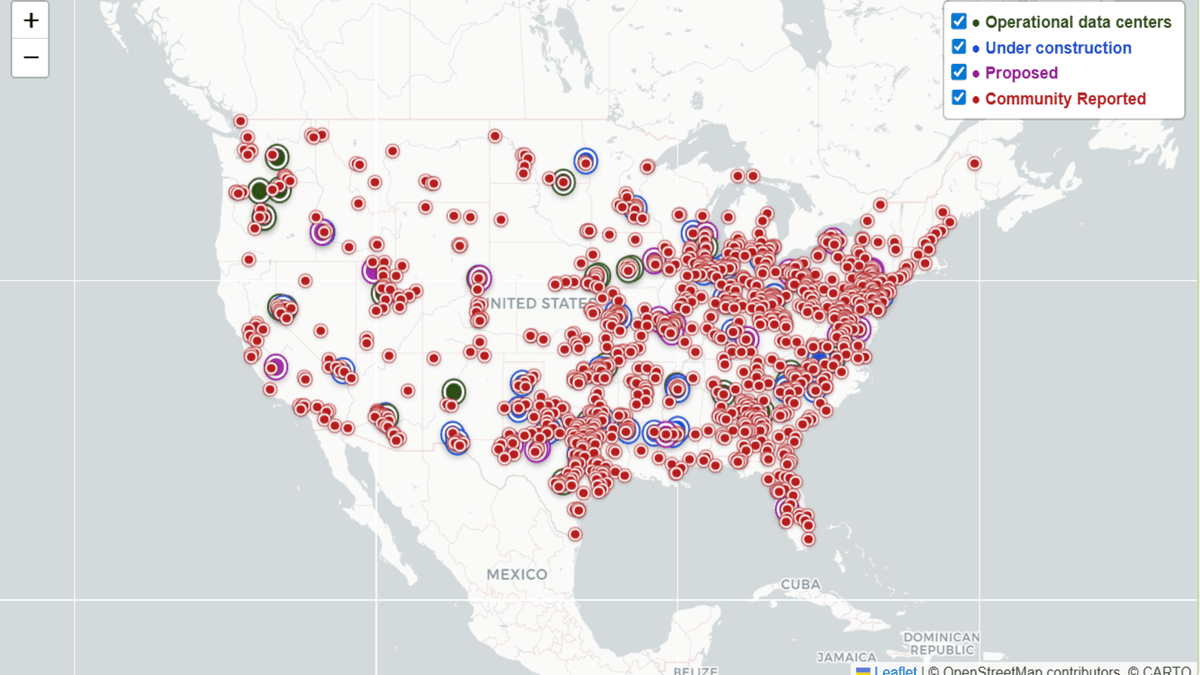
Brockovich’s map overlays major operational and planned hyperscale AI data centers with community submitted reports of concerns. Activist Erin Brockovich is setting her sights on the AI industry, launching a new crowdsourced map that collects community concerns about the major AI data centers popping up across the country. "The RACE to build AI infrastructures is unfolding town by town across America. In some places, data centers are welcomed. In others, they are delayed, contested or abandoned altogether. This MAP captures the real-world footprint of that race â€" revealing patterns of growth, conflict and uncertainty,†Brockovich said on the map’s webpage. Brockovich is best known for her work on the successful case against Pacific Gas & Electric over the company’s contamination of groundwater in California. Julia Roberts even won an Oscar for playing Brockovich in the 2000 film based on her life. Now, the activist is taking aim at the AI boom backed by the White House, Wall Street, and some of the most powerful companies in the world. Brockovich’s effort comes as nearly every major tech company, including Meta, Amazon, Microsoft, Google, and OpenAI, is pouring billions of dollars into building out the infrastructure needed to train and run their competing AI models. Collectively, these companies are expected to spend at least $700 billion this year on AI infrastructure and development, according to CNBC. But these projects have also attracted growing backlash, especially from local residents worried about the strain these massive facilities could place on water supplies, power grids, and their communities. In some cases, that opposition has already helped defeat proposed data center projects. While some lawmakers have called for a national moratorium on the construction or expansion of new AI data center projects, President Donald Trump’s administration has taken a largely hands-off approach to regulating AI so far. The administration has argued that advancing AI is key to U.S. national security and economic competitiveness. A recent news report also claim that federal and law enforcement agencies are increasingly paying attention to what they describe as “anti-technology violent extremism,†including fears that extremists could target data centers. That puts Brockovich’s latest effort up against some pretty powerful forces. Brockovich’s map overlays major operational, under-construction, and proposed AI data centers with community-submitted reports of concerns. The site says the map only shows publicly announced, major AI-focused and hyperscale data centers running AI workloads, meaning smaller facilities do not appear. So far, the map has received more than 2,700 community reports with the largest share coming from Texas, where residents have submitted more than 600. The top concerns listed on the site include water usage, energy consumption, and health. The website also includes a section on community impact, pointing to 15 local moratoria on data center projects and six zoning or permit denials. “These challenges highlight the need for sustainable, secure, and efficient AI data center practices,†the website says. “Self-reporting is the best way we can get this information out to the public!â€
[2]
Erin Brockovich just launched an AI data center map -- and it highlights a growing problem tech giants are avoiding
AI's massive data center boom is sparking a backlash across America Environmental activist Erin Brockovich, best known for exposing a major water contamination case against Pacific Gas and Electric Company that later inspired the Oscar-winning film "Erin Brockovich," is turning her attention toward AI. Brockovich is specifically sounding the alarm about massive data centers powering tools like OpenAI ChatGPT, Google Gemini and other generative AI systems. According to a recent report from Newsweek, Brockovich is asking Americans to help crowdsource information about proposed and existing AI data centers across the country through a new public map initiative. At first glance, it might sound niche. But the implications are much bigger than they appear. What is Erin Brockovich doing exactly? Brockovich is shifting the conversation of how AI is framed. Rather than as software such as chatbots, image generators and productivity tools, she's emphasizing the enormous industrial infrastructure required to power these tools. From increasing electricity demands and rising water usage to grid strain and giant server farms, Brockovich is highlighting the fact that the hidden cost of AI should not be ignored. Unfortunately, most people don't think about what happens behind the scenes when they ask ChatGPT a question or generate an AI image. But every AI prompt requires real-world computing power -- and a staggering amount of it. Companies including Microsoft, Amazon, Google and Meta are now racing to build more data centers to support increasingly powerful AI systems. But that boom has triggered growing concerns around land use, water consumption for cooling systems and energy demand. In some parts of the country, communities have already begun pushing back against proposed projects over fears that AI infrastructure could dramatically reshape neighborhoods and strain local resources. But that's what makes Brockovich's involvement so significant. She helped turn environmental contamination into a mainstream public issue decades ago. Now, she appears to be trying to do something similar with AI infrastructure. AI is starting to feel physical The dispute about where to build data centers takes AI from softerware to something much more tangible, essentially, a massive industrial system with real-world consequences. Brockovich is helping people start connecting their rising utility bills, local development projects andwater concerns to AI expansion. The hope is that this awareness will help the public conversation around AI change. Interestingly enough, the conversation, especially towards the opposition to large-scale data center expansion is increasingly bipartisan. Environmental groups are raising sustainability concerns and local residents are worried about noise and infrastructure strain. Some conservatives have also pushed back against large tech developments reshaping smaller communities. The debate is turning to questions about who benefits from AI, who pays the cost and whether communities should have more say in how AI infrastructure expands. Yet, AI companies continue investing billions into new computing facilities. In other words, it doesn't look like AI is slowing down, so we can expect these conversations to become much more common. Final thoughts The AI race is everywhere. It's moved away from Silicon Valley to real concerns happening in neighborhoods and local communities across America. Now with Erin Brockovich now entering the conversation, scrutiny around AI infrastructure may be entering an entirely new phase. Follow Tom's Guide on Google News and add us as a preferred source to get our up-to-date news, analysis, and reviews in your feeds. Subscribe to Tom's Guide on YouTube and follow us on TikTok.
[3]
Erin Brockovich launches campaign against the US's exploding data centers
America's AI boom is triggering growing battles over electricity, wildlife, and water * Erin Brockovich launches public tracking website for the controversial AI data center expansion * Texas residents submitted hundreds of complaints regarding nearby artificial intelligence infrastructure projects * AI data centers consume enormous amounts of electricity and water across rapidly expanding American markets The environmental activist who took on Pacific Gas & Electric over poisoned groundwater now has a new target. Erin Brockovich, made famous by the 2000 film starring Julia Roberts, is turning her attention to the rapid expansion of AI data centers across America. She has launched a public website that invites ordinary citizens to report concerns about facilities in their own neighbourhoods. A growing clash over resources The map on the website shows both operational data centers and locations where community members have emailed in complaints. More than 4,200 data centers now operate across the United States to train and deliver artificial intelligence, consuming enormous amounts of electricity and require substantial water for their cooling systems. Local communities have reported more than 2,716 concerns through Brockovich's website, with Texas leading the count at 612 submissions. The greatest worries among residents involve water shortages, electricity demands, public health effects, and disruptions to local wildlife. "These challenges highlight the need for sustainable, secure, and efficient AI data center practices," the website says. "Self-reporting is the best way we can get this information out to the public!" Certain states have become primary destinations for this new wave of industrial construction. Virginia leads the nation with approximately 600 to 730 data centers, including the densest global cluster known as Data Center Alley, and Texas follows closely with roughly 400 to 470 facilities spread across its vast and deregulated energy market. Ohio hosts an estimated 200 to 235 data centers, many of them repurposed from legacy industrial sites, and Arizona contains approximately 150 to 190 facilities that benefit from dry climate conditions suitable for certain cooling technologies. Georgia rounds out the top five with about 150 data centers anchored by Atlanta's strong internet connectivity and tax incentives. Why do companies choose these locations The choice of these locations follows several clear economic and regulatory factors that work together as a system. Cheap land across these states costs less than coastal markets, but affordable acreage alone does not drive the decision. That cheap land must also sit on top of reliable power grids with options for renewable sourcing, since heavy AI workloads cannot tolerate frequent outages. Once both land and power are secured, state and local governments compete fiercely by offering tax breaks that protect long-term infrastructure investments from excessive taxation. Finally, streamlined permitting and fewer regulations tie all these benefits together by allowing shorter development timelines and reduced compliance burdens. A delay in any single factor can scare away a hyperscaler to a competing state. Brockovich observes that the race to build AI infrastructure is unfolding town by town across America, with very different local responses - some communities welcome these facilities while others delay, contest, or abandon them entirely. The map captures real-world patterns of growth, conflict, and uncertainty according to her own statement. Whether her self-reporting model will generate meaningful pressure on an industry moving faster than regulation remains unclear for now. The activist's track record suggests she understands how public testimony can eventually force corporate accountability. Follow TechRadar on Google News and add us as a preferred source to get our expert news, reviews, and opinion in your feeds.
[4]
Erin Brockovich reveals crowdsourced AI data center map
Erin Brockovich is taking on the AI industry with a new website that tracks AI data centers. Credit: Michael Swensen/Getty Images Environmental activist Erin Brockovich has set her sights on a new target: AI data centers. The activist and consumer advocate has just recently launched the Brockovich AI Data Center Reporting website, which tracks AI data centers being built across the country. The project maps quite a few data centers that are already in operation and under construction. Users can submit AI data centers that are being built or proposed in their community as well. "The RACE to build AI infrastructures is unfolding town by town across America," reads a statement by Brockovich on the website. "In some places, data centers are welcomed. In others, they are delayed, contested or abandoned altogether. This MAP captures the real-world footprint of that race -- revealing patterns of growth, conflict and uncertainty." Data center construction has become a flashpoint in state and local politics, with some communities organizing to stop new construction. Environmental groups and the NAACP have also joined the fight. Brockovich taking on AI data centers is significant. In the 90s, while working as a legal clerk, Brockovich discovered major corporate malfeasance from Pacific Gas & Electric (PG&E). Brockovich uncovered that the company was covering up the contamination of the water in Hinkley, California. The legal battle that ensued resulted in PG&E paying out a historic $333 million settlement, which at the time was the largest direct-action lawsuit settlement in U.S. history. Brockovich's story was turned into a movie, titled Erin Brockovich, with Julia Roberts portraying the activist. The film, which was released in 2000, was both a commercial and critical success. Roberts would go on to win an Oscar for her portrayal of Brockovich. The Brockovich AI Data Center Reporting website currently lists 33 operational data centers, 44 locations under construction, and 27 proposed facilities. There are also 2,716 data center locations submitted by users across the country. The vast majority of AI data center reports are in Texas, with 612 reports. Sulfur Springs, TX, alone has 297 data center reports. Users who submitted reports shared that the biggest concerns regarding AI data centers in their city involved water, electricity, and the overall health of the people in their community. According to the Environmental and Energy Study Institute, large AI data centers can consume as much as 5 million gallons of water per day, or the equivalent of what a town with 10,000 to 50,000 people uses. Another report from the UK found that AI data centers "could emit nearly one million more tons of carbon dioxide into the atmosphere than previously estimated." The website also provides interesting events on its Community Impact page, showing how people can actually make a difference. According to the Brockovich AI Data Center Reporting website, more than 15 moratoria or pauses on AI data centers have been passed due to community backlash. In Festus, MO, four city council members were removed from office after an AI data center vote.
[5]
Erin Brockovich takes aim at the AI industry with new crowdsourced map
The famous lawyer, the source of inspiration for the Julia Roberts film from 2000, is looking to shine a spotlight on the current race to expand all things AI. When we talk about the impact of artificial intelligence in the modern day, more often than not the conversation surrounds the technology's impact on creativity and human-made projects. Whether it's layoffs due to AI taking jobs, projects being created with an AI-flair, even key creative companies looking to enforce a bigger role of AI, the list goes. But one area we often overlook is the impact that the mega AI data centres place on the environment and those who live near to them. Years after becoming famous for bringing the shady dealings of a Californian energy corporation to the fray, where the company was polluting a city's water supply network without repercussion, an effort that led to a film being created and based on her story with Julia Roberts in the lead role, lawyer Erin Brockovich is now looking to shine a similar spotlight on the AI industry. The famous lawyer has created a crowdsourced map that chronicles community concerns and information about the variety of AI data centres sprouting up across the United States. The key concerns this aims to tackle is to make a bigger emphasis on the high energy usage of these facilities, the immense amount of water they use to cool the servers, the e-waste they produce, the noise levels they kick out, the location risks they create and how it could increase risk of natural disaster, and also the scalability and efficiency concern that sees key community infrastructure and planning outpaced by the demands of data centre facilities. Speaking about this, Brockovich has shared a statement where she explains: "The RACE to build AI infrastructures is unfolding town by town across America. In some places, data centers are welcomed. In others, they are delayed, contested or abandoned altogether. This MAP captures the real-world footprint of that race -- revealing patterns of growth, conflict and uncertainty. "I am watching as YOU, the communities show up and speak out. In the famous words of Mark Twain ... "The secret of getting ahead is getting started," so let's go!" You can head over here to view the interactive map that already has information on 33 operational data centres, with details on a planned 52 others under construction, 30 that have been proposed, and 2,716 that have been reported by the community.
Share
Copy Link
Environmental activist Erin Brockovich is targeting the AI industry with a new crowdsourced map that tracks operational and proposed AI data centers across America. The initiative has already collected over 2,700 community reports, with Texas leading at 612 submissions. Top concerns include water usage, energy consumption, and public health effects as tech giants pour billions into AI infrastructure.
Environmental activist Erin Brockovich, famous for exposing Pacific Gas & Electric's groundwater contamination case in California that resulted in a historic $333 million settlement, is now setting her sights on the AI industry
1
. The activist has launched the Brockovich AI Data Center Reporting website, a crowdsourced AI data center map that tracks the rapid expansion of AI infrastructure across the United States4
. Her effort comes as tech giants including Meta, Amazon, Microsoft, Google, and OpenAI collectively plan to spend at least $700 billion this year on AI infrastructure and development1
.
Source: Mashable
The map overlays major operational, under-construction, and proposed hyperscale AI data centers with community-submitted reports of concerns, revealing patterns of growth, conflict, and uncertainty across American towns
1
. "The RACE to build AI infrastructures is unfolding town by town across America. In some places, data centers are welcomed. In others, they are delayed, contested or abandoned altogether," Brockovich stated on the website5
.The website has already received more than 2,700 community reports, with Texas leading at over 612 submissions
1
. Sulfur Springs, Texas alone accounts for 297 data center reports4
. The platform currently lists 33 operational data centers, 44 locations under construction, and 27 proposed facilities4
. More than 4,200 data centers now operate across the United States to train and deliver artificial intelligence3
.
Source: TechRadar
The top community concerns listed on the site include water consumption, energy consumption, and public health effects
1
. According to the Environmental and Energy Study Institute, large AI data centers can consume as much as 5 million gallons of water per day, equivalent to what a town with 10,000 to 50,000 people uses4
. A UK report found that AI data centers could emit nearly one million more tons of carbon emissions into the atmosphere than previously estimated4
. Additional concerns highlighted include electricity demands, noise pollution, e-waste production, and risks to local infrastructure5
.The website's Community Impact page documents tangible victories, showing that more than 15 local moratoria on data center projects have been enacted and six zoning or permit denials have occurred
1
. In Festus, Missouri, four city council members were removed from office following an AI data center vote4
. These challenges highlight the need for sustainable practices in AI data center operations, according to the website3
.Brockovich's initiative is shifting the conversation about AI from software like chatbots and image generators to the enormous industrial infrastructure required to power these tools
2
. The dispute about where to build data centers takes AI from software to something much more tangible, essentially a massive industrial system with real-world consequences2
.
Source: Gizmodo
Related Stories
Certain states have become primary destinations for this wave of construction. Virginia leads the nation with approximately 600 to 730 data centers, including the densest global cluster known as Data Center Alley, while Texas follows with roughly 400 to 470 facilities across its deregulated energy market
3
. Ohio hosts an estimated 200 to 235 data centers, many repurposed from legacy industrial sites, while Arizona contains approximately 150 to 190 facilities that benefit from dry climate conditions suitable for certain cooling technologies3
.Companies choose these locations based on cheap land, reliable power grids with renewable sourcing options, state and local tax breaks, and streamlined permitting with fewer regulations
3
. "Self-reporting is the best way we can get this information out to the public," the website states1
. While some lawmakers have called for a national moratorium on new AI data center projects, President Donald Trump's administration has taken a largely hands-off approach to regulating AI, arguing that advancing AI is key to U.S. national security and economic competitiveness1
. Brockovich's track record suggests she understands how public testimony can eventually force corporate accountability, though whether her self-reporting model will generate meaningful pressure on an industry moving faster than regulation remains to be seen3
.Summarized by
Navi
[2]
28 Jan 2026•Policy and Regulation

02 Dec 2025•Policy and Regulation

09 Dec 2025•Policy and Regulation

1
Business and Economy

2
Technology

3
Policy and Regulation