Estonian startup unveils AI-powered monowheel robot designed to patrol facilities autonomously


2 Sources
[1]
One-wheeled robot suits up for future security patrol
The self-balancing 1Rollo robot is made to keep an AI eye on property Why pay to design and mass-produce a four-wheeled autonomous security robot, when you can make a less costly one with just one wheel? That's the thinking behind the 1Rollo, a monowheel-bot that could soon be patrolling near
[2]
Video: Self-balancing monowheel robot for autonomous security patrols
An Estonian startup has unveiled an autonomous monowheel robot it says is the world's first stable single-wheel security robot designed for real-world patrols. Built to autonomously monitor industrial sites, campuses, and other large facilities, the robot navigates preset routes while balancing on
Share
Copy Link
Rollo Robotics has introduced 1Rollo, the world's first stable single-wheel autonomous security robot. The self-balancing monowheel uses a high-speed internal flywheel for stability and can patrol industrial sites, campuses, and critical infrastructure at speeds up to 30 km/h. Available through a subscription model starting in 2027, it promises cost-efficient surveillance with minimal human intervention.
Estonian Startup Tackles Security with Single-Wheel Design
Rollo Robotics, an Estonian startup founded in 2025, has unveiled what it claims is the world's first stable autonomous monowheel security robot capable of real-world patrols
1
2
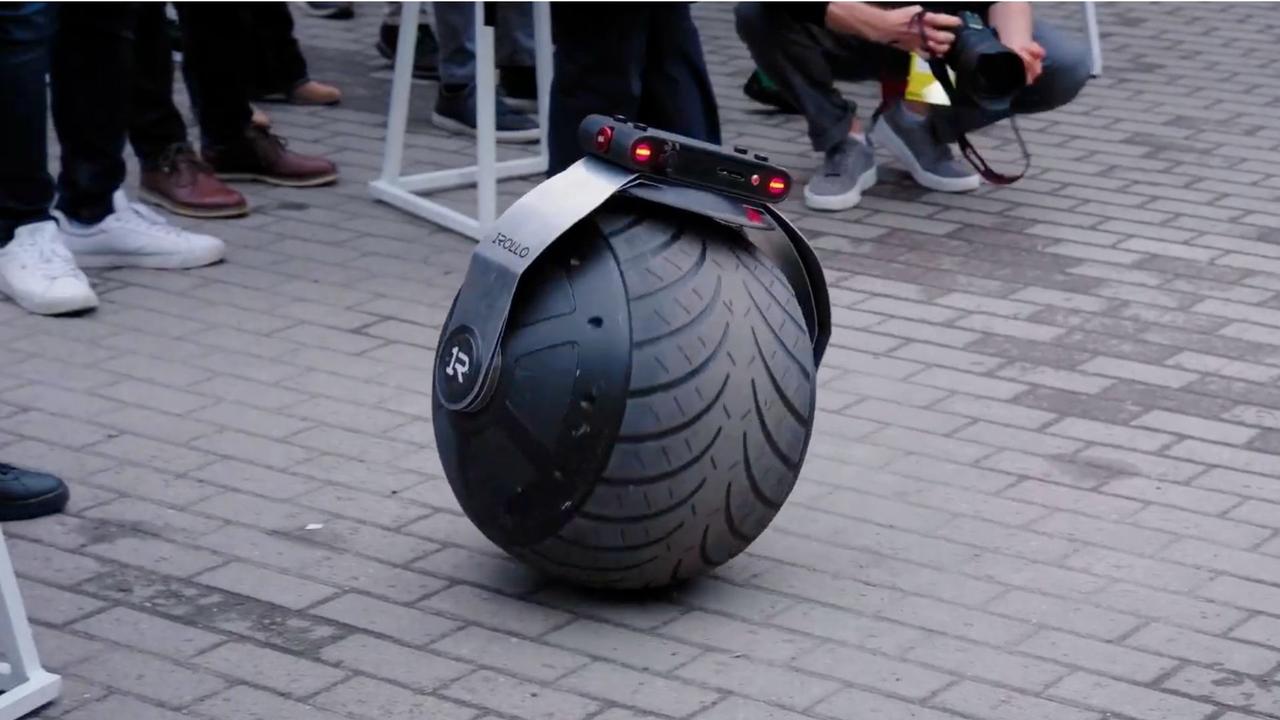
. The 1Rollo represents a departure from conventional four-wheeled security robots, instead balancing on a single 60-centimeter wheel while autonomously monitoring industrial sites, campuses, data centers, airports, and other large facilities. Currently in functional prototype form, the AI-enabled robot is designed to roll around properties following predefined maps, using both a 360-degree computer vision system and RTK-GNSS positioning for highly accurate navigation1
.
Source: New Atlas
Gyroscopic Stabilization Solves Balance Challenge
The core innovation behind 1Rollo lies in its proprietary stabilization system, which Rollo Robotics says solves the long-standing challenge of keeping a monowheel robot stable while moving, turning, and stopping
2
. At the heart of the design sits a high-speed flywheel mounted vertically inside the main wheel. This spinning flywheel generates gyroscopic forces that keep the robot upright across various conditions, including uneven terrain and windy environments. To change direction, the internal flywheel tilts, allowing the robot to lean into turns much like a motorcycle2
. High-frequency sensors continuously feed data to Rollo Robotics' in-house control software, which makes constant adjustments to maintain balance.Compact Form Factor Enables Navigation in Tight Spaces
Standing 110 centimeters tall and weighing approximately 45 kilograms, 1Rollo combines a compact footprint with high mobility
2
. The robot can travel at speeds of up to 30 km/h, enabling efficient patrol of expansive facilities1
. One of its biggest practical advantages is the slim, single-wheel design that can navigate tighter spaces, narrow corridors, entrances, and crowded walkways where larger four-wheeled robots might struggle2
. Powered by a battery delivering up to eight hours of operation per charge, it automatically returns to a wireless charging station when power runs low, allowing around-the-clock deployment with minimal human intervention1
2
. Its IP65-rated enclosure enables reliable operation in rain, dust, and temperatures ranging from -20°C to 55°C2
.
Source: Interesting Engineering
Related Stories

AI-Powered Detection and Cloud-Based Fleet Management
The robot's 360-degree vision system uses computer vision and edge AI to monitor surroundings in real time, detecting people, vehicles, open doors, and other unusual activity
2
. As it patrols, 1Rollo uses cameras and other sensors both to detect and avoid obstacles and to identify anomalies1
. When something suspicious is spotted, the robot immediately transmits an alert to a human overseer via 4G, 5G, or Wi-Fi1
2
. Operators can then access live video, communicate through the robot's integrated microphone and speaker, or dispatch security personnel if needed. Utilizing a cloud-based platform, overseers can remotely monitor whole fleets of 1Rollos simultaneously from a centralized dashboard1
2
. The robot also features a modular architecture that supports thermal cameras, PTZ cameras, night vision systems, RFID readers, and other mission-specific payloads2
.Subscription Model Targets Cost-Efficient Security
Rather than selling the hardware outright, Rollo Robotics will offer 1Rollo through a Robotics-as-a-Service subscription model. "Our goal is to provide autonomous security patrols at a significantly lower operating cost than traditional security solutions, whether that's human guards alone or a combination of guards and patrol vehicles," CEO and co-founder Sander Sebastian Agur stated
1
. Customers will pay a monthly fee covering the hardware, maintenance, software updates, and future hardware upgrades, reducing upfront capital investment while ensuring the system remains current throughout its deployment1
2
. The subscription model also ensures customers always have access to the latest hardware, software, and support without significant upfront investment1
. Commercial availability is planned for 20272
. The approach reflects a broader trend in robotics deployment where operational expenses replace capital expenditures, potentially making advanced security technology accessible to a wider range of facilities and organizations looking to supplement or reduce reliance on traditional human patrols.References
Summarized by

Navi
[2]
Related Stories
China Deploys AI-Powered Spherical Robot for Urban Policing
11 Dec 2024•Technology

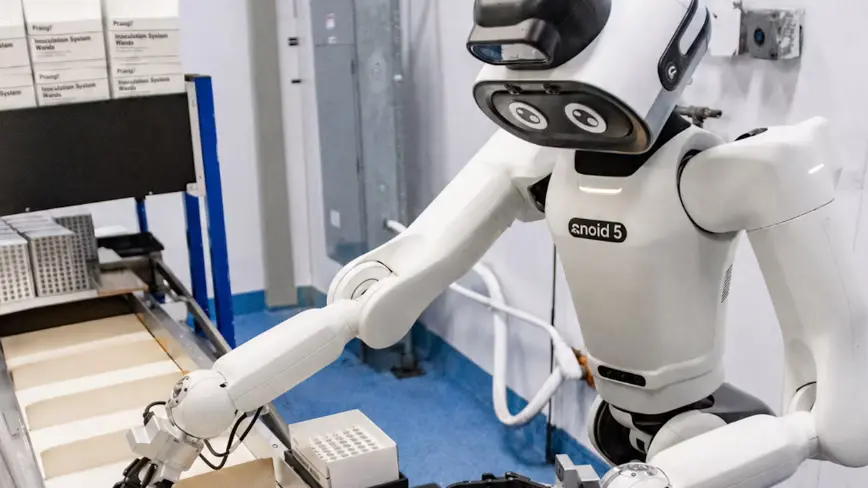
Robot.com launches R-noid humanoid robot to tackle labor shortages in kitchens and warehouses
23 Jun 2026•Technology
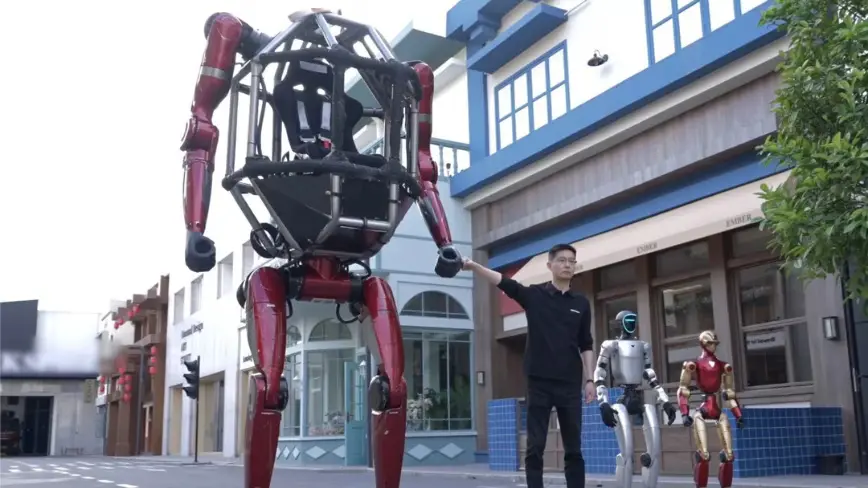
Unitree unveils $650K giant rideable mecha robot as company files for $7 billion IPO
15 May 2026•Technology
Recent Highlights
1
Meta Unveils Muse Wonder Frontier AI Models, Claims Performance Matching OpenAI and Anthropic
Technology

2
IMF Report Warns AI Market Correction Could Spark Global Financial Crisis With $1.4T at Risk
Business and Economy

3
OpenAI Releases 722 AI-Generated Math Solutions, Triggering Existential Crisis in Mathematics
Technology

Recent Highlights
Today's Top Stories









Don’t drown in AI news. We cut through the noise - filtering, ranking and summarizing the most important AI news, breakthroughs and research daily. Follow topics that matter to you and stay ahead.


