4 Sources
[1]
Nvidia competitor Etched hits $5B valuation, $1B in sales for AI chip
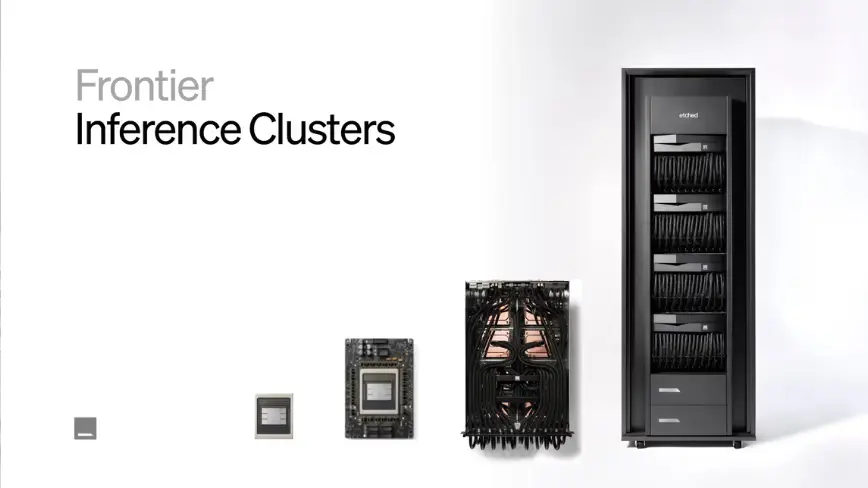
Nvidia AI chip competitor Etched issued a progress report on Tuesday, after TSMC successfully manufactured its chip earlier this year. The startup says it has already booked $1 billion in contract orders for its product: full systems powered by those chips. Etched is currently in the process of testing that first product with customers. It calls these systems "frontier inference clusters," bundles that include the chips along with custom-designed racks and software, all built to help frontier models run inference faster, more cheaply, and with better power efficiency than rivals, Etched claims. (Inference is what happens after a user submits a prompt -- it's currently the biggest bottleneck, and the biggest cost center, for AI companies trying to serve customers at scale, which is exactly why investors are paying attention to anyone promising to solve it.) Etched, founded in 2022, also revealed that it has now raised a total of $800 million to date. The most recent tranche was an unannounced $500 million round closed in December at a $5 billion post-money valuation, the company said. The startup has attracted a notable group of investors, too, including VentureTech Alliance, Jane Street, Hudson River Trading, Two Sigma, and Ribbit Capital. It has also secured angel investment from AI heavyweights including Andrej Karpathy, Geoffrey Hinton, Fei-Fei Li, Arthur Mensch, and Scott Wu. The cap table also includes billionaires Stanley Druckenmiller and Peter Thiel. Although the startup's press release frames Tuesday's announcement as Etched "coming out of stealth," co-founders -- CEO Gavin Uberti and president Robert Wachen -- have actually been talking to TechCrunch about their chip plans since 2024. Both dropped out of Harvard and became Thiel fellows to found Etched, as Uberti told TechCrunch at the time. By 2024, Etched was already on investors' radar, having raised more than $125 million. But on Patrick O'Shaughnessy's "Invest Like the Best" podcast, the founders said that back in 2023, they struggled to get investors interested -- even with a 30-page memo arguing that AI would eventually need specialized chips, not just general-purpose GPUs. Every major investor they pitched passed. The company was reportedly operating month-to-month, close to running out of cash, in those early days. Today's funding environment looks like a different planet by comparison. Investors are chasing everything AI-related, especially chip technology that speeds up inference. Competitor Cerebras had the first breakout IPO of the year, while AI chip maker Groq just raised $650 million. Hyperscalers Amazon, Google, and Microsoft all build their own in-house AI chips. Even OpenAI just announced its first custom chip, built by Broadcom.
[2]
Nvidia rival Etched raises $800M with backing from Jane Street and a TSMC-linked fund
AI chip startup Etched has raised $800M backed by Jane Street and a TSMC-linked fund, with one billion dollars in sales contracts and summer shipments planned. AI chip startup Etched has raised $800 million and revealed that its backers include trading firm Jane Street and VentureTech Alliance, a venture firm with a strategic partnership with TSMC. The company, which designs chips specifically for running AI models rather than training them, says it has signed one billion dollars in sales contracts and plans to start shipping to customers this summer. The bulk of the funding came from a $500 million round led by Stripes that closed in December, valuing Etched at five billion dollars. That round included Peter Thiel, Positive Sum, Ribbit Capital, Hudson River Trading, and Two Sigma. Jane Street separately led a previously unannounced round and has invested more than $100 million in total, according to Bloomberg. The investor list reads like a who's who of AI. Geoffrey Hinton, who won a Nobel Prize for foundational work in modern AI, is an investor. So are computer vision pioneer Fei-Fei Li and hedge fund manager Stanley Druckenmiller. Founded in 2022 by Harvard dropouts Gavin Uberti and Robert Wachen, Etched has been quiet for roughly two years while building its product. The company's chip, called Sohu, is designed to run transformer models by embedding the architecture directly into silicon rather than relying on general-purpose GPUs. Working with TSMC, Etched developed what it calls low-voltage inference, running chips at lower voltage to prevent overheating and squeeze more performance from the hardware. Etched also designed its entire server rack, including circuit boards, cooling plates, and networking connections, rather than just the chip itself. No other chip startup has done this, Wachen told Bloomberg. The company has 400 employees, more than half based near its San Jose headquarters. The inference chip market is attracting enormous capital as the industry shifts from training models to running them at scale. Nvidia paid Groq $20 billion in December for a licensing deal that took most of its engineers. Google announced in April that a version of its own AI chips will focus on inference. London-based Fractile raised $220 million for inference chips that put compute and memory on the same die. The race to build purpose-built silicon for inference, rather than repurposing training GPUs, is now one of the most capital-intensive bets in the semiconductor industry. Whether Etched can deliver on one billion dollars in contracts depends on whether its chips perform as promised under production workloads, a question no startup in this space has fully answered yet. "If you have compute now, people will buy it," said Positive Sum CEO Patrick O'Shaughnessy. The startup's bet is that being early with a full-stack rack, not just a chip, gives it an edge that matters more than benchmark numbers on a spec sheet.
[3]
Etched Pulls 400+ Engineers From NVIDIA, TSMC & More to Build a New Frontier Inference Cluster For AI Which Is Already Worth $1B in Demand
Etched, a new startup with a team of 400+ engineers, has announced its latest AI solution, the Frontier Inference Clusters. Etched Comes Out of Stealth To Unveil Its Frontier Inference Clusters, Achieves Successful A0 Tapeout & On-Track For $1B+ In AI Contracts What happens when 400+ Engineers from leading firms such as NVIDIA, Google, Broadcom, TSMC, SK Hynix, and more come together? Well, Etched happens. This is a new AI startup who are co-designing chips, racks, software, and advanced manufacturing methods for frontier models. The company promises best-in-class throughput, latency, cost, and power efficiency for both prefill and decode workloads, and they have first silicon proof to back up their claims. Today, Etched officially announced itself and the successful tapeout of its very first A0 silicon. The tapeout was actually done earlier this year on TSMC's N4P process technology, and they've since been busy validating their first rack-scale product, which has already racked in $1B+ in AI customer demand. The company has so far raised $800M across four unannounced financings, including a strategic investment from VentureTech Alliance, and is working to deepen & expand partnerships with leading semiconductor firms. VLI Processor Pumps Out 80% Peak Flops At Half The Voltage of Existing AI Chips So coming to the infrastructure, Etched lays out the plans to tackle frontier models including multi-trillion-parameter MoEs, long-context and agentic AI workloads. For this, the company had to work on a range of new chips, packages, PCBs, cold plates, interconnects, and more. The first of these is a Low-Voltage Inference (LVI) for high-throughput workloads. This chip comes with a new architecture that allows it to do math at half the voltage of most AI chips. With this approach, Etched solves the sustained performance issues that occur in most AI chips that throttle down as chips draw more power at full-voltage mode, leading to under half the peak FLOPs. CMS Accelerator Offers HBM/SRAM Combo The second part is the Cluster Scale Memory (CSM) for low-latency workloads. We've seen the move towards massive SRAM blocks over HBM for faster decode speeds, but SRAM chips don't offer good FLOPs throughput or memory capacity. Etched's solution with CSM is a lower-latency and shared memory pool product that retains high-bandwidth interconnect for faster memory access. This HBM/SRAM hybrid tackles both memory capacity and memory latency while offering lower cost, higher reliability, better yields, and improved thermal characteristics. All combined, Etched has been able to achieve state-of-the-art throughput, latency, and power efficiency in early customer tests across inference workloads. Etched's VLI processor can run trillion-parameter sparse MoEs at 80% peak FLOPs without thermal throttling. Currently, Etched is scaling production at an unprecedented pace and has built a 2MW datacenter in its offices, along with the opening of a factory in Taiwan for 24/7 engineering. The company is promising more updates on performance and roadmaps this summer. Follow Wccftech on Google to get more of our news coverage in your feeds.
[4]
Etched raises $800 million from Jane Street, TSMC-linked VC - Bloomberg By Investing.com
Investing.com - AI chip startup Etched said it has raised $800 million and revealed that its investors include Jane Street and a venture firm linked to Taiwan Semiconductor Manufacturing Co. (NYSE:TSM), according to reporting from Bloomberg. The aspiring competitor to Nvidia Corp. (NASDAQ:NVDA) plans to start shipping chips to some customers this summer. Bloomberg previously reported that Etched raised a $500 million round valuing the company at $5 billion. Led by investment firm Stripes with participation from billionaire Peter Thiel, Positive Sum and Ribbit Capital, that round closed in December and also included an investment from Jane Street, Hudson River Trading, Two Sigma and VentureTech Alliance, which has a strategic partnership with TSMC, Etched said. Jane Street led a previously unannounced funding round, according to Etched co-founder and president Robert Wachen, and has invested additional funds since then. The trading firm has invested a total of more than $100 million in Etched, according to people familiar with the matter. Founded in 2022, Etched designs chips to run artificial intelligence models. The company is currently testing its products and has signed sales contracts worth $1 billion, said Wachen, who declined to name any customers. This is the first time Etched has publicly discussed its funding and chip plans in about two years. Working with TSMC, Etched has developed a technology it calls low-voltage inference, running the chips at lower voltage to prevent overheating. The company also developed a memory system that combines High-Bandwidth Memory and Static Random-Access Memory. Etched designs its entire server rack including the circuit boards, plates for cooling the chips and networking connections. This article was generated with the support of AI and reviewed by an editor. For more information see our T&C.
Share
Copy Link
AI chip startup Etched has raised $800 million and secured $1 billion in sales contracts for its specialized inference chips, positioning itself as a serious Nvidia competitor. The company successfully manufactured its first silicon with TSMC and plans to start shipping frontier inference clusters this summer, backed by AI luminaries including Geoffrey Hinton and Peter Thiel.
AI chip startup Etched has officially emerged from stealth mode with a striking announcement: the company has raised $800 million in total funding and secured $1 billion in sales contracts for its specialized inference hardware
1
. The bulk of this capital came from a $500 million round led by Stripes that closed in December, valuing Etched at $5 billion post-money2
. Founded in 2022 by Harvard dropouts Gavin Uberti and Robert Wachen—both Thiel fellows—the company has attracted an exceptional roster of investors including Jane Street, which led a previously unannounced round and has invested more than $100 million in total4
.

Source: TechCrunch
The investor list reads like a who's who of AI and finance. VentureTech Alliance, a venture firm with a strategic partnership with TSMC, participated alongside trading firms Hudson River Trading and Two Sigma, plus Ribbit Capital
2
. Angel investors include AI heavyweights Geoffrey Hinton, who won a Nobel Prize for foundational work in modern AI, computer vision pioneer Fei-Fei Li, Andrej Karpathy, Arthur Mensch, and Scott Wu. Billionaires Stanley Druckenmiller and Peter Thiel also back the venture1
.Etched positions itself as a Nvidia competitor by focusing exclusively on AI inference rather than training. The company successfully completed its first A0 silicon tapeout earlier this year using TSMC's N4P process technology
3
. This specialization matters because inference—what happens after a user submits a prompt—is currently the biggest bottleneck and cost center for AI companies trying to serve customers at scale1
.The company's chip, called Sohu, embeds the transformer architecture directly into silicon rather than relying on general-purpose GPUs
2
. Etched has developed what it calls low-voltage inference technology, running chips at half the voltage of most AI chips to prevent overheating and maintain sustained performance4
. This approach solves a critical problem: most AI chips throttle down as they draw more power at full-voltage mode, delivering under half their peak FLOPs. Etched's VLI processor can run trillion-parameter sparse MoEs at 80% peak FLOPs without thermal throttling3
.
Source: The Next Web
What sets Etched apart from other specialized AI chips startups is its full-stack approach. The company sells what it calls frontier inference clusters—complete systems that bundle the chips with custom-designed server rack hardware including circuit boards, cooling plates, and networking connections
4
. No other chip startup has designed the entire rack system, according to co-founder and president Robert Wachen2
.Etched has also developed a Cluster Scale Memory system that combines High-Bandwidth Memory and SRAM to tackle both memory capacity and memory latency challenges
3
. This hybrid approach addresses the tradeoffs between massive SRAM blocks that offer faster decode speeds but poor throughput, and HBM that provides capacity but higher latency. The company promises best-in-class throughput, latency, cost, and power efficiency for both prefill and decode workloads across multi-trillion-parameter models, long-context, and agentic AI applications3
.Related Stories
The timing of Etched's announcement reflects a dramatic shift in the AI hardware landscape. Back in 2023, the founders struggled to attract investor interest despite a 30-page memo arguing that AI would eventually need specialized AI chips beyond general-purpose GPUs. Every major investor they pitched passed, and the company reportedly operated month-to-month, close to running out of cash
1
. Today's funding environment looks completely different, with investors chasing everything AI-related, especially chip technology that speeds up inference.The company has assembled a team of over 400 engineers from leading firms including Nvidia, Google, Broadcom, TSMC, and SK Hynix
3
. More than half are based near its San Jose headquarters2
. Etched has built a 2MW datacenter in its offices and opened a factory in Taiwan for 24/7 engineering operations3
.
Source: Wccftech
The inference chip market is attracting enormous capital as the industry shifts from training models to running them at scale. Competitor Cerebras had the first breakout IPO of the year, while Groq raised $650 million. Hyperscalers Amazon, Google, and Microsoft all build their own in-house AI chips, and OpenAI recently announced its first custom chip built by Broadcom
1
. London-based Fractile raised $220 million for inference chips that put compute and memory on the same die2
.Etched is currently testing its first product with customers and plans to start shipping this summer
2
. Whether the company can deliver on its $1 billion in contracts depends on whether its chips perform as promised under production workloads. As Positive Sum CEO Patrick O'Shaughnessy noted, "If you have compute now, people will buy it"2
. The startup's bet is that being early with a full-stack rack solution gives it an edge that matters more than benchmark numbers alone.Summarized by
Navi
[2]
14 Jan 2026•Startups

25 Feb 2026•Startups

04 Feb 2026•Business and Economy

1
Policy and Regulation

2
Technology

3
Science and Research