Faraday Future unveils Embodied AI robotics lineup with $1,990 FX Navi quadruped robot


2 Sources
[1]
US firm unveils Futurist humanoid, FX Navi robot dog in California
US robotics firm Faraday Future (FF) has unveiled its first-half embodied AI (EAI) robotics lineup, introducing a full-form Robot World that spans six major product series. The company also launched what it describes as the world's first Three-in-One EAI Robotics Education Ecosystem Strategy,
[2]
The EV Company That Just Launched a $1,990 Robot Dog
Faraday Future's June 16 event introduced humanoids, quadrupeds, education tools, and an ambitious plan to bring Embodied AI into homes and classrooms. Faraday Future has spent more than a decade working on intelligent electric vehicles. Now it wants to put that same mix of artificial
Share
Copy Link
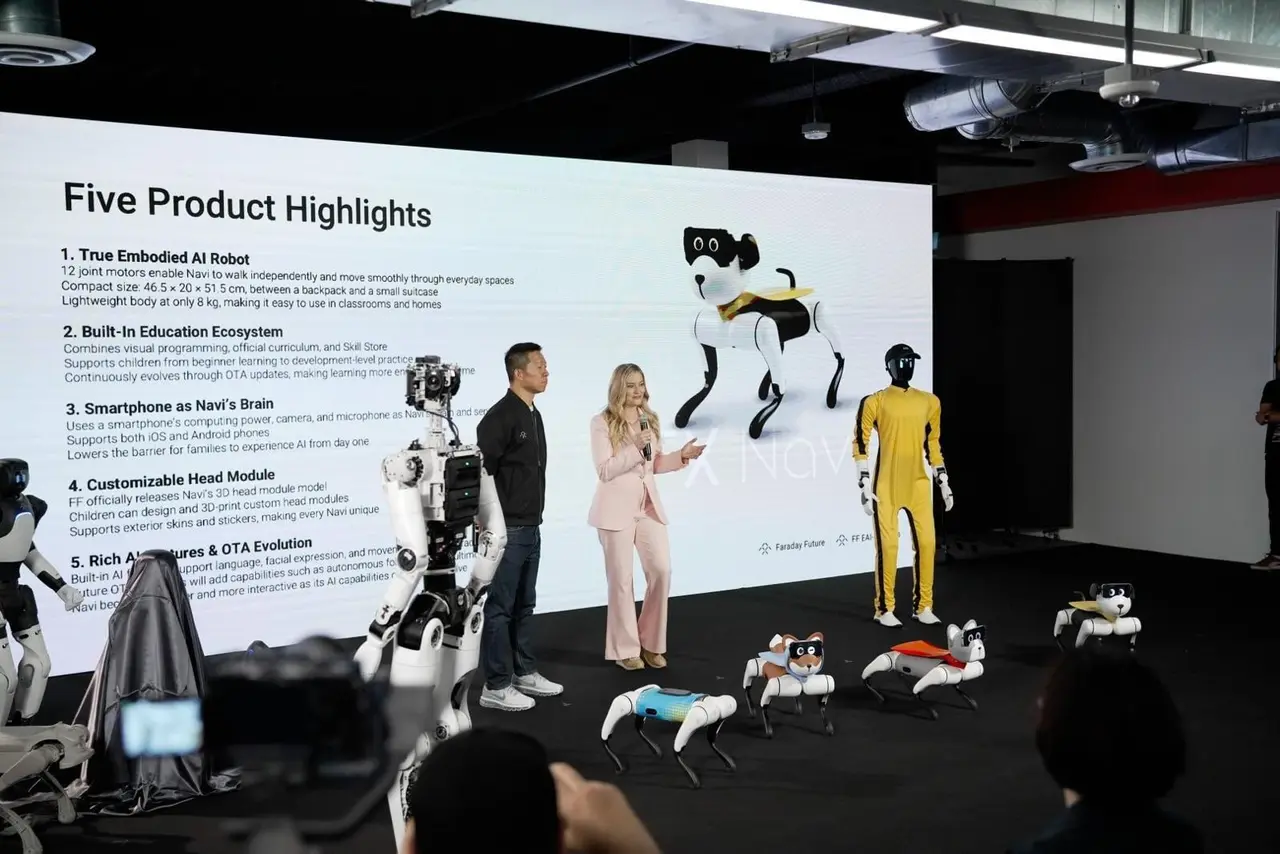
Faraday Future debuted its Full-Form EAI Robot World at its California headquarters, introducing the Futurist humanoid robot and FX Navi quadruped robot alongside an education ecosystem. The FX Navi, priced at $1,990, marks the company's entry into consumer robotics with a smartphone-powered design aimed at homes and classrooms.
Faraday Future Expands Into Embodied AI With Six-Product Robotics Lineup
Faraday Future has unveiled its first-half EAI robotics lineup at a June 16, 2026 event held at its new headquarters in El Segundo, California, marking a strategic shift for the electric vehicle company into the robotics sector
1
. The Full-Form EAI Robot World spans six major product series, introducing both professional-grade and consumer-focused robots designed to bring Embodied AI into homes, classrooms, and industrial environments2
.
Source: Geeky Gadgets
The launch event featured employees, investors, media, educators, and school representatives, with California State Treasurer Fiona Ma appearing via video to congratulate the company
2
. Faraday Future also announced what it describes as the world's first Three-in-One EAI Robotics Education Ecosystem Strategy, aimed at connecting robotics education, industry applications, and consumer adoption1
.FX Navi Quadruped Robot Targets Education Market at $1,990
The most accessible product in the lineup is the FX Navi quadruped robot, which Faraday Future markets as the first foundational Embodied AI learning quadruped robot in the United States and the only quadruped priced below $2,000 that supports secondary development
2
. Available for immediate sale and delivery at $1,990, the FX Navi features 12 motorized joints in a body weighing approximately 8 kilograms (17.6 pounds) and can navigate everyday indoor environments including carpets, hallways, and door thresholds1
2
.The robot's most distinctive feature is its computing approach: rather than embedding all processing components internally, a smartphone inserted into the head module serves as its computing platform, supporting both iOS and Android devices
1
. This design lowers the barrier to ownership while allowing users to leverage hardware they already possess2
. Users can customize the robot through downloadable and printable 3D head designs, while over-the-air updates will continuously add new capabilities such as autonomous following, multimodal perception, and natural interaction1
.For an additional one-time payment of $390, users can unlock a lifetime development and skills package, while a separate $490-per-year curriculum option provides nine progressive levels of Embodied AI instruction
2
.Futurist Humanoid Robot Leads Professional-Grade Offerings
Leading the EAI robotics lineup is the All-New Futurist humanoid robot, positioned as Faraday Future's flagship professional-grade platform
1
. Standing approximately 5 feet 8 inches tall and weighing about 121 pounds (54 kilograms), the humanoid robot is 14 percent lighter than its predecessor and features a redesigned structure for greater stability and more natural movement1
.
Source: Interesting Engineering
Equipped with 31 degrees of freedom and a knee-joint torque of up to 320 Nm, the Futurist humanoid robot can run at speeds approaching 11 mph (17.7 km/h)
1
2
. It is powered by a 1,152-Wh dual-battery system that offers up to 6 hours of runtime1
2
. The robot natively supports NVIDIA Sonic's full-body motion-control system, and a higher-performance Futurist Ultra model, expected later, will use NVIDIA's Jetson Thor computing platform2
.Built on a Vision-Language-Action (VLA) architecture combined with a World Model for advanced perception, reasoning, and autonomous decision-making, the Futurist is designed for commercial reception, guided services, industrial handling, warehouse operations, and hazardous-environment tasks
1
. Additional specifications and pricing will be announced at Automate 2026 in Chicago on June 221
.Related Stories

One Brain, Multiple Forms Strategy Powers Robotics Ecosystem
Faraday Future's robotics strategy centers on a "one brain, multiple forms" approach designed to power a wide range of Embodied AI robots from a shared intelligence platform
1
2
. At the core of this strategy is the evolving EAI Brain, based on Vision-Language-Action architecture and World Model, supported by an open-source developer ecosystem1
. The platform is designed to operate across different environments, perform tasks autonomously, and adapt to new applications through its Skills and Agent system1
.Rather than focusing on a single humanoid robot, Faraday Future is developing multiple robot form factors under its Full-Form EAI Robot World concept, allowing a common AI brain to be deployed across different devices and use cases
1
. The company previewed two upcoming humanoid robots: Master Mini, approximately one meter tall and designed for education and robotic sports competitions, and Nova, standing about 50 centimeters tall and intended as an entry-level educational and companion robot for children1
2
.The ecosystem is further supported by an EAI Data Factory that gathers real-world operational data and a global industry network aimed at improving manufacturing efficiency and reducing costs
1
.Open Developer Platform and Education Ecosystem Drive Adoption
Faraday Future launched an open developer platform featuring tools such as Brain Blocks visual programming, natural-language coding, robot personality customization, motion-generation software, and SDKs for professional developers
1
. The Brain Blocks tool enables visual programming for users without extensive coding experience, while the EAI Soul feature allows designers to create robot personality and knowledge systems2
.Through its new Agent Skill Store and Developer Ecosystem Program, Faraday Future aims to encourage contributions from students, educators, researchers, and software developers while expanding robotics adoption across homes, schools, and industry
1
. Students will be able to create robot skills, test them in simulation, deploy them to physical devices, and publish their work through a Youth Agent Skill Store2
.The company also announced the FF Robotics Partner Program, designed to expand global collaboration across its robotics ecosystem
1
. This gives Faraday Future several possible customers at once: families, schools, universities, developers, content partners, and businesses seeking specialized robots2
. The company is betting that the path to mass-market robotics may begin with education, targeting young developers and classrooms as the foundation for broader adoption2
.References
Summarized by

Navi
[1]
[2]
Related Stories
Roomba Creator Colin Angle Unveils AI Robot Companion That Learns Your Daily Habits
04 May 2026•Technology

1X Technologies Opens US Factory, Plans 10,000 Neo Humanoid Robots for Homes This Year
30 Apr 2026•Technology

Sirius: The AI-Powered Robot Dog Blending Cutting-Edge Technology with Pet-Like Companionship
27 Jun 2025•Technology

Recent Highlights
1
Microsoft and Nvidia Launch Surface Laptop Ultra: A $2,599 AI-Ready PC With RTX Spark Chip
Technology

2
Trump Consulted Grok AI Before Ordering Venezuela Invasion and Capture of Nicolás Maduro
Policy and Regulation

3
Scientists Build AI Model That Reconstructs Images From Brain Scans in Record Time
Science and Research

Recent Highlights
Today's Top Stories






Don’t drown in AI news. We cut through the noise - filtering, ranking and summarizing the most important AI news, breakthroughs and research daily. Follow topics that matter to you and stay ahead.


