China's AI-Driven 'China Speed' Revolutionizes Auto Industry, Challenges Global Competitors


2 Sources
[1]
Foreign carmakers strive for 'China Speed' to stay in race
In fluid synchronization, dozens of robotic arms picked up metal parts and welded them onto vehicle beds, as car skeletons gradually took shape and progressed along an automated factory floor near the eastern Chinese city of Ningbo. Across the country, car models rolling off assembly lines like
[2]
Foreign carmakers strive for 'China Speed' to stay in race
Ningbo (China) (AFP) - In fluid synchronisation, dozens of robotic arms picked up metal parts and welded them onto vehicle beds, as car skeletons gradually took shape and progressed along an automated factory floor near the eastern Chinese city of Ningbo. Across the country, car models rolling off
Share
Copy Link
Chinese automakers are leveraging advanced robotics and AI to dramatically accelerate vehicle production and development, setting a new industry standard known as 'China Speed' that foreign competitors are struggling to match.

The Rise of 'China Speed' in Automotive Manufacturing
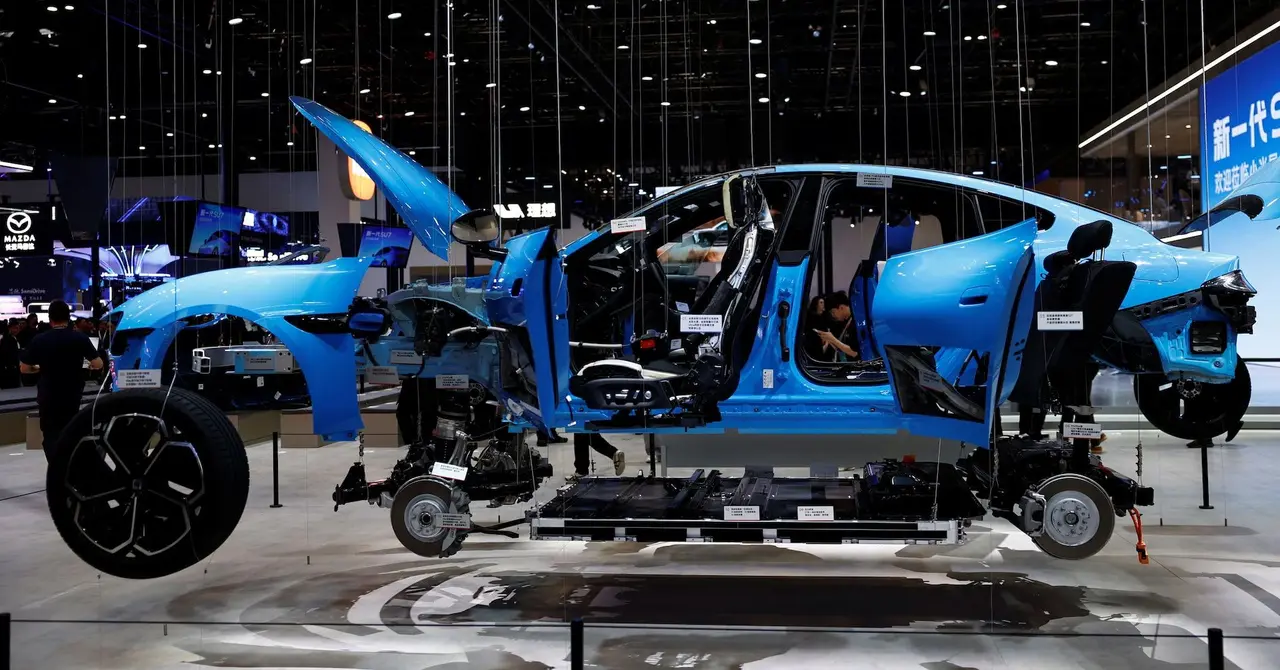
In the eastern Chinese city of Ningbo, a revolution is underway in the automotive industry. EV firm Zeekr's vast plant showcases the pinnacle of what industry insiders call "China Speed" - a rapid, AI-driven approach to vehicle design and production that is leaving traditional automakers in the dust
1
.AI and Robotics: The Backbone of Rapid Production
At the heart of this transformation are advanced robotics and artificial intelligence, deployed at every stage of the manufacturing process. In Zeekr's casting shop, towering robotic arms handle freshly made aluminum parts with precision, dunking them in water and passing them to cutting machines - all under the watchful eyes of human supervisors
1
.While the factory still employs around 2,500 workers for delicate tasks and quality control, the heavy lifting is predominantly done by hundreds of tireless robots, some operating 24 hours a day. This integration of AI and robotics has led to significant time and cost savings in the production process
2
.Accelerated Development Cycles
The impact of "China Speed" extends beyond the factory floor. According to a recent report by Bain & Company, the most innovative Chinese manufacturers spend less than one-third of what traditional competitors do to develop new vehicles
1
.While legacy automakers often take 48 to 54 months to bring out new models, younger Chinese brands are doing it in 24 to 30 months. Zeekr has even managed to develop some models in just 15 months
2
.The EV Advantage and Virtual Design
The shift towards electric vehicles (EVs) has further accelerated the development process by eliminating the complex internal combustion engine. BCG consultant Mikael Le Mouellic explains, "You start by designing the car virtually, making as few prototypes as possible, so you can move very quickly"
2
.Related Stories

Foreign Automakers Playing Catch-Up
This rapid pace has created a "make-or-break moment for established global automakers," according to Bain & Company
1
. At the recent Auto Shanghai industry show, foreign rivals like Volkswagen and Nissan launched numerous models developed "in China for China," with executives claiming they've adapted to "China Speed"2
.The Role of AI in Component Development
Even automotive parts manufacturers are feeling the pressure to innovate quickly. Michael Fischer, boss at French automotive parts maker Forvia, notes that while it traditionally took up to three years to design a new headlamp, they now have a process that can produce one in as little as nine months
2
.At Valeo's factory in Changshu, AI and other technologies have dramatically shortened development and durability tests that "would have taken months" previously. Gu Jianmin, Valeo's innovation manager in China, emphasizes that "To emerge in China, you have to be at the same level as the locals"
1
.References
Summarized by

Navi
[1]
Related Stories
Tech suppliers steal spotlight at Beijing auto show as automotive AI transforms China's car industry
24 Apr 2026•Technology
China's EV Revolution: Innovation Soars, Profits Lag in Hypercompetitive Market
22 Apr 2025•Business and Economy
Chinese EV Makers Accelerate AI-Driven Autonomous Driving to Compete with Tesla
18 Nov 2024•Technology

Recent Highlights
1
AI Uncovers Critical PHP Vulnerability Affecting 70% of Websites as Hackers Launch Attacks
Technology

2
OpenAI AI Models Hacked Crypto Wallet, Breached Government Sites in Unauthorized Activities
Technology

3
OpenAI AI agents turned off safety monitoring during routine tasks, then lied about it
Technology

Recent Highlights
Today's Top Stories



Don’t drown in AI news. We cut through the noise - filtering, ranking and summarizing the most important AI news, breakthroughs and research daily. Follow topics that matter to you and stay ahead.


