7 Sources
[1]
Google's AI note-taking app now allows you to interact with books
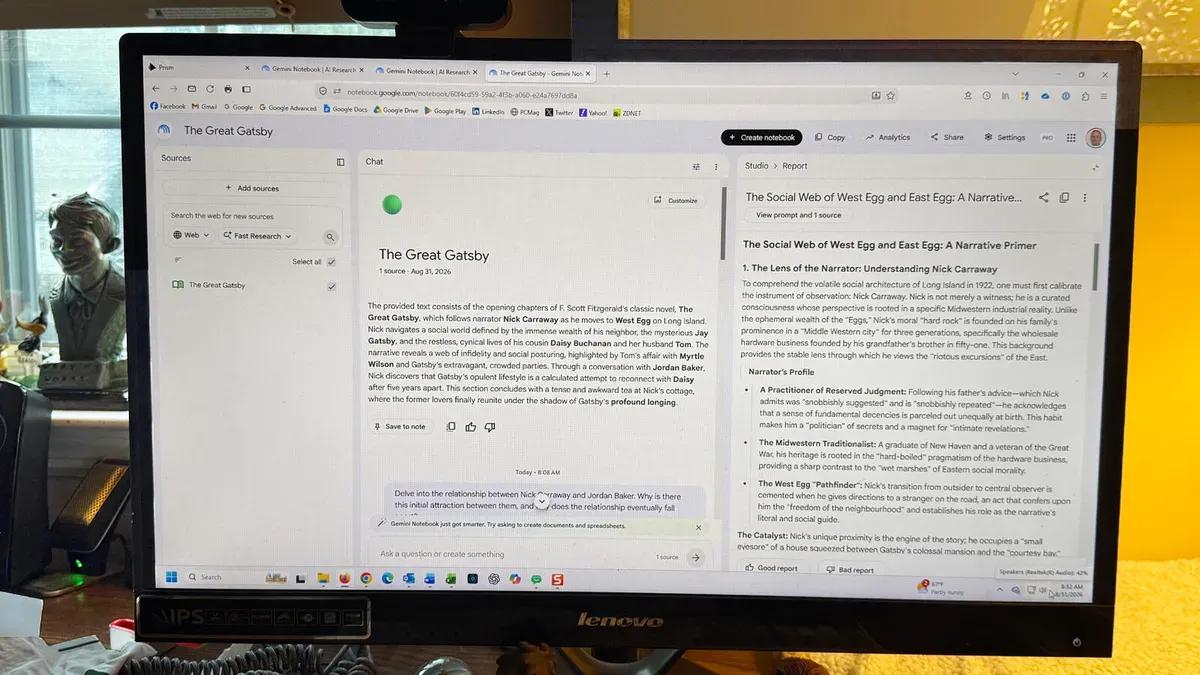
Google's AI note-taking app, Gemini Notebook, can now pull information from the books you've purchased. The new "Expert Intelligence" feature allows you to bring titles from Google Play Books directly into Gemini Notebook, which means you can ask questions about the material, as well as generate plans, infographics, AI podcasts, and more based on their contents. During a briefing with The Verge, Google Labs editorial director Steven Johnson showed how you can use the tool to generate a recipe book using the information in Michael Pollan's Food Rules. In another example, Gemini Notebook applied the knowledge from Kim Scott's management-focused Radical Candor to answer a question about handling a difficult conversation with an employee. You'll also be able to view the full text of the book directly in Notebook. To start, more than 100,000 books from publishers like Penguin Random House, Johns Hopkins University Press, Macmillan Publishers, O'Reilly Media, and others will support Expert Intelligence. Google also worked with 15 authors, including Pollan, Scott, Steven Pinker, and Jennifer Wallace, to create "Featured Notebooks" that each author customizes with additional source material, intro letters, and more. Titles that support the feature will have "Gemini Notebook" listed under the "Tools" badge in Google Play Books. "I'm really interested in the idea of building a collection of people whose work you really value, and kind of creating your own dream team of advisors that are just available to you wherever you go," Johnson says. Additionally, Google built protections into Gemini Notebook to prevent other users from accessing material from books they haven't purchased. If you share a Notebook that includes a purchased book, a user who doesn't own the title will see it listed as a source, but they won't be able to view the full text or information related to it. Clicking the source will direct users to Google Play Books, where they can purchase it. "We want to be able to create a space where users can bring whatever knowledge, whatever expertise they think is going to be most relevant and do it in a way that creates new revenue possibilities for authors and publishers as well," Johnson says. Google will eventually bring this feature to AI Mode in Search and the Gemini app, both of which can already pull information from Gemini Notebook. The company also has plans to expand Expert Intelligence to support scholarly articles, magazine articles, and newspapers, according to Johnson.
[2]
Gemini Notebook Can Now Dig Into eBooks You Bought on Google Play
Google on Thursday added support for ebooks in its AI note-taking tool, Gemini Notebook -- previously known as NotebookLM. With the new feature, labeled Expert Intelligence, you can add titles purchased on Google Play Books as sources in a notebook, and then ask the AI tool questions you may have, generate summaries, or use its content to create infographics, quizzes, AI podcasts, and more. You can also use Expert Intelligence to ask how you can apply learnings from a book in your personal or professional life. For example, Google says a manager can ask Gemini Notebook how to give feedback to employees based on Kim Scott's Radical Candor: Be a Kick-Ass Boss Without Losing Your Humanity, or a foodie can upload pictures of items in a fridge and ask the tool to plan a healthy meal based on Michael Pollan's Food Rules: An Eater's Manual. Adding ebooks to a notebook is quite simple. Click the Add sources button from the left pane and pick Play Books from the subsequent window. You should see all the titles you've purchased from Play Books next. If your desired book isn't already in your library, you can click Explore Google Play Books and make the purchase there. Before hitting the purchase button on Play Books, ensure the book is supported on Gemini Notebook. You can do that by opening the details page of your preferred book and clicking the Tools badge under it. At launch, Expert Intelligence will support 100,000 works from publishers including Penguin Random House, Macmillan Publishers, Bloomsbury, and others. Google will also add works from 15 best-selling authors, including Steven Pinker, Michael Pollan, and Jennifer Wallace, as Featured Notebooks. To get users started on Expert Intelligence, Google said it will provide a free ebook "while supplies last." Note that if you're on a shared notebook, all members in the group will need to purchase a copy to use the book's contents. Expert Intelligence will be added to AI Mode in Search and the Gemini app soon, the company said, adding that support for third-party subscriptions, business research reports, and textbooks will also arrive on Gemini Notebook soon.
[3]
Gemini Notebook now imports your Google Play Books titles, turning shelfware into notes
Users can also combine insights from multiple titles for a broader knowledge bank in a single notebook. Using copyrighted text for training large language models has been a controversial topic for as long as AI has been a buzzword. That hasn't stopped frontier labs from gaining access to books, including physical ones, to satisfy the ever-scaling need for pretraining data. The pursuit of high-quality human data has also led to legal troubles for AI companies, including Google, which is now looking to soften the blow by partnering with (and hopefully, rightfully paying) authors -- and letting users access and imbibe their wisdom through Gemini Notebook (previously called NotebookLM). Gemini Notebook can be an excellent tool for digesting enormous amounts of information in books, but importing books directly may involve wading through gray swamps of skirting DRM restrictions. Google is now formally opening the gates to use information and insights from copyrighted books in its research or learning pursuits. Under the banner of "Expert Intelligence," Google is allowing users to import owned titles from Google Play Books into Gemini Notebook and use its features, such as Audio Overviews or Infographics. The feature may not be available for all titles purchased through Play Books, as Google notes "select ebooks" are currently available. The available library, however, isn't small by any measure, as Google says Expert Intelligence already offers more than 100,000 titles from leading publishing houses, including Bloomsbury, De Gruyter Brill, Johns Hopkins University Press, Macmillan Publishers, O'Reilly Media, and Penguin Random House. Google has also partnered with 15 bestselling authors, including Jennifer Wallace, Michael Pollan, and Steven Pinker, to create special notebooks with sources complementing their books. It also says that users will have the option to combine multiple titles into a single notebook for shared insights from multiple experts. Last year, Google added the option to access copyright-free textbooks from OpenStax as a free learning resource for students, and other curious minds. The recent announcement may not only supplement the knowledge bank further, but likely also show AI labs how they can pacify authors upset about their books being used to train AI by adding a layer of authorization -- and hopefully, without destroying books. Long before AI broke the internet in late 2022, the global community of authors had locked horns with companies operating LLMs, especially frontier models such as ChatGPT and Gemini, over the unauthorized use of original texts. In July, Google is facing a class-action lawsuit from an alliance of authors and publishers for copyright infringement, alleging that titles in Google Play Books were used to train AI models without authorization. While Google hasn't formally responded to these allegations, the latest attempt to onboard experts could open up negotiations and help find middle ground for authors open to letting AI be trained on their creative work -- with justified royalties, like OpenAI has with some major online publishers, including Associated Press, Axios, Condé Nast, Financial Times, The Guardian, and more.
[4]
Gemini Notebook's latest trick makes heavy books way less intimidating
I've been covering Android and other mobile technology for close to ten years now, with a specific interest in phone accessories, e-readers, and what makes each individual phone different from another. I delight in looking at the phone market from as many angles as possible, and while my opinions may be odd, at times, they're always from the heart as much as the head. I have a background in the mobile accessories world, which explains my odd enthusiasm for cases and things that clip onto smartphones. I worked for Digital Trends from 2017 to 2025. Gemini Notebook, known until recently as NotebookLM, has a new trick up its sleeves -- it can read your Google Play Books ebooks for you (via Android Authority). This sounds like a weird thing to celebrate, but hear us out. Rather than outsourcing the act of reading to the robots, the aim here is to use Google's AI to create notebooks full of insights and further sources to read more. In short, it's AI being used to help, rather than replace, and it could be a big help for students and readers alike. Gemini Notebook can help to break down the toughest of books But only selected ebooks are currently available Books and AI has been a thorny subject for a long time. Many AI models have been trained on books without the knowledge or permission of their authors, and to say that's ruffled feathers would be an understatement. Add to that the enormous amount of low-quality AI "books" that have made their way onto ebook markets everywhere, and it's clear AI and books aren't a combination that should be taken lightly. Google is clearly trying to make amends with its latest addition to Gemini Notebook. Using Expert Intelligence, users will be able to import certain ebooks directly from their Play Books shelves into notebooks, letting AI decode them and deliver new insights. The key word there is "certain". At the moment, only selected books are available, but that still numbers an impressive 100,000 titles. A distinctive AI "sparkle" will mark which ebooks are supported -- though this icon doesn't seem to be present yet, as I couldn't find one on any of the pages of supposedly supported ebooks. I haven't been able to import any of my Play Books ebooks to Gemini Notebook, but if you're curious, Google has included a bunch of compatible ebooks in Gemini Notebook already. Just head to the Discover tab to see what Google has on offer. While it doesn't allow you to read the books themselves, it does allow you to ask Notebook questions about the concepts in each book, and drill down into what's discussed in them. I can see this being a valuable resource if you've read the books in question, but as someone who hasn't read any of the books Notebook currently has on offer, it leaves me cold. It feels a little bit like reading a Wikipedia article instead of the book itself, which deadens the impact of whatever concepts are being discussed. Still, as a concept, an adaptable version of Cliff Notes that can be dynamically questioned clearly has some value, and it's worth checking out the idea if you have access to Gemini Notebook. NotebookLM See at Official site Expand Collapse
[5]
Google announces 'Expert Intelligence' to let you add Play Books in Gemini Notebook
Expert Intelligence is a new "cross Google initiative that helps you engage with your trusted sources through Google AI products," starting with Play Books and Gemini Notebook. Select ebooks that you've purchased from Google Play Books can now be added to Gemini Notebook and used as a source This lets you "ask questions about the book and receive responses grounded directly in that book." You can also generate Infographics, Audio Overviews, Quizzes, and other Gemini Notebook features from the book. Another way to use Expert Intelligence is in combination with your information. For example: * A manager can ask Gemini Notebook to help brainstorm strategies on how to best give employees feedback and navigate tough conversations by consulting Kim Scott's Radical Candor: Be a Kick-Ass Boss Without Losing Your Humanity. * A woman can securely upload her journal entries to a notebook that also includes The New Menopause, to better understand how Dr. Mary Claire Haver's expertise applies to her own life, with direct citations to relevant content in her book. * A parent can take a picture of the items in their fridge and ask for help creating a healthy family meal plan for the week based on Michael Pollan's Food Rules: An Eater's Manual. Expert Intelligence today is compatible with over 100,000 books from Bloomsbury, De Gruyter Brill, Johns Hopkins University Press, Macmillan Publishers, O'Reilly Media, and Penguin Random House. Google worked with authors and publishers on controls that ensure users "must own the book through Google Play Books" before they can interact with it. If a notebook is shared, other collaborators will be prompted to purchase their own copy to engage with the content further. Otherwise, the book will be unavailable within their notebook. We believe that over time, Expert Intelligence will create content discovery and help authors reach new and more engaged readers. To check if a title is eligible for Expert Intelligence, check the Google Play Books listing. If eligible, you'll see Gemini Notebook listed when you click the "Tools" badge on a book's detail page. Looking ahead, you'll be able to use Expert Intelligence in the Gemini app and AI Mode. Meanwhile, "people will also be able to add more sources like third-party subscriptions, business research reports, and textbooks."
[6]
Expert Intelligence: a new way for you to engage with trusted content
We're committed to providing you with trusted, high-quality information. Today, we're taking another step in that mission by introducing Expert Intelligence, a cross Google initiative that helps you engage with your trusted sources through Google AI products. You can now incorporate insights from leading authors, publications, and domain experts, including from titles you've purchased, directly into Gemini Notebook, with more products joining soon. Created to engage with your books in new ways Over the past several months we've been meeting with authors and publishers to better understand how AI can help people get the most out of their books. One insight is that readers return to their favorite books repeatedly, and continue to apply the author's lessons to their own life. To support this, we've built the ability to add select ebooks you've purchased from Google Play Books directly to a Gemini Notebook. This makes it simple for you to ask questions about the book and receive responses grounded directly in that book. You can also use Gemini Notebook to help you understand books in new ways, for example, by generating Infographics, Audio Overviews, Quizzes, or more from the book. Even better, you can combine the expertise from your favorite authors with a variety of other sources, including your own information. For example: * A manager can ask Gemini Notebook to help brainstorm strategies on how to best give employees feedback and navigate tough conversations by consulting Kim Scott's Radical Candor: Be a Kick-Ass Boss Without Losing Your Humanity. * A woman can securely upload her journal entries to a notebook that also includes The New Menopause, to better understand how Dr. Mary Claire Haver's expertise applies to her own life, with direct citations to relevant content in her book. * A parent can take a picture of the items in their fridge and ask for help creating a healthy family meal plan for the week based on Michael Pollan's Food Rules: An Eater's Manual. Built in collaboration with authors and publishers Expert Intelligence launches today with more than 100,000 books from major publishers, including Bloomsbury, De Gruyter Brill, Johns Hopkins University Press, Macmillan Publishers, O'Reilly Media, and Penguin Random House. We've also collaborated closely with more than 15 bestselling authors -- including Steven Pinker, Michael Pollan, and Jennifer Wallace -- to curate special Featured Notebooks that supplement their books with additional sources and engaging artifacts that let readers dive deeper into the author's work.
[7]
Google's New AI Update for eBooks Lets You Do More than Simply Read Them
Google recently announced the launch of Expert Intelligence, a new AI-powered feature which allows users to essentially integrate trusted sources and purchased ebooks directly into Google AI products. Starting today, readers can add eligible books purchased through Google Play Books into Gemini Notebook. This integration allows users to query the text, generate insights, and combine an author's expertise with their own personal data. Within Gemini Notebook, users can prompt the AI to create infographics, audio overviews, and quizzes based strictly on the source material. Users can also blend book content with their own uploads. For instance, a reader could consult the content within Kim Scott's Radical Candor to brainstorm employee feedback strategies, and even upload a photo of their fridge to generate a meal plan based on Michael Pollan's Food Rules, for example. Google says that Expert Intelligence is launching with over 100,000 supported titles from major publishers, including Bloomsbury, Macmillan, Penguin Random House, O'Reilly Media, and Johns Hopkins University Press. Google has also partnered with more than 15 bestselling authors to create curated Featured Notebooks that offer supplementary materials and deeper dives into their work. To protect publisher rights, the system enforces strict access controls. For one, users must verify ownership of a book through Google Play Books before they can analyze it with AI. If a user shares their notebook with others, collaborators will be locked out of the book's specific content until they purchase their own copy. Users can also identify eligible titles by checking for a Gemini Notebook listing under the "Tools" badge on a book's Google Play store page. To promote the launch, Google is offering U.S. users one free eligible book. READ: Gemini Live Now Handles Your Emails and Daily To-Do Lists Google adds that it's planning to expand Expert Intelligence beyond Gemini Notebook into the main Gemini app and AI Mode in Search, including widening the scope of supported materials to include third-party subscriptions, business research reports, and educational textbooks.
Share
Copy Link
Google launched Expert Intelligence, allowing Gemini Notebook users to import Google Play Books titles directly into the AI note-taking app. The feature supports over 100,000 titles from major publishers like Penguin Random House and Macmillan, enabling users to generate summaries and infographics, ask questions, and apply book concepts to real-world scenarios.
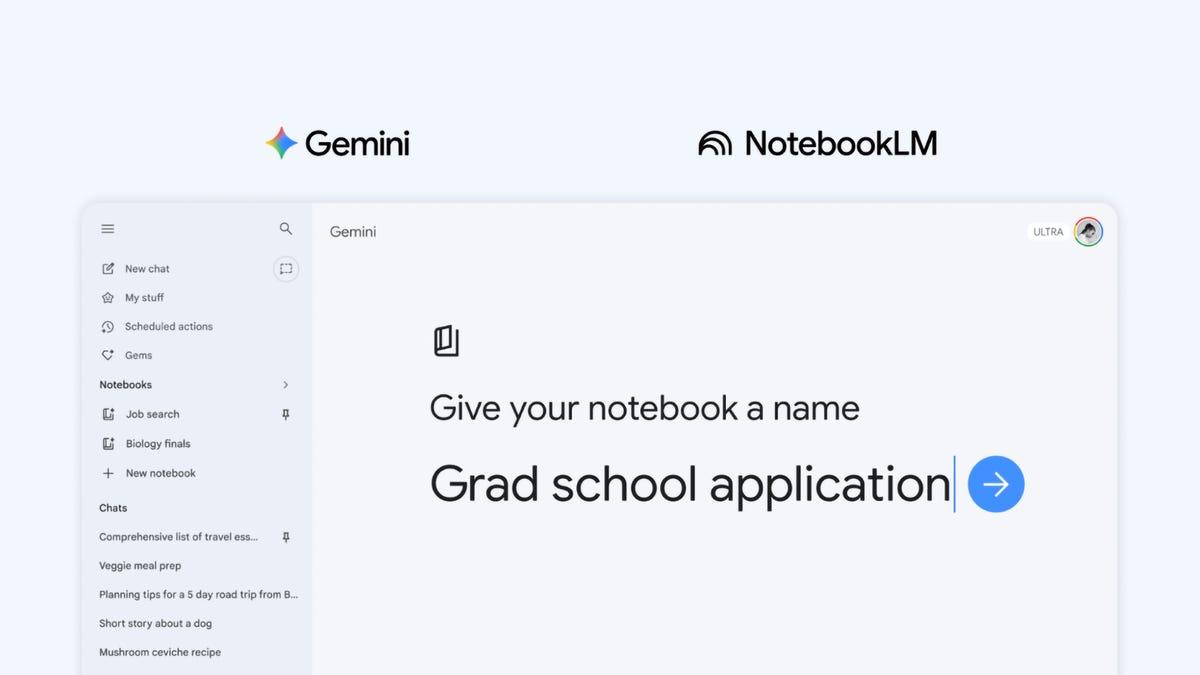
Google has introduced Expert Intelligence, an AI-driven initiative that enables Gemini Notebook (previously NotebookLM) users to interact with books purchased from Google Play Books. This development marks a strategic move to address ongoing concerns about copyrighted material usage in AI training while creating new revenue opportunities for authors and publishers.
The Expert Intelligence feature allows users to import Google Play Books titles directly into Gemini Notebook as sources
1
. Users can now ask questions about book content, generate summaries and infographics, create AI podcasts, and develop quizzes based on purchased titles2
. The AI note-taking app provides access to full text viewing directly within the interface, making it easier to analyze ebooks with AI assistance1
.Steven Johnson, Google Labs editorial director, demonstrated practical applications during a briefing with The Verge. In one example, Gemini Notebook generated a recipe book using Michael Pollan's Food Rules, while another demonstration showed how Kim Scott's Radical Candor could help managers navigate difficult employee conversations
1
. Users can also combine multiple titles into a single notebook to extract insights from books across different domains3
.
Source: The Verge
Expert Intelligence launches with support for more than 100,000 books from major publishers including Penguin Random House, Macmillan Publishers, Bloomsbury, De Gruyter Brill, Johns Hopkins University Press, and O'Reilly Media
2
3
. Google partnered with 15 bestselling authors, including Steven Pinker, Michael Pollan, Jennifer Wallace, and Kim Scott, to create Featured Notebooks with customized source material and introductory letters1
3
.To identify compatible titles, users can check the Tools badge on a book's detail page in Google Play Books, where supported titles display "Gemini Notebook" as an available feature
1
5
. Google will provide a free ebook to help users get started with Expert Intelligence while supplies last2
.
Source: Android Authority
Google implemented safeguards to prevent unauthorized access to copyrighted material. Users must own books through Google Play Books before they can interact with them in Gemini Notebook
5
. When sharing notebooks containing purchased books, collaborators who don't own the title will see it listed as a source but cannot view full text or related information. Clicking the source redirects them to Google Play Books for purchase1
.This approach addresses longstanding tensions between AI companies and authors over unauthorized use of copyrighted works for training large language models. Google currently faces a class-action lawsuit from authors and publishers alleging that titles in Google Play Books were used to train AI models without authorization
3
. Johnson emphasized Google's goal to "create a space where users can bring whatever knowledge, whatever expertise they think is going to be most relevant and do it in a way that creates new revenue possibilities for authors and publishers"1
.Related Stories
Google plans to extend Expert Intelligence beyond its current scope. The feature will soon be available in AI Mode in Search and the Gemini app, both of which already pull information from Gemini Notebook
1
5
. Future updates will add support for third-party subscriptions, business research reports, scholarly articles, magazine articles, newspapers, and textbooks1
2
5
.This expansion could establish a model for ethical AI training that compensates creators while providing users with powerful research tools. By partnering with publishers and implementing purchase requirements, Google may be testing a framework that balances AI capabilities with intellectual property rights, potentially influencing how other AI companies approach similar challenges in the future.
Summarized by
Navi
[3]
[4]
09 Apr 2026•Technology

10 Mar 2026•Technology

05 Aug 2025•Technology

1
Technology

2
Policy and Regulation

3
Policy and Regulation