Google Unleashes Ironwood TPU v7: Seventh-Generation AI Chips Challenge Nvidia's Dominance


9 Sources
[1]
Google deploys new Axion CPUs and seventh-gen Ironwood TPU -- training and inferencing pods beat Nvidia GB300 and shape 'AI Hypercomputer' model
Today, Google Cloud introduced new AI-oriented instances, powered by its own Axion CPUs and Ironwood TPUs. The new instances are aimed at both training and low-latency inference of large-scale AI models, the key feature of these new instances is efficient scaling of AI models, enabled by a very
[2]
TPU v7, Google's answer to Nvidia's Blackwell is nearly here
Chocolate Factory's homegrown silicon boasts Blackwell-level perf at massive scale opinion Look out, Jensen! With its TPUs, Google has shown time and time again that it's not the size of your accelerators that matters but how efficiently you can scale them in production. Now with its latest
[3]
Google's rolling out its most powerful AI chip, taking aim at Nvidia with custom silicon
Sundar Pichai, chief executive officer of Alphabet Inc., during the Bloomberg Tech conference in San Francisco, California, US, on Wednesday, June 4, 2025. Google is making its most powerful chip yet widely available, the search giant's latest effort to try and win business from artificial
[4]
Google debuts AI chips with 4X performance boost, secures Anthropic megadeal worth billions
Google Cloud is introducing what it calls its most powerful artificial intelligence infrastructure to date, unveiling a seventh-generation Tensor Processing Unit and expanded Arm-based computing options designed to meet surging demand for AI model deployment -- what the company characterizes as a
[5]

Google's Ironwood TPU To be Generally Available in Coming Weeks | AIM
TPU v7 offers 10x peak performance improvement over TPU v5, and 4x better performance per chip for both training and inference workloads compared to TPU v6. Google announced that Ironwood, its seventh generation of TPUs (tensor processing units), will be made generally available in the coming few
[6]

Google unleashes Ironwood TPUs, new Axion instances as AI inference demand surges - SiliconANGLE
Google unleashes Ironwood TPUs, new Axion instances as AI inference demand surges Google LLC today announced it's bringing its custom Ironwood chips online for cloud customers, unleashing tensor processing units that can scale up to 9,216 chips in a single pod to become the company's most powerful
[7]

Google to offer Ironwood TPU for public use; Anthropic among first major clients
Ironwood, the seventh-generation tensor processing unit (TPU) launched by the search giant in April this year for testing and deployment, is built by linking up to 9,216 chips in one pod. It removes data bottlenecks to let customers run and scale the largest, most data-intensive models. Tech giant
[8]

Hot Take: The True AI Chip Challenge for NVIDIA Isn't from AMD or Intel -- It's Google's TPUs Heating Up the Race
NVIDIA's biggest competition in the AI industry, which has emerged as a formidable rival, is not currently AMD or Intel, but rather Google, which is catching up in the race. Interestingly, NVIDIA's CEO, Jensen Huang, is already aware of it. Well, this might seem a bit surprising at first, but
[9]

Google's Latest AI Chip Puts the Focus on Inference | The Motley Fool
Google announced on Thursday that Ironwood, its seventh-generation TPU, would be available for Google Cloud customers in the coming weeks. The company also disclosed that its new Arm-based Axion virtual machine instances are currently in preview, unlocking major improvements in performance per
Share
Copy Link
Google Cloud introduces its most powerful AI infrastructure yet with Ironwood TPU v7 chips offering 4x performance gains and massive scaling capabilities up to 9,216 chips per pod. Anthropic commits to using up to 1 million TPUs in a multi-billion dollar deal.
Google's Most Powerful AI Chip Yet
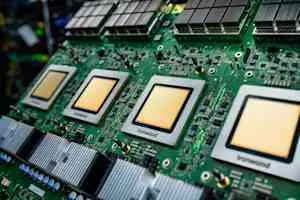
Google Cloud has unveiled Ironwood, its seventh-generation Tensor Processing Unit (TPU), marking a significant leap in the company's custom silicon capabilities. The chip will become generally available in the coming weeks, representing Google's most ambitious effort yet to challenge Nvidia's dominance in the AI accelerator market
1
3
.
Source: VentureBeat
Ironwood delivers more than four times better performance for both training and inference workloads compared to its predecessor, TPU v6, and offers a ten-fold peak performance improvement over TPU v5
4
5
. Each Ironwood TPU boasts 4.6 petaFLOPS of dense FP8 performance, positioning it competitively against Nvidia's Blackwell GPUs at 4.5 petaFLOPS2
.Massive Scaling Capabilities
The architecture's most striking feature is its unprecedented scale. A single Ironwood pod can connect up to 9,216 individual chips through Google's proprietary Inter-Chip Interconnect network operating at 9.6 terabits per second
1
. This massive interconnect fabric provides access to 1.77 petabytes of High Bandwidth Memory, delivering a total of 42.5 FP8 ExaFLOPS for training and inference1
.
Source: The Register
This scale far exceeds Nvidia's competing platforms. While Nvidia's GB300 NVL72 system delivers 0.36 ExaFLOPS, Google's Ironwood pods achieve 118 times more FP8 ExaFLOPS performance
1
4
. Google's Jupiter datacenter network technology could theoretically support compute clusters of up to 43 TPU v7 pods, encompassing roughly 400,000 accelerators2
.Anthropic's Billion-Dollar Commitment
In a striking validation of Ironwood's capabilities, Anthropic has committed to accessing up to one million TPU chips, representing one of the largest known AI infrastructure deals worth tens of billions of dollars
3
4
. The AI safety company plans to use these TPUs to operate and expand its Claude model family, citing major cost-to-performance gains1
.
Source: AIM
Other companies are also adopting Google's platform. Lightricks has begun deploying Ironwood to train and serve its LTX-2 multimodal system, while Indian conglomerate Reliance recently unveiled Reliance Intelligence, which will utilize Google Cloud infrastructure running on TPUs
1
5
.Related Stories

Technical Architecture and Reliability
Google employs a unique 3D torus topology for its TPU pods, where each chip connects to others in a three-dimensional mesh, eliminating the need for expensive, power-hungry packet switches
2
. While this approach may require more hops for chip-to-chip communication compared to Nvidia's switched topology, it enables the massive scaling capabilities that define Google's approach.To ensure reliability at this unprecedented scale, Google uses Optical Circuit Switching technology that acts as a dynamic, reconfigurable fabric
1
. When components fail, the system automatically reroutes data traffic around interruptions within milliseconds, maintaining continuous operation. Google reports fleet-wide uptime of approximately 99.999% for its liquid-cooled systems since 20204
.References
Summarized by

Navi
[1]
[2]
[4]
Related Stories
Google deploys billions to turn TPU chips into serious challenge against Nvidia's AI dominance
22 Jun 2026•Business and Economy

Google Unveils Ironwood: A Powerful AI Chip Focused on Inference
10 Apr 2025•Technology
Google splits eighth-gen TPU into training and inference chips to challenge Nvidia dominance
20 Apr 2026•Technology

Recent Highlights



Recent Highlights
Today's Top Stories







Don’t drown in AI news. We cut through the noise - filtering, ranking and summarizing the most important AI news, breakthroughs and research daily. Follow topics that matter to you and stay ahead.


