Google Signs Largest Rice-Methane Carbon Credit Deal With Indian Startup Mitti Labs


2 Sources
[1]
Google signs its biggest rice-methane carbon credit deal with Indian startup Mitti Labs
Google has agreed to buy 1 million carbon credits from Indian climate-tech startup Mitti Labs through 2030, in what the companies say is the largest publicly announced deal to date for credits generated from cutting methane emissions in rice farming. The four-year agreement will cover rice farms
[2]
Google Signs Carbon-Credit Scheme with Indian Startup Mitti Labs
The Big Tech giant has been struggling with its net-zero targets due to the massive investments it has made in AI datacentres and is continuing to do so Google has signed a one-million carbon-credit scheme with climate-tech startup Mitti Labs, an Indian entity working with small farmers across
Share
Copy Link
Google has secured 1 million carbon credits from Indian climate-tech startup Mitti Labs through 2030 in the largest publicly announced deal for reducing methane emissions in rice farming. The agreement covers 100,000 hectares across Karnataka, Andhra Pradesh, and Telangana, cutting methane by 50% and saving 1.5 trillion liters of water while supporting Google's net-zero emissions by 2030 goal.
Google Secures Landmark Carbon Credit Deal to Address AI Infrastructure Emissions
Google has committed to purchasing 1 million carbon credits from Indian climate-tech startup Mitti Labs through 2030, marking the largest publicly announced carbon credit deal focused on reducing methane emissions in rice farming
1
. The four-year agreement addresses a critical challenge for the tech giant: achieving net-zero emissions by 2030 while simultaneously expanding AI infrastructure that drove its greenhouse gas emissions up 18% year-over-year in 2025 to approximately 14.5 million metric tons of carbon dioxide equivalent1
.
Source: TechCrunch
The partnership with Mitti Labs represents corporate sustainability meeting agricultural innovation at scale. Google's evaluation process included rigorous scrutiny of the startup's monitoring technology and on-site farm visits before finalizing the agreement
1
. Xavier Laguarta, co-founder of Mitti Labs, noted that having Google—one of the market's most sophisticated buyers with rigorous due diligence processes—validates their approach and provides the scale needed to work with large corporate buyers1
.Transforming Rice Cultivation Across Three Indian States
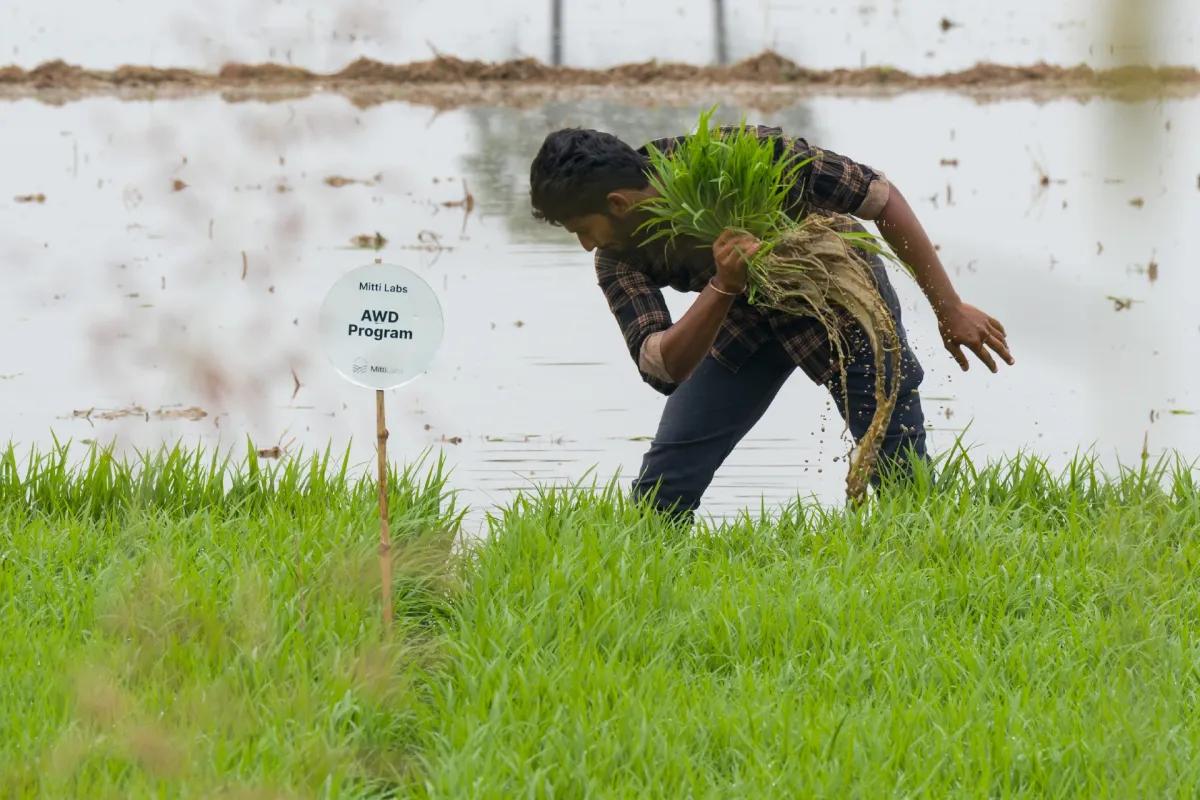
The carbon credit deal will cover rice farms across Karnataka, Andhra Pradesh, and Telangana, reaching approximately 100,000 hectares at peak delivery
1
. The project compensates farmers for adopting practices that reduce flooding duration in rice fields, directly cutting methane released during cultivation while simultaneously reducing irrigation water use1
.Mitti Labs employs an Alternate Wetting and Drying model that can reduce methane emissions by approximately 50% and irrigation water use by about 40% without sacrificing crop yields
1
. By 2030, the partnership is projected to unlock 1.5 trillion liters of water savings—roughly equivalent to three years of Bengaluru's entire water supply—across critical watersheds in India2
. This water conservation becomes increasingly vital as water storage across India's 166 major reservoirs fell from 38% of capacity in late April to just 32% by July 2026, with roughly 60% of India's farmers dependent on monsoon rainfall2
.GeoAI Platform Powers Scalable Methane Reduction
Founded in 2023 and based in New York and Bengaluru, Mitti Labs has built a GeoAI platform that combines satellite radar imagery with field measurements to remotely track crop growth, soil moisture, and flooding across smallholder farms
1
. The AI-powered platform uses synthetic aperture radar imagery from commercial and public satellites, with resolutions ranging from 50 centimeters to 10 meters, supplemented by proprietary field data to train its AI models1
.
Source: CXOToday
This technology, developed with support from NASA, delivers real-time information on crop health, soil moisture, and flooding status for each small farm holding, making it a solution capable of operating at population scale across multiple geographies
2
. Traditional rice farming keeps fields continuously flooded, creating ideal conditions for methane-producing microbes to thrive. Methane carries 85 times the warming potential of carbon dioxide and is responsible for roughly one-third of current global warming, though it breaks down in the atmosphere far quicker than carbon dioxide, making methane abatement an effective lever to limit near-term peak warming2
.Related Stories

Farmer Adoption and Revenue Distribution
Mitti Labs currently works with more than 100,000 farmers and aims to reach millions of farmers by 2030
1
. A majority of revenue from the startup's projects flows directly to farming communities, though specific payment details for the Google project were not disclosed1
. Yield concerns remain the primary worry when Mitti Labs pitches their process to farmers, making the demonstrated ability to maintain crop yields while reducing emissions and water use critical to adoption2
.The credits sold to Google can be issued under either Gold Standard or Isometric certification bodies, with projects undergoing independent third-party verification before credits are issued
1
. The startup's projects have already saved more than 500 billion liters of water over the past two years1
.Expansion Plans and Market Implications
Google began talks with Mitti Labs approximately a year ago as the tech company explored adding methane-reduction projects to its carbon-credit portfolio, drawn particularly to the project's water savings and Mitti Labs' ability to operate at scale
1
. While the Google project is limited to India, Mitti Labs plans to launch operations in the Philippines later this year and expand into Indonesia and Southeast Asian markets in 20271
.Laguarta sees significant room for market growth as more companies look to agricultural projects to tackle methane emissions, noting that about 150 million farmers grow rice across India, Southeast Asia, and China
1
. In addition to Google, Mitti Labs works with customers including carbon marketplace Cool Effect, rice producer Ebro Foods, and agricultural company Syngenta1
.This deal represents Google's second major carbon-removal investment in India. In January 2025, Google partnered with Gurugram-based Varaha to purchase 100,000 tons of carbon credits, marking its first large-scale purchase of carbon removal credits in the country involving biomass-produced biochar
1
. Google is also pursuing clean-energy projects in India, having signed an agreement tied to a 150-megawatt solar project in Rajasthan, bringing its contracted solar capacity with ReNew in the state to 300 megawatts1
. Watch for how this deal influences other tech companies facing similar tensions between AI infrastructure growth and climate commitments, and whether agricultural carbon credits become a preferred pathway for corporate sustainability goals amid water scarcity challenges across Asia.References
Summarized by

Navi
[1]
Related Stories
Google Unveils Five Major Sustainability Initiatives to Accelerate India's Clean Energy Transition
10 Sept 2026•Technology

Mitti Labs Raises $9.5M Led by Aramco Ventures to Scale Water-Resilient Rice Farming Across Asia
06 Aug 2026•Startups
Google Partners with Direct Air Capture Startup to Remove Carbon Emissions
12 Sept 2024

Recent Highlights
1
Microsoft and Nvidia Launch Surface Laptop Ultra: A $2,599 AI-Ready PC With RTX Spark Chip
Technology

2
Trump Consulted Grok AI Before Ordering Venezuela Invasion and Capture of Nicolás Maduro
Policy and Regulation

3
Scientists Build AI Model That Reconstructs Images From Brain Scans in Record Time
Science and Research

Recent Highlights
Today's Top Stories







Don’t drown in AI news. We cut through the noise - filtering, ranking and summarizing the most important AI news, breakthroughs and research daily. Follow topics that matter to you and stay ahead.


