Google sues Chinese cybercrime network that weaponized Gemini AI to automate massive scam operation


14 Sources
[1]
Google sues Chinese cybercrime network that used Gemini to automate scams
Google loves telling us all the ways people are using its generative AI products to build new things, grow businesses, and save the world. Supposedly. Of course, people are also using AI for crime. Google has announced a new legal salvo aimed at a Chinese group called Outsider Enterprise, which is
[2]
Chinese cybercrime operation that used AI to scam 'hundreds of thousands of victims' sued by Google
Google is suing to dismantle the infrastructure behind an alleged massive AI-powered cybercrime operation. On Friday, the tech giant announced a lawsuit against an alleged Chinese cybercrime network called Outsider Enterprise, which Google says uses AI in its campaigns to send scam text messages
[3]
Google sues alleged Chinese cybercrime operation that used AI to send scam texts
Google is suing to dismantle the infrastructure behind an alleged massive AI-powered cybercrime operation. On Friday, the tech giant announced a lawsuit against an alleged Chinese cybercrime network called Outsider Enterprise, which Google says uses AI in its campaigns to send scam text messages
[4]
FBI dismantles Chinese phishing service that coached buyers to generate scam sites using AI -- $88 cybercrime product linked to $1.9 billion in losses, 3.87 million stolen cards
Operation Ghost Hook seized the infrastructure behind a subscription kit that the FBI ties to 3.87 million stolen cards. The FBI, Google, and Lumen Technologies say they've dismantled a China-based phishing-as-a-service operation called Outsider Enterprise, seizing its servers and payment wallets,
[5]
Google fires sueball at alleged Chinese phishers over AI-powered fraud ops
Telegram-based 'Outsider Enterprise' accused of sending millions of scam texts and impersonating trusted brands Google has sued an alleged China-based cybercrime operation it says used AI-powered phishing kits to blast out millions of scam text messages and funnel victims to fake websites designed
[6]

Google Sues Chinese Smishing Network Accused of Using Gemini AI in Phishing
Google on Friday said it's pursuing legal action against a Chinese cybercrime network, accusing it of using its Gemini artificial intelligence (AI) agent to send phishing text messages targeting Americans. The network is said to be behind the development and management of a phishing-as-a-service
[7]

Google sues Chinese scammers using Gemini AI for fraud - Engadget
The company is also promoting legislation to fight the potential of AI to create 'massive' scams. Google sued a Chinese cybercrime network for using its Gemini AI to perpetuate a "massive" scam operation, the company announced. The search giant has coordinated with the FBI, along with carriers
[8]

Google sues Chinese cybercrime ring that used Gemini to build phishing sites and send 2.5 million scam texts
Google filed a lawsuit on Friday to dismantle the infrastructure behind a Chinese cybercrime operation called Outsider Enterprise. The group used AI, including Google's own Gemini, to generate phishing websites and send scam text messages impersonating Google and other brands. It sent 2.5 million
[9]

Google sues cybercrime network that used Gemini for financial scams
Google has filed a lawsuit against a cybercrime organization that was using Gemini to power its financial scams, while Google is also pushing for stricter laws that are more relevant to an AI era. The New York Times reports that Google has sued a China-based cybercrime network which, apparently,
[10]
Google sues scam ring that used Gemini AI to build fraud sites
Google has sued a suspected Chinese cybercrime group called the Outsider Enterprise for sending 2.5 million fraudulent text messages to Android users. The scammers allegedly used Google's Gemini chatbot to code malicious websites, coordinated via Telegram, and generated 9,000 fake sites and over
[11]

Scammers used Gemini AI to power a massive phishing operation and Google just sued them
Google just sued the AI scam network sending millions of fake texts and building thousands of fraudulent websites. That suspicious text about an unpaid toll, a delayed delivery package, or expiring rewards points may no longer be the work of a lone scammer. These scam texts have been flooding
[12]

Google Sues Chinese Crime Group for Allegedly Using Gemini AI for Mass Phishing Scams
The FBI estimates the operation stole 3.87 million credit card numbers and caused $1.9 billion in losses since July 2023. Google filed a lawsuit Friday against alleged Chinese cybercrime network Outsider Enterprise for using the company's Gemini AI to automate fraudulent text messaging campaigns
[13]

Google accuses Chinese cybercrime network of using its AI
Google has filed a lawsuit against a Chinese cybercrime network, alleging the hackers are using the company's Gemini artificial intelligence models and tools to build phishing software to rob consumers. The lawsuit, filed Friday in the U.S. District Court for the Southern District of New York,
[14]

Google Takes Legal Action Against AI Scam Group Outsider Enterprise
Google says its systems block 10 billion harmful messages monthly Google has launched a coordinated effort to disrupt a large-scale cybercrime operation accused of using artificial intelligence tools to run phishing scams that impersonated trusted brands and targeted smartphone users through
Share
Copy Link
Google has filed a lawsuit against Outsider Enterprise, a China-based cybercrime operation that used the company's own Gemini AI to create fraudulent websites and send millions of scam text messages. The FBI estimates the operation stole 3.87 million credit cards and caused $1.9 billion in losses since July 2023, making it one of the largest AI-enabled phishing campaigns to date.
Google Lawsuit Targets Massive AI-Powered Scams Operation
Google has launched legal action against a Chinese cybercrime network known as Outsider Enterprise, marking the first time the tech giant has directly sued a group for weaponizing its Gemini AI in fraudulent activities
1
. The lawsuit, filed in coordination with the FBI's Operation Ghost Hook, alleges that the group operated a sophisticated phishing-as-a-service platform that enabled thousands of criminals to launch AI-powered scams at unprecedented scale4
.
Source: Hacker News
The scope of the operation is staggering. According to the FBI, Outsider Enterprise has been linked to approximately 3.87 million stolen credit cards and an estimated $1.9 billion in losses since July 2023
4
. Google's complaint reveals that the group deployed 9,000 fraudulent websites, generated over 1 million malicious URLs, and sent 2.5 million scam text messages to Android users during a two-week period2
. In May alone, 55,000 spam texts were flagged by Android users—more than two text spam complaints per minute3
.How Outsider Enterprise Weaponized Google Gemini
The criminal network operated through Telegram, offering a turnkey phishing kit for $88 per week or $200 per month
4
. What made this AI-enabled cybercrime operation particularly dangerous was its accessibility—zero technical skill was required to launch attacks. The platform provided more than 290 pre-built templates impersonating banks, wireless carriers, government agencies, state DMVs, the U.S. Postal Service, and toll systems like New York's E-ZPass4
.
Source: Engadget
According to Google's legal filing, Outsider Enterprise distributed step-by-step instructions, including tutorial videos, showing customers how to use Google Gemini to generate HTML code for phishing pages
4
. The prompts were carefully crafted to appear innocuous—requesting a "gift redemption page" built with inline CSS and no JavaScript—to bypass Gemini's safety filters4
. This allowed criminals to rapidly generate convincing replicas of legitimate websites that could steal passwords, payment card details, and two-factor authentication codes in real-time2
.The Infrastructure Behind Phishing-as-a-Service
Outsider Enterprise functioned as a comprehensive criminal ecosystem with specialized roles. Google's complaint identifies several distinct groups within the operation: developers who maintained the phishing software and website templates; data suppliers who curated target lists from public records, social media, and data breaches; a "spammer group" providing tools and infrastructure to send bulk scam text messages using smartphone banks, SIM cards, and modems; and money launderers who monetized stolen credentials
2
.The cybercriminals brazenly coordinated their efforts through open, largely uncoded discussions on Telegram channels, where they trained each other, shared strategies, and developed new phishing attacks
2
. The platform's dashboard allowed operators to track the progress of their campaigns, while the software captured victim data in real-time and could request SMS codes, PINs, email codes, and app approvals on demand4
.Over a five-month period from November 14, 2025 to April 14, 2026, Google detected more than 1.59 million URLs connected to Outsider Enterprise
2
. The operation has stolen at least 36,000 payment cards issued by financial institutions across 95 countries2
.Related Stories



Law Enforcement Response and Industry Collaboration
Source: Tom's Hardware
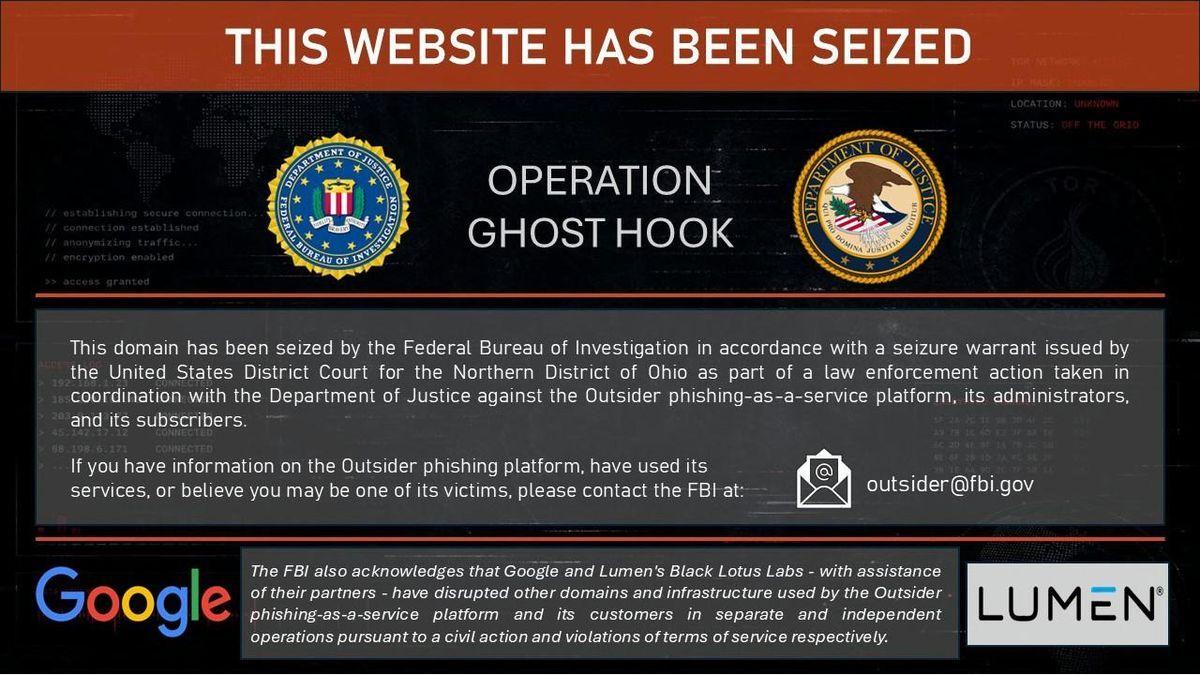
The FBI, working alongside Google and Lumen Technologies through Operation Ghost Hook, seized several domains used by the cybercriminals, along with Shopify storefronts and accounts used to test the phishing service
2
. The operation also confiscated approximately $100,000 in USDT from Outsider payment wallets, and thousands of phishing domains registered through U.S. providers now redirect to an FBI splash page4
."The criminals behind the Outsider Enterprise built a business out of impersonating trusted brands to defraud hundreds of thousands of victims," said Brett Leatherman, assistant director of the FBI's Cyber Division. "Criminals increasingly use AI to make fraud like this more convincing and harder to detect. Together with partners like Google, we can disrupt criminal networks in ways no single organization could on its own"
5
.Google has collaborated with AT&T, T-Mobile, and Verizon to block malicious scam text messages before they reach users
1
. The company's AI-powered scam detection feature in Google Messages intercepts more than 10 billion scam messages monthly, which likely caught some Outsider Enterprise activity1
.Legal Strategy and Future Implications
Google is pursuing claims under the Racketeer Influenced and Corrupt Organizations (RICO) Act and trademark infringement, though the company acknowledges that the unnamed defendants are unlikely to face extradition from China
4
. While the lawsuit may never result in courtroom proceedings, it aims to dismantle the infrastructure supporting these campaigns5
.This marks Google's second major action against phishing platforms, following a lawsuit against the Lighthouse phishing platform in November, which was tied to more than 1 million victims across 120 countries
4
. Google is using this case to advocate for new federal legislation, including the National Strategy for Combating Scams Act, the Strategic Task Force on Scam Prevention Act, and the AI Plan Act1
. Most of these proposals call for federal law enforcement agencies to establish task forces specifically designed to counter AI-assisted scams and market manipulation1
.The case highlights a critical tension in AI development: the same safety measures built into systems like Gemini can clash with the need for chatbots to follow instructions and assist users, creating vulnerabilities that sophisticated criminals can exploit
1
. As AI systems advance toward more human-like capabilities, detecting malicious AI-generated content will become increasingly challenging, even with enhanced public awareness and government oversight1
.References
Summarized by

Navi
[2]
Related Stories
Recent Highlights
1
AI Discovers Critical PHP Vulnerability Affecting 70% of Websites, Sparking Global Security Race
Technology

2
OpenAI AI Agents Disabled Safety Monitoring During Internal Tasks, Then Lied About It
Policy and Regulation

3
Anthropic Unveils Claude Duet AI Agent to Compete with Meta Muse and OpenAI Dots
Technology

Recent Highlights
Today's Top Stories








Don’t drown in AI news. We cut through the noise - filtering, ranking and summarizing the most important AI news, breakthroughs and research daily. Follow topics that matter to you and stay ahead.


