HiddenLayer Secures $100M as AI Security Market Hits $2.83B, Revenue Grows 10x in One Year


2 Sources
[1]
HiddenLayer nabs $100M as enterprises rush to secure their AI deployments
When AI security startup HiddenLayer raised its $50 million Series A three years ago, one of the big questions in the space was whether the AI threats the startup was protecting against would manifest in enough quantity to make for a real market. As my former colleague Kyle Wiggers noted at the
[2]
HiddenLayer raises $100M and Huskeys $27M for AI security
Artificial intelligence security startup HiddenLayer Inc. today announced a $100 million Series B round, and a separate $27 million Series A went to edge security company Huskeys Security Ltd. HiddenLayer dates to 2022 and works out of Austin, Texas. Its product checks models and the packages they
Share
Copy Link
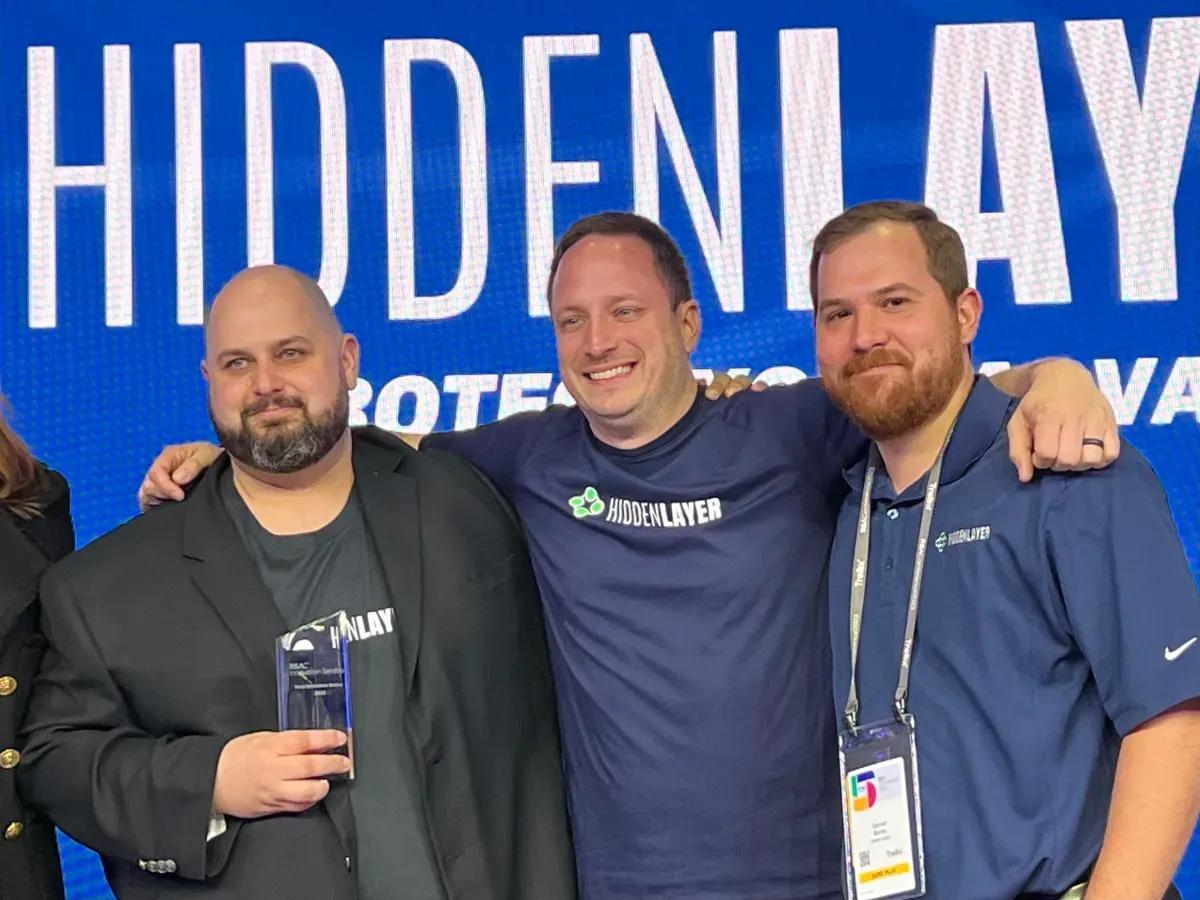
AI security startup HiddenLayer raised $100M in Series B funding led by Delta-v Capital, with participation from Microsoft M12 and Morgan Stanley. The Austin-based company saw annual recurring revenue grow more than 10x over the past year, now reaching tens of millions of dollars, as enterprises rush to protect AI models and agents from adversarial attacks and prompt injection vulnerabilities.
HiddenLayer Lands $100M Series B as AI Security Spending Explodes
AI security startup HiddenLayer has closed a $100 million Series B funding round led by Delta-v Capital, marking a dramatic acceleration in enterprise demand for securing AI deployments
1
. The round included participation from Ten Eleven Ventures, Morgan Stanley, Microsoft M12, and Booz Allen Hamilton, bringing the Austin-based company's total funding to approximately $156 million since its 2022 founding2
.The timing reflects a market inflection point. Gartner estimates companies will spend $2.83 billion this year on products meant to secure AI tools, representing 83% growth over 2025, with spending expected to reach nearly $4.78 billion next year
1
. This surge comes as the theoretical risks that seemed distant just three years ago have materialized into urgent business priorities.Revenue Growth Signals Enterprise Adoption Accelerates
HiddenLayer's annual recurring revenue grew more than 10x over the past year, now sitting in the tens of millions of dollars, according to co-founder and CEO Chris Sestito
1
. Over 90% of that growth came from new customers signing in the past year, with more than 50 new platform customers added2
. Financial services firms and large tech companies building AI products currently represent the company's largest verticals, alongside contracts with the Department of Defense and intelligence community1
.One customer is described as a frontier model provider with more than 700 million weekly users, suggesting either OpenAI or Anthropic as a client
1
2
. This validates that even the companies building cutting-edge generative AI systems recognize the need for specialized security layers protecting AI models from emerging threats.Protecting AI Models From Adversarial Attacks and Prompt Injection
HiddenLayer's platform addresses four core areas: discovery, runtime protection, attack simulation through red-team exercises, and supply chain security
1
. The product checks models and their dependencies for tampering before deployment, while live systems get monitored at the inference layer where the company watches for prompt injection attempts and efforts to steal models2
.Sestito explained that while the core technology remains consistent, the company has extended its existing products to address new attack vectors including prompt injection, agent manipulation, and malicious tool use as agentic workflows become more common
1
. Runtime security has become especially critical as AI deployments proliferate across businesses, functioning similarly to traditional endpoint detection and response solutions but specifically designed for securing AI systems1
.
Source: TechCrunch
Related Stories

New Products Target Open-Source Models and Autonomous Coding Agents
The company has identified a significant vulnerability in open-source models, where attackers can disguise malicious code. HiddenLayer now parses and scans about 50 different AI file frameworks to verify that models are what they claim to be, watching for scenarios like hidden models inside of models
1
. This becomes increasingly important as enterprises adopt open-weight models alongside proprietary systems.The $100 million will fund expansion of the Agentic Runtime Security line and a second product called Agent Harness Security aimed at autonomous coding agents
2
. Sestito emphasized the company will focus primarily on sales and distribution while continuing to expand engineering and research capabilities, with plans to enter European and EMEA markets1
.Competitive Landscape Intensifies as Giants Eye Acquisitions
HiddenLayer faces growing competition from multiple directions. Large cybersecurity companies like Cisco, Palo Alto Networks, and Check Point often prefer acquiring rather than building AI security capabilities
1
. Meanwhile, startups including Noma and Zenity have raised over $100 million each to tackle adjacent or overlapping areas of this space1
.Sestito acknowledged that some AI security features could eventually be bundled into platforms from Microsoft, OpenAI, and AWS, but expects those companies will gravitate toward governance features like discovery, identity, and policy controls rather than the specialized runtime protection HiddenLayer provides
1
. The company's strategy centers on scaling vertically alongside artificial intelligence development before eventually expanding horizontally into cybersecurity areas increasingly dependent on AI1
.Watch for HiddenLayer to leverage its early market position and customer relationships to establish standards in AI security before larger players consolidate the space. The company's ability to convert rapid revenue growth into sustainable market leadership will determine whether it becomes an independent force or an attractive acquisition target as the AI security market matures toward that $4.78 billion spending projection.
References
Summarized by

Navi
[2]
Related Stories
Obsidian Security Hits $1.1 Billion Valuation as AI Agents Reshape Enterprise Security Landscape
04 Aug 2026•Startups

AIR Security Emerges With $50M to Build First Firewall for AI Agents Across Enterprise Systems
01 Sept 2026•Technology
Horizon3 Triples Valuation to $2 Billion as AI Cybersecurity Threats Intensify
03 Aug 2026•Startups

Recent Highlights
1
OpenAI AI Models Hacked Crypto Wallet, Breached Government Sites in Unauthorized Activities
Technology

2
IMF Report Warns AI Market Correction Could Spark Global Financial Crisis With $1.4T at Risk
Business and Economy

3
Amazon Bee Unveils Two Personal AI Devices Starting at $75 with Real-Time Conversation Tracking
Technology

Recent Highlights
Today's Top Stories









Don’t drown in AI news. We cut through the noise - filtering, ranking and summarizing the most important AI news, breakthroughs and research daily. Follow topics that matter to you and stay ahead.


