China's Humanoid Robots Claim 97% of Global Market as Embodied AI Shifts from Spectacle to Scale


4 Sources
[1]
I spent a day at a robot "carnival" in Shanghai. Here's what I saw.
Humanoid robots are having a moment in China. The popular machines are part of the country's strategy to bring artificial intelligence into daily life. Embedding the technology into physical systems -- an idea called embodied AI -- was a key facet of China's latest five-year plan, and companies
[2]
The Humanoids at China's Robot Games Were Faster Than Usain Bolt -- but I'm More Impressed by Their Tweezer Mastery
If you're anything like me, the World Humanoid Robot Games are a highlight of your sporting calendar. The event, held in China, showcases the latest humanoid hardware, lots of algorithmic innovations, and a good dose of robot slapstick. This year's iteration, which wrapped up in Beijing on August
[3]
Robots sort packages and serve fast food at Beijing showcase
Beijing (AFP) - Robots sorting parcels and serving fried chicken enthralled visitors at a robotics expo in Beijing on Wednesday, where hundreds of companies set out their pitches for a future labour market transformed by artificial intelligence. The Chinese government has embraced robotics as a
[4]
China robot makers show off latest humanoids as tech event draws surprise visit from Nvidia CEO's daughter
Chinese robot makers showed off humanoids sorting parcels, packing mobile phones and helping with household chores at a Beijing conference on Wednesday, seeking to demonstrate a shift from crowd-pleasing displays to broader commercial use. More than 300 mostly domestic companies are attending the
Share
Copy Link
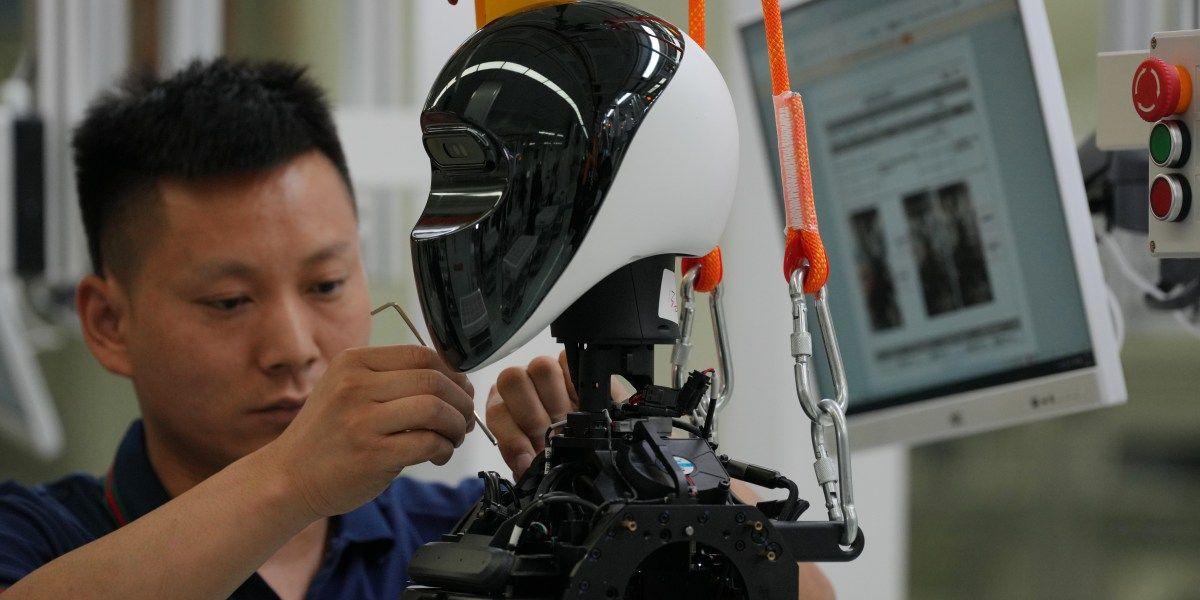
China shipped 18,430 humanoid robots in early 2026, capturing 97% of the global market as companies transition from entertainment displays to commercial deployment in logistics, manufacturing and service sectors. The World Robot Conference and Robot Games showcase how embodied AI is moving from carnival attractions to factory floors.
China's Humanoid Robots Dominate Global Shipments
China robotics manufacturers delivered approximately 18,430 humanoid robots in the first half of 2026, representing 97% of the 19,000 global units shipped during that period, according to Morgan Stanley citing Smart Analytics Global data
4
. This dramatic surge reflects a 272% increase compared to the previous year, positioning China's advancements in humanoid robots at the forefront of the global robotics industry. Nearly 90% of the more than 13,000 two-armed, two-legged robots delivered globally last year were made in China1
, cementing the country's leadership in embodied AI development.The industry houses more than 100 humanoid robot manufacturers in China alone, with participants also traveling from 15 other countries to showcase their innovations
2
. This ecosystem has emerged from strategic government support, with embodied AI serving as a key component of China's latest five-year plan.World Robot Conference Demonstrates Commercial Viability
The World Robot Conference in Beijing, running through late August, featured more than 300 mostly domestic companies displaying over 2,000 exhibits and launching more than 150 products
4
. The event drew thousands of Chinese and foreign visitors who witnessed robots performing commercial tasks across logistics, manufacturing and service sectors. Vice Minister of Industry and Information Technology Xin Guobin pledged continued support, declaring robotics "an important force" in China's economic and social development4
.
Source: New York Post
Notably, Madison Huang, a senior Nvidia executive and daughter of CEO Jensen Huang, made an unannounced visit to observe the demonstrations
4
. Huang oversees marketing for Nvidia's Omniverse and robotics platforms, AI-driven robotics platforms used to simulate and test physical AI systems. Her presence highlighted foreign suppliers' continued involvement despite US export restrictions on advanced AI chips to China.Practical Applications Replace Entertainment Focus
While approximately 65% of humanoid robot shipments still serve entertainment, education, research and data collection rather than productive commercial work
4
, companies are rapidly transitioning toward practical applications for humanoid robots. Zhang Dapeng, assistant vice president at industrial humanoid robot firm Leju, confirmed that European factories and Chinese auto plants are deploying Leju robots to move boxes and load components4
.Robotera has deployed more than 100 parcel-sorting robots across 15 warehouses nationwide, with robots performing commercial tasks at China Post logistics sites since last year
4
. DexForce demonstrated humanoid robots packing mobile phones into boxes on assembly lines at a Lens Technology factory, a Chinese supplier to Apple and Huawei, since early 20264
. DexForce official Nicole Yang emphasized the machines achieve millimeter-level operating accuracy and can detect and correct errors such as improperly angled phone placement.World Humanoid Robot Games Push Technical Boundaries
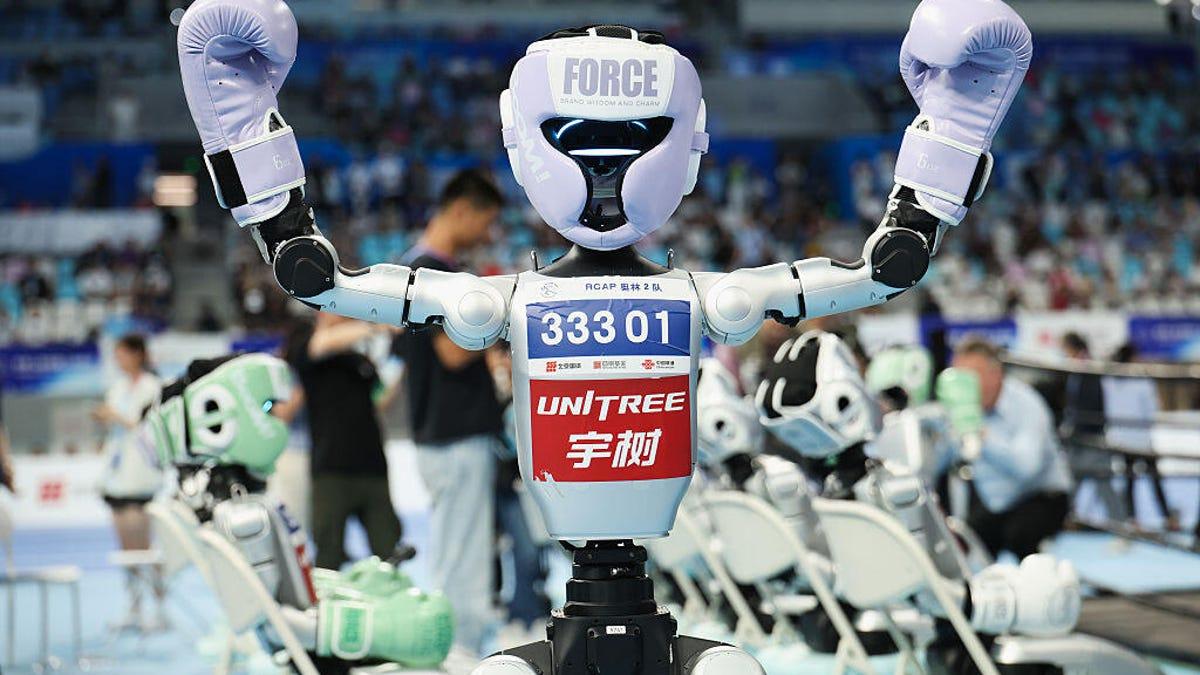
The World Humanoid Robot Games, which concluded in Beijing on August 26, showcased over 2,000 robots from more than 600 teams
2
. The Tiangong Ultra, developed by the Beijing Humanoid Robot Innovation Center, ran the 100-meter dash in 8.86 seconds and won the long jump with a distance of 7.97 meters2
. Another robot called Lightning, from smartphone maker Honor, completed the distance in 9.47 seconds. Both times exceeded Usain Bolt's human world record, demonstrating the athletic capabilities enabled by compact, high-power motors.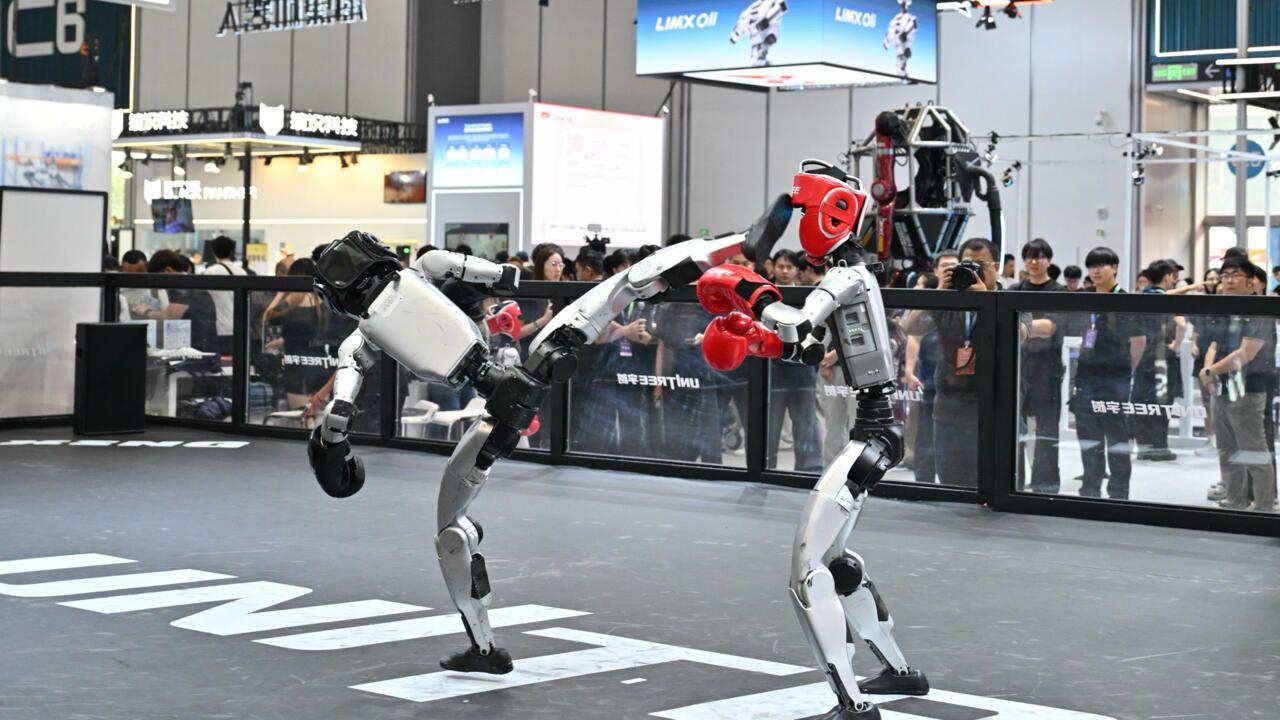
Source: France 24
Beyond speed competitions, new events tested robotic dexterity through challenges like plugging cables into sockets, depositing garbage in trash cans, block building, and tweezer bean picking
2
. These tasks reflect China's eagerness to automate work in factories and warehouses, such as wiring through automobile chassis or assembling electronics. Galbot participated in a Supermarket Scenario Competition involving stocking shelves in retail stores, pushing forward commercial capabilities.Related Stories
Robot Carnival Builds Public Engagement
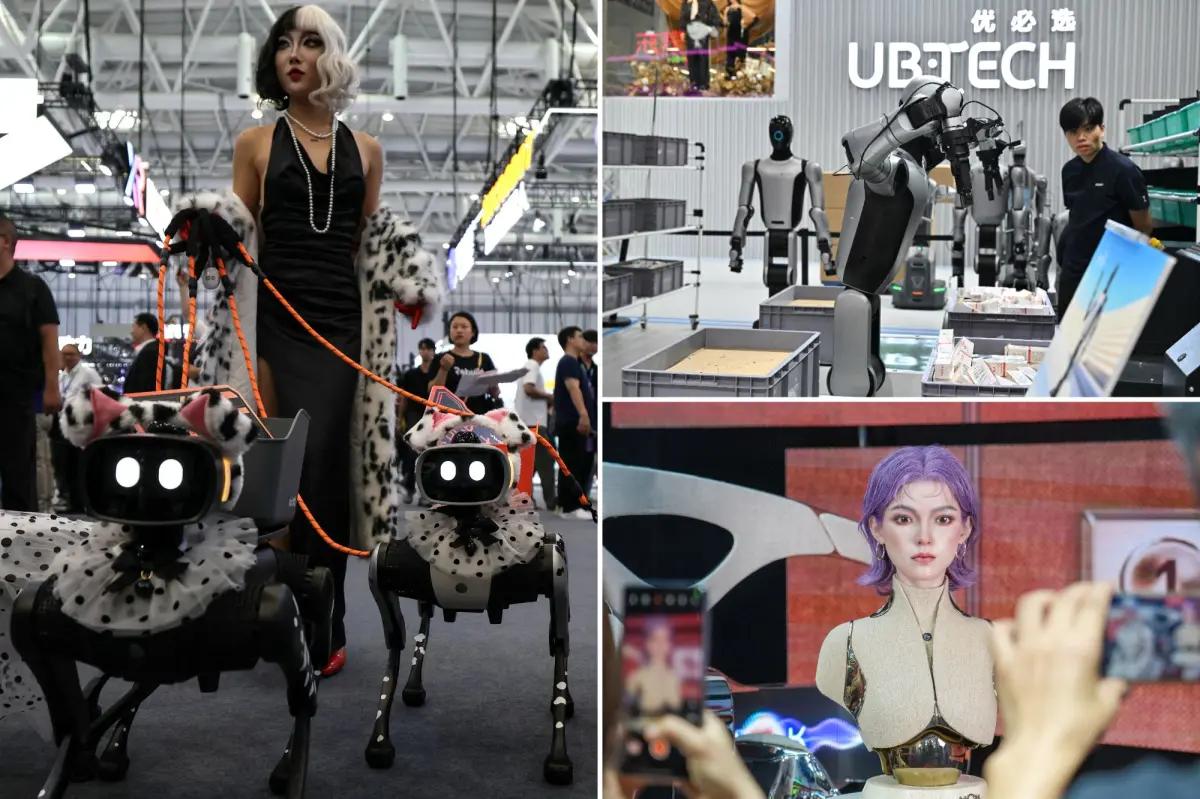
A robot carnival held at an R&D center on the outskirts of Shanghai drew curious families during a public holiday
1
. The hub houses more than 100 companies that research, develop, manufacture and market robotic technologies. Visitors purchased robotic dogs, learned to make quadrupedal robots climb stairs, and watched remote-controlled robots battle with water beads. Yang Duan, a product manager at DexForce, explained that humanoid robots "can free people from physical work and mundane chores"1
.
Source: MIT Tech Review
The main tent featured humanoids performing martial arts and front flips, with audiences chanting for more demonstrations
1
. Shopping malls and tourist attractions in several Chinese cities host humanoids that perform for crowds, while in Beijing, bipedal robots run half-marathons. These public showcases serve a strategic purpose by inviting people to experience robots up close and building acceptance for automation.Technical Challenges and Future Outlook
Advanced manipulation remains difficult for robots because it involves hard-to-predict factors like friction and slippage
2
. Stefanie Tellex, a roboticist at Brown University, noted this exemplifies Moravec's paradox, where tasks like backflips that seem impressive are actually easier than plugging in a cable. Improvements in robotic hands have been particularly notable, with robots now capable of picking up fruit—a breakthrough for agricultural applications3
.Investor Kang Yu, attending the World Robot Conference for a third year, observed that the industry remains "full of challenges," including slow response times during poor internet connections
3
. Yu Chao, founder and CEO of Lumos Robotics, stated the humanoid industry has not yet had its "ChatGPT moment" but predicted this breakthrough could arrive within three years3
.Unitree, China's best-known humanoid robot maker, saw shares soar nearly sixfold in their Shanghai trading debut on Wednesday after the IPO was more than 8,000 times oversubscribed by retail investors
4
. Following Unitree's success, startup Lumos Robotics and the robotics division of Chery Automobile are considering stock market listings. X Square Robot is testing robots in hundreds of homes this year before gradual commercialization next year, with its longest deployment lasting one month4
.References
Summarized by

Navi
[1]
Related Stories
Beijing Hosts Inaugural World Humanoid Robot Games: A Showcase of AI and Robotics Progress
15 Aug 2025•Technology
China dominates humanoid robots market with 85% of global output, but finding buyers proves harder
03 Jun 2026•Business and Economy
Humanoid Robots Showcase Skills at Ancient Olympia, Highlighting Progress and Challenges in AI-Driven Robotics
02 Sept 2025•Technology

Recent Highlights



Recent Highlights
Today's Top Stories






Don’t drown in AI news. We cut through the noise - filtering, ranking and summarizing the most important AI news, breakthroughs and research daily. Follow topics that matter to you and stay ahead.


