2 Sources
[1]
Modi faces challenge from activists over surveillance at India youth protest
NEW DELHI, July 27 (Reuters) - Indian activists are challenging Prime Minister Narendra Modi's government over the use of AI-powered surveillance at the largest youth protest in decades, with one court case set to become a test of federal powers even after agitation ended. The surveillance controversy erupted during last week's student protests over exam paper leaks, when demonstrators posted pictures on social media of a mobile police surveillance van equipped with cameras on a telescopic mast providing a 360-degree view of the gathering. One protester, student activist Aishe Ghosh, has asked the Delhi High Court to declare mass surveillance of protesters unconstitutional and direct the destruction of all personal data collected during the protest, as well as order the framing of guidelines on how surveillance technology can be used. Ghosh is pressing on with the case even though the protest ended after Education Minister Dharmendra Pradhan resigned in a rare setback for Modi, who has since announced a panel â to overhaul the cheating-prone exam system. India has no law governing the use of facial recognition technology by police and surveillance at the main protest site in New Delhi was a breach of the law, activists say. The government says such checks were legal and in the public interest to ensure law and order. Modi's government has often been accused by opposition parties and digital rights advocates of expanding surveillance powers and tightly controlling digital communications. It has rejected such accusations, saying it only acts in the public interest. During a hearing on Friday, Solicitor General Tushar Mehta defended the Indian police conduct, saying privacy claims at a public gathering were "ironical" and the checks were "absolutely necessary" and "in legitimate state interest." In a brief hearing on Monday, judges heard arguments from Ghosh that intrusive mass surveillance of protesters was disproportionate, as she sought broader disclosures on the state's surveillance policies during protests. The court will hear the matter on Tuesday. 'NEED FOR ACCOUNTABILITY' Internet Freedom Foundation, a New Delhi-based digital advocacy group, wrote to Delhi's police commissioner on July 24 demanding the deletion of â biometric data collected at the protest site. Delhi police did not respond to a Reuters request for comment. In a post on social media platform X on Sunday, the force said it had not "restricted anyone's freedom through the use of facial recognition technology". "We need proportionality even if we are to claim national security risks. Accountability must flow both ways," said Akash Karmakar, a technology law partner at Indian law firm Panag & Babu. He said if India used facial recognition to track protesters, it must also be used to identify police officers who allegedly acted without name â badges during the crackdown. Police were also seen noting Instagram handles of protesters arriving at the site. When asked why, Inspector Sunil Kumar told Reuters the checks were to ensure no-one with a criminal background entered the protest. 'FACE ACCURACY' MATCH The surveillance van parked at the site was emblazoned with the Delhi Police crest and the branding "Ikshana", Hindi for "vision". There is little detail online about Ikshana, barring â one post from its development partner, Indian CCTV company CP Plus, which said they were equipped with "Advanced AI-powered" cameras, mobile cameras and "Varifocal Bullet Cameras" with adjustable lenses. The 2023 post on CP Plus' website was removed over the weekend and was no longer accessible. CP Plus did not respond to a request for comment. When a Reuters reporter walked â past the van last week, one computer display inside showed his face with a green rectangular box around it and a "face accuracy" match metric next to it. Soon after, a police officer inside shut the van's window. "The computers here help us identify those who have a criminal history and it highlights them," police officer Raj Kumar Dahiya told Reuters. "AI also helps us count the number of protesters". Reporting by Saurabh Sharma, Munsif Vengattil; Editing by Aditya Kalra and Alex Richardson Our Standards: The Thomson Reuters Trust Principles., opens new tab * Suggested Topics: * Artificial Intelligence * Human Rights Munsif Vengattil Thomson Reuters Based in Bengaluru, Munsif Vengattil leads Reuters' technology news coverage in India. He tracks themes at the intersection of tech, business, and labor. A reporter for nine years, Munsif has written extensively on India's electronics manufacturing aspirations and its tech policy space, AI and election interference, satellite internet, streaming wars, and data breaches. His stories also focus on investigating corporate strategies and revealing India-specific initiatives and challenges of the biggest of tech firms - from Apple, Facebook, and Google, to Foxconn, Samsung, and Nvidia.
[2]
Modi Faces Challenge From Activists Over Surveillance at India Youth Protest
By Saurabh Sharma and Munsif Vengattil NEW DELHI, July 27 (Reuters) - Indian activists are challenging Prime Minister â Narendra â Modi's government over the use of AI-powered surveillance at â the largest youth protest in decades, with one court case set to become a test of federal powers even after agitation ended. The surveillance controversy erupted during last week's student protests over exam paper leaks, when demonstrators posted pictures on social media of a mobile police surveillance van equipped with cameras on a telescopic mast providing a 360-degree view of the gathering. One protester, student activist Aishe Ghosh, has asked the Delhi High Court to declare mass surveillance of protesters unconstitutional and direct the destruction of all personal â data collected during the â protest, as well as order the framing of guidelines on how surveillance technology can be used. Ghosh is pressing on with the case even though the protest ended after Education Minister Dharmendra Pradhan resigned in a rare setback for Modi, who has since announced a panel to overhaul the cheating-prone exam system. India has no law governing the use of facial recognition technology by police and surveillance at the main protest site in New Delhi was a breach of the law, activists say. The government says such checks were legal and in the public interest to ensure law and order. Modi's government has often been accused by opposition parties â and â digital rights advocates of expanding surveillance powers â and tightly controlling digital communications. It has rejected such accusations, saying it only acts in the public interest. During a hearing on Friday, Solicitor General Tushar Mehta defended the Indian police conduct, saying privacy claims at a public â gathering were "ironical" and the checks were "absolutely necessary" and "in legitimate state interest." In a brief hearing on Monday, judges heard arguments from Ghosh that intrusive mass surveillance of protesters was disproportionate, as she sought broader disclosures on the state's surveillance policies during protests. The court will hear the matter on Tuesday. 'NEED FOR ACCOUNTABILITY' Internet Freedom Foundation, a New Delhi-based digital advocacy group, wrote to Delhi's police commissioner on July 24 demanding the deletion of biometric data collected at the protest site. Delhi police did not respond to a Reuters request for comment. â In a post on social media platform X on Sunday, the force said it had not "restricted anyone's freedom through the use â of facial recognition technology". "We need proportionality even if we are to claim national security risks. Accountability must flow both ways," said Akash Karmakar, a technology law partner at Indian law firm Panag & Babu. He said if India used facial recognition to track protesters, it must also be used to identify police officers who allegedly acted without name badges during the crackdown. Police were also seen noting Instagram handles of protesters arriving at the site. When asked why, Inspector Sunil Kumar told Reuters the checks were to ensure no-one with a criminal background entered the protest. 'FACE ACCURACY' MATCH The surveillance van parked at the site was emblazoned with the Delhi Police crest and the branding "Ikshana", Hindi for "vision". There is little detail online about Ikshana, barring one post from its development partner, Indian CCTV company CP Plus, which said they were equipped with "Advanced AI-powered" cameras, mobile cameras and "Varifocal Bullet Cameras" with adjustable lenses. The 2023 post â on CP Plus' website was removed over the weekend and was no longer accessible. CP Plus did not respond to a request for comment. When a Reuters reporter walked past the van last week, one computer display inside showed his face with a green rectangular box around it and a "face accuracy" match metric next to it. Soon after, a police officer inside shut the van's window. "The computers here help us identify those who have a criminal history and it highlights them," police officer Raj Kumar Dahiya told Reuters. "AI also helps us count the number of protesters". (Reporting by Saurabh Sharma, Munsif Vengattil; Editing by Aditya Kalra and Alex Richardson)
Share
Copy Link
Indian activists are mounting a legal challenge against Prime Minister Narendra Modi's government over AI-powered surveillance deployed at student protests. The case, brought by student activist Aishe Ghosh, seeks to declare mass surveillance unconstitutional and force deletion of collected biometric data, testing federal powers in a nation with no laws governing facial recognition technology by police.
A legal challenge is unfolding in India after AI-powered surveillance was deployed at the largest youth protest in decades, raising fundamental questions about constitutional rights and government surveillance practices. Student activist Aishe Ghosh has petitioned the Delhi High Court to declare mass surveillance of protesters unconstitutional, demanding the destruction of all personal data collected during demonstrations and the establishment of guidelines for surveillance technology use
1
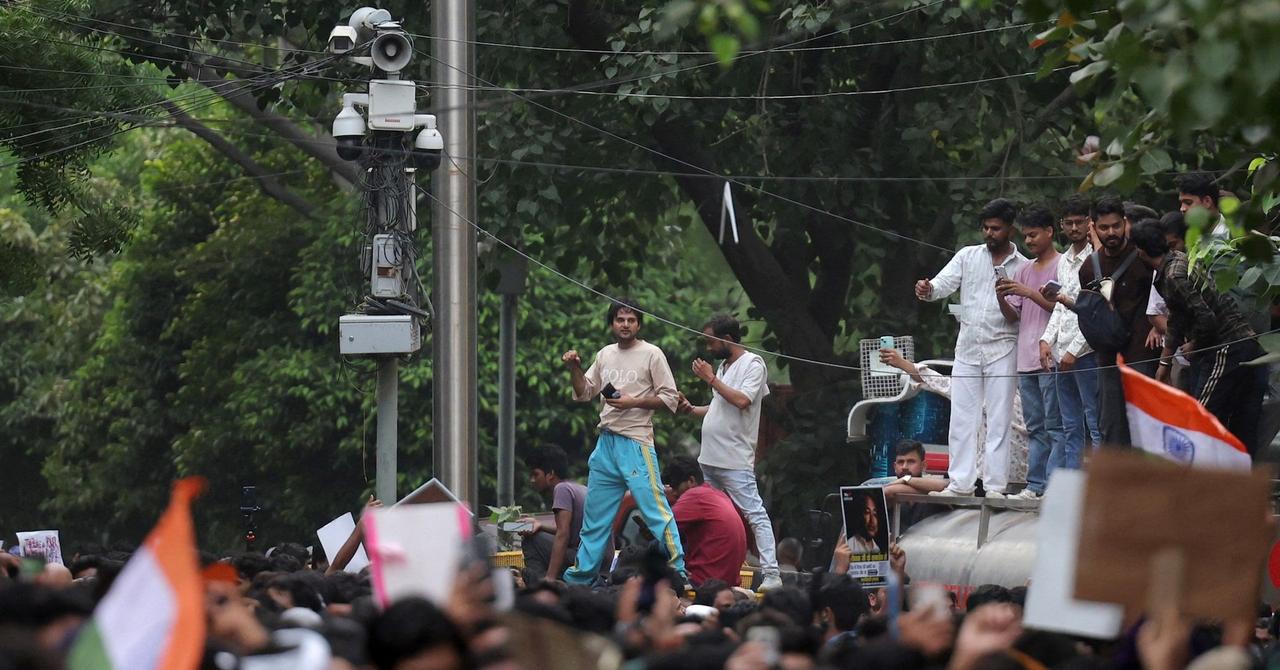
. The case proceeds even after the protest over exam paper leaks ended with Education Minister Dharmendra Pradhan's resignation, marking a rare setback for Prime Minister Narendra Modi.The surveillance controversy at India youth protest erupted when demonstrators shared images on social media of mobile police vans equipped with cameras on telescopic masts, providing 360-degree views of gatherings. A Reuters reporter who walked past one van observed a computer display showing his face with a green rectangular box and a "face accuracy" match metric
2
. Police officer Raj Kumar Dahiya explained that "the computers here help us identify those who have a criminal history," adding that "AI also helps us count the number of protesters."
Source: Reuters
India currently has no law governing the use of facial recognition technology by police, a regulatory gap that sits at the heart of the legal challenge. Activists argue that surveillance at the main protest site in New Delhi constituted a breach of law, while the government maintains such checks were legal and necessary for public order. During a Friday hearing, Solicitor General Tushar Mehta defended police conduct, calling privacy claims at a public gathering "ironical" and declaring the surveillance "absolutely necessary" and "in legitimate state interest"
1
.The Internet Freedom Foundation, a New Delhi-based digital advocacy group, wrote to Delhi's police commissioner on July 24 demanding deletion of biometric data collected at the protest site. Police were also observed recording Instagram handles of arriving protesters, with Inspector Sunil Kumar stating the checks ensured no one with a criminal background entered
2
. Akash Karmakar, a technology law partner at Indian law firm Panag & Babu, emphasized that "accountability must flow both ways," suggesting that if facial recognition tracks protesters, it should also identify police officers who allegedly operated without name badges during the crackdown.Related Stories
The surveillance vans deployed bore the branding "Ikshana," Hindi for "vision," and were equipped with what development partner CP Plus described as "Advanced AI-powered" cameras, mobile cameras, and "Varifocal Bullet Cameras" with adjustable lenses. A 2023 post detailing these AI-powered cameras on CP Plus' website was removed over the weekend and is no longer accessible
1
. The Delhi Police stated on social media platform X that it had not "restricted anyone's freedom through the use of facial recognition technology," though it did not respond to requests for comment on data collection practices.Modi's government has faced recurring accusations from opposition parties and digital rights advocates of expanding surveillance powers and tightly controlling digital communications, charges it has consistently rejected by citing public interest. The current legal challenge represents a test case for federal powers and could establish precedent for how surveillance technology can be deployed at future demonstrations. As the Delhi High Court continues hearings, the case highlights the tension between state security interests and individual privacy protections in an era where AI capabilities outpace regulatory frameworks.
Summarized by
Navi
10 Feb 2026â¢Policy and Regulation

25 May 2026â¢Technology

22 Apr 2026â¢Policy and Regulation