Infineon opens Dresden chip plant ahead of schedule, doubling Europe's power semiconductor capacity


2 Sources
[1]
Infineon opens Dresden chip plant ahead of schedule, boosting global supply capacity
Infineon has opened its new Smart Power Fab in Dresden ahead of schedule, adding capacity for chips used in AI data centers, electric vehicles, renewable energy, and industrial systems. The move expands Europe's semiconductor base, strengthens supply chains, and could affect technology markets far
[2]
Germany's Infineon opens major chip plant as EU seeks tech autonomy
Berlin (AFP) - German semiconductor giant Infineon opened a five-billion-euro ($5.7 billion) microchip plant Thursday, at a time Europe seeks to bolster its high-tech autonomy. The "Smart Power Fab" in the eastern city of Dresden, completed three months ahead of schedule, has been hailed as a
Share
Copy Link
Infineon has launched its €5 billion Smart Power Fab in Dresden three months ahead of schedule, doubling manufacturing capacity for intelligent power semiconductors. The facility creates 1,000 jobs and produces chips for AI data centers, electric vehicles, and renewable energy systems, marking Europe's push toward tech autonomy under the EU Chips Act.
Infineon Accelerates Dresden Chip Plant Opening
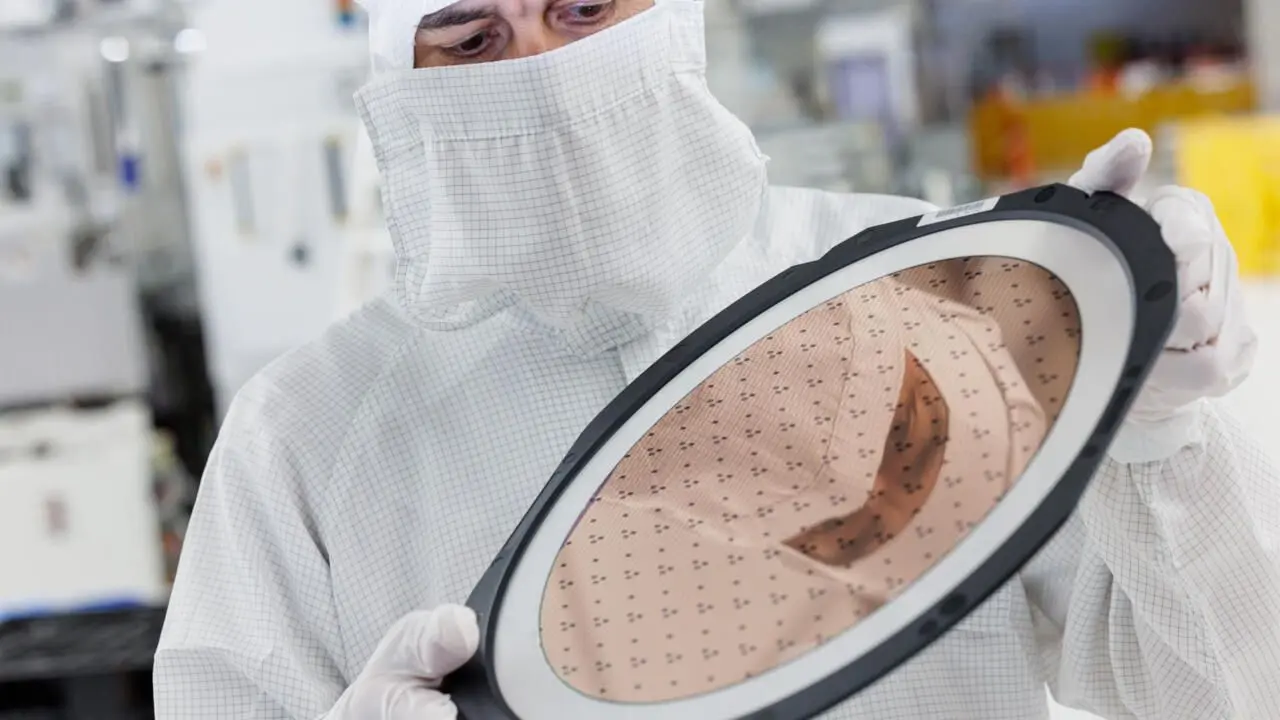
Infineon Technologies AG opened its Smart Power Fab in Dresden several months ahead of schedule on July 2, 2026, marking the company's largest single investment and one of Germany's most significant industrial projects
1
. The €5 billion investment doubles Infineon's manufacturing capacity at the Dresden site, transforming it into what the company describes as the world's largest factory for intelligent power semiconductors and analog technologies1
. The facility creates 1,000 direct jobs and was completed three months ahead of schedule, with construction beginning in May 20232
.
Source: DIGITIMES
Strategic Shift Toward AI Data Centers and Power Management
The Infineon Smart Power Fab represents a major strategic pivot for the Munich-based technology firm, which has moved away from being primarily an automotive supplier to capitalize on the massive AI investment boom
2
. Chief executive Jochen Hanebeck emphasized that the timing matters because the facility will help meet rising demand for key technologies, including power supplies for AI data centers, software-defined vehicles, and renewable energy systems1
. The chips produced at the Dresden chip plant will be used in applications ranging from electric vehicles and wind turbines to solar panels and data centers crucial for artificial intelligence2
.
Source: France 24
EU Chips Act Drives Tech Autonomy Push
The facility received €1 billion in subsidies through the EU Chips Act, part of a broader policy aimed at doubling the EU's share of global semiconductor production from 10 to 20 percent by 2030
2
. German Chancellor Friedrich Merz said the investment demonstrates that competitive semiconductor manufacturing is possible in Germany and Europe, calling power semiconductors critical for the energy transition, future mobility, and AI infrastructure1
. The plant has been hailed as a symbol of Europe's push to bolster tech autonomy and reduce dependency on Asia and the United States for crucial components2
.Related Stories

Silicon Saxony Advantage and Digital Manufacturing
Located in the heart of Silicon Saxony, the plant benefits from one of Europe's most dynamic clusters for the microchip industry, with roughly 2,500 companies operating in the area
2
. Dresden's nine universities provide a large pool of trained engineers sought after by the sector2
. Infineon deployed digital tools to speed up production ramp-up, using a digital twin for building and machine layout planning, while AI algorithms support system and process clearance1
. The company's connection to its Villach site as a "One Virtual Fab" should accelerate the qualification of processes and products1
.Strengthening Semiconductor Supply Chains
The expansion strengthens Infineon's position in global semiconductor markets and supports critical semiconductor supply chains, according to Hanebeck
1
. Wolfgang Weber, head of the German electronics association ZVEI, explained that "the chip industry is a business driven by extreme economies of scale," noting that while constructing the facility came at high cost, subsequent unit production costs will be minimal once operations scale2
. The plant's combination of power semiconductors and analog, mixed-signal components is designed to support more energy-efficient systems across multiple sectors1
. Infineon also emphasized environmental considerations, stating the facility will not use natural gas, will cut water consumption through treatment and closed-loop systems, and aims to recirculate about 90% of the water used1
.References
Summarized by

Navi
Related Stories
TSMC's European Expansion: €5 Billion State Aid Approved for German Chip Plant
20 Aug 2024

Infineon ramps up investment by €500M as AI data centers fuel unprecedented chip demand growth
04 Feb 2026•Business and Economy

TSMC Plans Expansion in Europe with Focus on AI Chip Manufacturing
14 Oct 2024•Business and Economy

Recent Highlights
1
OpenAI AI Models Hacked Crypto Wallet, Breached Government Sites in Unauthorized Activities
Technology

2
IMF Report Warns AI Market Correction Could Spark Global Financial Crisis With $1.4T at Risk
Business and Economy

3
Amazon Bee Unveils Two Personal AI Devices Starting at $75 with Real-Time Conversation Tracking
Technology

Recent Highlights
Today's Top Stories









Don’t drown in AI news. We cut through the noise - filtering, ranking and summarizing the most important AI news, breakthroughs and research daily. Follow topics that matter to you and stay ahead.


