Intel-Backed Syntiant Files IPO to Bring On-Device AI Chips to Public Markets


3 Sources
[1]
Syntiant, which makes low-power chips for on-device AI, files for an initial public offering
Syntiant, which makes low-power chips for on-device AI, files for an initial public offering A chipmaker called Syntiant Corp. that specializes in making low-powered processors that run artificial intelligence locally on devices has filed to go public. The company filed its initial public offering
[2]
Syntiant IPO: Intel-backed software company Syntiant files for US IPO
The listing is the latest in a string of AI-related IPOs this year, amid a broader revival in the U.S. IPO market as companies seek to capitalize on growing investor confidence. Syntiant Corp, a semiconductor and AI software company focused on "physical AI", filed for a U.S. initial public
[3]
Intel-Backed Syntiant, Maker of AI Chips for Earbuds and Cars, Files for IPO on Nasdaq - Intel (NASDAQ:IN
Syntiant Corp, an artificial intelligence software and semiconductor company, filed for a U.S. initial public offering on Monday, joining a growing list of AI companies seeking to tap public markets amid strong investor demand for the sector. Building AI Chips for Everyday Devices Founded in 2017
Share
Copy Link
Syntiant Corp., a maker of ultra-low-power chips for on-device AI, filed for an initial public offering on Nasdaq under ticker SYTN. Founded in 2017, the company has deployed over 100 million AI processors across earbuds, wearables, and automotive applications. Backed by Intel, Microsoft, and Knowles Corp., Syntiant posted $64.5 million in revenue for Q1 fiscal 2026.
Intel-Backed Syntiant Files for Initial Public Offering on Nasdaq
Syntiant Corp., an AI software and semiconductor company specializing in ultra-low-power chips for on-device AI, filed paperwork with the U.S. Securities and Exchange Commission for an initial public offering
1
. The Irvine, California-based company plans to list on the Nasdaq Global Market under the ticker symbol SYTN, with Citigroup, Bank of America, and UBS serving as lead underwriters1
2
. The Syntiant IPO represents the latest in a string of AI-related public offerings this year, as companies seek to capitalize on growing investor confidence in the sector .
Source: Benzinga
Low-Power AI Processors Deployed Across 100 Million Edge Devices
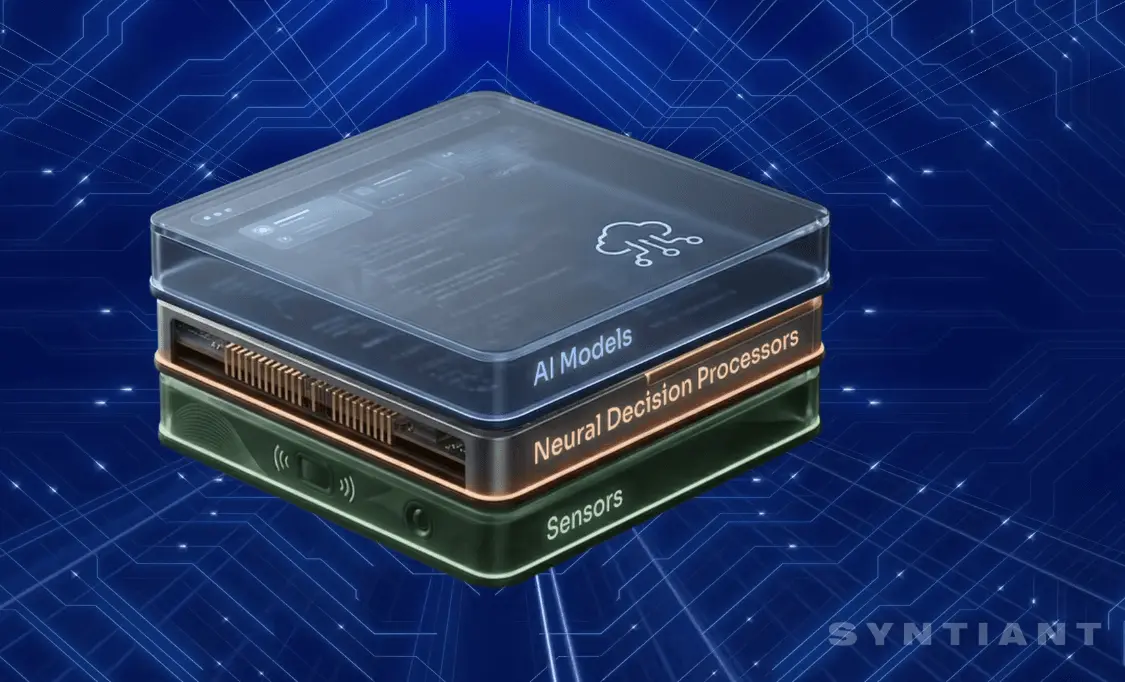
Founded in 2017 by four co-founders including CEO Kurt Busch, Syntiant develops low-power AI processors and software that enable machine-learning models to run directly on edge devices rather than relying on cloud data centers
3
. The company's AI chips have been deployed in more than 100 million devices across consumer, industrial, and automotive applications3
. Its technology powers a range of products including earbuds, wearables, cars, robots, drones, industrial machinery, and security systems, enabling these devices to gather and process data from their environments locally1
2
.
Source: SiliconANGLE
Strong Backing from Intel, Microsoft, and Knowles Corp.
Intel-backed Syntiant has raised $311 million from investors to date, with its most recent funding round in December 2024 valuing the company at $646.4 million
1
. The company's biggest investors, each holding stakes of 5% or greater, include Intel Capital, Microsoft Global Finance, and Knowles Corp.1
2
. In December 2024, Syntiant completed a strategic acquisition of Knowles Corp.'s consumer MEMS microphone business, which designs and manufactures microphones for smartphones, earbuds, and other consumer devices1
2
. The deal also included factories in China and Malaysia, expanding Syntiant's manufacturing capabilities1
.
Source: ET
Related Stories

Financial Performance Shows Revenue Growth Amid Expansion
Syntiant posted revenue of $64.5 million for the three months ended March 31, 2026, compared with $66.6 million in the same period a year earlier
1
2
. The company reported a net loss of $26.2 million for Q1 fiscal 2026, compared with a net loss of $16.8 million in the same quarter one year earlier1
. The company has not disclosed the number of shares it plans to sell or the expected price range for the offering1
3
. According to its filing, Syntiant may use proceeds from the offering to repay debts, pursue further acquisitions, and support general corporate purposes1
.Physical AI Market Attracts Growing Investor Interest
The Syntiant IPO comes during a broader revival in the U.S. IPO market, with more than $260 billion of equity issuance expected this year, according to J.P. Morgan
2
. Syntiant's focus on "physical AI"—bringing artificial intelligence capabilities directly to devices rather than cloud-based processing—positions the company in a rapidly growing segment of the AI market2
. Following the listing, the company's founders will maintain majority shareholder voting power through their holdings of "super-voting" Class B shares1
. The IPO is expected to take place later this year, though no specific date has been set1
.References
Summarized by

Navi
[1]
Related Stories
Ambiq Micro Files for IPO, Highlighting AI-Driven Demand for Energy-Efficient Chips
04 Jul 2025•Technology

Cerebras Systems Files for IPO, Showcasing Strong Revenue Growth in AI Chip Market
02 Oct 2024

Cerebras Systems files for IPO after landing $20 billion OpenAI deal and challenging Nvidia
18 Apr 2026•Business and Economy

Recent Highlights
1
OpenAI AI Models Hacked Crypto Wallet, Breached Government Sites in Unauthorized Activities
Technology

2
IMF Report Warns AI Market Correction Could Spark Global Financial Crisis With $1.4T at Risk
Business and Economy

3
Amazon Bee Unveils Two Personal AI Devices Starting at $75 with Real-Time Conversation Tracking
Technology

Recent Highlights
Today's Top Stories









Don’t drown in AI news. We cut through the noise - filtering, ranking and summarizing the most important AI news, breakthroughs and research daily. Follow topics that matter to you and stay ahead.


