Google orders over 3 million AI chips from Intel as TSMC capacity crunch forces industry shift


7 Sources
[1]
Google reportedly books Intel for packaging more than 3 million TPUs in 2028 -- SK hynix is testing Intel's EMIB packaging for HBM integration
TSMC's CoWoS lines are sold out through 2027, and Intel's EMIB is the only credible second source. Google has placed an order for Intel to build more than 3 million of its TPUs in 2028 after months of testing Intel's advanced packaging, according to The Information, citing four people familiar
[2]
Intel stock jumps after report claims Google ordered 3 million AI chips
Serving tech enthusiasts for over 25 years. TechSpot means tech analysis and advice you can trust. Rumor mill: Intel's effort to regain its footing in advanced chip manufacturing is drawing fresh interest, as some of the biggest players in AI look beyond their traditional suppliers. Alphabet's
[3]
Google and Nvidia eye Intel as a TSMC backup for AI chips
Google has reportedly placed an order for more than 3 million of its TPUs in 2028, and Nvidia is trialling Intel's 18A process, a rare vote of confidence in America's struggling foundry. For years, the AI boom has run through a handful of factory floors in Taiwan. That dependence is starting to
[4]
Google reportedly orders at least three million chips from Intel to arrive in 2028, as TSMC struggles to keep up with the AI boom
Despite a rough couple of years for the company, Intel could be set to make a turnaround with both its handheld chips performing well, and its Foundry business taking on substantial orders, at least if recent reports prove to be true. It seems like the AI boom has really squeezed semiconductor
[5]

Intel Foundry comeback! Is a bigger Intel stock surge ahead? INTC shares surge 9.16% today as Google's 3 million TPU order and Nvidia testing fuel Intel's AI revival
Intel stock is back in focus. INTC shares surged 9.16% after reports that Google ordered more than 3 million TPU AI chips from Intel for 2028. Nvidia is also testing Intel's advanced 18A process. As TSMC faces capacity pressure, Intel Foundry is emerging as a serious AI manufacturing contender,
[6]
US market today: Alphabet taps Intel to make three million in-house chips: Report
Nvidia has not placed an order with Intel yet, but has been evaluating whether the company's technology can be used to make a processor that combines four graphics chips into a single unit, the report said. Alphabet's Google has placed an order with Intel to manufacture more than three million
[7]

Intel gains ground on Google and Nvidia in AI chip manufacturing
Intel could receive a major boost from Google for its foundry business. According to The Information, the group has reportedly secured an order for over three million Tensor Processing Units (TPUs) scheduled for production in 2028. The report also indicates that Nvidia is exploring the use of
Share
Copy Link
Google has placed a massive order with Intel for more than 3 million Tensor Processing Units to be manufactured in 2028, marking a significant validation of Intel's foundry ambitions. The deal comes as TSMC's advanced packaging lines remain sold out through 2027, forcing major AI players to diversify chip suppliers and consider Intel as a credible TSMC alternative.
Google TPU Order Signals Major Win for Intel Foundry
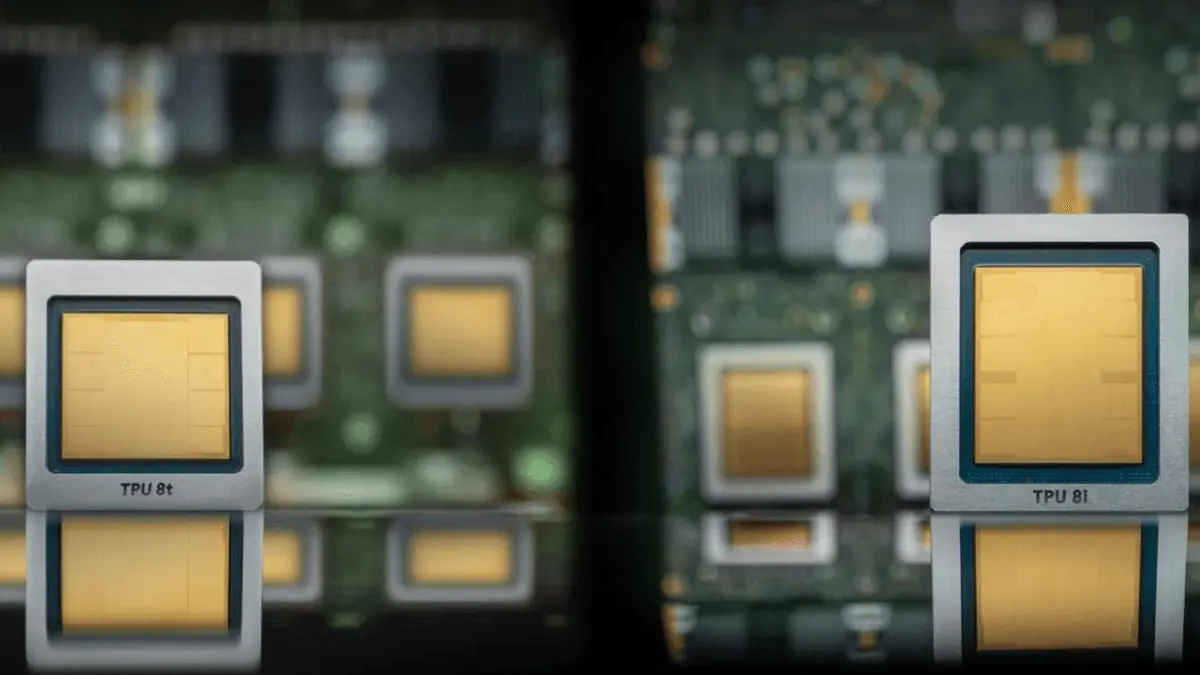
Google has placed an order with Intel to manufacture more than 3 million of its Tensor Processing Units in 2028, according to The Information, citing four people familiar with the matter
1
. The deal represents a significant commercial validation for Intel's contract manufacturing arm after months of testing Intel's advanced chip packaging technology2
. Morgan Stanley estimates Google will produce more than 6 million TPUs across 2027 and 2028 combined, suggesting the Intel Foundry relationship could scale substantially beyond the initial order5
.
Source: Tom's Hardware
These Google-designed AI chips power the company's model training and inference workloads, and Google now sells TPU computing access to major customers including Apple and Meta
4
. The INTC stock surged 9.16% on the news, defying a broader market selloff where the S&P 500 fell 2.6% and the Nasdaq dropped 4.2%5
.
Source: ET
Nvidia Tests Intel's 18A Process for Future GPU Architecture
Nvidia is evaluating whether Intel can build a future processor that fuses four GPU dies into one unit, tied to its Feynman architecture due in 2028
1
. The company is running early trials using Intel's most advanced 18A process through multiproject wafer runs, though no order has been placed yet3
. The fact that Nvidia, the world's most valuable chipmaker, is seriously testing Intel's manufacturing process rather than defaulting entirely to TSMC marks a credibility inflection point for Intel's foundry ambitions5
. D.A. Davidson analyst Gil Luria told Reuters, "Beyond the standard need to diversify, Google and Nvidia are even more motivated than usual to work with Intel. Supporting Intel supports US-based manufacturing, which is important for the relationship with the US administration"2
.
Source: Market Screener
TSMC Capacity Crunch Opens Door for Intel as TSMC Alternative
TSMC's leading-edge wafer lines and its CoWoS packaging are both at capacity, with CEO C.C. Wei stating at the company's annual shareholders' meeting that "it will be a long time before we can meet customer demand"
1
. The semiconductor manufacturer told the Semiconductor Industry Association that TSMC's advanced-node capacity falls "about three times short" of demand1
. Nvidia is expected to account for about 60% of global CoWoS demand this year, with Broadcom and AMD absorbing another 26% between them1
. The supply chain bottleneck has pushed major AI chip designers to diversify chip suppliers rather than wait for capacity that TSMC says will be short for years2
.Related Stories

SK Hynix Tests Intel's EMIB Packaging for HBM Integration
SK hynix is testing whether its high-bandwidth memory works reliably with Intel's packaging technology, specifically evaluating whether Intel can run AI chip manufacturing to the standard that AI accelerators demand
1
. Intel's embedded multi-die interconnect bridge, or EMIB, is the only alternative AI chip makers can realistically qualify at volume before the end of the decade, as TSMC's CoWoS is oversubscribed for more than two years1
. SK held a 57% share of HBM revenue in Q4 2025, and UBS expects it to take roughly 70% of the HBM4 supplied for Nvidia's Rubin platform this year1
.Bernstein analysts estimate EMIB packaging costs a few hundred dollars per chip against $900 to $1,000 for CoWoS on a Rubin-class processor
1
. Intel's EMIB-T variant adds through-silicon vias to the bridge die for vertical power delivery and is set to enter production fab rollout this year, supporting HBM3, HBM3E, HBM4, and future HBM5 stacks1
. An official validation from SK hynix would convert Intel's packaging from "tested" to "trusted" status in the industry1
.References
Summarized by

Navi
[1]
[3]
Related Stories
Intel Emerges as Alternative to TSMC's Strained CoWoS Packaging as AI Demand Surges
25 Nov 2025•Business and Economy
Intel bets billions on advanced packaging as Google and Amazon eye alternatives to TSMC bottleneck
06 Apr 2026•Technology

Nvidia considers Intel Foundry for Feynman AI chips as TSMC capacity constraints bite
28 Jan 2026•Technology
Recent Highlights
1
Meta Unveils Muse Wonder Frontier AI Models, Claims Performance Matching OpenAI and Anthropic
Technology

2
IMF Report Warns AI Market Correction Could Spark Global Financial Crisis With $1.4T at Risk
Business and Economy

3
OpenAI Releases 722 AI-Generated Math Solutions, Triggering Existential Crisis in Mathematics
Technology

Recent Highlights
Today's Top Stories








Don’t drown in AI news. We cut through the noise - filtering, ranking and summarizing the most important AI news, breakthroughs and research daily. Follow topics that matter to you and stay ahead.


