Intel Arc Pro B70 GPU brings 32GB VRAM to AI inference at half the price of Nvidia's rival


8 Sources
[1]
Intel Arc Pro B70 and Arc Pro B65 GPUs bring 32GB of RAM to AI and pro apps -- bigger Battlemage finally arrives, but it's not for gaming
Intel brings 32GB of VRAM and plenty of bandwidth to the local AI inference party Along with new Xeons and vPro platforms, Intel is launching a larger configuration of its Battlemage GPU for the first time, but it's not targeted at gaming. Instead, the new Arc Pro B70 and B65 cards bring options
[2]
Intel Targets AI Workstations With Memory-Stuffed Arc Pro B70 and B65 GPUs
The tech industry is undergoing rapid change as everyone focuses on AI. Intel is among the companies revving up new silicon and hardware to drive AI workloads, and it is now pushing its AI hardware to the next level with new Arc Pro B70 and B65 graphics cards. At heart, these are traditional
[3]
Intel's new Arc Pro B70 and B65 GPUs are built for AI work
Intel's new Arc Pro cards are here to run AI workloads on your workstation. Intel has launched two new graphics cards aimed at professionals: the Arc Pro B70 and Arc Pro B65. These are not gaming cards. They are built for local AI inferencing, software development, and running multiple GPUs
[4]
Intel launches the Arc Pro B70 graphics card based on the Big Battlemage GPU we've been waiting for forever but it's for AI, not gaming
The rumours were right, after all. But it doesn't actually matter. Intel has finally launched the fabled Big Battlemage GPU, the one with 32 Xe cores codenamed G31. But it's not the cut-price Nvidia RTX 5070 we've been hoping for. Instead, the new GPU has been branded the Intel Arc Pro B70, hooked
[5]

MAXSUN Debuts 32 GB Intel Arc Pro B70 Graphics Cards
MAXSUN has announced its Intel Arc Pro B70 series graphics cards, introducing a new professional GPU option aimed at AI development, inference, visualization, and dense multi-GPU deployments. The company positions the product as a higher-tier solution for users who need more local graphics memory
[6]

Intel finally announces 'Big Battlemage' with new Arc Pro B70 and Arc Pro B65 graphics cards
TL;DR: Intel's Big Battlemage, the Arc Pro B70 GPU, targets AI-focused workstations with 32GB of GDDR6 memory, 608 GB/s bandwidth, and 32 Xe cores, delivering up to 60% better AI performance than the B60. Priced at $949, it competes with NVIDIA RTX Pro 4000, offering strong AI inference and
[7]

Intel Arc Pro B70 Outclasses NVIDIA's RTX Pro 4000 In AI At Half The Cost, 50% More Memory
Intel's Arc Pro B70 is designed to offer accessible local inference for AI users, delivering more memory at half the price of the competition. So we talked about the unveiling of the Intel Arc Pro B70 graphics card in our other post, where we highlighted the specifications, availability, and
[8]
Big Battlemage Is Here - Intel Unveils Arc Pro B70 & B65 GPUs, Up To 32 GB Memory & 367 TOPS For AI
Intel has finally unveiled its "Big Battlemage" GPUs, the Arc Pro B70 & Arc Pro B65, with up to 32 GB of memory for AI & Pro workloads. Intel Expands Its AI & Pro Fleet With Big Battlemage-Powered Arc Pro B70 & Arc Pro B65 GPUs At its Pro Day 2026, Intel finally unveiled the one GPU that we have
Share
Copy Link
Intel launched the Arc Pro B70 and B65 workstation graphics cards, packing 32GB VRAM for AI workloads at $949. The cards feature Intel's largest Battlemage GPU yet with 32 Xe Cores and 367 TOPS performance, targeting local AI inference and professional applications. But there's a catch—these cards are not for gaming, despite using hardware originally designed for it.
Intel Unveils Arc Pro B70 GPU With 32 Xe Cores for AI Workloads
Intel has launched its most powerful Battlemage GPU to date, but it's not the gaming card enthusiasts have been waiting for. The Arc Pro B70 and Arc Pro B65 are workstation graphics cards designed specifically for AI inference and professional applications, marking Intel's aggressive push into the local AI market
1
. The Arc Pro B70 features 32 Xe Cores running at 2800 MHz, delivering 22.9 TFLOPS of FP32 compute performance and 367 TOPS of INT8 AI performance2
. This represents a 60% increase in cores compared to Intel's second-fastest chip in the series, positioning it as the company's fastest graphics processor to date.
Source: Wccftech
The hardware includes 4,096 pixel shaders, 32 ray-tracing units, and 256 XMX engines that drive AI performance
2
. Intel has equipped the card with a 256-bit memory bus and 32GB of 19 Gbps GDDR6 memory, enabling 608 GB/s of memory bandwidth1
. The Arc Pro B70 can operate within a wide power envelope of 160W to 290W, with Intel's reference design rated at 230W3
.32GB VRAM Targets Memory-Hungry AI Models and Local Inference
The standout feature of both cards is their 32GB VRAM configuration, a specification that directly addresses the memory capacity demands of AI workloads. For LLM inference workloads, fitting both AI models and context in GPU-local memory is critical to achieving optimal performance
1
. The large memory pool helps when working with bigger models and heavier datasets, particularly in professional applications where data spilling into system memory degrades performance5
.The Arc Pro B65 maintains the same 32GB memory capacity and 608 GB/s memory bandwidth as its more powerful sibling but reduces compute capability to 20 Xe Cores—identical to the existing Arc Pro B60
1
. This configuration targets users who need substantial memory for professional and creative applications but don't require the additional horsepower. The B65 delivers 197 TOPS of INT8 performance and is rated for 200W typical board power4
.Aggressive Pricing Positions Intel Against Nvidia's RTX Pro 4000
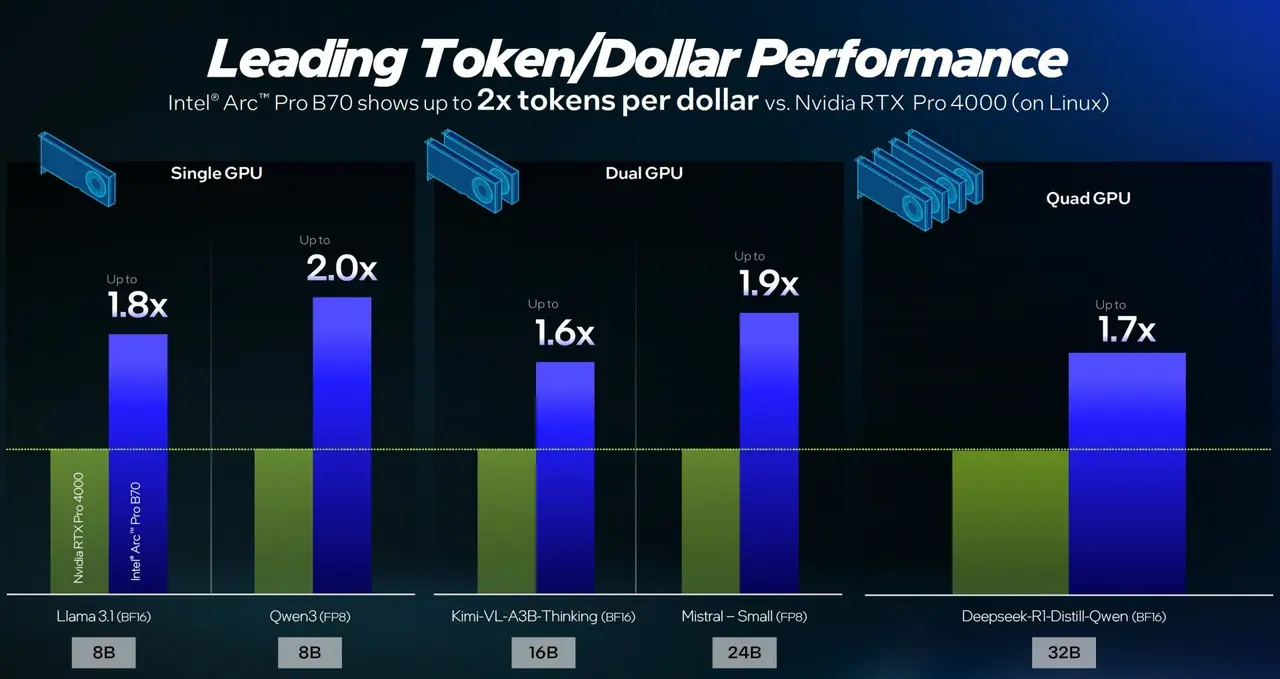
Intel has priced the Arc Pro B70 at $949, positioning it directly against Nvidia's RTX Pro 4000 Blackwell card, which costs $1,800 and offers only 24GB of memory
2
. The price difference appears deliberate, with Intel's card costing roughly half as much while providing superior memory capacity for running larger AI models4
. Intel's internal testing showed the Arc Pro B70 achieved significantly higher token throughput while handling AI workload requests from multiple users, and demonstrated advantages for larger context windows and time-to-first-token latency1
.
Source: Wccftech
The Arc Pro B70 also undercuts AMD's $1,299 Radeon AI Pro R9700, which had been another relatively affordable path to 32GB on a local AI card
1
. Intel emphasizes cost-per-token advantages across a range of models, noting that at $949 per card, any number of Arc Pro B70s would cost less than a single RTX Pro 40001
. Pricing for the Arc Pro B65 has not been announced but will arrive in mid-April1
.Multi-GPU Scaling and Partner Ecosystem for AI Deployment
Intel highlights multi-GPU support in its software stack, allowing users to scale LLM serving across multiple Arc Pro cards to increase memory capacity for larger context windows, larger models, or both
1
. The cards can be configured in arrays of two, four, or eight units in workstation or server rack modules2
. This scalability matters for organizations running multiple AI models simultaneously or pooling memory allowances for models too large for a single card's capacity.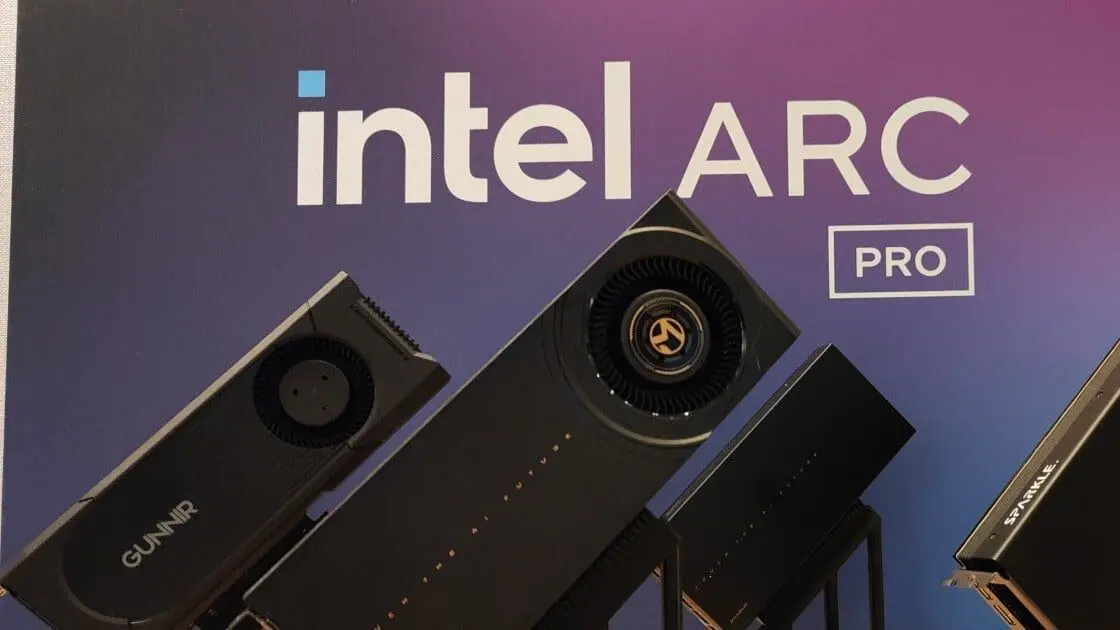
Source: PC Magazine
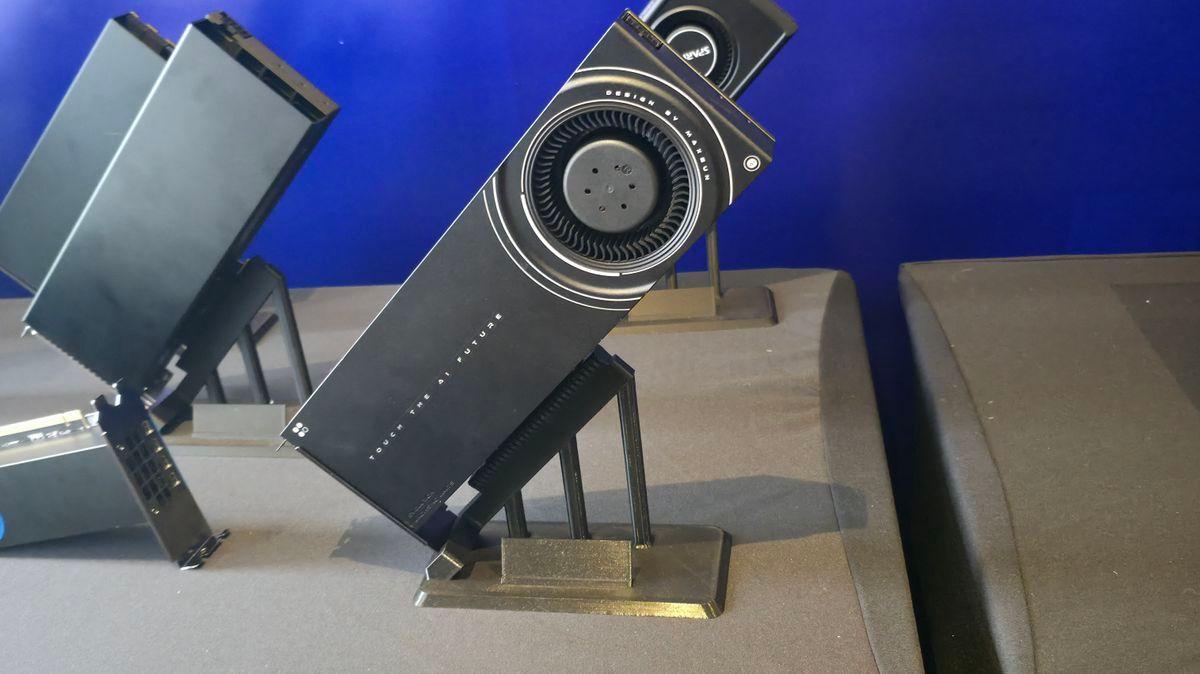
Partner cards will be available from ARKN, ASRock, Gunnir, Maxsun, and Sparkle, with varying thermal solutions and design changes
1
. Maxsun has announced two versions: a 32G Turbo edition with active cooling featuring a blower fan and vapor chamber, and a 32G Fanless edition for server environments with controlled chassis airflow5
. Both cards connect via PCI Express 5.0 x16 and support Intel's oneAPI, OpenCL 3.0, and OpenVINO, with certified drivers for Windows 10, Windows 11, and Linux3
.Related Stories


Software Stack Challenges and the Nvidia CUDA Moat
While the hardware specifications appear competitive, Intel faces significant software challenges. Nvidia's CUDA moat remains wide, and buyers considering an Arc Pro-powered solution would need to account for potential time and costs involved in handling issues of application support and stability on Intel's platform
1
. The relatively low cost of entry might appeal to organizations spinning up experimental on-premise AI servers for local usage, but more seasoned AI developers working toward scaling applications both locally and in the cloud will likely prefer systems built around Nvidia's offerings for compatibility, scalability, and total cost of ownership.Intel showcased most of its performance wins against the RTX Pro 4000 using models with BF16 quantizations, which obscures the Blackwell card's potential performance advantages with increasingly popular lower-precision data types like Nvidia's NVFP4
1
. The XMX matrix acceleration of Battlemage only extends down to FP16 and INT8 data types, while Blackwell supports a much wider range of reduced-precision formats. Nvidia also offers several RTX Pro cards above the RTX Pro 4000, allowing AI systems architects to precisely tailor memory and compute requirements without spreading workloads across multiple cards.Gaming Dreams Deferred as Memory Prices and AI Boom Shift Priorities
The Arc Pro B70 is based on the G31 GPU that gamers have been anticipating as a potential Arc B770 gaming card
4
. The presence of 32 ray-tracing cores confirms this GPU was originally intended as a gaming chip, but the AI boom and spike in memory prices have apparently killed prospects for launching G31 as a consumer product not for gaming4
. The consensus suggests that current silicon and memory supply constraints, combined with the lucrative AI market, have redirected Intel's priorities away from gaming applications for this hardware1
. The Arc Pro B70 launched on March 31, the same day Intel released its Core Ultra 7 270K Plus and Core Ultra 5 250K Plus CPUs2
.References
Summarized by

Navi
[1]
[3]
Related Stories
Recent Highlights
1
Microsoft and Nvidia Launch Surface Laptop Ultra: A $2,599 AI-Ready PC With RTX Spark Chip
Technology

2
OpenAI Releases 722 AI-Generated Math Papers on GitHub, Igniting Fury Among Mathematicians
Science and Research

3
Trump Consulted Grok AI Before Ordering Venezuela Invasion and Capture of Nicolás Maduro
Policy and Regulation

Recent Highlights
Today's Top Stories








Don’t drown in AI news. We cut through the noise - filtering, ranking and summarizing the most important AI news, breakthroughs and research daily. Follow topics that matter to you and stay ahead.


