Jailbroken PS5 Now Runs Local AI Models at 124 Tokens Per Second Using Native GPU Access


2 Sources
[1]
Jailbroken PS5s can now run local AI models at over 100+ tokens per second -- fork of PS5LM goes native, hijacks the CPU, and accesses the GPU and more RAM
The list of things a jailbroken PS5 can do gets longer, as Reddit user u/AdIllustrious7246 posted his fork of PS5LM, a llama.cpp port on the PS5 to run AI LLMs locally, with a massive improvement, allowing PS5LM to run natively on the PS5 and utilize the GPU to run bigger AI models such as
[2]
Jailbroken PS5 Turns into a Local AI Machine with Speeds Above 100 Tokens Per Second
A jailbroken PS5 can now run AI models at speeds above 100 tokens per second. A new app uses the console's GPU and more memory to deliver faster results. A jailbroken PlayStation 5 can now run AI models at more than 100 tokens per second. The speed comes from an updated version of PS5LM, a project
Share
Copy Link
A modified PS5 can now run local AI models at speeds exceeding 100 tokens per second. Reddit user u/AdIllustrious7246 created a fork of PS5LM that runs natively on the console, accessing the GPU through PS5_Vulkan and utilizing 11.4GB of RAM to process large language models like Qwen3.8-27B at 20 tokens per second and smaller models at over 100 tokens per second.

Jailbroken PS5 Breaks New Ground in Local AI Inference
A jailbroken PS5 can now run local AI models at speeds exceeding 100 tokens per second, thanks to a significant upgrade to PS5LM, a llama.cpp port for the PS5 that enables the console to process large language models locally and offline
1
2
. Reddit user u/AdIllustrious7246 posted his fork of the project, delivering a massive performance leap by allowing PS5LM to run natively on the console and utilize the PS5's GPU through PS5_Vulkan, a port of the AMD RADV graphics driver1
. This breakthrough demonstrates how AI hardware optimization on gaming consoles can unlock unexpected capabilities for local AI inference, transforming the PS5 into a capable offline AI assistant when not running games.From CPU Payload to Native GPU Acceleration
The original PS5LM implementation, created by GitHub user cobanov just 14 days prior, ran as a payload on the CPU, essentially hijacking the processor to insert AI instructions alongside the home screen and system services
1
. This approach limited memory access to approximately 6GB, as allocating more would freeze the home screen1
. The 6.8GB large language models would cause system crashes due to the CPU bottleneck1
. While cobanov intended to eventually utilize the GPU for running larger models, u/AdIllustrious7246 beat him to it with this improved fork1
.Unlocking the PS5's GPU Through Vulkan-Based RADV Driver
The breakthrough came from leveraging PS5_Vulkan, which allows instructions to be sent directly to the PS5 GPU
1
. Normally, the PS5 GPU remains locked down and cannot be accessed like a standard PC GPU, despite being based on AMD architecture1
. PS5_Vulkan has enabled numerous homebrew projects by opening up GPU capabilities, including the ability to run large language models1
. By running natively and fully utilizing the GPU, the new version opens up approximately 11.4GB of RAM for AI tasks, nearly doubling the previous 6GB limitation1
2
. This additional memory gives larger models significantly more room to operate, while GPU access accelerates token generation dramatically.Performance Benchmarks Across Multiple Models
The performance gains are substantial across different model sizes. The developer successfully ran a 27B parameter model, Qwen3.8-27B, at 20 tokens per second
1
2
. Smaller models deliver even more impressive speeds: Gemma 4 E4B runs at 61 tokens per second, while Llama 3.2 3B reaches 124 tokens per second1
2
. These speeds make the PS5 competitive with dedicated AI inference hardware for certain use cases, particularly for users seeking offline, privacy-focused AI capabilities.Related Stories

Enhanced Monitoring Dashboard and Web UI Integration
Beyond raw performance improvements, u/AdIllustrious7246 added a comprehensive dashboard displaying live token-per-second generation, GPU/CPU usage, power draw, temperatures, and memory allocation between the model and KV cache
1
2
. The fork also integrates with llama.cpp's web UI, enabling users to interact with the AI models from other local devices using a browser on the same network1
2
. This makes the console function as a local AI server accessible throughout a home network, expanding its utility beyond a single-user experience.Implications for AI Accessibility and Hardware Repurposing
This development highlights how existing gaming hardware can be repurposed for AI workloads, potentially democratizing access to local AI inference. While some commenters expressed concerns about a potential crypto mining-style crisis for PS5 consoles, this scenario remains unlikely given the ongoing demand from large AI data centers and the PS5's relatively modest GPU and RAM compared to dedicated AI hardware
1
. However, the project does demonstrate that consumer gaming hardware holds untapped potential for AI tasks when software barriers are removed. Watch for similar projects targeting other gaming consoles and whether manufacturers will respond by either tightening security or officially supporting AI workloads on their platforms.References
Summarized by

Navi
[1]
[2]
Related Stories
Modders Push AI Boundaries: Llama 2 Runs on Windows 98 PC and Xbox 360
14 Jan 2025•Technology

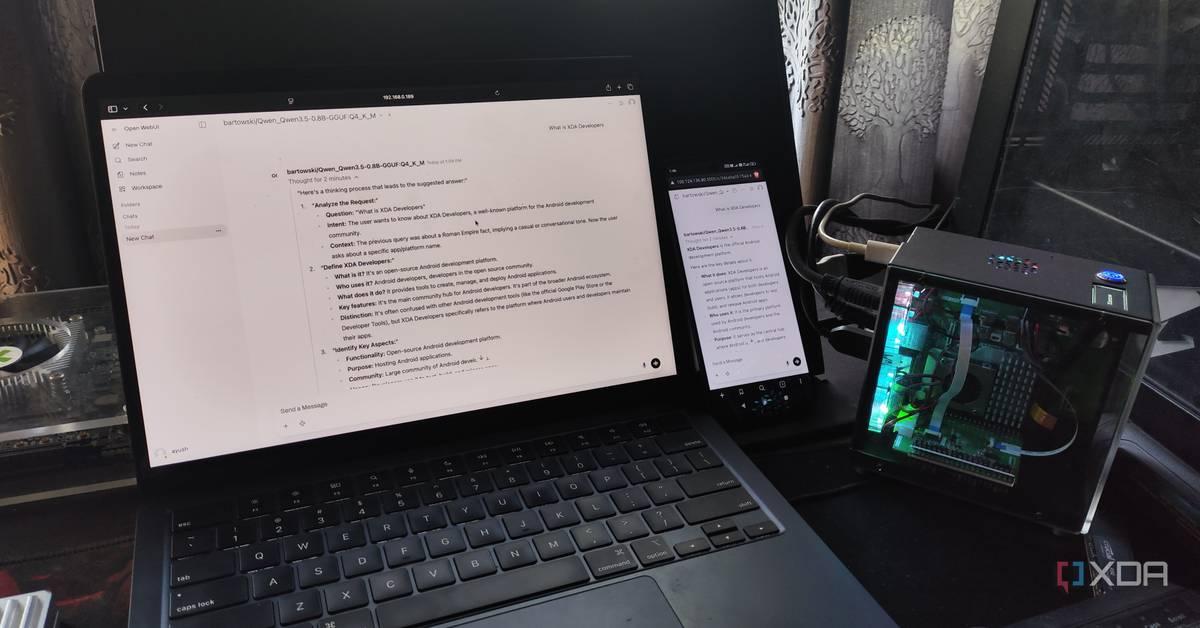
Tech enthusiasts build local LLM servers on Raspberry Pi and phones, proving on-device AI works
17 Apr 2026•Technology
Sony's AI Innovation: Custom Hardware and Collaboration with AMD for Next-Gen Gaming Graphics
19 Dec 2024•Technology

Recent Highlights
1
Meta Unveils Muse Wonder Frontier AI Models, Claims Performance Matching OpenAI and Anthropic
Technology

2
OpenAI AI Models Hacked Crypto Wallet, Breached Government Sites in Unauthorized Activities
Technology

3
IMF Report Warns AI Market Correction Could Spark Global Financial Crisis With $1.4T at Risk
Business and Economy

Recent Highlights
Today's Top Stories






Don’t drown in AI news. We cut through the noise - filtering, ranking and summarizing the most important AI news, breakthroughs and research daily. Follow topics that matter to you and stay ahead.


