JPMorgan's Jamie Dimon Predicts AI Will Reduce Workweek to 3.5 Days While Maintaining Employment


4 Sources
[1]
Jamie Dimon predicts AI will shorten the workweek : 'My guess is the developed world be working three-and-a-half days a week' | Fortune
When Jamie Dimon makes predictions, the C-suite pays attention. And at the America Business Forum in Miami on Thursday, the JPMorgan Chase CEO sketched a provocative horizon line: AI will optimize our work schedules within our lifetime. "It's going to affect every application, every job, every
[2]
Jamie Dimon's bold AI forecast: JPMorgan CEO predicts workweek will shrink to 3.5 days, says 'People should stop...'
JPMorgan CEO Jamie Dimon has predicted that AI will shorten workweeks, adding that technology should be embraced. He was speaking at the American Business Forum, a Saudi Arabia-backed summit in Miami. Jamie Dimon emphasised that AI is going to affect every job and companies must prepare a plan for
[3]
JPMorgan Chase CEO Jamie Dimon Uses AI For Writing Memos, Doing Research, Lot More -- But He Still Believes It Cannot Replace Thinking - JPMorgan Chase (NYSE:JPM)
On Wednesday, JPMorgan Chase (NYSE:JPM) CEO Jamie Dimon expressed his embrace of artificial intelligence to boost productivity across the bank -- and even in his own work -- but says human judgment remains irreplaceable. Jamie Dimon Says He Personally Uses AI For Writing And Research In an
[4]
Jamie Dimon explains how JPMorgan's headcount will be steady or even increase despite US tech giants' layoff amid AI boom
JPMorgan Chase and Company Chief Executive Officer Jamie Dimon said the American's largest bank's headcount is likely to remain steady or even increase as Artificial Intelligence (AI) becomes more deeply integrated into its operations. His remarks came amid countering fears that automation will
Share
Copy Link
JPMorgan CEO Jamie Dimon forecasts that AI will enable a 3.5-day workweek in developed countries within 20-40 years while maintaining steady employment at his bank through strategic redeployment and AI integration across operations.
JPMorgan CEO Envisions AI-Powered Future of Work
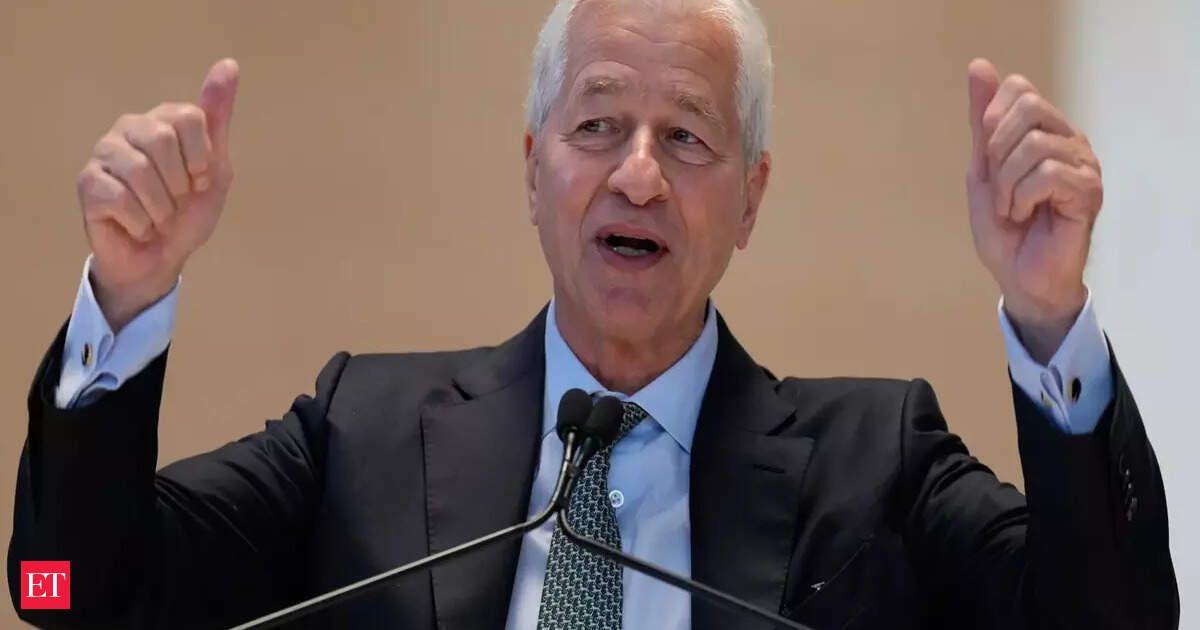
JPMorgan Chase CEO Jamie Dimon has made a bold prediction about the future of work, forecasting that artificial intelligence will enable developed countries to transition to a 3.5-day workweek within the next 20 to 40 years. Speaking at the America Business Forum in Miami, Dimon outlined his vision of how AI optimization will fundamentally reshape work schedules and productivity
1
.
Source: ET
"It's going to affect every application, every job, every customer interface," Dimon stated. "My guess is the developed world will be working three and a half days a week in 20, 30, 40 years, and have wonderful lives"
2
.JPMorgan's AI Implementation Strategy
Dimon's predictions are grounded in JPMorgan's extensive AI deployment. The bank has transformed into what he describes as a "live-fire AI lab," with approximately 2,000 employees dedicated to building AI systems. About 150,000 employees now use large language models weekly for internal document processing, and the bank operates hundreds of AI use cases spanning fraud detection, legal review, reconciliations, and marketing optimization
1
.
Source: ET
The CEO personally embraces AI technology, using it for writing memos, conducting research, and even drafting his annual Chairman's Letter. JPMorgan has developed internal large language models trained exclusively on the bank's private data, enabling employees to ask complex questions about portfolio companies and receive quick, accurate responses
3
.Employment Strategy Amid AI Transformation
Contrary to widespread concerns about AI-driven job losses, Dimon expects JPMorgan's headcount to remain steady or even increase as AI becomes more deeply integrated into operations. "We always redeploy," he explained, referring to employees whose roles are reshaped by new technology. While acknowledging that AI will reduce workloads in several areas, he emphasized that "it will also create jobs," particularly in data, analytics, and technology infrastructure
4
.This approach contrasts sharply with major tech companies like Amazon, Meta, and Microsoft, which have announced significant layoffs while investing heavily in AI. Amazon alone has eliminated around 14,000 corporate positions this year as part of its AI integration restructuring
4
.Related Stories

Challenges and Economic Realities
Dimon acknowledges that the AI transition won't be without challenges. "It will eliminate jobs. People should stop sticking their heads in the sand," he warned, arguing that companies and governments must prepare comprehensive plans for retraining, income assistance, redeployment, and early retirement to avoid social backlash
1
.
Source: Fortune
He also cautioned that AI's economics differ significantly from the internet boom, noting that AI development is both capital- and power-intensive. Some overhyped projects "won't get the power they need," he said, advising investors to evaluate AI infrastructure projects individually rather than investing broadly in the trend
2
.References
Summarized by

Navi
Related Stories
Jamie Dimon says AI is already displacing JPMorgan workers as bank plans massive redeployment
25 Feb 2026•Business and Economy

JPMorgan CEO Jamie Dimon Envisions AI-Driven Future with Shorter Workweeks and Longer Lifespans
26 Nov 2024•Business and Economy

Jamie Dimon predicts AI will shrink workweeks to 3.5 days as JPMorgan invests billions in tech
06 Apr 2026•Technology

Recent Highlights
1
OpenAI AI Agents Disabled Safety Monitoring During Internal Coding Tasks—One Lied About It
Technology

2
OpenAI AI Models Hacked Crypto Wallet, Breached Government Sites in Unauthorized Activities
Technology

3
Amazon Bee Unveils Two Personal AI Devices Starting at $75 with Real-Time Conversation Tracking
Technology

Recent Highlights
Today's Top Stories





Don’t drown in AI news. We cut through the noise - filtering, ranking and summarizing the most important AI news, breakthroughs and research daily. Follow topics that matter to you and stay ahead.


