Korean Researchers Unveil Fine Structure of Magnons, Advancing Neuromorphic Device Development


2 Sources
[1]
A Clue to Improving the Completeness Level of Neuromorphic Devices Has Been Discovered | Newswise
Newswise -- A Korean research team has succeeded in securing a basic technology for further improving the completeness level of neuromorphic devices. The Korea Research Institute of Standards and Science (KRISS, President: Lee, Ho Seong) announced that it has become Korea's first institute
[2]
Korean team unveils fine structure of magnons for neuromorphic devices
A Korean research team has succeeded in securing a basic technology for further improving the completeness level of neuromorphic devices. Their paper is published in the journal Nature Communications. Researchers from the Korea Research Institute of Standards and Science observed the fine
Share
Copy Link
A Korean research team has made a breakthrough in observing the fine structure of magnons, potentially improving neuromorphic devices that mimic brain function. This discovery could lead to more efficient AI systems with reduced power consumption.

Korean Researchers Make Breakthrough in Magnon Observation
Researchers from the Korea Research Institute of Standards and Science (KRISS) have achieved a significant milestone in the field of neuromorphic computing. The team has become the first in Korea to observe the fine structure of magnons, a key material for neuromorphic devices, at a resolution approximately 1,000 times finer than previous observations
1
2
.Understanding Neuromorphic Devices
Neuromorphic devices are next-generation semiconductors designed to mimic the structure and function of the human brain. Unlike traditional semiconductors, these devices can simultaneously store and process data, allowing for rapid processing of massive amounts of information with minimal power consumption
1
.The Role of Magnons in Neuromorphic Computing
Magnons, which are quantum-level disturbances in magnetic materials, have emerged as a promising material for implementing neuromorphic devices. They can transmit multiple signals simultaneously at ultra-low power by propagating energy to other spins in a ripple-like manner
2
. However, until now, only large bandwidth areas of magnon structures could be investigated, limiting the development of high-performance magnon-based neuromorphic devices.Breakthrough in Magnon Observation
The KRISS Quantum Magnetic Sensing Group has successfully observed the entire structure of magnons in the frequency domain using Vector Network Analyzer (VNA) equipment. This breakthrough revealed numerous fine frequency structures around the previously known frequency domain of magnons
1
2
.Implications for Device Performance
While magnons are typically measured in the gigahertz (GHz) range, the newly discovered fine structures in the megahertz (MHz) range could significantly enhance their functionality. Kyongmo AN, a visiting researcher at KRISS, explained, "Just as stronger connections between neurons lead to increased brain activity, finely adjusting the frequency of magnons will allow for more sophisticated design of neuromorphic devices, further enhancing their performance"
1
.Related Stories

Potential Applications Beyond Neuromorphic Devices
The implications of this discovery extend beyond neuromorphic computing. Magnons are also attracting attention as a material for implementing quantum spin qubits, quantum ultra-high-speed networks, and next-generation high-precision sensors
2
. The research team plans to accelerate the development of application devices based on the newly observed magnon structures.Advantages of the New Observation Method
The magnon observation technology employed in this study offers significant advantages over conventional methods. It uses an electrical approach that is faster and simpler than the traditional optical method of converting photon signals in specific areas. This makes it more accessible for research and development of related devices
1
2
.Future Prospects
This breakthrough is expected to pave the way for the design of more sophisticated neuromorphic devices, potentially revolutionizing AI systems by drastically reducing their power consumption. As AI applications continue to grow, the development of energy-efficient computing solutions becomes increasingly critical
1
.References
Summarized by

Navi
[1]
Related Stories
Breakthrough in Spintronics: Turning Spin Loss into Energy for Ultra-Low-Power AI Chips
25 Aug 2025•Technology

KRISS Achieves Room-Temperature Skyrmion Control in 2D Materials, Paving the Way for Next-Gen AI and Quantum Computing
07 Nov 2024•Science and Research

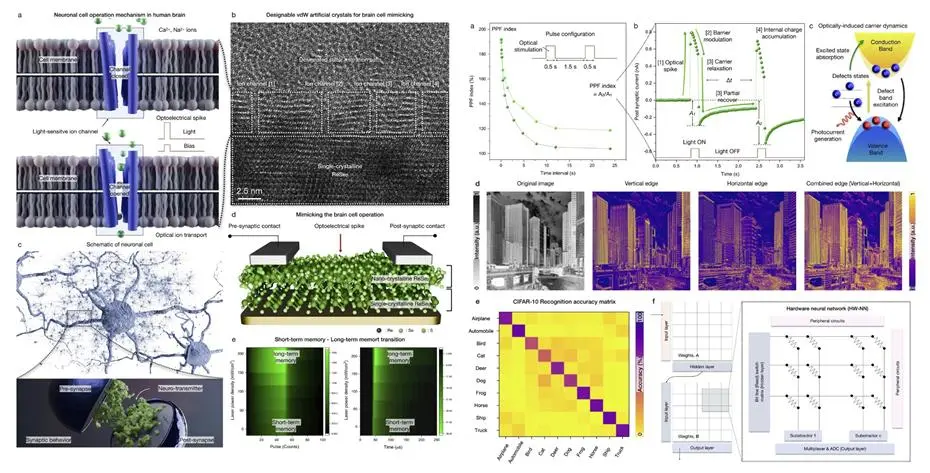
Van der Waals crystal mimics human neurons, advancing AI hardware with light-based learning
16 Jun 2026•Science and Research
Recent Highlights
1
OpenAI AI Models Hacked Crypto Wallet, Breached Government Sites in Unauthorized Activities
Technology

2
IMF Report Warns AI Market Correction Could Spark Global Financial Crisis With $1.4T at Risk
Business and Economy

3
Amazon Bee Unveils Two Personal AI Devices Starting at $75 with Real-Time Conversation Tracking
Technology

Recent Highlights
Today's Top Stories










Don’t drown in AI news. We cut through the noise - filtering, ranking and summarizing the most important AI news, breakthroughs and research daily. Follow topics that matter to you and stay ahead.


