LG and Nvidia Partner to Build Humanoid Robot Launching Q1 2027 with AI Factory Infrastructure


9 Sources
[1]
LG will show an Nvidia-powered humanoid robot in 2027
The bipedal robot arrives in early 2027 on Nvidia's stack, while the only thing LG puts to work this year is a wheeled machine in a Tennessee factory LG will unveil a bipedal humanoid robot in the first quarter of 2027, built on Nvidia's Jetson Thor processor, Isaac GR00T foundation model and
[2]
LG is getting into humanoid robots, and Nvidia is helping it build them
This isn't just another robot teaser. LG and NVIDIA just outlined actual hardware. With time, more and more legacy hardware companies seem to be racing to bolt a humanoid robot onto their roadmap. The latest entrant is LG, joining the race with tentative timelines. The company's bipedal humanoid,
[3]
NVIDIA and LG are building a next-generation humanoid robot that will make its debut at CES 2027
At a recent event at NVIDIA's headquarters in Santa Clara, California, Chairman and CEO of LG Corp Kwang Mo Koo and NVIDIA Founder and CEO Jensen Huang signed a 'memorandum of understanding' that included the development of a next-generation "bipedal humanoid robot." According to the press
[4]
LG is Teaming Up With NVIDIA to Build a Massive AI Platform for Robots
While LG has completely pivoted away from smartphones and pretty much any mainstream form of portable smart devices, the company has focused on strengthening its work on home electronics and appliances, computing, and even robotics. Speaking of the latter, LG recently announced that it's been
[5]

LG to unveil next-gen humanoid robot powered by NVIDIA Isaac GR00T in Q1 2027
LG is developing a next-generation bipedal humanoid robot using NVIDIA Isaac GR00T, NVIDIA's open reasoning humanoid foundation model, with plans to publicly unveil it in the first quarter of 2027. The company is also working with NVIDIA on robotics, AI factory infrastructure, and a next-generation
[6]

LG to unveil Nvidia-powered humanoid robot in Q1 next year - The Korea Times
LG Group Chairman Koo Kwang-mo, left, shakes hands with Nvidia CEO Jensen Huang during their meeting at LG Twin Tower on Yeouido, Seoul, June 8. Courtesy of LG LG Group will unveil a humanoid robot based on Nvidia's Isaac GR00T robot foundation model in the first quarter of next year, and extend
[7]

LG Group plans humanoid robot reveal in early 2027 - report By Investing.com
Investing.com -- LG Group is expanding its efforts in physical artificial intelligence through a partnership with Nvidia Corp (NASDAQ:NVDA), Business Korea reported. The South Korean conglomerate plans to introduce a bipedal humanoid robot in the first quarter of 2027 based on Nvidia's Isaac GR00T
[8]
LG and Nvidia partner on robotics and AI factory development By Investing.com
Investing.com -- LG Corp and Nvidia signed a memorandum of understanding to expand their strategic business cooperation in robotics, AI factories and mobility, LG said in a statement Friday. LG plans to unveil a next-generation bipedal humanoid robot based on Nvidia Isaac GR00T in the first
[9]

LG, Nvidia to Unveil Jointly Developed Humanoid Robot Next Year
South Korea's LG Group and U.S. technology giant Nvidia are jointly developing a humanoid robot, expanding their collaboration in physical artificial intelligence. The next-generation bipedal humanoid robot will be unveiled in the first quarter of 2027, LG said Friday, after the companies signed a
Share
Copy Link
LG signed a partnership with Nvidia on August 13 to develop a bipedal humanoid robot powered by Isaac GR00T and Jetson Thor, planned for Q1 2027 debut. The collaboration extends beyond robotics to include an 80-megawatt AI factory in South Korea and autonomous vehicle platforms, positioning LG as a comprehensive robotics solutions provider.

LG Nvidia Partnership Targets Early 2027 for Humanoid Robot Debut
LG Corp and Nvidia formalized their collaboration on August 13 at Nvidia's Santa Clara headquarters, with LG Corp Chairman Kwang Mo Koo and Nvidia CEO Jensen Huang signing a memorandum of understanding.
1
The bipedal humanoid robot will be unveiled publicly in the first quarter of 2027, likely at CES 2027, marking LG's formal entry into the humanoid robotics race.2
3
The next-generation humanoid robot runs on NVIDIA Jetson Thor for onboard processing and motion control, delivering 2070 FP4 TFLOPS of AI compute with 128 GB of memory.
3
It uses the NVIDIA Isaac GR00T foundation model, an open reasoning humanoid foundation model that processes multimodal input including language and images to produce actions needed for tasks across diverse environments.3
The Halos safety system, described as the industry's first full-stack safety framework built for robots, addresses the liability question of humanoids sharing floor space with human workers.1
2
Physical AI Platform for Robots Leverages LG's Manufacturing Strength
LG is sourcing actuators and sensors from LG Electronics and LG Innotek, with batteries from LG Energy Solution, keeping most of the bill of materials within the LG group.
1
This "One LG" approach combines core capabilities across the group's divisions.5
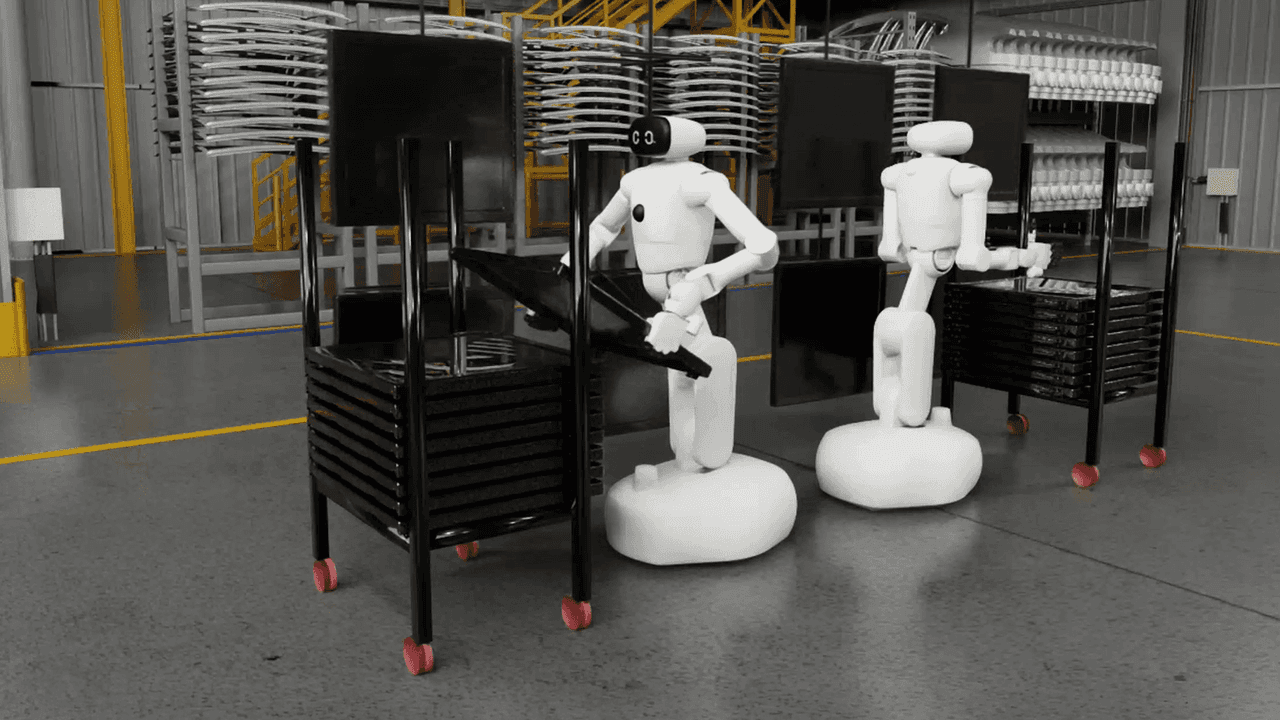
Before the humanoid robot launches, LG will deploy LG CLOiD, its wheel-based robot, at the company's washing machine manufacturing line in Tennessee by the end of 2026 for validation in a real-world production environment.1
5
The collaboration includes building a robot data factory powered by LG CNS PhysicalWorks, LG's robot data platform covering continuous data collection, synthetic data generation, robotics training, and verification.
5
LG's 10,000-square-meter Data Factory in Seoul will serve as the center of this effort, and when combined with synthetic data augmented through Nvidia's Cosmos world models, the facility is predicted to accumulate over 100,000 hours of training data by year-end.4
This data flywheel creates a continuous learning ecosystem designed to train, refine, and deploy autonomous robots while drastically shortening development cycles for LG's Robot Foundation Model.4
AI Factory Infrastructure Targets Global Market Expansion
LG outlined a two-stage plan for AI factory development. An AI factory reference site powered by Nvidia Vera Rubin platform is scheduled for the first half of 2027, followed by an 80-megawatt LG AI Factory in Cheonan, South Korea, by the first half of 2028.
1
5
These facilities will use the Nvidia DSX AI factory architecture together with LG capabilities across AI infrastructure, including thermal management, power, design, and operations.5
The AI factory infrastructure appears designed as more than an internal priority shift. LG plans to validate a "One LG" end-to-end AI factory solution based on the Nvidia DSX platform and pursue business opportunities in the global AI infrastructure market, including turnkey package solutions for global big tech customers.
5
The partnership also extends to future mobility, with LG developing a high-performance computing platform for next-generation AI-defined vehicles based on Nvidia DRIVE Hyperion, integrating LG's in-vehicle infotainment and automotive software capabilities.1
5
Related Stories
Nvidia's Open Stack Strategy Intensifies Humanoid Robot Competition
Nvidia is not backing a single winner in humanoids but selling the same stack to every contender, having already signed up Japan's robotics establishment for its open world models.
1
The company has been deliberately widening its roster beyond China's Unitree, which has been outselling Tesla on humanoids.1
LG faces competition domestically as well, with Samsung establishing a CEO-led robotics division targeting the same market and Hyundai owning Boston Dynamics.1
Jensen Huang framed the partnership around safety, stating that "the defining opportunity of physical AI is to give every machine the ability to understand the real world, reason and act safely alongside people - reshaping everyday life from the home and factory floor to the road."
3
LG CEO Lyu Jae-cheol emphasized the company's ambition to "become a comprehensive robotics solutions provider" through synergy built on "One LG" and strategic collaboration with global partners.4
Watch for how LG's manufacturing validation data from the Tennessee deployment informs the humanoid's capabilities and whether the company can leverage its appliance expertise to differentiate in an increasingly crowded field.References
Summarized by

Navi
[1]
[2]
[3]
Related Stories
NVIDIA and LG Group Build AI Factory to Advance Physical AI, Robotics and Autonomous Manufacturing
08 Jun 2026•Technology
LG Electronics and Nvidia explore AI collaboration across robotics, data centres, and mobility
29 Apr 2026•Technology

LG unveils Zero Labor Home vision with CLOiD robot and Physical AI at CES 2026
12 Jun 2026•Technology

Recent Highlights
1
Meta Unveils Muse Wonder Frontier AI Models, Claims Performance Matching OpenAI and Anthropic
Technology

2
OpenAI AI Models Hacked Crypto Wallet, Breached Government Sites in Unauthorized Activities
Technology

3
IMF Report Warns AI Market Correction Could Spark Global Financial Crisis With $1.4T at Risk
Business and Economy

Recent Highlights
Today's Top Stories







Don’t drown in AI news. We cut through the noise - filtering, ranking and summarizing the most important AI news, breakthroughs and research daily. Follow topics that matter to you and stay ahead.


